Last updated: October 27, 2026
The advertisement says $419 a month. It is a lovely number, round and friendly, and it is not the number you will pay if you lease a Tesla Model 3 this autumn. Tesla’s own offer, checked October 27, 2026, puts the Standard Rear-Wheel Drive car at $419 a month for 36 months, with $4,114 due at signing, 10,000 miles a year, and two quiet words underneath that do all the heavy lifting: excludes taxes.
This guide reads the whole contract the way your accountant would — the due-at-signing stack, the mileage meter running at 25 cents a mile, the buyout rule that changed while most websites weren’t looking — and then does the arithmetic Tesla leaves as a homework exercise.
First, some context the headline writers skipped. For three years, leasing was the back door to the federal tax credit. Buyers who earned too much to claim the $7,500 clean-vehicle credit themselves could lease instead, because the leasing company claimed the separate commercial credit and passed some of it through as a cheaper payment. That door closed on September 30, 2025, when the federal credits ended.
Tesla rebuilt its lease pricing without the $7,500 underneath it, which is why the price to lease a Tesla Model 3 in October 2026 costs meaningfully more than the one your neighbour signed in the summer of 2025. Anyone still advertising a $299 Model 3 lease without mentioning a date is selling you a memory.
Here is the current menu, all four trims, all 36 months, all 10,000 miles a year, prices checked October 27, 2026. The Standard RWD is $419 a month with $4,114 due at signing. The Premium RWD is $429 a month with $4,125 due. The Premium AWD is $499 a month with $4,195 due. The Performance AWD is $649 a month with $4,344 due.
The Standard car’s sticker price is $38,630 including destination, which matters later when we compare leasing against buying the same car outright. Notice the step from Standard to Premium RWD: ten dollars a month for roughly 42 extra miles of EPA-rated range. That is the cheapest range Tesla has ever sold, and it will matter in the verdict.
Now the due-at-signing figure, because $4,114 is a strange, spiky number until you take it apart. It is three things wearing a trench coat: a $3,000 down payment, the first month’s payment of $419, and a $695 acquisition fee — the toll Tesla charges for the privilege of starting a lease. $3,000 + $419 + $695 = $4,114. Exactly.
The Performance car’s $4,344 is the same recipe with a $649 first payment. What is not in that number: sales tax, title, registration, and any state fees. Depending on your state, expect the real cheque at delivery to be several hundred dollars heavier than the advertised due-at-signing total, and expect your monthly payment to grow by your local tax rate too. Tesla says “excluding taxes and fees” in its own leasing materials. Believe it. It is the most honest sentence in the offer.
Lease a Tesla Model 3: the true monthly cost, computed
Time for the sum Tesla hopes you never run. The $4,114 you hand over at signing already contains the first $419 payment, so you owe 35 more payments of $419: 35 × $419 = $14,665. Add the two together: $4,114 + $14,665 = $18,779. That is the real price of the advertised deal over three years, before tax. Divide by 36 months and the honest monthly cost is $18,779 ÷ 36 = $521.64 — call it $522 a month.
CarsDirect’s own effective-cost figure for this offer is $533 a month once typical fees creep in, which tells you our $522 is if anything polite. The headline says $419. The contract says $522. The gap, about $103 a month, is not a scandal; it is just a down payment wearing a monthly costume. But you should shop with the $522 number in your head, because that is the number your bank account will meet.
Tax makes it heavier. In states that tax the monthly payment, a 7% rate (est.) adds 36 × $419 × 0.07 ≈ $1,056 across the term, taking the all-in cost to roughly $19,835 (est.). Return the car at the end rather than buying it or leasing another Tesla, and a $395 disposition fee joins the bill, for a total near $20,230 (est.). None of these figures is hidden. All of them are absent from the advertisement. There is a difference, and the difference is the entire business model of lease marketing.
One more piece of arithmetic worth doing before you sign: cost per mile. When you lease a Tesla Model 3, you buy 30,000 miles for $18,779, which is $18,779 ÷ 30,000 = $0.626 a mile for the car itself, before electricity, insurance or tax. Our breakdown of what an electric car costs per mile puts home-charged electricity at a few cents on top of that. It is a useful yardstick when we get to the rivals, because a cheaper monthly payment on a shorter term with fewer miles is not cheaper at all once you divide properly.
How to lease a Tesla Model 3 without overpaying: the down payment trap
Tesla’s order page lets you adjust the deal to lease a Tesla Model 3 before you commit: Tesla’s own leasing support page confirms you can set your preferred down payment, term length and annual mileage to see an estimated payment, taxes and fees still excluded. That slider is where the most expensive mistake in leasing lives. The advertised deal bakes in $3,000 down.
Here is the part nobody reads aloud: a down payment on a lease is a capitalized cost reduction, and if the car is stolen or written off in month two, that $3,000 is gone. The insurer settles with the leasing company, the contract ends, and your three grand evaporates — it does not come back to you, because you never owned any part of the car it was reducing.
So here is a clear position, argued one way only: never put $3,000 down on a Tesla lease. Take the zero-down version instead. Rolling the $3,000 into the term adds $3,000 ÷ 36 = $83 a month before the small rent charge on it, so expect the payment to land near $505–$510 a month (est.) instead of $419.
Yes, the monthly looks worse. Yes, you pay a little more interest overall. What you buy with that difference is the right to keep your $3,000 in your own account, exposed to nothing, instead of pre-paying depreciation on a car that belongs to Tesla Lease Trust. If the worst happens in month two, the zero-down driver has lost almost nothing extra. The $3,000-down driver has lost $3,000. This is not a close call.
The term slider deserves a sentence too: Tesla offers 24, 36 and 48-month leases, and the 36 is the sweet spot in the current offer — the 24-month deals price the same depreciation over fewer payments and sting, while 48 months leaves you paying for a car whose basic warranty has expired before the contract does. Mileage is the slider that matters most, and it gets its own section below.
The mileage meter and the wear bill: the fine print that bills you later
The advertised lease allows 10,000 miles a year. The average American driver covers closer to 13,500. Read those two numbers together and you see the most common lease-end ambush in the business: drive an average year, three years running, and you return the car 10,500 miles over your allowance. Tesla charges $0.25 for every excess mile. 10,500 × $0.25 = $2,625. That is not a typo, and it arrives as a single invoice after you hand back the keys. It is the single most common way to lease a Tesla Model 3 badly. Even a modest overshoot hurts: 12,000 miles a year against a 10,000-mile lease is 6,000 extra miles, a $1,500 bill.
The defence is cheap if you buy it in advance and expensive if you don’t. Tesla sells 12,000 and 15,000-mile allowances at signing, and lease trackers consistently report extra miles bought upfront costing roughly $0.15–$0.20 each (est.) — less than the $0.25 penalty rate, and folded into a payment you have already budgeted for. Pick your mileage tier when you lease a Tesla Model 3 from your actual odometer history, not from optimism. If your last car did 12,400 miles in a year, you are a 15,000-mile driver wearing a 10,000-mile costume, and Tesla will charge you for the fitting.
Wear and tear is the second bill. Tesla publishes an Excess Wear and Use Guide and expects the car back with both key cards, the mobile charging cable, tyres with legal tread, and no damage beyond the guide’s idea of normal. Kerbed wheels are the classic Model 3 charge; owners who repair kerb rash before the final inspection routinely pay a local wheel shop less than a lease-end invoice would demand. Tesla also lets you fix items after inspection if you keep the receipts.
Note the smaller print on the return process: Tesla contacts you 30 to 60 days before maturity, inspections are scheduled through the app, and end-of-term charges appear in the app within about two business days of return. The $395 disposition fee is waived if you lease another Tesla within 30 days — which is less a kindness than a retention strategy, and a fairly effective one.
Can you buy the car at the end? Yes — and most websites have this wrong
Here is the premise correction this whole guide exists to make. For years, the famous Tesla rule was that Model 3 and Model Y lessees could not buy their cars at lease end — the car went back, full stop, and Tesla said so. That rule died on November 27, 2024.
Tesla’s current lease-end options page now lists “Purchase Your Tesla Vehicle” as a standard option: U.S. vehicles leased through Tesla Lease Trust may be eligible for purchase at the figure in your lease agreement, with a purchase fee of up to $350 plus local taxes and fees, arranged through the Tesla app. Two states are excluded — Iowa and Louisiana, where lease purchases are not eligible. Third-party dealers can also buy the car, which was previously blocked too.
Two caveats, both straight from Tesla’s page. First, check your own agreement: Tesla’s wording is that you should refer to your lease agreement for your purchase option, and if your agreement does not list one, you contact Tesla at lease end to see what is available.
Second, if you lease a Tesla Model 3 through a third-party lessor — U.S. Bank, Ally, Santander and Chase all appear in Tesla’s lessor list — that lessor’s rules control, not Tesla’s. And a warning about the wider internet: a remarkable number of lease advice sites, including ones updated this year, still state flatly that Tesla leases have no purchase option. They are describing a policy that ended in 2024. Print has a long half-life; contracts don’t care.
The practical effect is real. When you lease a Tesla Model 3 today, the contract no longer ends in a forced goodbye. It is a three-year test drive with an option attached — sign, drive, and decide in 2029 whether the car is worth its residual value to you. That changes the maths of leasing versus buying, which is exactly where we go next.
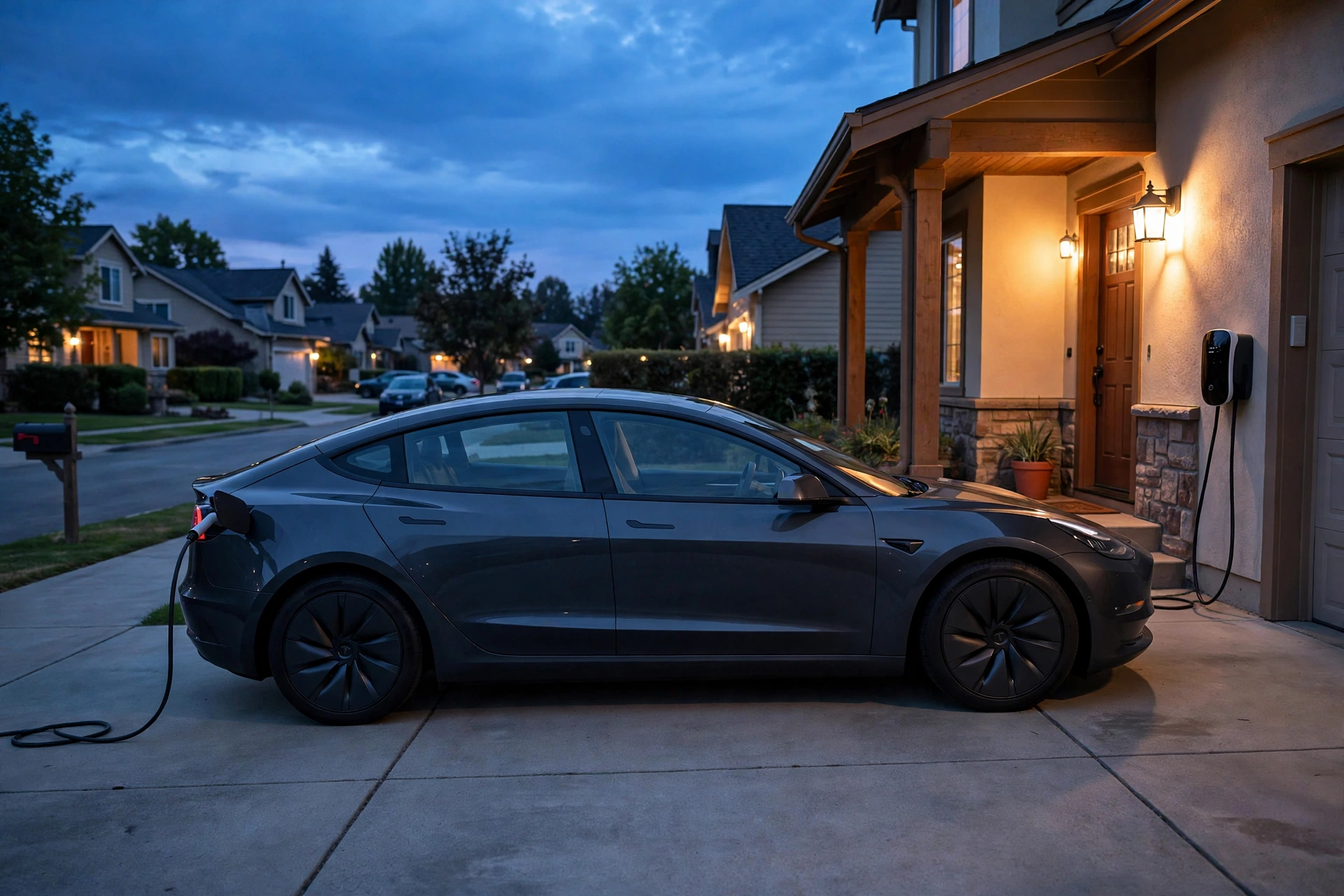
Lease a Tesla Model 3 or buy one? The three-year comparison
Run both routes on the same Standard RWD car. Buying: the sticker is $38,630 including destination. Add sales tax at an illustrative 7% (est.) and the cash price is about $41,334. Sell the car after three years and 30,000 miles at 55% of its sticker (est., in line with recent Model 3 resale performance) and you get $38,630 × 0.55 = $21,247 back. Net cost of three years of ownership: $41,334 − $21,247 = $20,087, and during those years the car was yours — unlimited miles, no wear inspection, sell it whenever you like.
Finance it instead of paying cash and interest pushes the buyer’s total higher still; for context, Experian puts the average new-car payment at $765 a month, and Tesla’s sharpest finance offer this month, 1.99% APR, applies to the Model 3 Performance, not the base car.
When you lease a Tesla Model 3, from our earlier sums, the cost is about $19,835 (est.) including payment tax, or roughly $20,230 (est.) if you hand it back and pay the disposition fee. In other words, the three-year costs of leasing and buying this car are now within a few hundred dollars of each other — a direct consequence of the tax credit’s death, which used to tilt the table.
The decision is therefore not really about money. It is about what you value. Leasing wins if you want the lowest monthly outlay, a car permanently inside its warranty, and a clean exit in 2029. Buying wins the moment your mileage is unpredictable, because an owner never meets a $0.25-a-mile invoice.
If you want to model your own mileage and electricity prices rather than our illustrative figures, our EV total cost of ownership calculator runs the same comparison with your numbers in it, and our notes on how we research prices and terms explain where every figure in this guide came from.
What the rivals charge — and the one thing Hyundai does better
Tesla does not lease in a vacuum. CARFAX’s roundup of the best Tesla deals for October 2026 confirms the $419 Model 3 offer, and the same market offers a Hyundai Ioniq 5 SE Standard Range at $339 a month — albeit for 24 months with $4,999 due at signing, so its honest monthly cost works out higher than the headline gap suggests. We have decoded Hyundai’s own small print in our guide to Hyundai Ioniq 5 lease deals, and Honda shoppers can compare against our Honda Prologue lease breakdown as well.
One genuine difference deserves calling out: Hyundai prints the lease-end purchase price — the residual — right inside its advertised offer, down to the $300 purchase option fee. Tesla’s advertisement never mentions a buyout figure at all, even now that buyouts exist. You have to sign first and read your agreement to learn what your own car will cost you in 2029. That is the least honest page in Tesla’s lease, and it is a choice, not an oversight.
The money factor is the other number Tesla declines to publish. Independent lease trackers put the money factor to lease a Tesla Model 3 at roughly 0.00210 (est.) for Tier 1 credit, which converts to about 5.04% APR (est.) — multiply any money factor by 2,400 to get its APR equivalent.
That is not extortionate, but it is well above the 1.99% Tesla offers Performance buyers who finance, and because Tesla’s pricing is fixed, there is no dealer desk where a charming afternoon can shave it. No negotiation exists anywhere in a Tesla lease: not on price, not on money factor, not on residual. The only levers you control are trim, term, mileage, down payment, and timing — inventory cars and quarter-end pushes are when Tesla quietly improves its offers, and delivery timing is the closest thing to haggling the company permits.
Our verdict
Our score: 6.5/10
- Deal honesty: 6/10 — The $419 headline survives contact with the contract better than most lease ads; it is still $522 in real money before tax, the residual stays unpublished, and the tax exclusion does quiet work in every figure.
- Flexibility: 7/10 — The 2024 buyout reversal, a once-only extension of up to six months, adjustable down payment and three mileage tiers make this a far less rigid contract than its reputation. The $0.25 excess-mile charge and the two-state buyout exclusion hold it back.
- Value vs buying: 6/10 — Post-credit, the three-year costs of leasing and buying are nearly level. The lease wins on cash flow and warranty cover; it loses on mileage freedom and equity. The Premium RWD at $429 is the pick of the range — ten dollars a month for 42 extra miles of range is the one unambiguous bargain in the document.
If you lease a Tesla Model 3 this year, do it with the $522 figure in your head, zero down, the mileage tier your odometer actually deserves, and a calendar note for month 35: that is when you price the buyout against the used market and decide whether this car stays. Drivers who read the contract that way will find a Tesla lease is a decent, unremarkable financial product. Drivers who shop the $419 will find the other $103 later, in instalments, with interest.
Frequently asked questions
How much does it really cost to lease a Tesla Model 3 in October 2026?
The advertised Standard RWD deal is $419 a month for 36 months with $4,114 due at signing, prices checked October 27, 2026. Because the due-at-signing amount includes the first payment, the full pre-tax cost is $4,114 + (35 × $419) = $18,779, an effective $522 a month. Sales tax, title and registration are extra everywhere.
Can I buy my Model 3 when the lease ends?
Yes, in most states — this changed on November 27, 2024. Tesla Lease Trust lessees can request a purchase estimate in the Tesla app; the price is the purchase option in your agreement, plus a purchase fee of up to $350 and local taxes. Iowa and Louisiana are excluded, and leases held by third-party banks follow that bank’s rules instead.
What happens if I go over the 10,000-mile yearly limit?
Tesla charges $0.25 per excess mile, billed after return. Driving 12,000 miles a year on a 10,000-mile lease means 6,000 excess miles and a $1,500 charge. Choosing the 12,000 or 15,000-mile tier at signing costs less per mile (est.) than paying the penalty rate, so size the lease to your real driving.
Is any of the old $7,500 tax credit still inside Tesla lease prices?
No. The federal clean-vehicle credits, including the commercial credit that leasing companies passed through, ended on September 30, 2025. Current Tesla lease pricing is built without it, which is why today’s payments are higher than 2024–25 deals on the same car. State incentives still exist in a few places and are worth checking separately.
Can I change the down payment or term on Tesla’s website?
Yes. Tesla’s lease pricing tool lets you set the down payment, term (24, 36 or 48 months) and annual mileage (10,000, 12,000 or 15,000) and shows an estimated payment, always excluding taxes and fees. Our advice to anyone about to lease a Tesla Model 3 stands: slide the down payment to zero and put the mileage where your odometer says it belongs.
What fees should I expect at the very end of the lease?
If you return the car: a $395 disposition fee (waived if you lease another Tesla within 30 days), $0.25 per excess mile, and any excess wear charges under Tesla’s guide — kerbed wheels are the usual item. If you buy the car instead: a purchase fee of up to $350 plus taxes. You can also extend the lease once, by up to six months, if your account is in good standing.
Before you sign, remember the checklist in this guide if you plan to lease a Tesla Model 3: choose zero down, pick the mileage tier you will actually drive, and price the buyout before you return the car. That discipline is what turns an advertised payment into a deal you can defend, and it is the simplest way to lease a Tesla Model 3 without paying for miles or fees you never planned to use. in short, to lease a tesla model 3 well, keep the 522 figure in mind.