Last updated: October 27, 2026
A lease quote is three numbers wearing a trench coat. Selling price, residual value, money factor. Everything else is garnish. And right now an ioniq 5 lease is the most interesting quote in the electric market, because Hyundai is quietly paying a large slice of it for you. Prices here were checked October 27, 2026. What follows is the structure, the sums, and the order to negotiate in.
The headline first. Hyundai Motor Finance’s national offer on the 2026 Ioniq 5 SE Standard Range is $339 a month for 24 months, with $4,999 due at signing and 12,000 miles a year. The 2027 cars are already landing on the same programme, from $359 a month. Both offers run to November 2, 2026. Sounds simple. It is not. The interesting part hides inside the capitalised cost, and almost nobody reads that line.
Why so cheap, a year after the federal money died? The $7,500 commercial clean vehicle credit, the one that used to flow straight into EV leases, ended on September 30, 2025, and the purchase credit followed at the end of 2025. Hyundai answered in two moves. It cut 2026 Ioniq 5 list prices by between $7,600 and $9,800 against the 2025 car, so the range now starts at $35,000 before destination. Then it kept stuffing its own money into the leases. The sums further down show roughly $7,350 (est.) of Hyundai support buried inside the cheapest advertised deal alone — the dead credit, quietly reincarnated as lease cash.
Our earlier roundup of Hyundai Ioniq 5 lease deals tracks the headline offers as they change month to month. This page does the other job: how the lease is built, what the advertised payment really costs once the signing money is spread back across the term, and how to push the number down at the desk. Read only the monthly figure and the dealer has already won the first round.
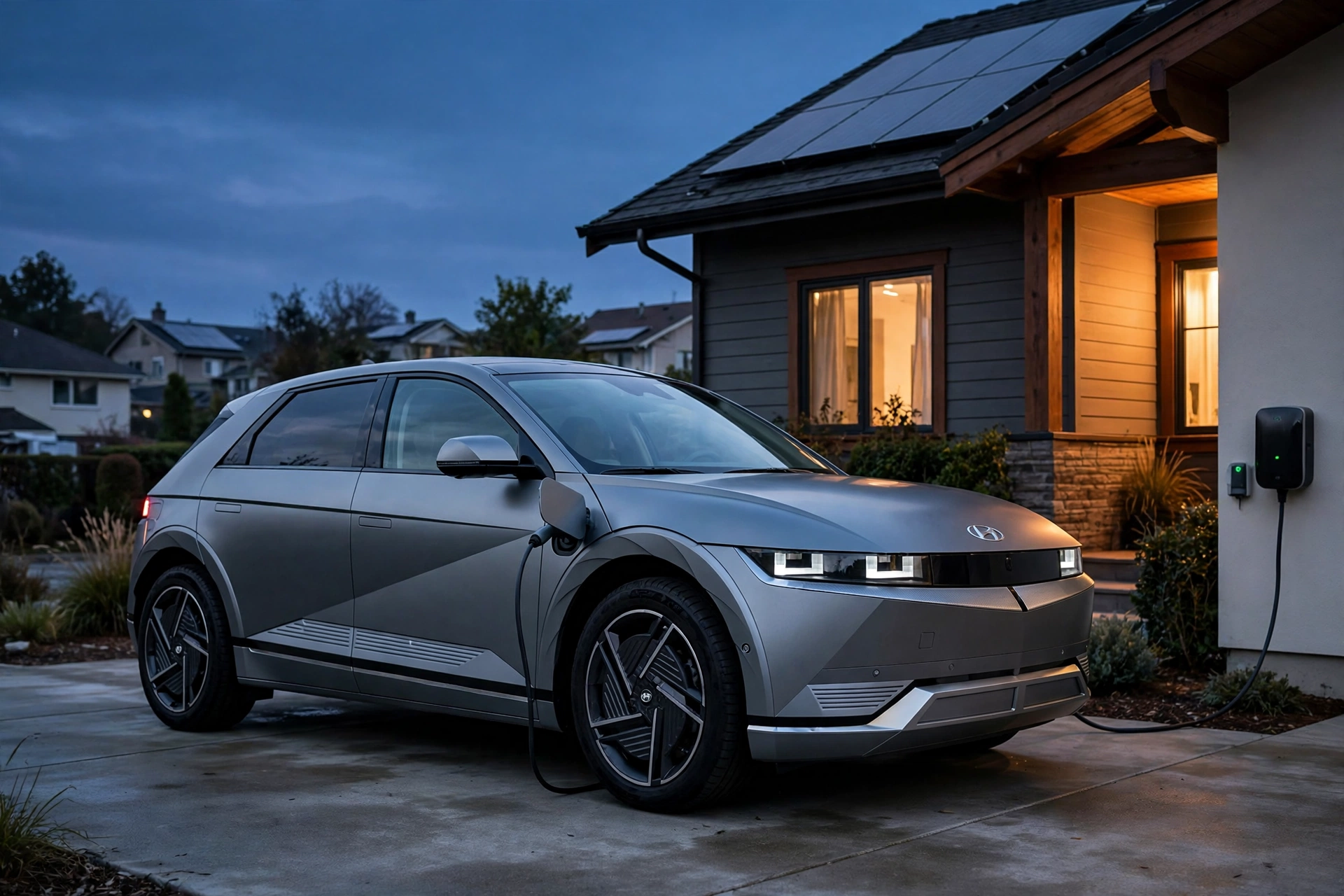
The ioniq 5 lease offers on the table right now
Four advertised 2026 deals are running nationally, all 24-month closed-end leases through Hyundai Motor Finance, all with $4,999 due at signing and 12,000 miles a year:
- SE Standard Range RWD — $339/month. MSRP $36,650 with destination. Net capitalised cost $25,290. Residual $19,424.
- SE RWD (long range) — $369/month, as listed on Hyundai’s own site this month. The 84 kWh car, 318 miles of range. This is the one to look at, and there is a section below explaining why.
- SEL AWD — $439/month. MSRP $44,950. Net capitalised cost $35,140. Residual $27,869.
- Limited RWD — $479/month. MSRP $46,725. Net capitalised cost $37,205. Residual $28,969. The XRT sits at the same $479 on a $47,925 sticker.
Every figure excludes tax, title, registration and dealer documentation fees, and every one assumes top-tier credit. The $4,999 is not a deposit: on the SE it splits into the first $339 payment plus $4,660 of capitalised cost reduction. The $650 acquisition fee is rolled into the deal, the disposition fee is $400 if you hand the car back, the purchase option fee is $300 if you buy it, and excess miles cost $0.20 each. The full fine print is published in Hyundai’s national offer terms, reproduced on dealer offer pages, and it is worth ten minutes of your evening. Nobody reads it. Be the exception.
One trap to flag early. These are 24-month offers. Ask for 36 months and the subsidy thins out fast, because the fat residuals and the lease cash are aimed at the two-year term. Hyundai’s own calculator has shown the 2027 SE at around $412 a month on 36 months (est., from Hyundai’s published calculator figures this month). Longer is not cheaper here. Longer is just longer.
How an ioniq 5 lease is actually built
Three ingredients. Learn them and you can rebuild any quote on a napkin.
Capitalised cost. The price the lease is based on: negotiated selling price, plus the $650 acquisition fee, minus anything you pay upfront and minus Hyundai’s lease cash. This is the single most negotiable number in the whole contract, because the sticker price is a starting bid, not a fact.
Residual value. What Hyundai says the car will be worth at the end, fixed at signing. On the advertised deals the long-range cars carry residuals of about 62% of MSRP after 24 months — $27,869 on the $44,950 SEL AWD, $28,969 on the $46,725 Limited. The Standard Range car is set at just 53% ($19,424 on $36,650). A high residual is free money for the lessee: you only pay for the slice between capitalised cost and residual, so Hyundai is deliberately shrinking that slice to move metal.
Money factor. The rent charge, written as a small decimal so it looks harmless. Hyundai does not print it in the ads, so reverse-engineer it. On the $339 deal: depreciation per month is ($25,290 − $19,424) ÷ 24 = $244.42. The remaining $94.58 of the payment is rent. Divide $94.58 by ($25,290 + $19,424) and you get a money factor of about 0.0021 (est., derived from Hyundai’s published offer figures). Multiply a money factor by 2,400 to think in APR: roughly 5.1% (est.). That is the interest rate Hyundai is too polite to print. Dealer quotes away from the advertised programme typically land somewhere between 0.0018 and 0.0028 (est., based on the advertised deal’s implied rate and current Hyundai Motor Finance tiers), so if a dealer writes 0.0028 on your worksheet, you are looking at about 6.7% APR (est.) dressed in a decimal costume — and money factor is negotiable down to the buy rate if your credit earns it.
The payment formula, for the napkin: (capitalised cost − residual) ÷ months, plus (capitalised cost + residual) × money factor, plus tax. That is the whole machine. Everything a dealer does to a quote touches one of those levers, which is why you negotiate the levers and never the monthly payment.
The real monthly cost: doing the sums on the $339 deal
Advertised monthly payments lie by omission. The $4,999 at signing is real money out of your account, so spread it back where it belongs.
Total cash over the 24 months: $4,999 at signing, then 23 further payments of $339 (the first month rides inside the signing money). That is $4,999 + $7,797 = $12,796. Divide by 24: $533 a month, the honest effective cost. Hand the car back and add the $400 disposition fee: $13,196 all-in, or $550 a month. Anyone comparing this ioniq 5 lease against a $500 loan payment without doing this sum is comparing a fruit with a photograph of a fruit.
Now the comparison that decides it. Buy the same SE Standard Range for cash at its $36,650 sticker and sell it after 24 months and 24,000 miles at Hyundai’s own residual figure of $19,424. Your depreciation bill: $17,226. The lease cost you $13,196 for the identical two years in the identical car. Even before finance interest enters the room, the lease is $4,030 cheaper over this horizon (est., using Hyundai’s residual as the resale proxy). That gap exists because Hyundai is over-valuing the car at lease end and subsidising the rate. When a manufacturer wants to lose money on a schedule, the correct response is to stand in the way.
It flips eventually, of course. Buy and keep the car six or seven years and ownership wins easily, which is the usual shape of these curves — run your own horizon through our total cost of ownership calculator before signing anything. Across a two-year window, though? The subsidised lease takes it, and it is not close.
Range per dollar: the Standard Range car is the wrong one to lease
Here is my favourite piece of arithmetic in this whole guide, and it takes twenty seconds. Divide each trim’s sticker price by its EPA range and you get the cost of a mile of range:
- SE Standard Range: $36,650 ÷ 245 miles = $149.59 per mile of range
- SE RWD long range: $39,150 ÷ 318 miles = $123.11 per mile of range
- SEL RWD: $41,450 ÷ 318 miles = $130.35 per mile of range
- Limited RWD: $46,725 ÷ 318 miles = $146.93 per mile of range
The range and consumption figures are the EPA’s — the fueleconomy.gov listing for the 2026 Ioniq 5 RWD shows 318 miles and 30 kWh per 100 miles for the long-range rear-drive car. Now stack that against the lease payments. The long-range SE costs $30 a month more than the Standard Range car on the advertised programme, and for that $30 you get 73 extra miles of range, the bigger 84 kWh battery, and a residual set near 62% instead of a miserable 53%. The $339 car is the headline. The $369 car is the deal. Take the long-range SE and do not let a salesperson talk you out of it with the smaller number.
Leasing the Limited is harder to defend. You would pay $479 a month to rent ventilated seats and a panoramic roof for two years, then hand every one of those toys back. The depreciation slice on a $46,725 car is simply bigger, and no residual trick fully hides it. Lease the middle of the range. It is where Hyundai’s subsidy does the most work per dollar.
Charging maths: where this lease gets properly cheap
Right. My territory. A leased Ioniq 5 on 12,000 miles a year, at the EPA’s 30 kWh per 100 miles, drinks 3,600 kWh a year. What that costs depends entirely on when the electrons arrive:
- Overnight on an EV tariff at $0.12/kWh (est.): 3,600 × $0.12 = $432 a year. $36 a month. $0.036 a mile.
- Flat-rate home power at $0.30/kWh (est.): $1,080 a year, $0.09 a mile.
- DC fast charging at $0.48/kWh (est.): $1,728 a year, $0.144 a mile — four times the overnight price for the same miles.
- The petrol comparison: a 30 mpg car at $3.20 a gallon (est.) burns $0.107 a mile, about $1,280 a year.
So the overnight habit alone is worth roughly $850 a year against petrol, and about $1,300 a year against living on public fast chargers. If you have rooftop solar, the experiment gets better: every surplus kilowatt-hour you pour into the car at noon instead of exporting it for pennies is range bought at the export rate, often $0.04–0.08/kWh (est.), which drags the yearly fuel bill under $300. Our page on what an electric car costs per mile breaks the same maths down by charging mix, and the pattern never changes: the tariff is the fuel price now, and the tariff has a timetable.
My position, stated plainly: an ioniq 5 lease signed by someone who will charge at home overnight is a genuinely cheap way to run a new car. The same lease signed by someone who will feed it at motorway fast chargers gives most of the advantage back. The car has a native NACS port and charges from 10% to 80% in about 20 minutes on a fast enough charger, which is excellent for trips and a terrible business model for weekly fuel. Get the wallbox. Set the timer for the cheap hours. Let the car charge while you sleep and the spreadsheet behaves.
How to get the best deal: the order that works
Sequence matters more than charm. Do these in this order.
- Negotiate the selling price first, as if you were buying. Every $1,000 off the capitalised cost is worth roughly $42 a month on a 24-month term (est., depreciation plus rent). Hyundai is advertising cash discounts of around 10% on 2026 Ioniq 5s this month to clear the way for the 2027 cars, so a selling price below sticker is not optimism — it is the current market. Only mention the lease once the price is agreed.
- Ask for the three numbers in writing: capitalised cost, residual, money factor. Compare the money factor against the roughly 0.0021 (est.) implied by the national deal. A dealer marking it up to 0.0028 (est.) is adding around $30 a month (est.) that no advertisement will ever mention.
- Keep the upfront money at the advertised structure and no more. Extra capitalised cost reduction does not make the lease cheaper in any meaningful way; it just prepays the same bill. Worse, if the car is written off in month three, the insurer settles with the finance company and your extra thousands evaporate. Money down on a lease is a donation to risk. Refuse it.
- Check your state’s money before you sign. With the federal credit gone, state programmes are the remaining layer: Colorado’s 2026 credit is $750, with a further $2,500 for cars under a $35,000 MSRP — the base Ioniq 5 sits right on that line, so how the state counts destination charges decides it. New York’s Drive Clean rebate runs up to $2,000, Connecticut’s CHEAPR offers $1,000 on a battery-electric car, and Massachusetts MOR-EV lists $3,500 (state programme figures as published for 2026; amounts and funding change, so verify before relying on any of them). Some of these pay the dealer or lessor rather than you — ask who actually receives it.
- Play the model years against each other. The 2027 SE starts at $359 a month on the new programme while dealers still hold discounted 2026 stock. Two quotes, one for each year, and let the sales managers compete with their own employer’s cars.
- Be honest about your mileage. The deals above carry 12,000 miles a year. Excess miles cost $0.20 each at the end — 3,000 miles over is a $600 farewell gift. Buying the miles upfront inside a higher allowance is almost always cheaper than paying the exit toll (est., based on standard Hyundai Motor Finance terms).
Our verdict on the current ioniq 5 lease
Our score: 8.4/10 — Monthly value: 9/10 · Terms fairness: 7.5/10 · Running costs: 9/10
The monthly value is close to unbeatable in this class right now: a $533 effective month (est., from the worked example above) for a 318-mile electric crossover with a 10-year battery warranty behind it, in a programme where Hyundai absorbs the steepest depreciation. Terms fairness loses marks for the $4,999 upfront structure — it exists to make the headline number small, and you should see it for exactly that — and because the generous residuals live only on the 24-month term. Running costs score near the top because the car is efficient, the warranty outlasts the lease twice over, and home charging on an evening rate makes the fuel bill almost disappear. Our full research approach is set out on our how we research page, including how these scores are built.
ioniq 5 lease questions, answered straight
How much does an ioniq 5 lease cost in total, not just per month?
On the advertised 2026 SE Standard Range deal: $4,999 at signing plus 23 payments of $339 totals $12,796 over 24 months — $533 a month effective — plus a $400 disposition fee if you hand the car back, for $13,196 all-in. Taxes and dealer fees sit on top. Any quote you compare should be reduced to this same total-cash shape before you judge it.
Is the $7,500 federal tax credit still included in the lease?
No. The commercial clean vehicle credit that funded lease discounts ended on September 30, 2025, and the purchase credit ended at the close of 2025. What you get instead is Hyundai’s own money: 2026 sticker prices cut by up to $9,800 and, inside the advertised SE deal, roughly $7,350 (est., worked out from the published capitalised cost) of lease support replacing the old credit. Our guide to whether EVs are worth buying without tax credits runs the wider post-credit picture.
Should I put extra money down to get the payment under $300?
No. A bigger upfront payment barely changes the total cost of the lease; it mostly moves your own money earlier, where it earns nothing and sits exposed. If the car is stolen or written off early, that prepaid reduction is gone for good. Keep the cash, accept the honest monthly figure, and judge the deal on total cost.
What happens if I drive more than 12,000 miles a year?
You pay $0.20 for every mile over the allowance at lease end, so a 15,000-mile-a-year driver hands back the car with a $1,200 bill (est., 6,000 excess miles over two years). If that is your real mileage, price a higher allowance into the quote at signing or look at buying instead — the exit toll is the worst way to pay for miles.
Can I buy the car when the lease ends?
Yes. The buyout is the residual value printed in your contract, plus a $300 purchase option fee in most states. On the advertised SE Standard Range deal that is $19,424 + $300. If the car is worth more than that on the open market when the term ends — quite possible, given Hyundai set these residuals to flatter the payments — buying it out and keeping it, or selling it and pocketing the difference, is the smart exit.