Last updated: October 27, 2026
Search for the hyundai vehicle recall palisade ioniq ev story and you will find two very different problems sharing one headline. One involves a charging unit inside Hyundai’s electric cars that can quietly stop feeding the 12-volt battery until the car runs out of power. The other involves seat belt buckles in a big family SUV that may not latch at all. Both are free to fix. Both are worth acting on quickly. And they have almost nothing else in common, so let us take them apart slowly, with the numbers in front of us.
First, a correction that matters. There is no electric Palisade. The Palisade has been a petrol SUV since it launched: a 3.8-litre V6 for the 2020–2025 models, then a redesigned 2026 range with a 3.5-litre V6 and the first Palisade Hybrid, a 2.5-litre turbo hybrid.
No plug, no battery pack, no electric motor driving the wheels on its own. The electric side of this pairing belongs entirely to the Ioniq 5 and Ioniq 6, Hyundai’s dedicated EVs. Anyone who tells you their Palisade EV was recalled is mixing up two separate campaigns, and the mix-up is understandable, because Hyundai announced so many recalls in the same period that the headlines blur together.
Here is the short version before we go deeper. The Ioniq campaign is NHTSA recall 24V-868, Hyundai’s own number 272, covering 145,235 Hyundai and Genesis EVs built around the Integrated Charging Control Unit, or ICCU.
The Palisade campaign is NHTSA recall 25V-607, Hyundai’s number 283, covering 568,580 SUVs from 2020–2025 whose front and second-row seat belt buckles may fail to latch. Hyundai’s own filing for the Palisade campaign, the Part 573 report lodged with NHTSA, puts the estimated share of vehicles actually carrying the defect at 1 percent. Hold that figure in mind. It shapes everything about how worried you should be, and we will do the arithmetic on it further down.
What should you do first? The same thing for both nameplates. Find your 17-character VIN — on the driver’s side dashboard, visible through the windscreen, and on your registration documents — and run it through a recall lookup before you book anything. Recall lists describe production ranges, and production ranges are a blunt instrument. Your neighbour’s 2023 Ioniq 5 can be inside the ICCU campaign while yours, built three weeks later, is not. The VIN result is the only answer that counts, and it takes about two minutes.
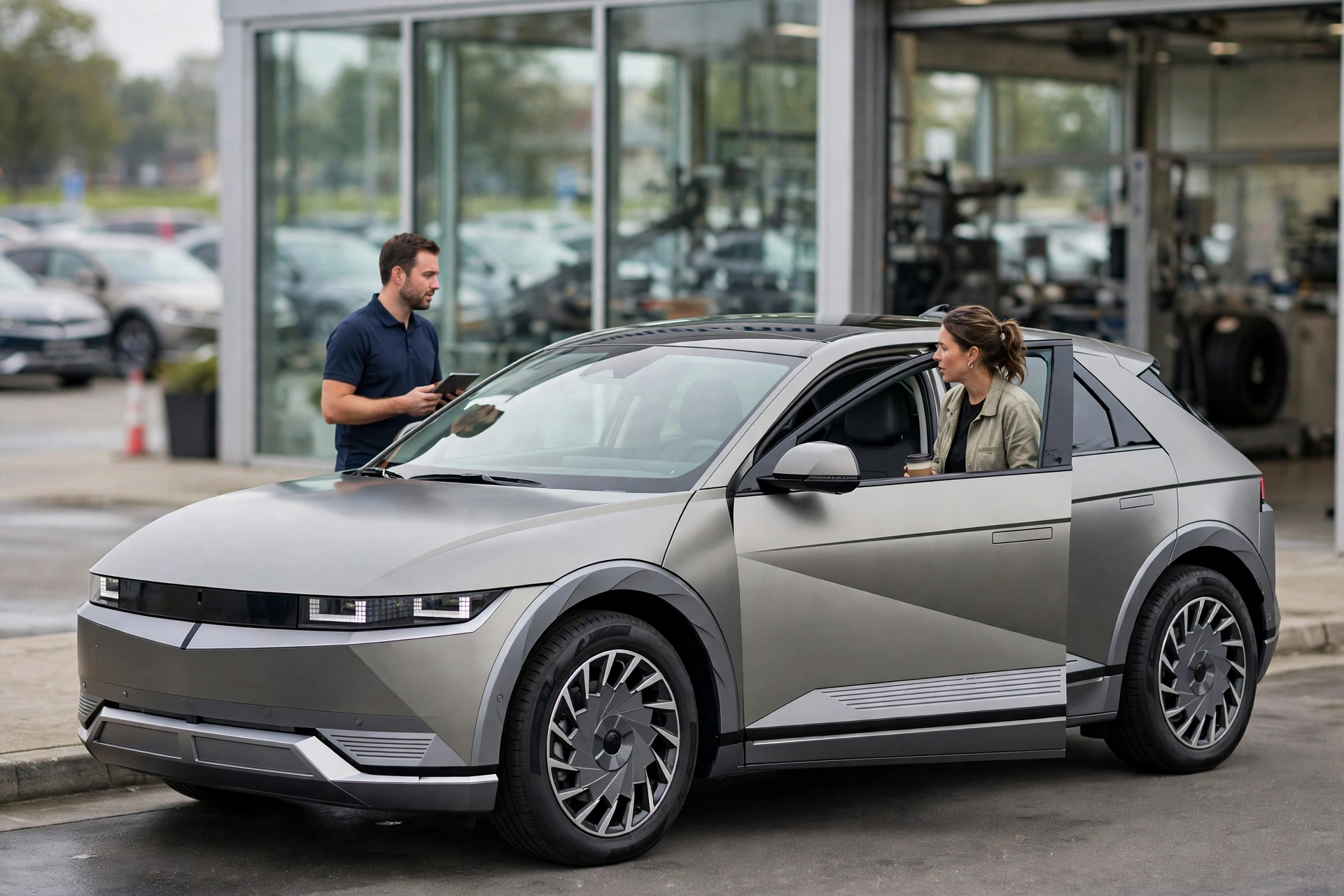
The Ioniq half of the hyundai vehicle recall palisade ioniq ev story: one small box called the ICCU
The ICCU is the hardest-working box in an E-GMP Hyundai. It converts AC power from a home charger or public post into DC for the high-voltage battery. It steps that battery’s voltage down to keep the little 12-volt battery charged. It also runs the vehicle-to-load function that lets an Ioniq 5 power a kettle, a laptop or a string of lights from its charge port.
Three jobs, one unit, mounted under the rear seat area — and if it fails, the failure travels in a specific direction that every owner should understand.
Here is the chain, step by step. Inside the ICCU, a transistor can be damaged by electrical overstress and heat. The fuse that protects the circuit blows. From that moment, the 12-volt battery stops receiving charge. The car keeps driving on whatever charge that small battery already holds, which is why the failure feels gradual rather than sudden. Warning messages appear. Power is progressively limited to stretch the remaining volts. If the driver keeps going until the 12-volt battery is fully depleted, the car loses motive power altogether. Hyundai’s filing is blunt about that end point, and it is the reason this is a safety recall rather than a service bulletin.
The campaign history explains a lot of owner frustration. Hyundai first recalled these cars in March 2024 under NHTSA 24V-204, Hyundai number 257, covering roughly 98,878 vehicles with a software update and inspection.
The fix did not hold for everyone. In November 2024 the company expanded and replaced that campaign with 24V-868 — the current one — covering 2022–2024 Ioniq 5, 2023–2025 Ioniq 6, and the Genesis GV60, GV70 Electrified and G80 Electrified. The NHTSA acknowledgement letter for recall 24V-868 lists 145,235 potentially involved vehicles. Cars repaired under the first recall need the second remedy as well. Two dealer visits for the same component is not a good look, and owners who grumble about it have a fair point.
The remedy itself has two layers. Every car gets updated ICCU software, which changes how the unit handles the voltage spikes that damaged the transistor. The dealer also checks for a stored fault code — P1A9096 is the one named in owner documents. If that code is present, the ICCU and its fuse are replaced, free. If it is absent, most cars leave with software only. That distinction explains the wide spread in owner reports: one person’s appointment takes an hour (est., based on typical dealer times for a software-and-inspection visit), another person’s car stays overnight waiting for a unit.
Now the part that sits in my corner of the world: what does any of this do to the battery? Less than owners fear. The ICCU fault lives in the charging electronics, not in the cells. A car that suffers an ICCU failure has not suddenly aged its high-voltage pack, and a car that receives a new ICCU has not gained a younger one. Degradation curves keep following their own slow arithmetic — a few percent of capacity across the early years (typical for this platform, based on published fleet data), driven by mileage, heat and charging habits, untouched by whether a transistor upstream behaved itself.
If you are new to how these packs age, our guide to how an EV battery actually works walks through the chemistry in plain language.
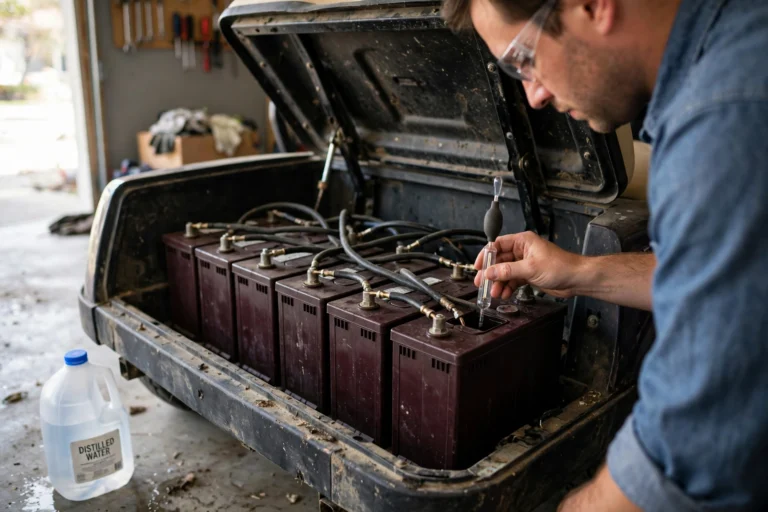
The component that does suffer is the humble 12-volt battery. Each deep discharge shortens a lead-acid battery’s life, and a car that limped through an ICCU failure may keep a weakened 12-volt unit long after the recall work is done. My standing advice for E-GMP owners is simple: treat the 12-volt battery as a wear item with a three-to-five-year horizon (est., the normal service range for this battery type), replace it on age rather than waiting for a no-start morning, and ask the dealer to test it whenever the car is in for recall work. It is the cheapest insurance on the whole vehicle.
The Palisade side: 568,580 family SUVs and a buckle that may not click
Turn to the Palisade side of the hyundai vehicle recall palisade ioniq ev pairing and the mood changes. There is no software subtlety here. The buckle assemblies in the driver’s, front passenger’s and second-row outer seats can contain out-of-specification parts that add friction inside the latch channel. Cold weather makes the friction worse. Push the belt tongue in slowly, at an angle, the way a tired parent does at midnight with a sleeping child in the other arm, and the buckle can fail to latch fully — while looking and feeling very much like it has.
Hyundai’s interim advice deserves to be followed literally until your car is fixed: insert the belt firmly, with a quick and direct motion, then pull on the belt to confirm it is genuinely secured. Make it a habit for every occupied seat, and show anyone who drives your children — grandparents, carpool parents, older siblings — the same tug test. A buckle that has not latched offers no restraint at all in a crash, which is why this recall, not the ICCU one, is the most urgent item in this entire article for families.
The scale is the story. At 568,580 vehicles, recall 283 covers effectively the whole 2020–2025 Palisade population in the United States. Interim letters went out from October 23, 2025. The remedy — replacement buckle assemblies, free — is being mailed in phases, with final remedy letters expected to run from June 2026 through December 2026.
Read that again. Some owners will wait well over a year from the recall announcement to their repair letter. That is too slow for a part your family trusts on every single trip, and here is my plain position: do not sit at home waiting for the envelope. Call your dealer, give them the VIN, and ask directly whether your car can be inspected and fitted under campaign 283 now that parts are flowing. Dealers handle phased campaigns vehicle by vehicle; a polite owner with a VIN in hand regularly gets seen ahead of the letter schedule.
The 2026 Palisade has its own separate entries, and they are worth knowing because the redesigned model is the one now sitting in showrooms. In March 2026, Hyundai recalled 46,787 of the 2026 Palisade and Palisade Hybrid in Limited and Calligraphy trims (NHTSA 26V-169, Hyundai number 297) for damaged wiring inside the third-row driver’s-side seat belt buckle, which can make the unbelted warning unreliable; dealers fit a wiring harness extension and replace the belt assembly where needed.
A second 2026 campaign covers roughly 61,000 (est., from published reports of the filing) Limited and Calligraphy SUVs whose second- and third-row power seats may not stop when the sensor detects contact — a defect linked in NHTSA’s file to a child fatality in Ohio in March 2026. That one carries an over-the-air interim update and a stop-sale on affected stock. If you are shopping a new Palisade, ask for written confirmation that both campaigns show as completed on that exact VIN before you sign anything.
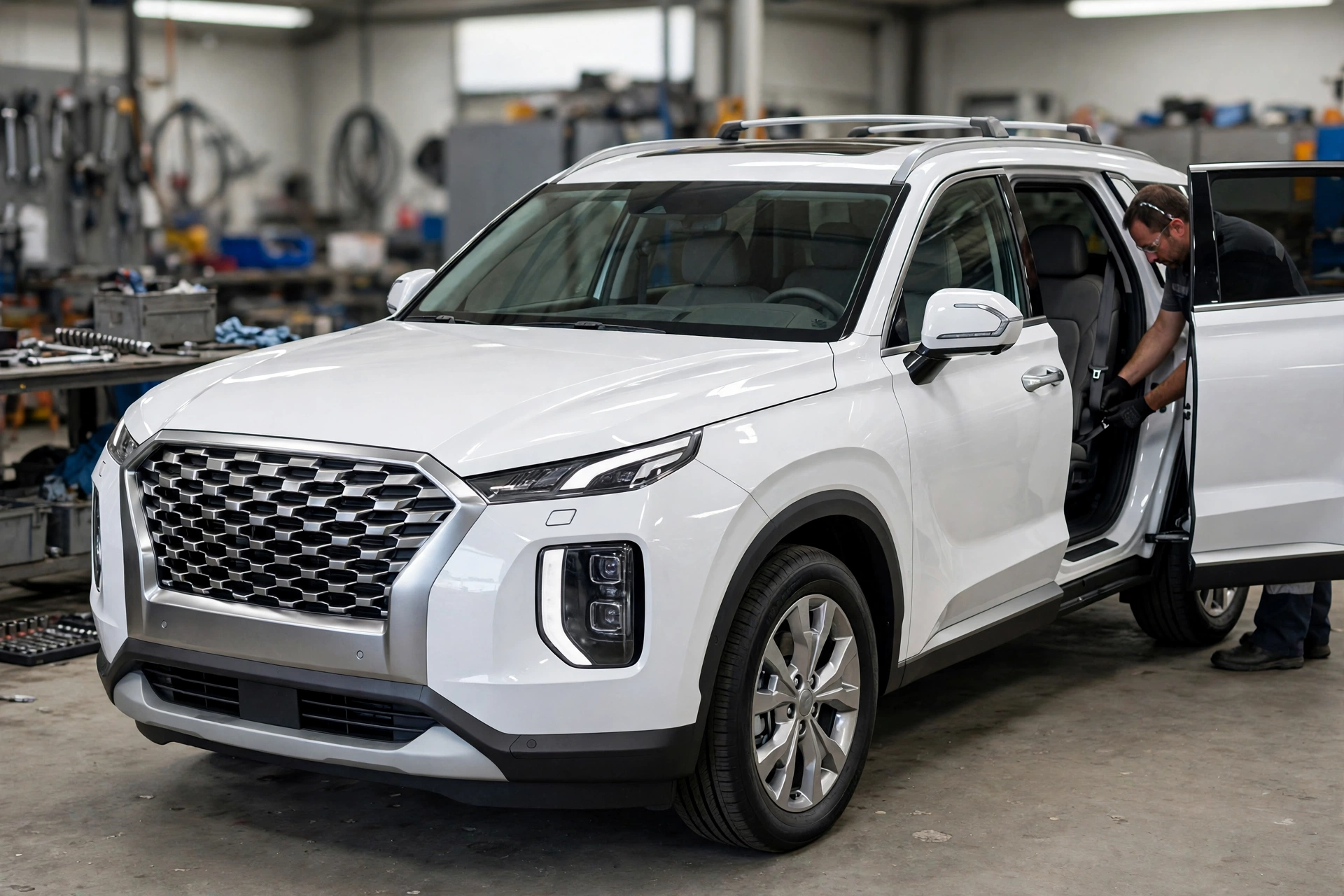
The hyundai vehicle recall palisade ioniq ev numbers, counted properly
Recall headlines trade in big numbers, and big numbers frighten people out of proportion. So let us count the hyundai vehicle recall palisade ioniq ev campaigns the way a battery engineer counts capacity: total population first, then the share that is actually expected to fail.
Ioniq and Genesis EVs, recall 24V-868: 145,235 vehicles in total. The Ioniq 5 accounts for 100,880 of them. Do the division: 100,880 ÷ 145,235 = 0.695, so one model is 69.5 percent of the entire campaign. Add the Ioniq 6’s 28,932 and Hyundai-badged cars total 129,812 — that is 129,812 ÷ 145,235 = 89.4 percent, with Genesis models making up the remaining tenth.
Hyundai’s estimated defect rate is 1 percent, so the expected number of vehicles that would actually suffer the ICCU failure is 145,235 × 0.01 ≈ 1,452. One percent is not nothing — 1,452 stranded cars is a real queue of tow trucks — yet it also means roughly 99 of every 100 recalled cars were never going to fail. The recall exists because the failure mode, loss of drive power, is dangerous wherever it lands.
Palisade, recall 25V-607: 568,580 vehicles, same 1 percent estimate in Hyundai’s filing. The arithmetic: 568,580 × 0.01 ≈ 5,686 SUVs expected to carry a genuinely faulty buckle. That number should change how you behave. With almost half a million Palisades sharing your roads, the tug test after buckling costs you one second per trip. Spend the second.
Combined: 145,235 + 568,580 = 713,815 vehicles across both filings, with an expected defective population of roughly 7,138 by Hyundai’s own 1 percent estimates. All figures in this section were checked against the NHTSA filings on October 27, 2026, and the percentages above are our own calculations from those filing totals — the method we use for every guide is set out on our research method page.
Now the owner’s side of the ledger, because “free repair” is only half the cost story. The parts and labour are free on every campaign in this article, and a fixed EV keeps its running-cost edge — our cost per mile breakdown shows how small the per-mile numbers are on a healthy car.
What you actually spend is time. Budget half a day (est.) for a Palisade buckle visit once parts are on the shelf, and anything from one hour to a full day (est.) for an ICCU appointment depending on whether your car needs the unit itself. Set against that, price the alternative honestly: a single tow for a depleted Ioniq runs $100–$200 at typical US rates (est.), a replacement 12-volt battery fitted in a hurry costs similar money, and neither figure touches the real cost of a seat belt that was never latched. The recall visit wins the arithmetic every time.
Owners sometimes ask what a full traction battery would cost if the worst happened to the pack itself; the honest answer is “far more than any of this,” and our battery replacement cost estimator will show you the range for your model.
A calm checklist for both nameplates
Step one, today: run your VIN through the recall lookup linked from Hyundai’s owner pages or the NHTSA site, and screenshot the result. Open campaigns show immediately; a clean result is worth saving too, because it settles arguments later — with a dealer, a buyer, or an insurer.
Step two, this week: call the dealer with the campaign number ready — 272 for the ICCU cars, 283 for the Palisade buckles, 297 for a 2026 Palisade’s third-row buckle wiring. Ask two questions: is my VIN in the population, and what is the earliest slot if I need parts? Write down the name of whoever you spoke to. Patient, specific callers get callbacks; vague ones get queues.
Step three, at the visit: for an Ioniq, ask whether the fault code was found and whether your ICCU was inspected, replaced, or software-only — and get the answer on the invoice, not just verbally. For a Palisade, ask which seating positions received new buckles. Keep the paperwork with the car’s service history. A documented recall history is worth real money at resale, because the next owner will run the same VIN check you did.
Step four, if you are buying used: treat recall status as part of the price negotiation, ahead of paint and tyres. A 2023 Ioniq 5 that had the March 2024 remedy still owes you the November 2024 one, and plenty of sellers genuinely do not know. An open Palisade buckle recall on a family SUV should be fixed before the car carries your kids, not scheduled around them. Walk away from any seller who resists a VIN check. There are always other cars.
Our verdict on the hyundai vehicle recall palisade ioniq ev response
Hyundai deserves credit for the breadth of both campaigns: 713,815 vehicles is not a token gesture, the filings are detailed, and every remedy is free.
The hyundai vehicle recall palisade ioniq ev story still earns a mixed grade from us, for two reasons. The ICCU needed two campaigns to reach a remedy owners trust, and repeat failures after the first fix were reported widely enough that the second recall had to call those cars back. And the Palisade buckle remedy is rolling out across most of 2026, which asks families to live with an interim workaround — a firmer push and a tug — for months. Neither point makes these bad vehicles. Both points make “wait and see” the wrong owner strategy.
Our score: 7/10 for Hyundai’s handling of these campaigns.
Safety urgency: 9/10 — a buckle that may not latch and an EV that can lose drive power both demand prompt action.
Fix convenience: 6/10 — the ICCU visit is quick for most cars; the Palisade parts phase-in is genuinely slow.
Owner cost: 10/10 — every inspection, part and software update in both campaigns is free of charge.
Frequently asked questions
Does the hyundai vehicle recall palisade ioniq ev campaign include the 2025 Ioniq 5?
No. Recall 24V-868 covers 2022–2024 Ioniq 5 and 2023–2025 Ioniq 6. The refreshed 2025 Ioniq 5 sits outside the campaign as filed. That is not a promise your individual car can never develop a 12-volt problem — it means this specific remedy does not apply to it. Any EV that shows charging warnings or a fading 12-volt battery deserves a dealer visit, recall or not.
Is there an electric or plug-in Palisade in these recalls?
No. Every Palisade in campaign 283 burns petrol in a 3.8-litre V6, and the 2026 campaigns add the Palisade Hybrid, which still has no plug. When people say hyundai vehicle recall palisade ioniq ev, the “ev” belongs to the Ioniq 5 and Ioniq 6 only. The two halves of the story share a badge and a filing cabinet, not a drivetrain.
My Palisade’s buckles click and feel solid. Can I skip the recall?
No, and this is the question I answer most firmly. The defect involves buckles that can feel latched while sitting partly engaged, with cold weather adding friction. A buckle that passes your tug test today is behaving today; the campaign replaces the assemblies because the margin is wrong, not because every unit fails every time. Book the car in, keep the tug test as a habit, and let the new parts close the question.
Will the ICCU remedy change my Ioniq’s range or battery life?
No measurable change either way. The updated software manages how the charging unit protects itself; it does not alter the pack’s capacity, charging curve in normal use, or the degradation path your battery was already on. Owners chasing long pack life should keep doing the unglamorous things that actually move the curve: avoid leaving the car sitting at 100 percent in summer heat, favour AC charging for daily use, and replace the 12-volt battery on schedule. Recall work protects you from a failure. Habits protect the battery.
I already had the first ICCU recall done in 2024. Do I really need to go back?
Yes. Hyundai’s second campaign explicitly expands and replaces the first, and cars repaired under 24V-204 need the 24V-868 remedy completed. This is the single most common misunderstanding in the whole hyundai vehicle recall palisade ioniq ev saga, and it is an easy one to clear up: run the VIN, look for campaign 272 showing as open or completed, and book the visit if it shows open. Ten minutes of checking beats one flat 12-volt battery on a dark road, every single time.
To sum up the hyundai vehicle recall palisade ioniq ev story, check your VIN, book the free fix, and keep the tug test as a habit until the new parts are fitted. If this hyundai vehicle recall palisade ioniq ev guide helped you, share it with another owner, and return here for updates as the hyundai vehicle recall palisade ioniq ev campaigns progress.
For owners still unsure, the hyundai vehicle recall palisade ioniq ev checklist above is the fastest route to a free fix. Keep this hyundai vehicle recall palisade ioniq ev page bookmarked, and check back for hyundai vehicle recall palisade ioniq ev updates as remedy letters arrive.