Last updated: October 27, 2026
Nobody buys a cargo bike for the spec sheet. You buy it because the supermarket is 1.8 miles away, the car park costs more than the petrol, and the weekly shop will not fit in a backpack. The buzz beekeeper cargo ebike is Buzz Bicycles’ answer to that exact problem: a step-through cargo hauler with a 400 lb payload rating, a 500W hub motor and a price that undercuts almost every purpose-built rival. It is not fast. It is not light. It is a tool, and judged as a tool it makes a serious case for itself.
First, who is Buzz? The brand sits inside United Wheels, the parent company behind Huffy, Batch and Niner, and Buzz is its dedicated e-bike label. That is why the Beekeeper is sold through Huffy’s own store and big-box channels rather than a boutique dealer network.
Prices checked October 27, 2026: the list price is $1,499.99, street prices have sat near $999.99 for months, and launch coverage in April 2026 put early units at $799. Cargo e-bikes from recognised brands normally start around $1,500 and climb past $4,000. A rated cargo hauler at three figures is the whole story here, and the rest of this guide is about the trade-offs.
For shoppers comparing models, the buzz beekeeper cargo ebike is the name to search when checking current stock and pricing.
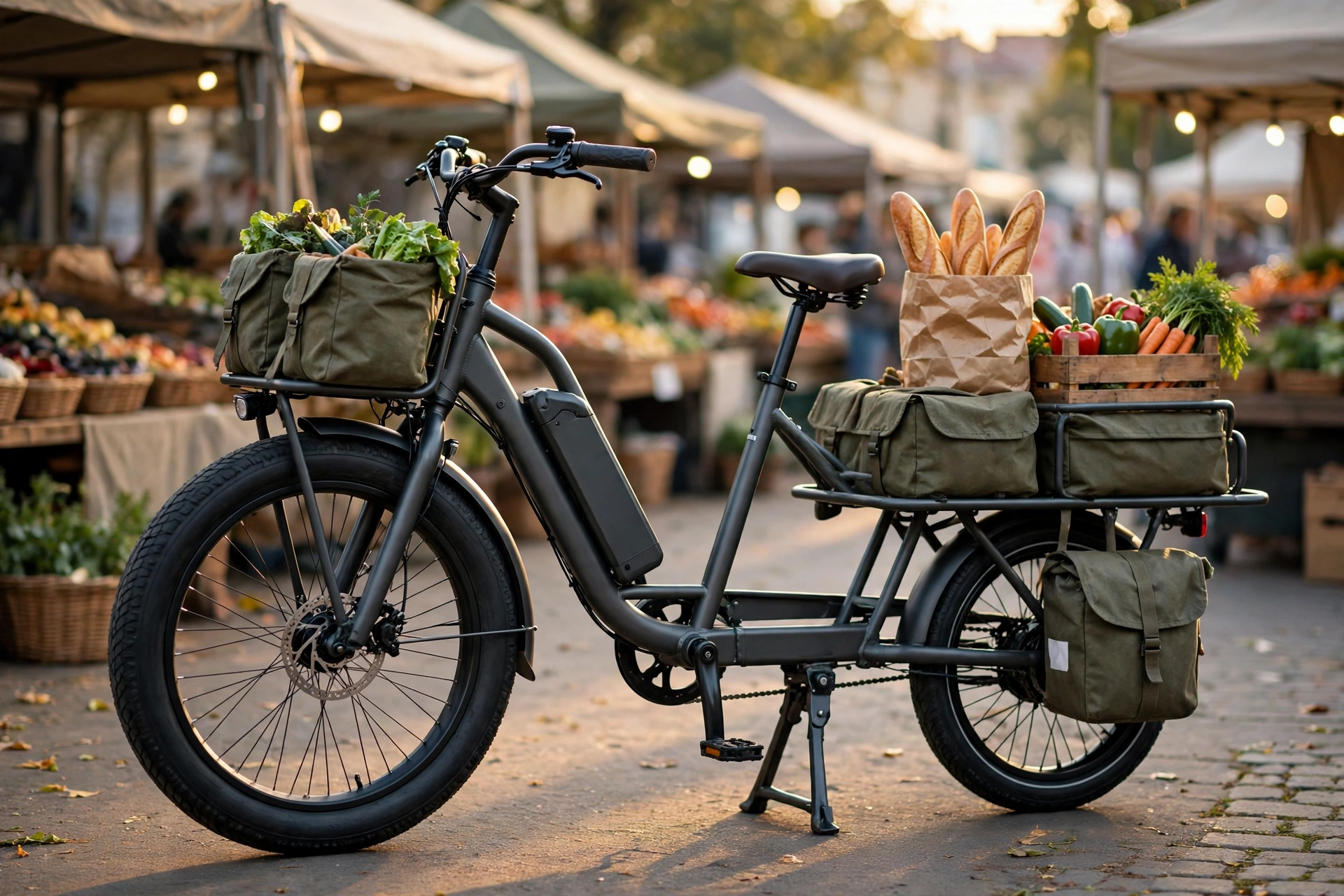
Here is the shape of the bike. The buzz beekeeper cargo ebike is a compact longtail with a mixed wheel setup: a 24-inch front wheel and a 20-inch rear, both wearing 3-inch tyres. The smaller rear wheel drops the cargo deck low, which matters more than any motor figure when you are wobbling away from a stop sign with 60 lb of shopping behind you.
The frame is aluminium, step-through, and it fits riders from about 5’2″ to 6’3″. There are racks front and rear, full fenders, integrated lights, a bell, a centre kickstand and a manual dropper seat post you normally meet on bikes costing twice as much.
It is also, let us be plain, a budget build. The motor is a rear hub unit rather than a mid-drive. The brakes are mechanical discs, not hydraulic. The battery is 500Wh in a class where rivals offer 624Wh and more. None of that is hidden; it is simply where the money was saved. The commuter question is narrower: does it get you and a heavy load across town, in the rain, up your hill, without drama, week after week? That is the test this guide applies.
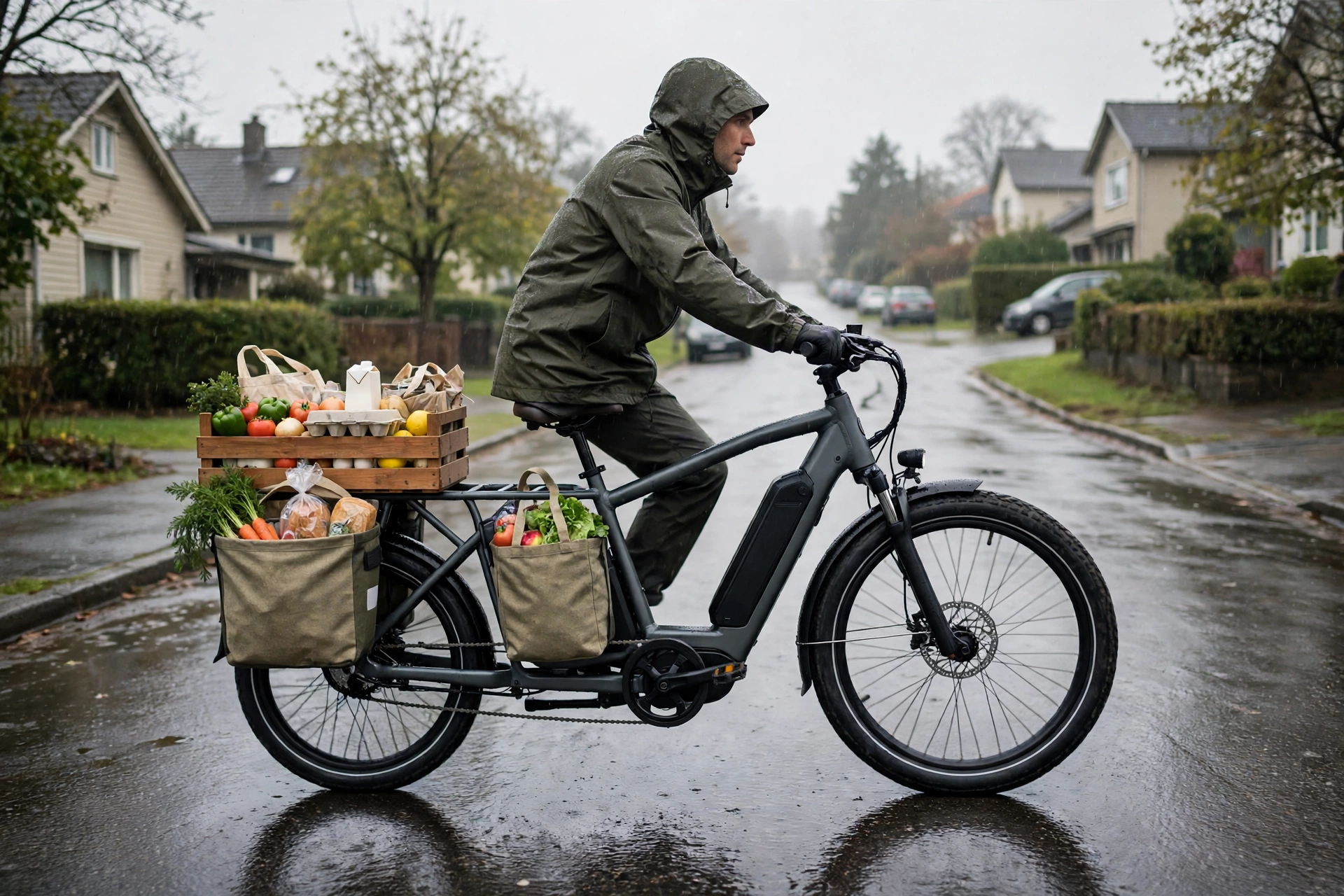
One naming note before the numbers. The “beekeeper” name is a pun on the brand, and Buzz originally pitched the bike at motorsport pit crews hauling fuel and tools around paddocks. Ignore the paddock. The families and errand-runners who buy it use it for school runs, grocery hauls and the business of not owning a second car. Buzz introduces the model itself in its own Beekeeper announcement on the Buzz Bicycles site, which leans on the same 400 lb payload and two-child-seat rack claims we check below.
Buzz Beekeeper Cargo Ebike specs in plain English
The electrical system is simple. A 500W rear hub motor delivers a claimed 60 Nm of torque, fed by a removable 48V 10.4Ah battery. Multiply the volts by the amp-hours and you get 499.2Wh, which the industry rounds to 500Wh. It is a Class 2 e-bike: pedal assist up to 20 mph across five assist levels, plus a thumb throttle that will move you from a standstill without pedalling.
That throttle matters on a cargo bike, and we will come back to it. Charge time is quoted at 4 to 6 hours, and the pack lifts off the frame for indoor charging, which apartment dwellers should treat as essential rather than nice. Taken together, those figures describe the buzz beekeeper cargo ebike as a simple, practical commuter setup.
The mechanical parts are honest, unglamorous Shimano. A 7-speed drivetrain with a TZ 14-28T cassette and a 48T chainring, a trigger shifter, and mechanical disc brakes at both ends. Seven gears sounds thin until you remember the motor does the heavy lifting and the cassette’s job is mostly to give your legs something sensible to do at different speeds. Replacement parts for this drivetrain are cheap and available everywhere. Nobody in the history of commuting has been stranded by a Shimano TZ cassette being too exotic to source.
The details that decide daily life are present. A centre-mounted LCD shows speed, assist level, battery state and trip distance. The dropper post lets two riders of different heights share the bike without carrying an Allen key, and on a bike borrowed by partners and teenagers, that is worth real money. Total weight is 72 lb, which is normal for the class and still heavy enough that you will not be carrying it up apartment stairs. Plan on ground-floor storage, a garage corner, or a lift you trust.
Safety paperwork, briefly: Electrek’s launch coverage describes the battery as UL-compliant. Buzz does not advertise a full UL 2849 system certification for this model the way some rivals do, so if your building or insurer asks specifically for a 2849-listed system, check the current listing before you buy rather than assuming. For how the classes and certifications fit together, our Class 1 e-bike guide lays out the framework this Class 2 bike sits inside.
What the buzz beekeeper cargo ebike can actually carry
The headline claim is a 400 lb payload. Read it correctly: that is total weight on the bike, rider included, not 400 lb of cargo behind a rider. The arithmetic is simple and worth doing before you buy. A 180 lb rider leaves 400 − 180 = 220 lb for children, shopping and kit. A 220 lb rider leaves 180 lb.
For most households that is still a serious allowance: two children in seats on the rear rack (Buzz rates the extended rack for two child carriers), or one child plus a full weekly shop, or an adult’s worth of tools and materials for a small job. That arithmetic is the first check to run on the buzz beekeeper cargo ebike before choosing child seats or bags.
How does the value stack up against the obvious rival? Take the Lectric XPedition2, the budget cargo benchmark: $1,399 list, 450 lb payload. Price per pound of rated payload, worked out loud:
- Beekeeper at list: $1,499.99 ÷ 400 lb = $3.75 per pound
- Beekeeper at its common street price: $999.99 ÷ 400 lb = $2.50 per pound
- Lectric XPedition2: $1,399 ÷ 450 lb = $3.11 per pound
So at list price the Lectric is actually the better payload bargain, and it adds a torque sensor, hydraulic brakes and 85 Nm of motor torque. At the street price the Beekeeper undercuts everything purpose-built. This is the first clear verdict of this guide: the buzz beekeeper cargo ebike only makes sense bought at or near $999. At $1,499.99 you should buy the Lectric. At $999, the Lectric cannot answer. Watch the price, because it moves, and the bike’s value moves with it.
A word on how the load rides. The low rear deck and the smaller back wheel keep the weight close to the ground, and independent testers have found the bike stays composed with serious weight aboard on the flat. The long rack takes Buzz’s own cargo carrier and pannier bag, rack bins and a cooler, all sold separately.
Budget for them. A cargo bike without bags is a shelf on wheels, and the accessory bill (est., based on Buzz’s accessory pricing) will add roughly $100 to $200 to the real purchase price. The honest all-in figure at street price is therefore around $1,100 to $1,200, still well under rival list prices.
Range: ignore the 40-mile claim and plan around 20 to 25
Buzz claims “up to 40 miles” from the 500Wh battery. Do the division the brochure hopes you skip: 500Wh ÷ 40 miles = 12.5 Wh per mile. That is an unloaded rider, gentle assist, flat ground and no headwind. It is not a lie so much as a best case wearing a headline’s clothes. No independent lab has published an instrumented range test of this bike yet, so our planning figures are estimates with the working shown. Those planning figures matter more than the headline when judging the buzz beekeeper cargo ebike for daily use.
Our derate rule for loaded cargo riding: a working cargo bike at commuting pace, mid-level assist, carrying a rider and a real load, burns roughly 20 Wh per mile (est.). On that basis: 500Wh ÷ 20 Wh/mi = 25 miles. Ride throttle-heavy or fully loaded and a figure near 25 Wh per mile (est.) is realistic, which gives 500 ÷ 25 = 20 miles.
Cross-check the pessimism against a tested rival: OutdoorGearLab’s lab test of the Lectric XPedition2 measured 21.9 miles from 624Wh in its range protocol, which is 28.5 Wh per mile under test conditions. Real cargo bikes burn far more than brochures admit, and the Beekeeper has no magic that exempts it. Plan on 20 to 25 miles per charge and you will never walk home.
For commuting, that is usually enough. A three-mile-each-way school-and-shop routine is six miles a day; the Beekeeper covers three to four days of it per charge. A ten-mile round trip wants a charge every second night.
The running cost is nearly a joke: a full 0.5 kWh charge at an average US residential rate around $0.17 per kWh (est.) costs about nine cents. Our breakdown of what it costs to charge an electric bike shows why the electricity is the cheapest line in the whole ownership ledger, and why tyres and brake pads will outspend it many times over.
Hills, headwinds and the buzz beekeeper cargo ebike
A hub motor does not multiply your effort the way a mid-drive does, and it cannot use the bike’s gears. What you get is a steady push from the rear wheel, up to that 60 Nm. On the flat and on gentle grades with a load aboard, it is plenty. Momentum is the game: keep the bike rolling, spin a sensible gear, and the motor holds speed without complaint. This is the riding most cargo bikes actually do, and the Beekeeper does it without fuss.
Steep hills with a full load are the honest weakness, and independent reviewers say so plainly: load it heavily and point it up a steep grade and you will be contributing serious legwork, and even that may not be comfortable. A hub motor working slowly under a big load also runs hot and inefficient, which eats the range figures above.
If your town is flat to rolling, buy with confidence. If your commute includes a long, steep climb, ride one loaded before you pay, or step up to a mid-drive cargo bike and accept the price difference with open eyes.
The throttle deserves its paragraph. Starting a 72 lb bike plus rider plus cargo from a dead stop at a junction, uphill, in the rain, is where underpowered cargo bikes become stressful. The Beekeeper’s thumb throttle lets you roll away on motor power alone and jotraffic at a predictable pace, then pedal once you are moving.
On a loaded cargo bike a throttle is not a toy. It is the difference between a calm start and a wobbling one, and any cargo bike without one starts every loaded journey at a disadvantage. For loaded starts, that throttle is a practical reason to shortlist the buzz beekeeper cargo ebike.
Commuters arriving un-sweaty should also note the flip side: five assist levels let you dial in just enough help to keep a shirt presentable on the last climb before the office, which is, for many of us, the entire point of the purchase.
Brakes, rain and the commuting grind
The brakes are the spec I would change tomorrow. Mechanical discs work, and they have one real virtue: any rider with a barrel adjuster and a YouTube video can keep them sharp at the kitchen table.
But stopping a bike carrying up to 400 lb of total weight, in the wet, down a hill, asks more of your hands than hydraulic brakes would, and pad wear on a heavy bike ridden daily is a recurring cost rather than an occasional one. Budget for pads, check them monthly in winter, and treat the first wet descent of the season with respect until you know the lever feel.
The bike’s saving grace is pace: it is a 20 mph machine, and kinetic energy is a speed problem before it is a weight problem.
Everything else about the wet-weather package is right. Full fenders keep the spray off your trousers and off the cargo. The 3-inch tyres give a wide, reassuring contact patch on wet tarmac and tramlines. Integrated lights mean you are never the rider who forgot to charge a clip-on. The step-through frame means mounting with a loaded rear rack is a step, not a leg-swing over somebody’s groceries.
These are not glamorous features. They are the features that decide whether a bike gets ridden in November. Those details help explain why the buzz beekeeper cargo ebike remains usable through wet-weather commuting.
Reliability, in the commuter sense, is about boring parts. Shimano’s entry-level drivetrain, a standard hub motor, a common battery format and mechanical brakes can be serviced by any bike shop in the country, and most of it by you. There is no proprietary app to abandon, no firmware update to brick a Tuesday.
For a bike whose job is to start every morning, that ordinariness is a feature, and it is the same thinking we apply when we score own
ership costs in our EV total cost of ownership guide: the cheapest machine to own is usually the one any mechanic can fix.
Ownership: support, warranty and the fine print
Buzz’s parentage cuts both ways. United Wheels and Huffy are large, established companies; the brand is not going to vanish overnight, parts and accessories are listed in a catalogue, and the bike is sold through channels with real returns desks.
Set against that, there is no dealer network of Buzz specialists, so warranty help runs through the seller and the brand’s support line rather than a local shop that knows the model. Our research method page explains how we weight that kind of support record when we score bikes like this. That support picture is part of the ownership case for the buzz beekeeper cargo ebike.
Read the warranty before you buy, not after. Electrek’s reporting on Huffy-family e-bikes found the pattern to be generous cover on frames and short cover on the electrical system, six months in the terms it examined.
We could not verify the Beekeeper’s exact current terms from a public listing (est. that the same structure applies), so treat the electrical cover as short until the document in front of you says otherwise. On a $999 bike that risk is manageable. It is another reason the $1,499.99 list price is hard to defend: the same fine print costs more to swallow at full price.
Hands-on reviewers have been kinder to the bike than its price suggests. Magnetic Magazine’s full Beekeeper review praised the complete package of racks, fenders and lights included in the box, the stable low-deck handling and the sheer value, while flagging the mechanical brakes, the hub motor’s manners and the way real-world range falls with heavy cargo, all of which matches the spec sheet analysis above. Nobody who has ridden it calls it refined. Everybody calls it cheap for what it does. Both are correct.
Verdict: our score for the buzz beekeeper cargo ebike
Our score: 7.4/10 — Load honesty: 7/10 · Hills & brakes: 6/10 · Value: 9/10
Load honesty scores well because the 400 lb figure, correctly read as rider-plus-cargo, is real carrying capacity in a class where some rivals play games with rack ratings; it loses marks because the brochure never explains the rider’s share of it. Hills and brakes score lowest, and should: the hub motor fades on steep loaded climbs and the mechanical discs are the one place the budget shows under pressure. Value is the headline. At its common street price near $999, nothing purpose-built carries this much, this completely equipped, for this little money.
Buy the buzz beekeeper cargo ebike if your routes are flat to rolling, your loads are children and shopping rather than trade gear, and you catch it at or near $999. Skip it if your commute climbs seriously, if you need more than 25 miles from a charge, or if the only price you can find is the full $1,499.99, at which point the Lectric XPedition2 earns the extra money back in brakes, torque and battery. That is not a fence-sitting verdict. It is a price with a condition attached, and the condition is the deal.
Frequently asked questions
Is the buzz beekeeper cargo ebike worth it at $1,499?
At the full list price of $1,499.99, no. The Lectric XPedition2 at $1,399 offers a 450 lb payload, a torque sensor, hydraulic brakes and a larger 624Wh battery. At the street price the Beekeeper commonly sells for, around $999.99, the answer flips completely: nothing else purpose-built carries 400 lb this completely equipped for three figures. All prices checked October 27, 2026.
How far will it really go on one charge?
Buzz claims up to 40 miles, which works out to 12.5 Wh per mile and assumes an unloaded rider in gentle conditions. Loaded commuting at mid assist, we estimate 20 to 25 miles (est., from 500Wh at 20 to 25 Wh per mile). OutdoorGearLab’s lab test of a rival cargo bike measured 28.5 Wh per mile under test conditions, which is why we plan pessimistically. Riders covering under 10 miles a day will charge once or twice a week.
Can it carry two children?
Yes, within the maths. The extended rear rack is rated for two child carriers, and the 400 lb total payload is the ceiling: rider weight plus children plus everything else must stay under it. A 180 lb rider has 220 lb of allowance, which covers two children in seats comfortably. Check your local rules on carrying passengers and the rack’s own limits; the bike has no passenger footboards as standard, so choose seats with proper leg protection. That maths is the key check for families considering the buzz beekeeper cargo ebike.
Is a Class 2 e-bike legal where I ride?
Class 2 means pedal assist and throttle both capped at 20 mph. Most US states treat Class 2 bikes like ordinary bicycles, with access to bike lanes and most shared paths, though some trails and cities restrict throttle-equipped bikes. Rules vary and change, so check your state and city position before assuming path access. If your routes are mostly throttle-restricted trails, a Class 1 bike is the safer purchase.
How long does the battery take to charge, and can I take it indoors?
Quoted charge time is 4 to 6 hours from flat, and the 48V 10.4Ah pack removes from the frame, so you can charge it indoors, at a desk, or in a flat while the bike stays in a rack or garage. A full charge uses 0.5 kWh of electricity, roughly nine cents at average US residential rates (est.). There is no fast-charge option; overnight is the rhythm this bike expects.
Who should skip the Beekeeper and buy something else?
Riders with long, steep hills on the daily route, anyone needing hydraulic brakes for heavy descents in the wet, and anyone whose day genuinely needs more than 25 miles per charge. Also anyone who needs a UL 2849-listed system for a building or insurer, since Buzz does not advertise that certification for this model. Everyone else with flat-to-rolling errands and an eye on the price is exactly who this bike was built for.
That is the full picture for the buzz beekeeper cargo ebike: a budget cargo hauler that makes sense at street price, with a buzz beekeeper cargo ebike payload and range that suit flat-to-rolling errands, and a buzz beekeeper cargo ebike value case that depends on catching it near $999.