Last updated: October 27, 2026
A seat is not an accessory. Bolt one on and a scooter stops being a vehicle you stand on and becomes a vehicle you sit in — and every number that matters, braking distance, stability and crash behaviour, changes with it. That is why this guide treats the sit down electric scooter for adults as three separate machines wearing one name, and why the scoring leads with brakes rather than top speed.
Three kinds of product share the search results. The first is an ordinary standing kick scooter fitted with a proper seat on a post. The second is a commuter designed from the first sketch to be ridden seated, with a saddle, foot platform and storage. The third is a mobility-adjacent machine for riders whose legs cannot take a standing commute — different shops, different rules, different job. Mixing the three up is the most common and most expensive mistake when choosing a sit down electric scooter for adults.
Sitting down moves your weight lower and further back. Your feet stop working as suspension and as emergency brakes. You can no longer step off a failing scooter at walking pace, nor shift your hips over the rear wheel to load it under hard braking. A seated rider also sits roughly a head lower in traffic, closer to car door height. None of this makes a sit down electric scooter for adults unsafe. It makes the brake hardware, the tyre size and the frame geometry decisive in a way they are not on a standing scooter.
The verdicts in this sit down electric scooter for adults guide are graded on tested numbers wherever they exist — measured range and measured braking distances from independent instrumented tests, and battery capacity in watt-hours rather than marketing miles. Prices were checked on October 27, 2026, and figures no tester has verified carry an (est.) tag with a stated basis.
The short version, before the detail. Buy the Segway Ninebot Max G2 with Segway’s own seat if you want a sit down electric scooter for adults under $850. Buy the EMOVE RoadRunner V3 if you want the strongest brakes and the longest tested range in this class, and accept the legal homework that comes with 34 mph. Buy the EWheels EW-36 if standing is the problem itself. Skip every no-name clamp-on seat, and skip lead-acid batteries at any price above $500.
Three machines hide inside the phrase sit down electric scooter for adults
Segment one is the converted standing scooter. You buy a normal kick scooter — the Segway Ninebot Max line and the Dualtron range are the usual bases — and fit the manufacturer’s seat post and saddle. Done with the seat the scooter was designed to accept, this is a legitimate machine. Done with a universal clamp-on seat, it is a lever arm bolted to a deck never load-tested for your seated weight, and it should be avoided entirely.
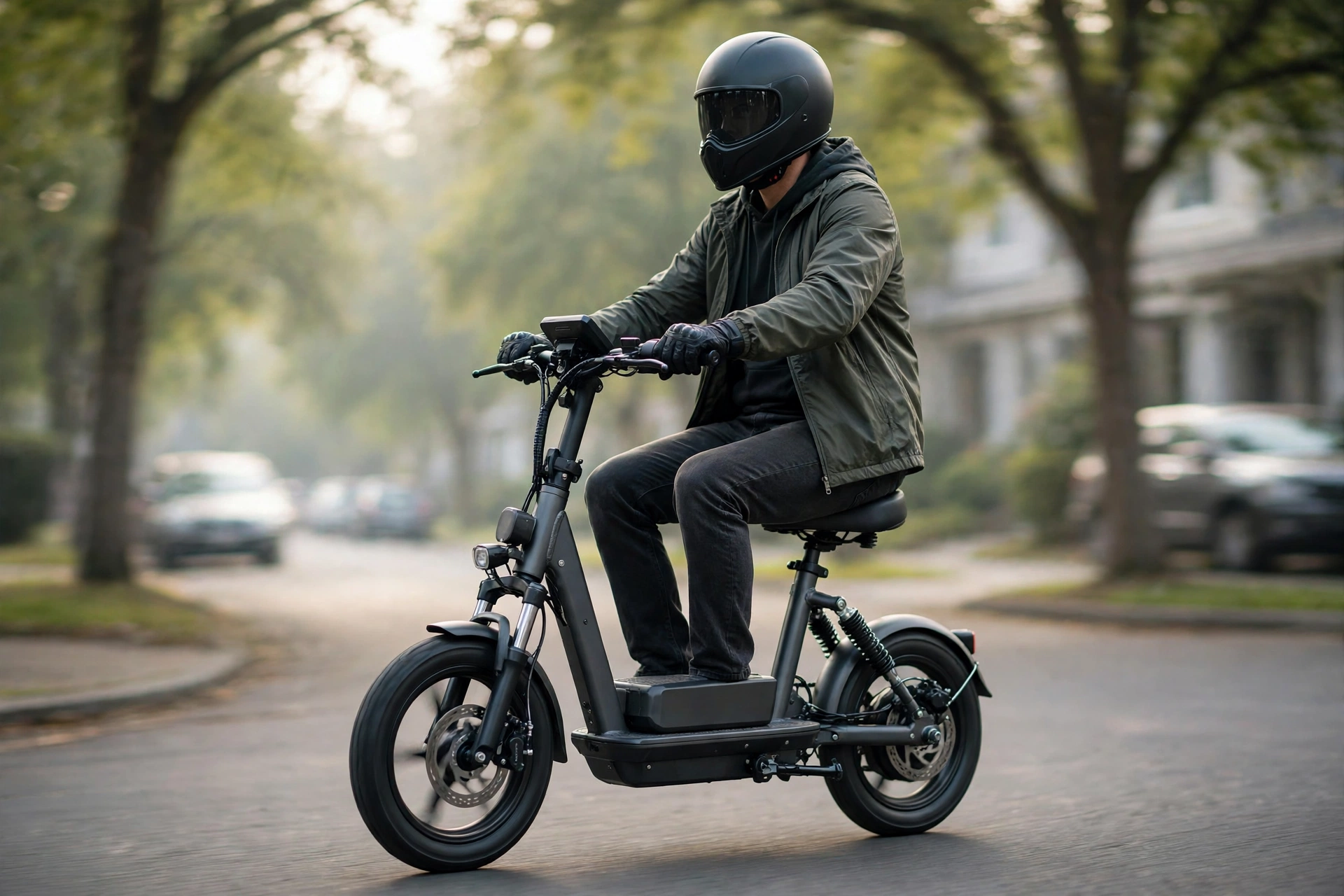
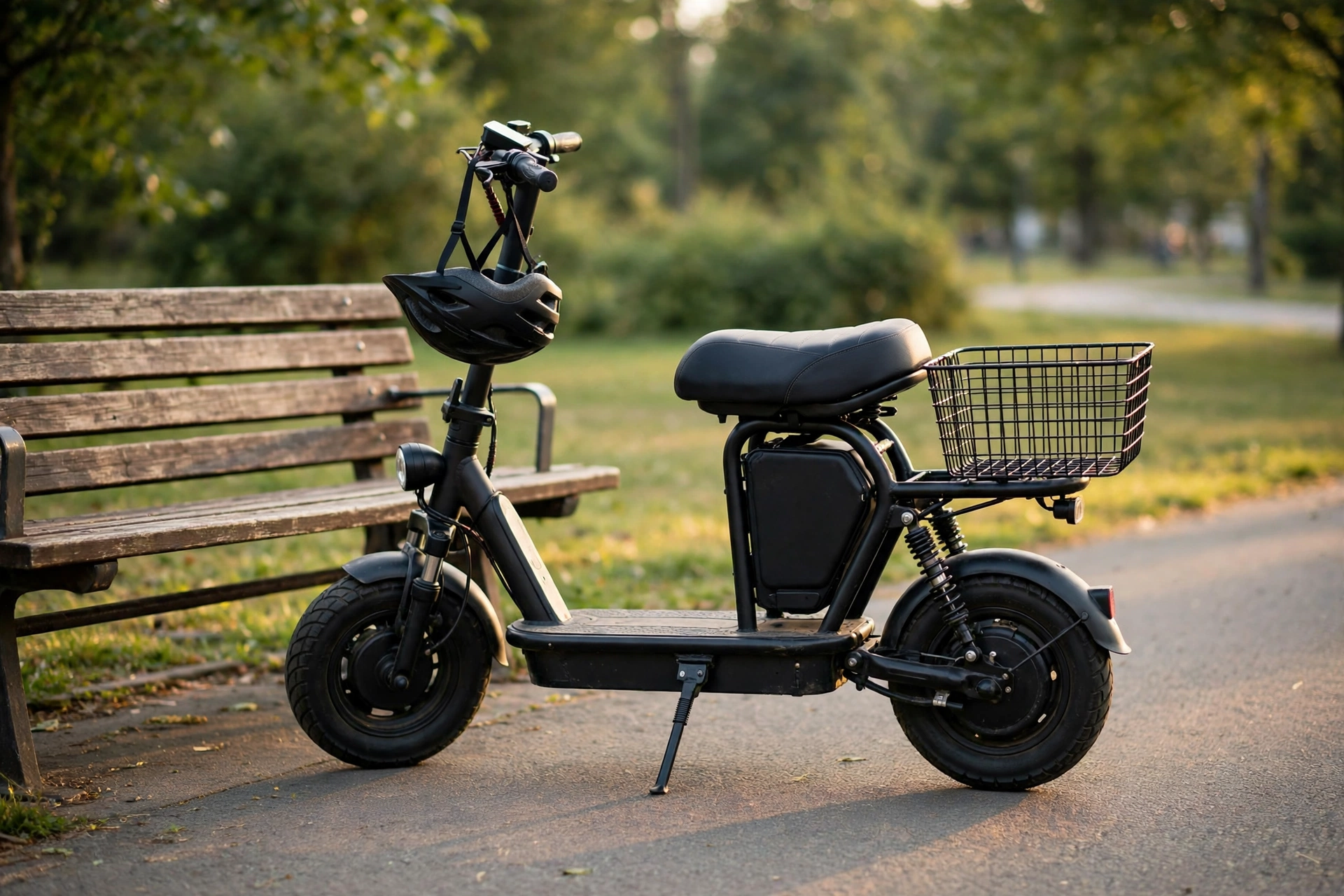
Segment two is the purpose-built sit down electric scooter for adults. The saddle is part of the frame design, the battery sits low between your feet or under the seat, and the wheels are usually 14 to 16 inches rather than the 8.5 to 10 inches of a standing scooter. Bigger wheels roll over cracked tarmac instead of dropping into it, which matters more when you cannot unweight your feet over a pothole. Storage baskets and racks are normal here, because seated riders use these machines for errands, not just the ride.
Segment three is the mobility-adjacent seated scooter: three wheels, a captain’s chair, armrests, electromagnetic brakes, sold by mobility dealers rather than scooter shops to people who cannot stand for a 20-minute ride. They are also not the same purchase as a four-wheel medical mobility scooter fitted through medical channels — a distinction drawn carefully below, because confusing the two wastes money in both directions.
Route one: a sit down electric scooter for adults built from a standing scooter and a proper seat
Segway Ninebot Max G2 plus the Segway saddle seat — the sensible default
The Max G2 is the strongest base scooter in this segment: a 450W rear motor with 1,000W peak output, a 551Wh battery, front hydraulic and rear spring suspension, 10-inch self-healing pneumatic tyres, and a front drum brake paired with a rear regenerative brake. Segway claims up to 43 miles. Independent testers measured less, as they always do: Rider Guide recorded 26.6 miles on its range loop, TechGearLab measured 34.4 miles of effective range, and braking from 15 mph took 11.7 feet in eRideHero’s instrumented test.
Segway sells its own saddle seat for the Max G2, with an integrated storage case, for around $109 (est. — US street pricing varies by retailer; EU stock lists at $109). Buy that seat, not a universal one: it mounts where the frame expects the load. Add the $699 scooter and the all-in seated price is $808, the benchmark every other pick here has to beat.
Ridden seated, the G2’s limits show in two places. The drum brake is gentle and maintenance-free, and 11.7 feet from 15 mph is adequate rather than strong; a seated rider cannot throw weight rearward to help it. And the 10-inch wheels demand respect at kerb cuts. Within those limits it is a composed, thoroughly engineered machine. Owners of the closely related G30P will find the full breakdown in our Segway Ninebot Max G30P complete guide.
Our score: 8.6/10 — Brakes & stability: 7.5/10 · Comfort: 8.5/10 · Value: 9.0/10
The Dualtron-class alternative, and the clamp-on warning
At the performance end, Minimotors makes a factory seat for Dualtron models including the Dualtron X, at around $196 to $206 through parts channels (est.). A big Dualtron on its proper seat is a serious machine with hydraulic brakes to match — and some trims are 60-mph-capable, which is motorcycle territory for licensing.
The warning bears repeating. A clamp-on seat introduces a tall, loaded pivot point the scooter was never engineered around; under emergency braking the post becomes a lever working against two small bolts. Fit the manufacturer’s seat or buy a scooter born seated. There is no third option worth your collarbone.
Born seated: the purpose-built sit down electric scooter for adults
EMOVE RoadRunner V3 — the brake benchmark, with a legal bill attached
The RoadRunner V3 is the machine this sit down electric scooter for adults category is measured against. Two 500W motors, a 48V battery of 1,124Wh certified to UL 2849, hydraulic front suspension, 14-inch tubeless tyres, and XTECH hybrid hydraulic brakes on 180mm rotors. The full specification is on the EMOVE RoadRunner V3 product page at Voro Motors. Claimed performance is 34 mph and up to 50 miles. At $1,695 it is not cheap. It does not need to be.
Electric Scooter Guide’s instrumented testing, set out in its EMOVE RoadRunner V3 review, found a tested top speed of 36.4 mph, a tested range of 32.8 miles, and a braking distance of 10.2 feet from 15 mph — the shortest stop recorded for any scooter in this guide.
Now apply the arithmetic that governs every brake on this page. Braking distance grows with the square of speed. Multiply 10.2 feet by (36.4 ÷ 15)², which is 5.89, and the same brakes need roughly 60 feet to stop this scooter from its tested top speed (est., from the physics of kinetic energy). Excellent brakes. A long stopping distance anyway. Ride it at the speed its brakes can answer for.
Legally, the V3 has no pedals as standard and at 34 mph plus it exceeds every US e-bike class — the full classification problem gets its own section below. Where it can be registered and ridden as the moped-class machine it is, it is the best seated scooter here. Where it cannot, an honest buyer prices it as a 28-mph machine with headroom.
Our score: 8.9/10 — Brakes & stability: 9.0/10 · Comfort: 9.0/10 · Value: 8.5/10
Gotrax Flex — the budget seated commuter, honestly limited
The Flex, a sit down electric scooter for adults, takes the opposite approach: a 400W motor, a 36V 7.8Ah battery of 280.8Wh, a 15.5 mph top speed, 14-inch pneumatic tyres, dual rear suspension and a rear basket. Gotrax claims up to 18.6 miles; its own manual says 16; plan on 12 to 14 miles (est., applying the two-thirds derating independent tests of this class consistently produce). Street prices run roughly $399 to $499 by variant (est., checked October 27, 2026).
The brakes are dual drums. Drums are sealed, weatherproof and kind to maintain, and they are also the weakest hardware in this guide, with long, soft lever travel and modest bite. At 15.5 mph on a light machine that is acceptable. It would not be acceptable at 25 mph, and Gotrax was right to keep this scooter slow. The seat is wide, the deck is wide, and the whole machine weighs about 46 lb (est.), light enough to carry up a flight of stairs. For short, flat, slow errands it earns its place. Hills are its documented weakness.
Our score: 6.8/10 — Brakes & stability: 5.5/10 · Comfort: 7.5/10 · Value: 8.0/10
Razor EcoSmart Metro — comfortable, proven, and running on yesterday’s battery
The EcoSmart Metro has been on sale for over a decade, the most proven sit down electric scooter for adults design here: a 500W chain-drive motor, 16-inch bicycle-size pneumatic tyres, a bamboo deck, a padded seat and a luggage rack, at an MSRP of $859.99 on Razor’s own store. It is genuinely comfortable. It is also built around a 36V sealed lead-acid battery, claims only 12 miles, and stops with a single hand-operated rear brake.
Real range on lead-acid, which should never be discharged deeply, works out near 8 to 10 miles (est.). One rear brake is the weakest braking layout in this guide. In 2026, $860 for lead-acid chemistry and one brake is not a price this guide can defend, however pleasant the ride. Buy it discounted under $500 as a neighbourhood runabout, or do not buy it.
Our score: 5.9/10 — Brakes & stability: 4.5/10 · Comfort: 8.0/10 · Value: 5.0/10
The legal line: when a seated scooter becomes an e-moped
Classification follows speed, power and pedals — never the presence of a seat on a sit down electric scooter for adults, and never the word the retailer chose. The NIU UQi GT marks the line clearly. It pairs a Bosch hub motor of roughly 1,500W with a 48V battery of about 2,016Wh in US trim, disc brakes with combined braking, and a 28 mph top speed. It has no pedals. In most US states that combination is a moped: it needs registration, a licence or endorsement in many jurisdictions, and it has no business in a bike lane. Ridden on those terms it is a fine urban vehicle. Ridden on bicycle terms it is unregistered, uninsured and illegal.
Applied to this guide’s picks, the split is clean. The Gotrax Flex at 15.5 mph and the Max G2 at 22 mph fall inside typical scooter limits in most states, though some cities cap scooters at 15 mph. The RoadRunner V3 at 34 mph plus does not, and its optional pedal kit moves the pedals question, not the speed question — a bolt-on kit does not reclassify a 1,000W machine with a 36 mph tested top speed.
Three consequences follow. A seated scooter classed as a moped usually cannot use sidewalks or multi-use paths at all. An unregistered moped in a collision can void the rider’s position with insurers regardless of fault. And resale collapses: a machine that cannot legally be ridden where the buyer lives is worth a fraction of its specification sheet. Check state and city rules before paying for speed. The check costs ten minutes. The mistake costs the whole purchase.
A sit down electric scooter for adults who cannot stand the ride standing up
For some riders the seat is not a preference. Bad knees, balance disorders, recovering injuries and simple fatigue make a standing scooter impossible over any distance. These machines look different because the job is different: three wheels so balance at walking pace is a non-issue, a captain’s chair with armrests, a tiller instead of handlebars, and electromagnetic brakes that engage when the throttle is released — the correct philosophy for a rider who may not be able to squeeze a lever hard.
EWheels EW-36 — the fast end of mobility-adjacent, bought on mobility terms
The EW-36 is the reference point: a three-wheeler with a 500W brushless motor, a 48V sealed lead-acid system of about 960Wh, 16-inch pneumatic tyres, full suspension, a 350 lb capacity and a weight of roughly 215 lb. EWheels claims up to 43 miles; top-speed figures in listings disagree, ranging from 12 to 18 mph (est.). On lead-acid, plan on 25 to 30 miles of real use (est., derating the claim as mobility dealers themselves advise). Typical mobility-retailer pricing sits near $2,599 (est., checked October 27, 2026).
Judged as mobility equipment, it scores well: the electromagnetic brake is the right hardware, the seat is the best in this guide by a wide margin, and stability at car-park speeds is total. Judged as transport, 215 lb means it does not fold into a car boot without a lift or ramp. The first judgement is the one that matters for its buyer.
Our score: 7.2/10 — Brakes & stability: 7.0/10 · Comfort: 9.5/10 · Value: 6.0/10
Now the distinction that saves real money. If a clinician has identified a medical need for powered mobility, the correct purchase is usually a four-wheel mobility scooter — a Pride or Drive Medical class machine at 4 to 6 mph — bought through durable medical equipment channels, fitted to the user, and serviced locally. Some of those purchases attract insurance support; a recreational three-wheeler bought online does not. A rider who simply cannot stand for long, with no medical-device requirement, should not be sold a 4-mph medical scooter either. Two different problems. Two different shops. Anyone who blurs them is selling, not advising.
The arithmetic: what each tested mile costs
Claims are cheap; tested miles are the currency. Divide the purchase price of a sit down electric scooter for adults by its independently tested range and the category sorts itself. Where no independent test exists, the estimate and its basis are shown instead of hidden.
Ninebot Max G2 plus factory seat: $699 + $109 = $808, ÷ 26.6 tested miles = $30 per tested mile. Gotrax Flex: $449 (est.) ÷ 13 miles (est.) = $35 per mile. EMOVE RoadRunner V3: $1,695 ÷ 32.8 tested miles = $52 per tested mile. Razor EcoSmart Metro: $860 ÷ 9 miles (est.) = $96 per mile. EWheels EW-36: $2,599 (est.) ÷ 28 miles (est.) = $93 per mile.
Energy tells the same story for a sit down electric scooter for adults. The RoadRunner consumed 1,124Wh over 32.8 tested miles: 34.3 Wh per mile, the price of two motors and 36 mph. The Max G2 used 551Wh over 26.6 tested miles: 20.7 Wh per mile. A seated position does not by itself waste energy — the G2’s figures were recorded standing, and a saddle adds little drag at 20 mph. Power and speed waste energy. Choose them knowingly. Our breakdown of how much it costs to charge an electric bike applies the same per-mile method across the wider category, and any aftermarket electrical accessory is worth running against the EV charger compatibility checker first.
Brakes, suspension and gear: the non-negotiables
Hardware first. A sit down electric scooter for adults needs two independent brakes, and at least one of them should be a disc. Drum plus regenerative, as on the Max G2, is the acceptable minimum at speeds under 25 mph. A single rear brake, as on the EcoSmart Metro, is a design from a slower decade. Suspension matters more seated than standing, because your legs are no longer the second stage of it: rigid-fork seated scooters on 10-inch wheels punish spines on broken tarmac. Tyre size is the third leg of the stool — 14 inches and up is the comfort threshold.
Gear is not a suggestion on a seated machine, because a seated rider goes over the front or off the side rather than stepping clear. A full-face helmet is the correct choice above 20 mph; the chin bar exists for the face-first departure a seated crash produces. Below 20 mph a certified bicycle helmet is the floor, never the ceiling. Gloves and closed shoes complete a kit that costs less than one emergency-room deductible. The braking and suspension hardware on the standing machines in our Kaabo King GTR explained guide shows where the performance end of this engineering leads, and the discipline is identical: brakes first, speed second.
Setup takes ten minutes. Set the saddle so your knee keeps a slight bend with your foot flat on the platform. Confirm both brake levers fall under your fingers without stretching. Practise one hard stop from 15 mph in an empty car park before your first commute, seated, so the weight transfer is familiar rather than surprising. Our standards for every figure in this guide are set out on the how we research page.
Frequently asked questions
What is the best sit down electric scooter for adults for a daily commute?
The Segway Ninebot Max G2 with Segway’s own saddle seat, at about $808 all in: the longest affordable tested range here — 26.6 miles in Rider Guide’s testing — with suspension at both ends and a 22 mph top speed that stays legal in most jurisdictions. Riders with a legal route for higher speeds and a bigger budget should step up to the RoadRunner V3.
Can I add a seat to any standing scooter?
No, and the distinction is mechanical, not commercial. Fit a seat only where the manufacturer offers one for that exact model, because the mounting points and deck were load-tested for a seated rider’s weight working through a post. Universal clamp-on seats were not tested on your scooter at all. On models with no factory seat option, the correct answer is a different scooter.
Are seated electric scooters legal on bike paths?
Only the slow ones, and only sometimes. A sit down electric scooter for adults limited to typical e-bike speeds is treated like an e-bike or standing scooter in many states, while anything faster without pedals falls into moped law and off the path entirely. City rules sit on top of state rules and can be stricter. Verify both layers for the exact model you are buying, because classification follows the machine, not the rider’s intentions.
How much range will I actually get?
Apply two-thirds to the claim, then check whether an independent test exists. Here the tested figures are 26.6 miles for the Max G2 and 32.8 miles for the RoadRunner V3, against claims of 43 and 50 — a consistent ratio across brands. Seated riding itself costs little range; speed, rider weight, hills and cold cost a great deal.
Is a mobility scooter the same thing as a seated electric scooter?
It is not. A four-wheel medical mobility scooter is a fitted medical device, typically 4 to 6 mph, bought through medical equipment channels with matching service and possible insurance support. A mobility-adjacent three-wheeler like the EW-36 is faster recreational transport for people who cannot stand for long. Buy from the channel that matches the need, and be suspicious of any seller who treats the two as interchangeable.
In short, a sit down electric scooter for adults is worth buying only when its brakes, wheels and legal class match how you will actually ride it. Choose on those terms, and a sit down electric scooter for adults will feel stable, practical and easy to live with, rather than simply fast on paper. That is the right way to choose a sit down electric scooter for adults.