Last updated: October 27, 2026
Every repair story starts the same way. A light. A chime. A message written in engineer-speak: “Drive system fault — service required.” Before you panic, translate it. That message means the car has logged a fault code, stored the conditions around it, and flagged a system for inspection. It is a report, not a death sentence. And long before that light ever appears, anyone shopping for an Air or a Gravity should understand what a lucid certified repair center actually is, because the phrase misleads almost everybody who reads it.
Here is the calm version. The car records nearly everything: battery cell behaviour, drive unit temperatures, door handle retries, the exact second a sensor disagreed with its neighbour. When something breaks, the fix rarely starts with a spanner. It starts with somebody reading those logs properly. The real question at purchase time is not whether a Lucid will ever log a fault. It will. Every complex car does. The question is who can read the report, who is allowed to order the part, and how far away that person sits from your driveway. This guide works through seven things, in the order a diagnostician would check them. What the certified label really means. Which network handles body damage and which handles mechanical faults. What the warranty pays for and when the meter switches to your wallet. What the mobile van can fix at your house. Then the arithmetic nobody runs at the showroom: the true yearly cost of living a long way from help.
One clarification up front, because it shapes everything else. Lucid runs two separate systems that owners constantly merge into one. Company-run Lucid Service Centers handle mechanical, electrical and software work. Collision and body repairs go to independent shops admitted to Lucid’s body repair program. Different doors, different rules, different waits.
And the network is small. When Lucid opened its Rutherford, New Jersey facility in 2026, the company counted 43 permanent locations across all of North America — with 15 studios and service centers in California alone. That concentration is the single most important fact in this article. A Lucid is a California-dense car wearing a national badge, and your ownership experience will be shaped by your distance from that cluster.
1. A lucid certified repair center is a body shop, not a Lucid Service Center
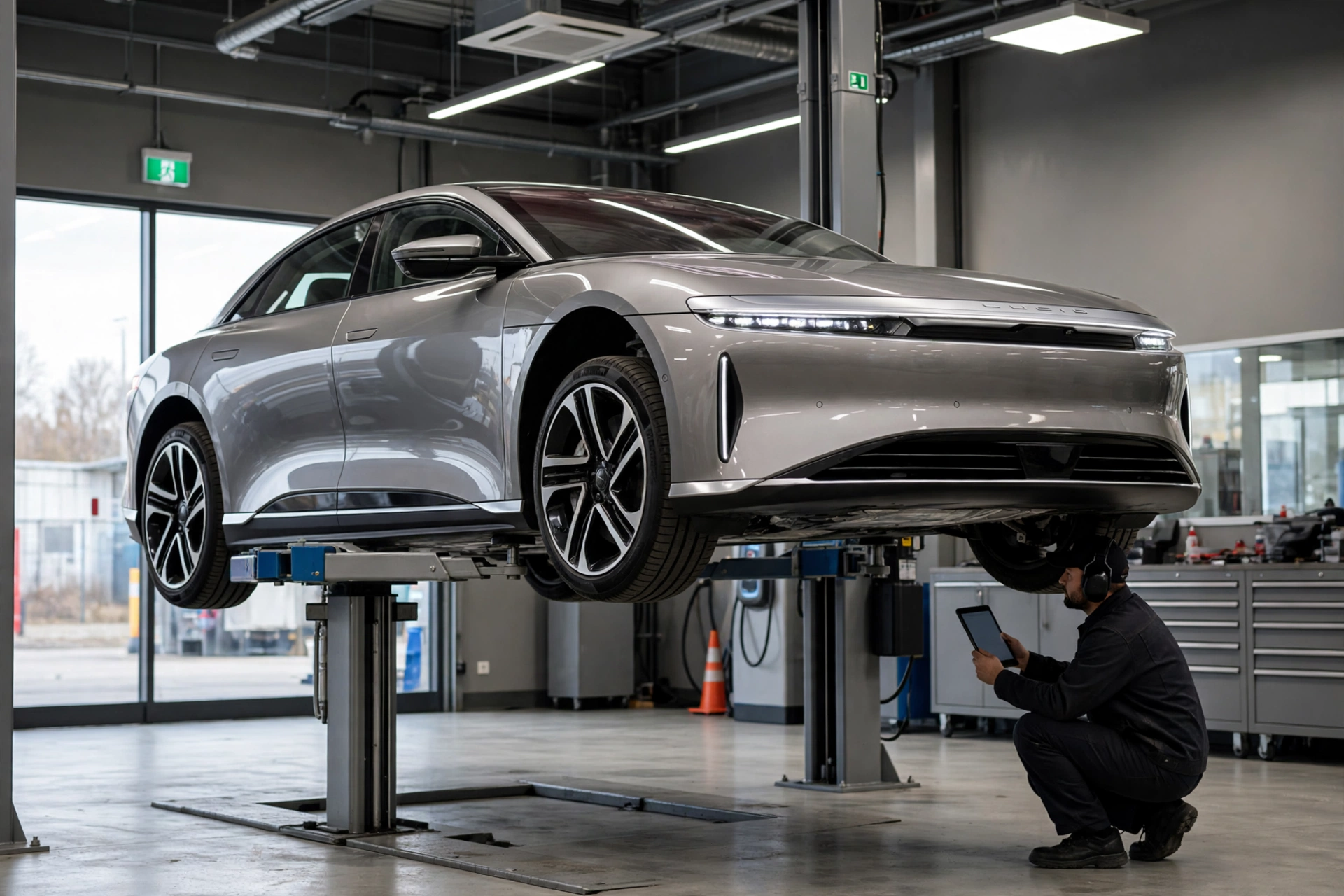
Start with the name, because the name is where the confusion lives. Lucid’s own paperwork calls the collision network the Lucid Approved Body Repair Program. Entry is invitation-only: Lucid selects independent body shops, trains their technicians, and grants them access to factory repair procedures and restricted parts. The shops themselves market the credential as “Lucid Certified Collision Center,” which is how the phrase lucid certified repair center entered everyday owner language. Same network, two labels, one official.
Reporting on Lucid’s first company-owned body and paint center in Riyadh noted that outside the Middle East, Lucid shares its body repair information with collision shops only through this invitation-only Lucid Approved Body Repair Program. Invitation-only matters. Your favourite independent body shop, however skilled, cannot simply apply, pay a fee and join. If Lucid has not invited them, they sit outside the fence — and, as the next section shows, outside the parts catalogue too.
Mechanical and electrical work is a different door entirely. Drive units, battery packs, suspension, software faults, warranty claims: those go to a Lucid Service Center, staffed by Lucid’s own technicians, or to a Lucid mobile technician. A certified body shop cannot clear a powertrain fault code for you, and a service center is not where you send a crumpled rear quarter panel. Knowing which door your problem belongs to saves you the most common owner error — booking the wrong network and losing two weeks to a redirect.
Lucid trains its collision technicians centrally; its body repair program runs its instructor hub out of the Millbrae, California service center. That detail tells you how seriously the company guards structural repair quality on an aluminium-intensive car. It also tells you capacity is finite. Training pipelines do not scale at marketing speed.
2. What “certified” actually covers: procedures, parts and calibration
Strip the badge down to its working parts and certification buys three things. First, procedures: the factory method for sectioning an aluminium panel, bonding a replacement, and protecting the battery enclosure during structural work. Second, parts: certified shops can order structural and safety-related components that Lucid simply will not sell to an uncertified shop. Third, calibration: after body work, the cameras and sensors behind DreamDrive need documented recalibration, and the shop’s sign-off is what makes that calibration count.
The parts restriction is the one that bites owners hardest, and owner forums carry the receipts. One Air owner with minor trunk damage reported that his insurer’s chosen shop — a business he had used for thirty years — was refused parts because it was not a certified Lucid shop, turning a simple repair into a two-hour relocation problem. Read that story as a policy document. It is not spite. A high-voltage car with a structural battery enclosure is the wrong place for improvisation, and Lucid has chosen control over convenience, every single time.
My position, stated plainly: for anything structural, anything touching the battery enclosure, anything involving sensor calibration, the certified route is the only defensible choice. The restriction is a safety feature wearing an annoying disguise. Where it genuinely overreaches is cosmetic work — a mirror cap, a scuffed bumper skin — where a competent independent could finish the job in days. Lucid makes no such distinction, and owners pay for that rigidity in time.
So what does a lucid certified repair center charge? Collision work is almost always insurance-billed, priced from the same estimating databases every body shop uses, with Lucid-specific procedures and parts priced at factory list. Out-of-pocket cosmetic repairs at certified shops tend to land where other luxury-brand certified shops land (est., based on comparable certified-program rates published by insurers). The bill rarely shocks. The calendar does.
3. The warranty clock decides who pays — read it before you buy
Forget the badge for a moment and read the clocks, because the clocks decide everything. Lucid’s New Vehicle Limited Warranty, checked October 27, 2026, runs like this:
- Basic vehicle: 4 years / 50,000 miles
- Powertrain (drive units, transmission, differential): 8 years / 100,000 miles
- High-voltage battery: 8 years / 100,000 miles, warranted to retain 70% capacity
- Corrosion perforation: 10 years / unlimited miles
- Body and paint defects: 4 years / unlimited miles
- Restraint system (SRS): 5 years / 60,000 miles
Translate those numbers into workshop language. A failed rear drive unit at 30,000 miles — a case owner press has documented twice on the same Air Touring inside three months — is a powertrain claim. Lucid pays. The same failure at 110,000 miles is your money, and a drive unit is not a four-figure problem you shrug off. The battery line deserves equal attention: capacity loss is warranted against a 70% floor for eight years, and our guide to how EV battery warranties and degradation actually work walks through what that floor means in daily range. If you are pricing a used Air, run its pack size and age through our EV battery replacement cost estimator before you negotiate, not after.
Two more clauses owners miss. Damage caused by a Lucid over-the-air update is covered during the warranty period — significant, on a car whose behaviour changes overnight by software. And recalls sit outside the warranty entirely: a safety recall repair is free at a service center whether the car is two years old or twelve. Lucid’s Gravity second-row seat anchor recall covered 4,476 SUVs; every one of those repairs is on Lucid’s account, not the owner’s.
Scheduled maintenance softens the early years further. Lucid Care scheduled maintenance is included for the first two years or 24,000 miles at no extra cost on a new purchase or lease. Inside the warranty window, then, a lucid certified repair center or service center visit should cost you nothing except time. Hold that sentence. Time is where the bill hides, and section 5 does that sum properly.
4. Mobile service: the van that reads the car first
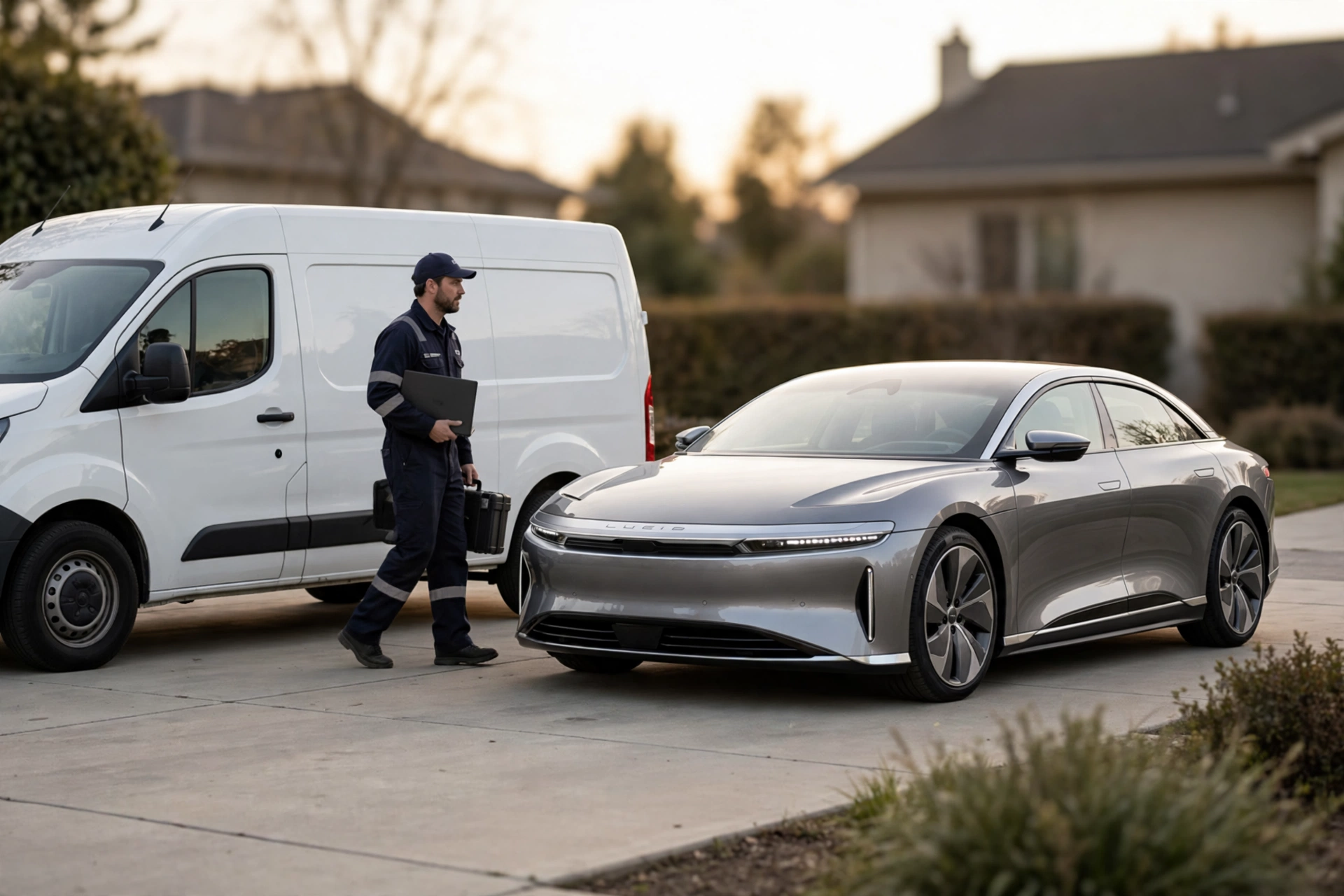
The strongest part of this whole system never appears in the brochure headline. Lucid’s service and care page describes its Mobile Service platform plainly: technicians perform a wide range of procedures at your home or workplace. In practice that means software diagnosis, trim and handle faults, 12-volt battery work, sensor checks, many of the small electrical gremlins that generate the scariest dashboard messages. The van arrives with the laptop, the parts most likely to be needed, and a technician who has already seen your car’s uploaded logs.
That last point is the diagnostician’s delight. Before the visit, the car has usually already told the network what it thinks is wrong. The technician’s job becomes verification, not archaeology. Compare that with the old ritual: drive to a workshop, describe a noise that refuses to perform on cue, collect a verdict of “could not replicate.” Remote log reading kills half of that theatre.
Know the limits, though. Mobile service works within a coverage radius of a service hub, and it cannot lift a car, drop a battery pack, swap a drive unit or straighten structure. Those jobs route to a service center, full stop. When you book through the Lucid app — self-scheduling lets you pick your preferred center and a drop-off time — the system triages: van if the fault allows it, center if it does not. Ask, before you sign for the car, whether your address sits inside mobile range. That one answer redraws your ownership map.
5. The 150-mile problem: what distance from a lucid certified repair center really costs
Now the arithmetic. Take an owner 150 miles from the nearest service center — unremarkable in Texas, the Mountain West or the Midwest. Assume no loaner pickup is offered, so each center visit means driving there twice: once to drop off, once to collect.
- One visit = 2 round trips = 4 × 150 = 600 miles, roughly 10 hours of driving
- Assume 3 center visits a year (one scheduled, two fault-driven; owner forums suggest this is a fair planning figure, est.): 3 × 600 = 1,800 miles a year
- Energy: 1,800 miles ÷ 4.0 miles per kWh (est., real-world mixed driving) = 450 kWh × $0.16 per kWh home charging (est.) = $72
- Wear and depreciation: 1,800 × $0.55 per mile (est.) = $990
- Your time: 30 hours × $25 an hour (est.) = $750
- Total hidden distance cost: about $1,812 a year (est.)
Run the same sum for an owner 25 miles out and the total collapses to roughly $300 a year. Six times less. Same car, same warranty, wildly different ownership cost — and none of it appears in any lease quote. Our breakdown of the real cost per mile of running an electric car uses the same per-mile method if you want to rebuild the sum with your own numbers and your own distance.
Distance also compounds delay. A part on back-order costs a nearby owner an extra trip. It costs the 150-mile owner an extra 600 miles and another day of logistics — or a rental car while the Lucid sits. When a lucid certified repair center or service center quotes you a wait, multiply it by your map before you decide how annoyed to be.
6. Waits, queues, and the sentence Lucid’s own chief executive said out loud
Calm, again, and factual. Owner-reported waits in 2026 are long at several locations: a Denver owner told the Lucid owners forum in October 2026 that diagnosis alone was quoted at nearly 90 days; a Houston owner reported two months to get an appointment, then three and a half weeks with the car in the shop; another Air sat seven weeks in a service queue. Treat these as owner reports from specific centers, not network-wide averages — waits vary sharply by location, and some centers run close to on time.
The seven-week case carries its own quiet sum. A Gravity payment around $1,500 a month (owner-reported) across seven weeks in a queue works out to roughly $2,400 paid for a car standing still (est.). Loaners soften that — owners frequently report a Lucid loaner or an Enterprise-supplied luxury rental — yet a loaner is a mitigation, not a repair.
Credit where the record supports it: Lucid’s leadership has stopped pretending. Its chief executive told analysts the company had “under-invested in service” and “responded too slowly to quality issues,” and the network is still adding locations — San Jose, San Diego and Rutherford among the recent openings. A company naming its own failure is easier to trust than one hiding it. The honesty does not shorten next month’s queue, though. Buy on the network that exists today, not the one in the press release.
7. Read the map before you read the brochure
So, the buying advice, reduced to checks you can finish in one evening. Open Lucid’s locations map and measure your real distance to the nearest service center — door to door, not as the crow flies. Ask the studio, in writing, whether your home address is inside mobile service range. Ask which certified body shop serves your region and how far that is. Then ask current local owners, in the forums, what the actual appointment wait is at your specific center this quarter. Global averages will lie to you politely; your center’s calendar will not.
My verdict on distance is not diplomatic. Inside roughly 75 miles of a service center, with mobile coverage at your address, buy the car and enjoy it — the warranty is generous, the diagnostics are genuinely modern, and the certified collision network does careful work. Beyond 150 miles with no mobile coverage, I would not buy new today, however much the car appeals. The engineering is not the risk. The geography is. Our wider comparison of EV range, charging and ownership costs makes the same point from the running-cost side.
Used buyers get one extra check. A three-year-old Air with 40,000 miles carries the balance of that 4-year basic warranty and years of powertrain cover — good. Confirm the balance in writing, confirm the car has no accident history that routed repairs outside the certified network, and have a service center run a full diagnostic scan before money moves. The scan takes an hour. It is the cheapest certainty in the entire transaction.
Our verdict on the lucid certified repair center network
Our score: 6.5/10
- Coverage: 6/10 — genuine factory control over structural and high-voltage repair, a thin map of roughly 43 North American locations (est.)
- Convenience: 6/10 — mobile service and app scheduling are excellent where they reach; queues at busy centers are not
- Cost: 8/10 — long powertrain and battery clocks, included early maintenance, free recall work; distance is the real charge
The system behind the lucid certified repair center label is well designed and honestly run. It is also small, and small networks turn every fault code into a logistics exercise. Buy the car with your eyes on the map and the ownership maths works. Buy it on the brochure alone and the first warning light will teach you this article the expensive way.
lucid certified repair center questions, in plain English
Is a lucid certified repair center the same as a Lucid Service Center?
No. A Lucid Service Center is run by Lucid and handles mechanical, electrical, software and warranty work. A lucid certified repair center is an independent body shop admitted to Lucid’s invitation-only Approved Body Repair Program for collision and structural work. Different networks, different booking routes.
Can my local independent shop order Lucid parts?
For many structural and safety-related parts, no — Lucid restricts those sales to its service centers and certified body shops, and owners have been refused parts for exactly this reason. Consumables and some cosmetic items circulate more freely. If the repair touches structure, the battery enclosure or sensors, plan on the certified network from the start.
What does the warranty actually pay for at a service center?
Defects in materials or workmanship: 4 years/50,000 miles for the basic vehicle, 8 years/100,000 miles for the powertrain and the battery (to a 70% capacity floor), 10 years for corrosion perforation. Damage caused by a Lucid software update is covered during the warranty period, and safety recall repairs are always free, whatever the car’s age.
Does mobile service cost extra?
Mobile visits follow the same billing logic as center visits: warranty faults are covered inside the warranty window, and scheduled maintenance is included for the first two years or 24,000 miles on a new Lucid. Outside warranty, you pay for the repair itself. The saving is your travel, not the labour rate.
My nearest center is 200 miles away. Should I still buy an Air or Gravity?
Only with mobile service coverage confirmed at your address and a loaner arrangement you have seen in writing. Without those two, our maths says distance will cost you roughly $2,400 a year in travel, wear and time (est., scaled from the 150-mile calculation above) — before the first queue. At that point the honest answer is to wait for the network, or buy a brand whose map already includes you.