Last updated: October 27, 2026
Every charge you will ever do at home gets timed by one device, and it is not your car. It is the electric meter on the side of your house. That grey box decides what each kilowatt-hour costs, whether your off-peak window even exists, and whether the number on your bill matches the number in your charging app. Ignore it and you are racing without a timing sheet. Read it properly and home charging turns into the cheapest lap you will ever run.
Here is the blunt version up front. Most EV owners need nothing new from the meter itself. The meter belongs to your utility, and if it is too old to record when you used power, the utility swaps it — usually on their dime. The money questions sit around it: which rate the meter feeds, whether a second meter for the car ever pays back, and how to pull a real cost figure off the display instead of trusting an app estimate.
Think of it as three splits. Split one: what your meter can measure. Split two: what your tariff does with those measurements. Split three: what you verify with your own two eyes. Nail all three and the average driver keeps hundreds of dollars a year that sloppy timing gives away.
This guide works through each split in order. What an electric meter records. Why a smart meter and a spinning dial are not in the same race. How time-of-use windows turn the same electrons into cheap ones or expensive ones. When a dedicated EV meter makes sense, when a sub-meter is the smarter tool, and the two-minute reading routine that tells you exactly what last night’s charge cost.
No guesswork. Numbers on the table, arithmetic shown, and the gimmicks called out. Prices and program details were checked October 27, 2026, against utility tariff pages and federal data, and anything we could not confirm from an official source is marked (est.) with its basis.
Your electric meter is the stopwatch for every charge
A meter does one job: it counts kilowatt-hours. One kWh is 1,000 watts running for one hour. Your car sipping 7.7 kW from a wall charger for five hours takes 38.5 kWh, and the meter counts every one of them. Speed matters here. A Level 2 session is the biggest single load most houses ever pull, bigger than the oven, bigger than the dryer. The meter sees it all.
The difference between meter generations is resolution. An old dial meter records one running total, like an odometer. It cannot tell the utility whether those 38.5 kWh arrived at 2 p.m. or 2 a.m. A smart meter records in intervals — typically every 15 or 60 minutes — and reports those intervals to the utility daily. That timestamp is the whole game. Without it, time-of-use pricing is impossible, because nobody can prove when the energy flowed.
Smart meters also split the total into registers when a tariff needs it. On a time-of-use plan the display may cycle through period totals: peak kWh, off-peak kWh, sometimes a mid-peak bucket too. Those registers are your sector times. If the off-peak register climbs and the peak register sits still, your timing is clean. If both climb together, you are charging whenever you plug in and paying for the privilege.
One more capability worth knowing: interval data feeds the usage graphs in your utility app or web portal. That graph is the closest thing to telemetry a homeowner gets. A clean overnight charging block shows up as a flat-topped mesa between midnight and dawn. Spot that shape and you have proof, not vibes, that your schedule is working.
Smart electric meter vs the old dial: not the same race
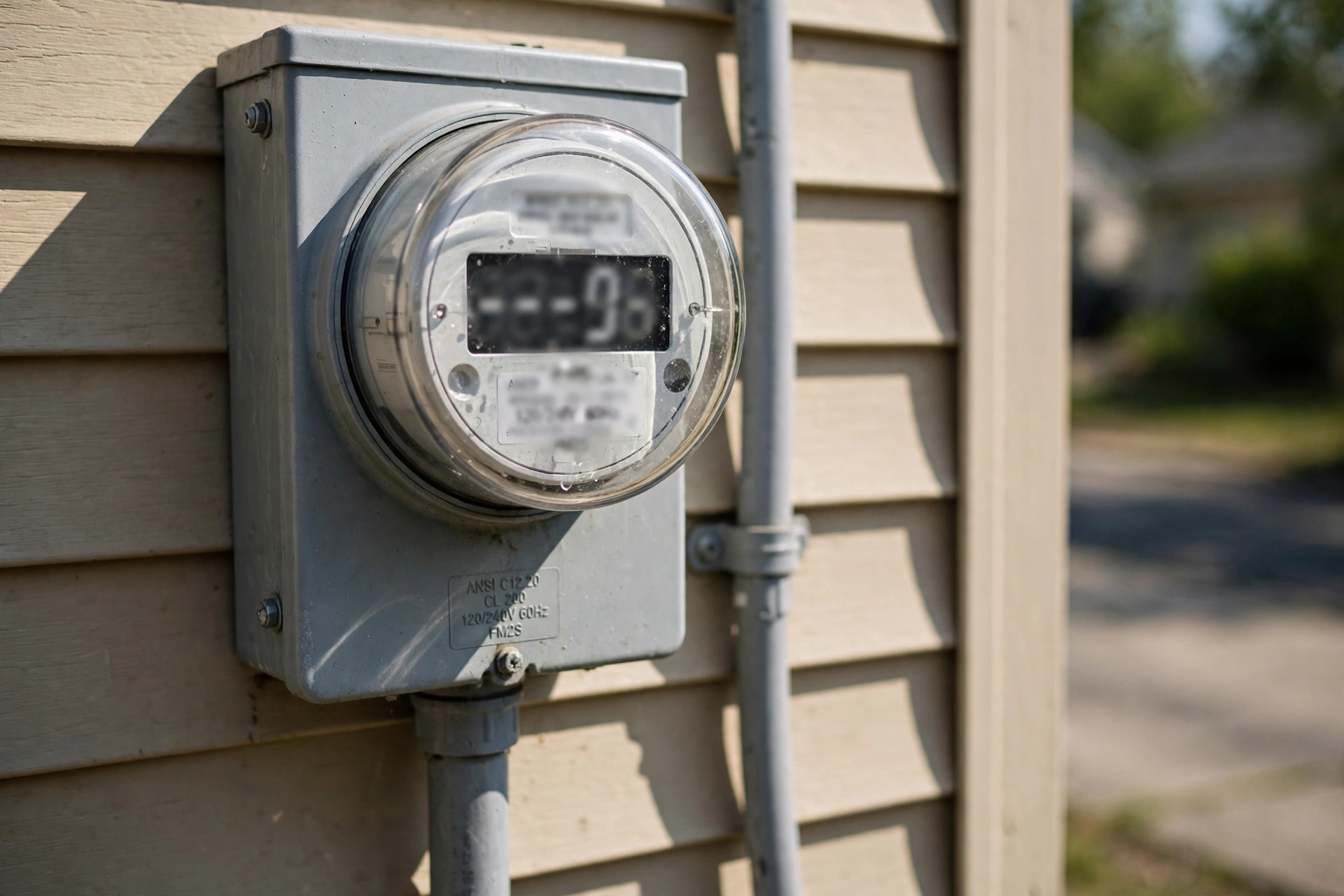
The rollout is already deep. The U.S. Energy Information Administration’s smart meter count puts advanced metering infrastructure at about 119 million installations, roughly 72% of all electric meters in the country, with about 73% of residential meters now smart. Odds are good your house is already covered. Check the meter face: a digital display cycling numbers means interval metering. Spinning aluminium disc and clock-style dials means analogue.
If you still have the dial, here is my position, no hedging: take the smart meter swap the moment your utility offers it. A dial meter in 2026 blocks you from every serious EV tariff, hides your usage until the bill lands, and gives you nothing in return. The swap itself is normally free because the meter is utility property and the upgrade serves their grid data as much as your bill. Some states let customers refuse and keep the old meter for a monthly opt-out fee, commonly $10–$40 (est., based on state opt-out schedules published by utilities). Paying a monthly fee to stay uninformed is the worst deal on this page.
Enrolling in a time-of-use EV plan with a dial meter triggers the swap automatically at many utilities. The utility needs interval data to bill the plan, so they book the exchange as part of enrollment, again normally at no charge to you. Ask one question on the call: “Is the meter exchange included?” If the answer is no, get the fee in writing before agreeing to anything, because third-party installers have quoted homeowners for work the utility does free.
Renters and condo owners, one caution. The meter account usually sits with the unit or the building, and the swap decision may not be yours. Your move is different: read the section on sub-meters below, because that is the tool built for your situation.
The rate clock: off-peak windows decide what a mile costs
Now the arithmetic, because this is where the meter earns its keep. Take a typical driver: 12,000 miles a year in a car using 0.30 kWh per mile, a normal figure for a midsize EV crossover. Annual charging energy: 12,000 × 0.30 = 3,600 kWh. Run that energy through three timing strategies.
Flat rate first. At $0.16 per kWh (est., close to recent U.S. residential averages published by the EIA), 3,600 × $0.16 = $576 a year. Simple. Predictable. Beaten.
Time-of-use, timed properly. Many EV plans price overnight energy near $0.09 per kWh (est., representative of overnight EV windows outside the highest-cost states). Charge inside the window: 3,600 × $0.09 = $324 a year. Saving against flat: $576 − $324 = $252 a year, $1,260 over five years, from changing nothing except when the car drinks.
Time-of-use, timed badly. Peak prices bite hard. PG&E’s EV2 tariff sheets in March 2026 put off-peak at about 22.6 cents and summer peak near 53.8 cents — a 31-cent spread on the same wires. At a $0.45 peak-heavy average, our 3,600 kWh costs $1,620. Versus the $324 disciplined figure, sloppy timing throws away nearly $1,300 a year in an expensive market.
Same car. Same miles. The only variable is the clock, and the meter is the clock’s scorekeeper. Our full breakdown of per-mile maths lives in this site’s work on the real cost per mile of an electric car, and the U.S. Department of Energy’s guide to charging an electric vehicle at home walks through the same cost-per-mile formula from the federal side.
Windows vary. Common patterns: midnight to 6 a.m., 11 p.m. to 5 a.m., or — on solar-heavy grids — a cheap daytime block like 8 a.m. to 4 p.m. Weekends are often off-peak all day. Your charger’s schedule feature or the car’s charge timer exists for exactly this. Set it once, verify on the meter registers after the first week, then stop thinking about it.
Does a home charger need an electric meter upgrade?
Short answer for most houses: no. The wall charger does not draw through some special meter pathway. It is a circuit on your panel, and the existing meter counts it like any other load. If your meter is already digital, there is nothing to upgrade for the charger’s sake. If it is a dial, the TOU enrollment swap above handles it.
Where quotes get fat is the panel and service, a different job that salespeople love to blur into “meter work.” A new meter base or socket runs $500–$1,500 (est., from typical electrician quote ranges checked October 27, 2026), and a full 100-amp to 200-amp service and panel upgrade runs $1,300–$3,000 (est., same basis), sometimes more with trenching. Those numbers buy capacity for the whole house, not a better count of your charging. Do not let anyone sell you a service upgrade as a metering requirement. Separate the two line items and price them separately.
Before paying for capacity, run the load maths. Our EV charger sizing calculator helps you match charger amps to the driving you actually do; a 32-amp charger overnight covers most households, and a load-management device that pauses charging when the house peaks can legally avoid an upgrade in many cases. Plenty of drivers also start by simply charging an electric car from a regular outlet while they plan — slow, yes, and completely meter-friendly, because 1.4 kW never stressed any panel built after the war.
The one genuine meter-side upgrade: capacity of the meter socket itself on very old services, where the utility requires a modern socket before they will fit a smart meter. That surfaces during the swap booking, the utility specifies the part, and your electrician fits it. Annoying, uncommon, and still not a reason to touch anything before the utility asks.
The second electric meter, timed: dedicated EV meters rarely win
Some utilities still offer a dedicated second meter that measures only the car. PG&E’s EV-B plan is the classic template: the whole house stays on its normal rate while a separate meter bills the EV on its own time-of-use schedule, with a small daily meter charge of about 5 cents, roughly $1.50 a month. Southern California Edison runs a friendlier variant, giving second-meter households a monthly credit that offsets the extra basic charge. The pitch sounds precision-engineered. Separate the car, bill the car, done.
Now time it like an engineer. The hardware catch: the utility supplies the meter, and you pay an electrician to install the second meter panel, socket and circuit. A California Public Utilities Commission commissioner put the separate-meter installation cost at up to $2,000 when the commission pushed utilities to drop the requirement. Call it $1,800 (est., mid-range electrician pricing for a second meter panel and circuit).
What does it buy that a whole-home EV rate does not? In most territories, nothing on price: the off-peak rate on the dedicated meter matches the whole-home EV plan’s off-peak rate. Your net extra gain is often just protection of the house’s other usage from peak pricing — worth maybe $20–$60 a year for a careful household (est.). Against $1,800, payback runs past 30 years. Even in the rosiest case, where the second meter unlocks a rate 2 cents cheaper on 3,600 kWh, the gain is $72 a year and payback is 25 years. The lap time does not lie. Skip the second meter.
The exception proves the rule: a second meter can pay when the utility — not you — funds the installation through a rebate or a managed-charging program, or when a rental or business use genuinely needs the car on a separate utility account. Everyone else gets the same timing data free, because California’s approach has spread: many utilities now accept the sub-metering built into smart chargers themselves for EV-only billing. The charger’s own counter, certified, does the second meter’s job with zero panel work. Our research method for claims like these is set out on our how-we-research page, because vendor brochures and tariff PDFs rarely agree on the first read.
Sub-meters: split timing for shared parking and landlords
Different tool, different job. A sub-meter is a private meter you own, wired on one circuit — usually the charger’s — downstream of the main meter. It never talks to the utility. It exists so two parties can split a bill fairly, or so you can watch one load in isolation.
Hardware is cheap and quick. A DIN-rail or inline sub-meter with a display runs $150–$400 (est., typical retail pricing checked October 27, 2026), plus an hour or two of electrician time to fit it on the charger circuit. Models with Wi-Fi logging cost more and earn it in shared setups, because both sides can see the same numbers. That shared visibility kills billing arguments before they start.
Who should buy one:
- Landlords providing a charger in a rented home or small multi-unit building, billing the tenant for actual kWh used.
- Tenants whose landlord agrees to charging in a shared garage, where the house meter serves several units.
- Roommates or family members splitting a driveway charger between two EVs.
- Anyone expensing home charging to an employer who wants a clean, dedicated record.
Two rules before money changes hands. First, check whether your sub-meter is revenue-grade — a certified accuracy class — because some jurisdictions only allow billing tenants from certified devices, and several states restrict reselling electricity above the utility rate. Second, agree the formula in writing: kWh from the sub-meter, multiplied by the household’s actual average rate, settled monthly. Fair, boring, final.
Reading your electric meter like a timing sheet
Final split: verification. Two minutes, once a month, and no app can gaslight you again.
Smart meter: stand at the display and wait for it to cycle. You are looking for the cumulative kWh screen — often labelled with the total, sometimes flicking between total and per-period registers. Write the number down, or photograph it, right before a charge starts and again when it ends. The difference is the energy the house used in that window. Do it on a quiet night with nothing else big running and the delta is your charge, within a whisker.
Worked example. Reading at plug-in: 18,204.1 kWh. Reading next morning: 18,242.3 kWh. Difference: 38.2 kWh. At your off-peak $0.09, that session cost 38.2 × $0.09 = $3.44. Compare the car’s app, which might claim 34 kWh delivered to the battery. The gap is charging loss — the meter counts what left the wall, the car counts what landed in the pack, and the missing 10% or so (est.) went to heat and conversion. The meter number is the one your bill uses, so the meter number is the truth.
Dial meter: read the dials left to right, taking the lower number whenever a pointer sits between two, and remember some dials rotate in opposite directions. Honestly? If you are still doing dial arithmetic in 2026, that is one more reason to accept the free smart swap and let interval data do this work for you.
Our verdict: fix the timing before buying hardware
Our score: 8/10 for sorting your metering setup before spending on charging hardware — the single highest-value hour in home charging.
- Upgrade value: 6/10 — the smart meter itself is essential and usually free; paid meter hardware beyond it rarely earns its money back.
- Tariff savings: 9/10 — $252 a year on representative numbers, over $1,200 across five years, purely from charging inside the window your meter makes visible.
- Hassle: 5/10 — one enrollment call, one schedule to set, one register check a month. Front-loaded effort, then it runs itself.
The podium, in order. First: confirm you have a smart meter, or book the free swap. Second: enroll in your utility’s EV time-of-use plan and set the car’s charge schedule to the window. Third: verify for one month with your own readings. The second meter stays off the podium. It is a beautifully engineered answer to a question your charger already answers for free.
Frequently asked questions
Can my electric meter tell me exactly what one charge cost?
Yes, with the before-and-after method above. Note the cumulative kWh reading when you plug in and again at unplug, multiply the difference by your rate for that period, and you have the true cost to within the house’s background usage during the session. Do it overnight, when background load is smallest, for the cleanest number.
Do I need a smart meter to get an EV time-of-use rate?
Almost always, yes. Time-of-use billing needs interval data — proof of when energy was used — and a dial meter cannot produce it. Utilities typically install the smart meter as part of enrollment, normally at no charge, since the meter is their equipment.
Who pays if my meter or panel needs upgrading for a charger?
The meter itself is the utility’s property and their cost, including a smart meter swap. Your panel, meter base and wiring are yours: a meter base runs $500–$1,500 (est.) and a full service upgrade $1,300–$3,000 (est.), based on typical electrician quotes checked October 27, 2026. Get the two scopes quoted separately so nobody bundles utility work into your bill.
Is a dedicated second EV meter ever worth it?
Rarely. With installation up to about $2,000 and typical extra savings of $20–$72 a year over a whole-home EV rate, payback stretches past 25 years on our numbers. It makes sense when the utility funds the install, or when a rental or business genuinely needs the car on its own utility account.
Can a landlord bill me for EV charging through a sub-meter?
In most places, yes, provided the arrangement follows local rules — some jurisdictions require a certified revenue-grade sub-meter for tenant billing and cap resale at the utility’s rate. A fair setup reads kWh from the sub-meter monthly and multiplies by the household’s real average rate, agreed in writing before the first charge.
For EV owners weighing the options, an electric meter check is a quick win: confirm the electric meter is recording off-peak use correctly, and let the electric meter guide your charging schedule rather than guessing from an app.
Checking the electric meter before you switch tariffs is simple: read the electric meter, note the off-peak total, and compare that electric meter reading with your next bill.