Last updated: October 27, 2026
Start the clock. Type “tesla camper” into a search bar and you get tents, mattresses, trailers and rendering artists. You do not get a product. Tesla has never sold a camper. No factory conversion. No camper van. No pop-top Model Y rolling out of Fremont with a sink in the back. The tesla camper is a method, not a model — four different methods, and they post wildly different lap times once you measure what they do to range, charging stops and your wallet. That measurement is this page. We checked Tesla’s own shop and support material, plus independent towing and overnight tests, on October 27, 2026, and priced every route.
Here is the field, fastest summary first. Method one: sleep in the car on Camp Mode. Cost of entry, a mattress. Method two: tow a small camper trailer. Cost of entry, a hitch, a trailer, and half your range. Method three: Cybertruck plus Tesla’s own CyberTent bed tent, $2,750 at Tesla’s shop, checked October 27, 2026. Method four: a dedicated conversion, headlined by the Space Campers Wedge at $24,000 — a number that spends like a second car. Each tesla camper method gets timed below. Each gets scored.
One rule governs all four. A Tesla battery is a fuel tank that also runs your hotel. Every kilowatt-hour spent on heat, air con or a fridge is a kilowatt-hour that does not move the car. Gas campers separate the two budgets. A tesla camper merges them into one gauge, and the gauge always wins the argument.
There is no factory Tesla camper, and that is the point
Tesla’s catalogue, checked October 27, 2026, contains cars, a truck, chargers, apparel and exactly one camping accessory: the CyberTent. There is no Tesla camper van, no Tesla camper conversion programme, no factory fit-out for the Model Y. Anyone selling you an “official” camper beyond that one tent is selling you a sticker. The honest framing matters because it sets the budget. Everything in this guide is an add-on to a car you already own or are pricing, so every figure below is an accessory cost, a towing penalty or an overnight drain — never a trim level.
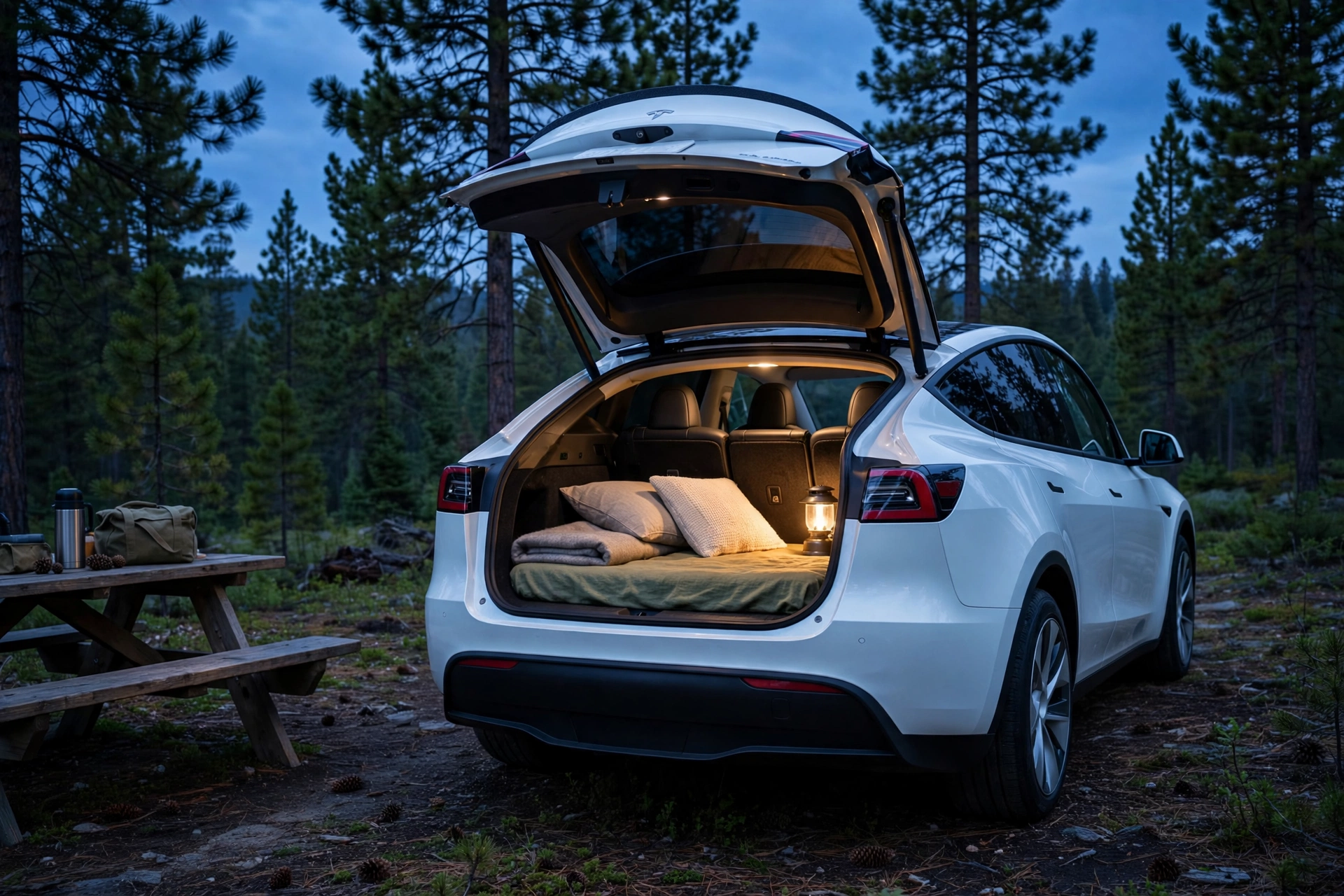
What Tesla does build in, free, is Camp Mode. It arrived by software update years ago and it is the reason the whole idea works at all. Camp Mode holds a cabin temperature indefinitely, keeps the screen and USB ports live, keeps the 12-volt socket powered, and disables the walk-away lock behaviour that would otherwise fight you all night. It also shuts Sentry Mode’s alarm logic down so a raccoon does not trigger a light show at 3 a.m. Tesla’s manual is blunt about the floor: Camp Mode will not run the battery below 20 percent. It warns you, loudly, before it quits. Wake-up insurance, standard.
Tesla camper method one: Camp Mode is the hotel
The Model Y is the pick of the sleepers, and it is not close. Rear seats fold to a flat floor roughly 6 feet 6 inches long (est., measured bumper-to-seatback by owners). Two adults fit. That is why it leads any tesla camper shortlist.
The Model 3 works — the floor is long enough — but the sedan’s low roof and the hump at the seat fold steal headroom you feel at hour six. The Model X is the roomiest of the three and its flat floor swallows a proper mattress, though the car itself starts at money that makes the whole budget-camper premise wobble. Model S? No factory-flat sleeping pitch worth making, and Tesla rates it for no towing at all in the US. Skip it for this job.
Setup time is the stat that sells a tesla camper. Park. Fold. Unroll a fitted mattress — the good ones run $150 to $400 (est., accessory-brand pricing checked October 27, 2026) — set 68 degrees, lights out. Under five minutes, every time, in the rain, in the dark. A ground tent on a wet site does not beat that time. A rooftop tent does not beat it either once you price the ladder climb at midnight.
The overnight stint, measured. EV-MATS compiled Camp Mode data across several Model 3 and Model Y cars over 8 to 10 stays per temperature band between 2023 and 2026, and its figures are the most useful published set we found. On a mild night, 59 to 77 degrees outside, expect 8 to 15 percent of the pack across eight hours. Warm nights, 77 to 95 degrees, push that to 15 to 25 percent. Around freezing, the bill jumps to 30 to 50 percent a night.
Convert to energy on a Model Y Long Range pack of about 78 kWh usable (est.): a mild night costs roughly 6 to 12 kWh. Call it 9 kWh in the middle. Freezing costs 23 to 39 kWh. That is not a rounding error. That is a third of your fuel tank burned while parked.
Now the week-long maths, because one night is a demo and seven nights is a trip. Seven mild nights at 9 kWh: 63 kWh total. At home electricity prices around $0.17 per kWh (est.), that is about $11 of energy for a week of hotel rooms. At Supercharger prices around $0.45 per kWh (est.), about $28. Trivial either way.
Seven freezing nights at 31 kWh each: 217 kWh. That is 2.8 full Model Y packs. Arithmetic verdict: you cannot do a sub-freezing week unplugged. You plan around campsite hookups — where Camp Mode runs off grid power while the car tops up — or you accept a Supercharger visit every second morning. Our own guide to electric car winter range loss covers why the cold tax hits parked and moving consumption alike.
Our score: 8.7/10 — Sleep practicality: 8/10. Range cost: 9/10. Value: 10/10. Camp Mode is the single best camping feature fitted to any car at any price, because the price is zero and the setup time is five minutes. It wins this comparison on the stopwatch before the others leave the pits.
Tesla camper method two: tow the bedroom behind you
The ratings, from Tesla’s own specs. Model Y: 3,500 pounds with the factory tow package. Model X: 5,000 pounds. Cybertruck: 11,000 pounds. Model 3: 2,200 pounds with the factory hitch where offered (est. for current US cars). Model S: not rated. On paper, the Model Y rating covers every teardrop and small camper worth towing. On the highway, the rating is not the limit. The battery is. For a tesla camper, that battery limit matters more than the rating.
Independent tests agree on the damage, and they agree it is mostly aerodynamics, not weight. MotorTrend hitched a boxy U-Haul cargo trailer to a Model Y and watched highway range collapse to roughly 100 miles. An owner-documented 1,050-mile tow of a 5-by-8 U-Haul recorded about 700 Wh per mile — double the car’s normal consumption.
Then the control experiment: InsideEVs reported on the Camp365 folding cabin, a low, aerodynamic trailer, towed by a Model Y Long Range for 218 miles on a charge, a loss of only about 30 percent. Same car. Same hitch. The trailer’s shape, not its mass, set the time. As Jalopnik’s summary of the Model Y towing picture puts it, plan around the range, not the rating. Our own Tesla Model Y speed and range test breakdown shows the same aero sensitivity at speed, trailer or not.
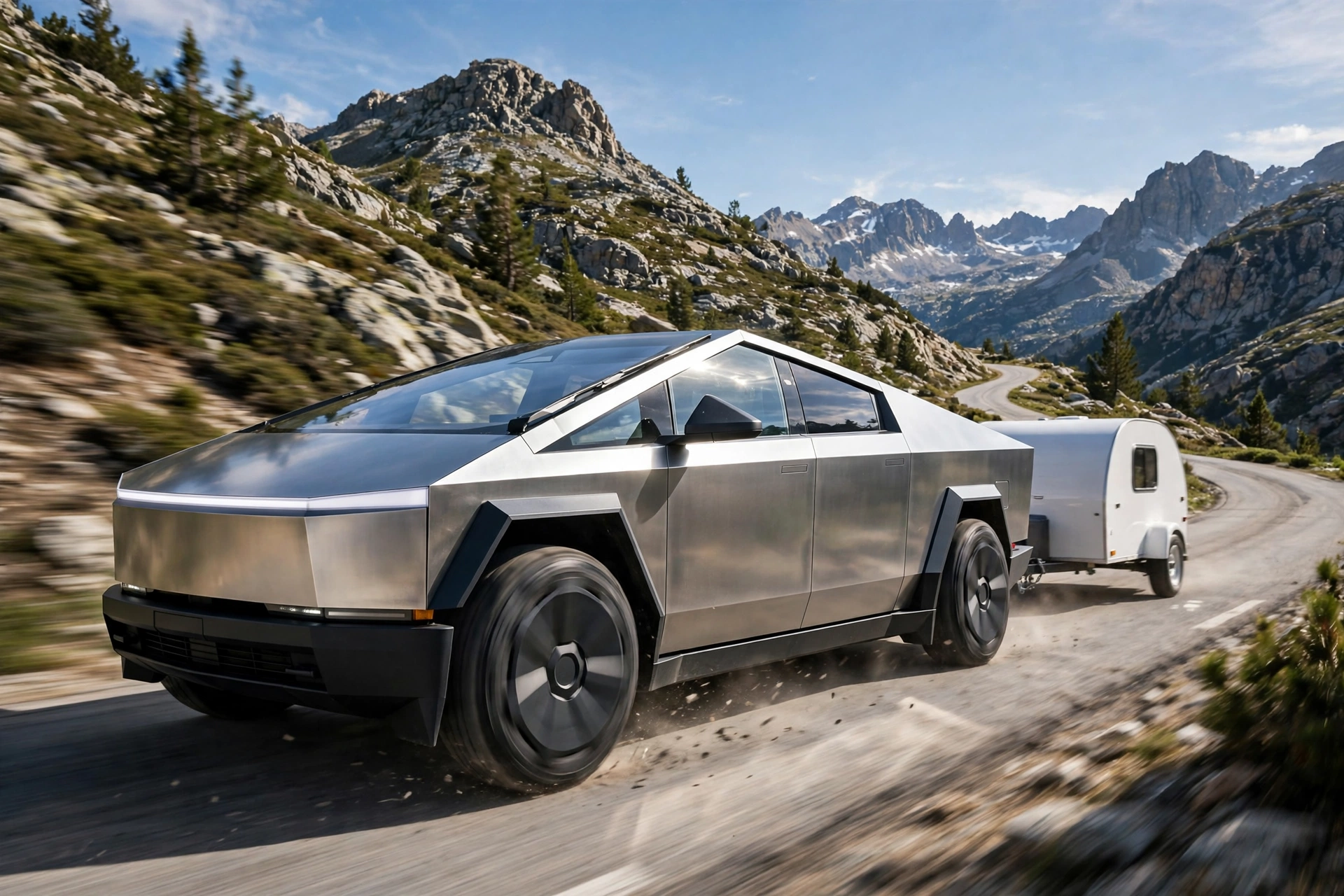
The 600-mile tow, timed to the minute
Here is our own timing model, built from the tested figures above. Take a Model Y Long Range, 78 kWh usable (est.), towing a boxy 2,500-pound camper at highway pace. Tested consumption: 700 Wh per mile. Full-charge range: 78,000 ÷ 700 = 111 miles. Run the sensible 10-to-90-percent window and each leg is 62.4 kWh, about 89 miles. Six hundred miles ÷ 89 = 6.7 legs, so six charging stops. Allow 45 minutes per stop — charge time plus the unhitch-and-reposition dance that most Supercharger stalls force on a towing rig (est.) — and charging eats 4.5 hours. Driving at a 60 mph average eats 10. Total: roughly 14.5 hours.
Same car, same 600 miles, no trailer: about 270 Wh per mile on the highway (est.), legs of roughly 230 miles in the same charge window, two stops of 25 minutes. Total: about 10.8 hours. Same car again, now towing the low aerodynamic trailer at the Camp365-tested figure of about 358 Wh per mile: full-charge range 218 miles, legs near 174 miles, three stops. Total: about 12 hours. Read those three totals again. The trailer purchase that decides your trip is not the heavy one or the light one. It is the tall one or the low one. Two and a half hours of your life, spent or saved at the trailer dealership.
Cybertruck towing posts better raw numbers and the same percentage pain. Its 123 kWh pack and 11,000-pound rating look like a tow rig’s spec sheet. One of the first independent tests, towing roughly 6,000 pounds, recorded 749 Wh per mile and about 160 miles of range. A winter maximum-load test at the full 11,000 pounds returned roughly 90 miles. The truck pulls hard, instantly, with torque a diesel cannot match off the line. Then it stops. Often. And note the missing upgrade: Tesla cancelled the bed-mounted range extender pack in 2025 and refunded deposits, so the 123 kWh you bought is the 123 kWh you keep.
Our score: 5.9/10 — Sleep practicality: 9/10. Range cost: 3/10. Value: 6/10. A towed camper is the best bed and the worst schedule in this guide. For trips under 200 miles with a low trailer, it works. For a 600-mile highway day, it is a plan built out of charging stops.
Cybertruck plus CyberTent: the official Tesla camper accessory
This is the one camping product Tesla actually sells, and its file needed updating. The tent launched in March 2024 under the name Basecamp at $2,975, built with German tent maker Heimplanet around a geodesic air frame that inflates with a hand pump — no poles. Tesla has since renamed it. The Cybertruck CyberTent listing on Tesla’s shop, checked October 27, 2026, shows $2,750 and in stock. A $225 price cut and a name change since the headlines you remember. Prices checked October 27, 2026.
The fine print matters more than the price. The CyberTent fits only the Cyberbeast and Premium All-Wheel Drive trucks. It needs the bed L-track system, sold separately. It cannot deploy with the bed cargo divider fitted. First installation happens at a Tesla Service Center — shipping and that install are included — and the stowed pack lives above the bed, under the tonneau cover, so it does not eat the vault.
Engage Tent Mode on the touchscreen and the truck levels its suspension for a flat sleeping platform. The bed outlet keeps devices charged off-grid. As engineering, it is tidy. As value, $2,750 for a nylon tent remains $2,750 for a nylon tent, and the truck underneath it starts at a price (est., from about $80,000 for the all-wheel drive) that ends most budgets before the tent enters the chat.
Range cost is where the CyberTent redeems itself. Stowed under the tonneau, it adds no meaningful drag and no trailer. Your 325-mile EPA-rated truck (est., all-terrain tyres) stays a 325-mile truck. Compare a towed tesla camper’s 50 percent haircut and the tent’s near-zero penalty is the best efficiency figure in this entire guide. You sleep two, in the bed, with no kitchen, no bathroom and no standing room. It is a tent. It was only ever a tent.
Our score: 6.3/10 — Sleep practicality: 7/10. Range cost: 8/10. Value: 4/10. The right accessory at the wrong price, bolted to a truck that was never the cheap option. Owners who already have the truck and camp monthly will use it constantly. Everyone else is paying a badge tax.
Conversions: Space Campers and the deposit graveyard
Dedicated conversions promise the real camper: bed, kitchen, storage, standing headroom. One headline act survives. Space Campers, a Californian outfit, builds the Wedge, a composite wedge shell for the Cybertruck bed with a Murphy bed, storage cubbies and options like a camp kitchen at $3,800 on top of the $24,000 base (prices from the maker’s site, checked October 27, 2026). Its simpler fixed-roof Cap starts at $6,385 (est.). The catch is delivery: Wedge production has been delayed by funding problems, and the order book is a queue, not a showroom. The company’s lighter Cap is the realistic buy.
Everything else in the Cybertruck camper gold rush — remember CyberLandr’s 2019 renders and deposit book — never reached volume production. Treat any conversion you cannot sit in before paying as a pre-order, because it is one.
Model Y conversions exist at the shallow end: fitted mattress kits, window-shade sets, and drawer systems that turn the folded floor into a flat bed with storage underneath, mostly $300 to $1,500 (est.). They are a tesla camper built on Camp Mode, with better furniture. That is not an insult. Camp Mode with better furniture is the correct product. The deep end — cutting, plumbing, fixed cabinetry in a crossover — buys you a worse car and a mediocre camper in a single transaction. Hard pass, permanently.
Our score: 5.5/10 — Sleep practicality: 9/10. Range cost: 7/10. Value: 3/10. The Wedge is genuinely clever and genuinely $24,000, and its delivery timeline is a rumour with a deposit attached. The Cap and the Model Y drawer kits are the only conversion money we would spend.
Who should buy which Tesla camper setup
Solo travellers and couples doing one-to-three-night trips within 250 miles of home: Camp Mode in a Model Y, a fitted mattress, done. Total spend under $400 (est.). Nothing else in this guide beats it on cost per night, ever — run your own figures against our EV total cost of ownership guide if you doubt the arithmetic. Families who need a real bed for four and camp within 200 miles of a charger: a low, light trailer behind a Model Y or X, accepting the extra stops as the price of the bed.
Cybertruck owners who camp often: the CyberTent, bought with eyes open about the price. Long-distance tourers: none of the above. A tesla camper is a regional weapon. The stopwatch does not care about your feelings, and at 600 miles it has already delivered its verdict.
And the performance footnote, because it is the part nobody prints. Hitched or loaded, the cars stay quick. A Model Y Long Range still runs 0 to 60 mph in about 4.6 seconds (est.); the Cybertruck’s instant torque makes a 6,000-pound trailer feel like a rumour up an on-ramp. The drivetrain is never the problem. The clock is the problem. Every tesla camper plan is a charging plan wearing a tent costume — budget it with the same honesty you would budget fuel, using the per-mile figures in our electric car cost per mile breakdown, and the method stops mattering. The numbers pick the winner.
Frequently asked questions
Can I buy an official tesla camper from Tesla?
No. Tesla sells no camper vehicle and no camper conversion. The closest official product is the CyberTent bed tent for the Cybertruck, $2,750 at Tesla’s shop, checked October 27, 2026. Everything else called a Tesla camper is an accessory, a trailer or a third-party conversion.
How much battery does Camp Mode use overnight?
On a mild night, about 8 to 15 percent of a Model 3 or Model Y pack over eight hours — roughly 6 to 12 kWh. Around freezing, budget 30 to 50 percent. Those are compiled multi-car figures from EV-MATS testing between 2023 and 2026. Camp Mode stops at 20 percent charge to protect your drive out.
How far can a Model Y tow a camper?
Plan on 100 to 160 miles per charge with a typical boxy camper at highway speed, based on independent tests. A low, aerodynamic trailer can reach about 218 miles, as the Camp365 test showed. The 3,500-pound rating is not the constraint. Drag is.
Is the CyberTent worth $2,750?
For a Cybertruck owner who camps monthly, yes — it stows under the tonneau, costs almost no range and sets up in minutes. For occasional campers, a quality ground tent at a tenth of the price does the same sleeping. The score above says the quiet part: Sleep 7, Value 4.
Can you sleep in a Tesla while it charges?
Yes. Plug into a campsite hookup or a charger and Camp Mode runs from grid power while the battery holds or fills. It is the strongest setup for cold nights, when an unplugged car can burn 30 to 50 percent of its pack just staying warm.
Which Tesla is best for camping?
The Model Y. Flat floor, real headroom, 3,500-pound tow rating, the biggest charging network access and a purchase price that leaves budget for the trip. The Model X sleeps bigger and tows more, at roughly double the money. The numbers, as ever, have voted.
In short, a tesla camper setup works best when you match the method to the trip. Plan charging first, pack light, and test a tesla camper night close to home before a long tour. That first tesla camper trial will tell you more than any spec sheet.