Last updated: October 25, 2026
Start with the only question that matters: can you carry it up three flights of stairs? A compact electric dirt bike is not a spec sheet. It’s a storage decision. If the bike sleeps in a hallway corner, rides in the lift, and travels to the trail in the boot of a hatchback, it has to earn that life in pounds and inches before it earns a single thing in watts.
So this guide flips the usual order. Weight first. Footprint second. Theft-proofing third, because a bike stored in a shared hallway is a bike somebody else can walk away with. Speed and range come last, and they come with tested numbers attached, not brochure numbers.
A compact electric dirt bike bought on these tests is far more likely to be ridden regularly than one bought on headline speed alone.
The class is tighter than the marketing suggests. At the tiny end you’ve got powered balance bikes a determined five-year-old can drag around. At the top end sits the Yozma IN10, 121 lb of mini-moto that two adults can wrestle into a car. And just past the line, close enough to tempt you and too big to live with, sits the Sur-Ron Light Bee X.
Every figure below is checked against manufacturer spec sheets and US dealer listings on October 25, 2026, and every price is US. Where a number is an estimate rather than a spec, it’s marked (est.) and the basis is stated. No test rides were invented for this guide; where a bike has been independently tested, the test is named.
What counts as a compact electric dirt bike? We draw the line with three tests
“Compact” gets slapped on anything with small wheels. Ignore that. A bike earns the label here only if it passes three tests a flat-dweller actually faces.
The lift test. One reasonably fit adult can deadlift roughly 75 lb into a car boot alone, a few times, without hating their life (est., based on ordinary one-person lifting guidance). Two adults working together can manage up to about 130 lb. Anything past 130 lb is not a lift; it’s a loading operation involving a ramp, a rack, or a trailer.
The door test. A standard interior door is 32 inches wide, and handlebars are the widest part of any dirt bike. Bars at 31 inches or under glide through. Wider bars mean the tilt-and-shimmy dance every single time the bike goes in or out, and you will get tired of that dance.
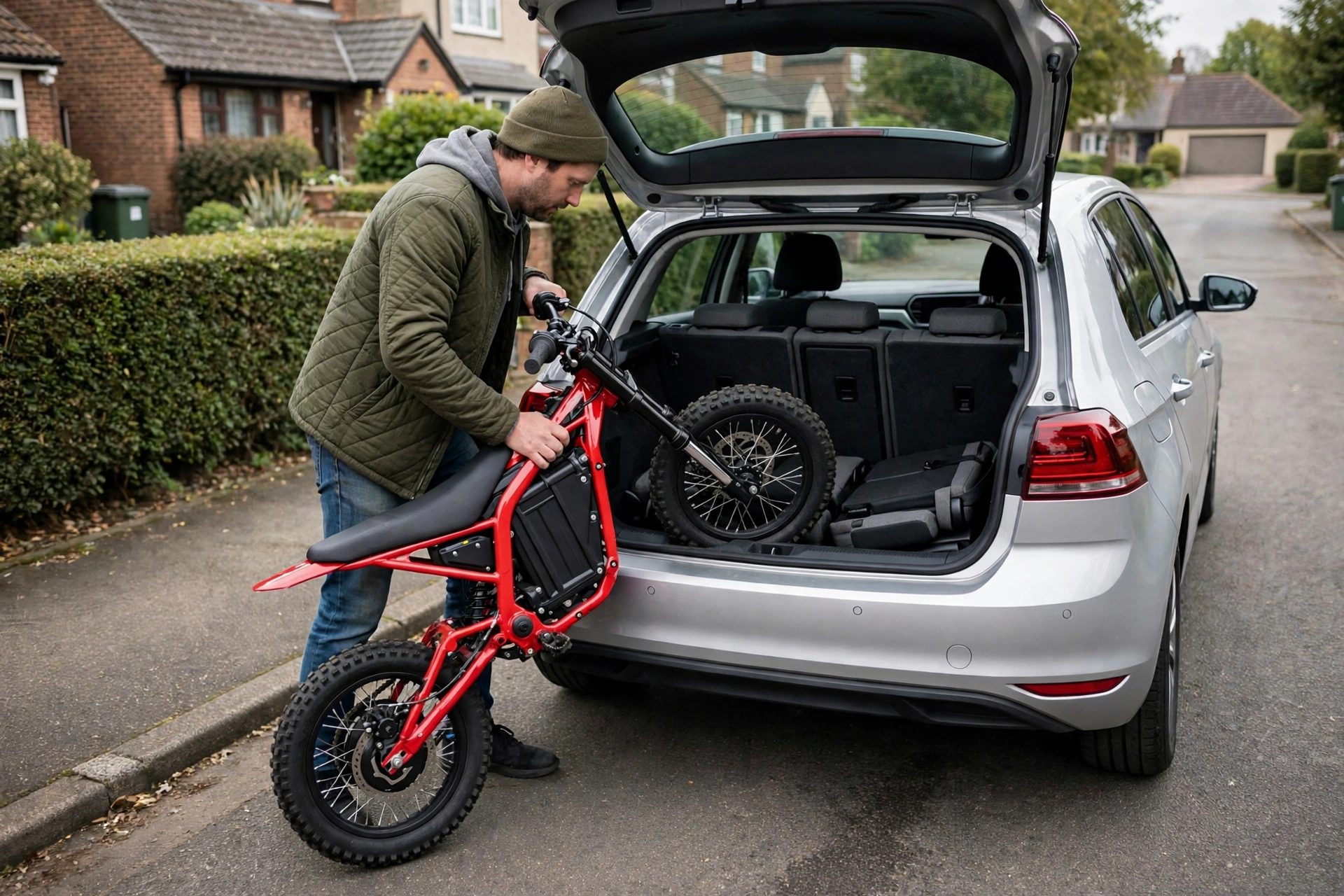
The diagonal test. A Golf-class hatchback gives you roughly 55 inches of load floor with the rear seats folded and about 67 inches corner to corner (est., from owner-measured dimensions for this class of car). A bike longer than that diagonal does not go in the boot. Full stop. It goes on a rack, at rack prices.
Pass all three and you’re looking at a genuine compact electric dirt bike. Fail one and you’re looking at a small motorcycle with big storage bills. Our line is blunt: anything over 130 lb, over roughly 70 inches long, or wearing bars wider than 31 inches is not compact, whatever the listing says. The Light Bee X fails on length alone: 72.8 inches of bike into a 67-inch diagonal is geometry, not opinion.
The class, measured: weight, seat height, run time and price
Here’s the whole field on one table, with prices checked October 25, 2026. Run times for the kids’ bikes are quoted in hours because at trials pace, hours are the honest unit; miles at 9 mph would just be arithmetic theatre.
| Bike | Weight | Seat height | Run time / range | Price (US) |
|---|---|---|---|---|
| Stacyc 16eDrive Brushless | 20 lb | 17 in | 30–60 min per pack | $1,049 |
| Kuberg Start | 46 lb | 15–17 in | ~1 hour (manufacturer) | ~$1,299 (est.) |
| Kuberg Trial Hero | 73 lb | 20.5 in | ~2 hours (manufacturer) | $2,595 |
| OSET TXP-20 (sold via Triumph) | 90 lb | 21.5 in trials / 27.6 in with seat | Up to 4 hours at trials pace (manufacturer) | $3,495 |
| OSET TXP-24 (sold via Triumph) | 108 lb | 25 in trials / 31.9 in with seat | Up to 4 hours at trials pace (manufacturer) | $3,995 |
| Yozma IN10 | 121 lb | 28 in | 53 miles claimed; 15–20 miles realistic (est., from independent tests) | $1,099 |
| Sur-Ron Light Bee X (over the line) | 125 lb | 32.7 in | Up to 46.6 miles at 25 mph (manufacturer) | $4,499 |
Read that table the city way. The Stacyc weighs less than a checked suitcase. The Kuberg Start, at 46 lb, weighs about the same as a full hiking pack. The Trial Hero and the TXP-20 land in the 73–90 lb band: carryable by one adult for a short flight of stairs, miserable by the fourth. The TXP-24 and the IN10 are two-person bikes, whatever the adverts imply.
Now the maths the brochures never do. Peak watts per pound of bike: the Kuberg Start makes 1,000 W ÷ 46 lb = 21.7 W/lb. The Kuberg Trial makes 3,000 W ÷ 73 lb = 41.1 W/lb. The TXP-24 makes 2,000 W ÷ 108 lb = 18.5 W/lb. The Yozma IN10 makes 2,600 W ÷ 121 lb = 21.5 W/lb. And the Light Bee X makes 8,000 W ÷ 125 lb = 64 W/lb. Two lessons hide in there. First, the little Kuberg Trial has nearly double the IN10’s power-to-weight, so small does not mean feeble; it means the power is packaged where a young rider can actually use it.
Second, 64 W/lb is exactly why the Sur-Ron is a motorcycle that happens to be lightish, not a compact that happens to be quick.
Price per pound flips the chart again. Stacyc: $1,049 ÷ 20 lb = $52.45 per pound, the priciest fun in the class, and we’d pay it, because a bike a five-year-old can pick up unaided is a bike that gets ridden. Kuberg Trial Hero: $2,595 ÷ 73 lb = $35.55 per pound. TXP-24: $3,995 ÷ 108 lb = $36.99 per pound. Light Bee X: $4,499 ÷ 125 lb = $35.99 per pound. And the IN10: $1,099 ÷ 121 lb = $9.08 per pound. Nine dollars a pound. Nothing else in this guide is within a factor of four.
Then add the rack tax, the cost nobody budgets. If a bike fails the boot test, add a hitch receiver at roughly $180–$350 fitted (est.) and a motorcycle carrier rated for the weight at roughly $150–$400 (est.). Call it $449 all-in (est.). The Light Bee X’s real starting price is therefore closer to $4,499 + $449 = $4,948 (est.), and after paying it you still can’t store the bike in the flat. The IN10, diagonal and all, costs $1,099 flat. That gap is the entire argument for buying compact on purpose.
Living with a compact electric dirt bike: stairs, lifts and the boot test
Stairs sort this class faster than any dyno. At 20 lb, the Stacyc goes up one-handed while you carry a helmet in the other. At 46 lb, the Kuberg Start is a two-handed carry, fine for two or three flights. At 73–90 lb, the Trial Hero and TXP-20 are a workout with a rest stop on the landing; be honest about whether you’ll still bother in February. At 108–121 lb, the TXP-24 and IN10 are a two-person carry or a ground-floor life. There’s no shame in that, but buy with your staircase in mind, not your ambitions.
The boot test is where the tape measure earns its keep. Yozma publishes the IN10’s full dimensions on its official IN10 page: 66.1 inches long, 28.3-inch bars, 38.2 inches tall at the bars. Against the roughly 67-inch hatchback diagonal (est.), it fits with an inch to spare, bars turned, leaned over because of that bar height. It is a fit the way a sofa through a doorway is a fit: possible, undignified, and much easier the second time.
Most owners drop the front wheel out, which trims roughly a foot of length (est.). The Stacyc, both Kubergs and the two smaller OSETs go in seats-up in most hatchbacks. The TXP-24 needs the seats folded. The Light Bee X, at 72.8 inches, needs a different car.
Lifts are the easy part. Every bike here fits a standard passenger lift diagonally, and the real enemy is mud, not dimensions. A cheap waterproof cover or a builder’s rubble sack under the wheels keeps the building manager out of your life. If your lease has a clause about motor vehicles in the flat, a compact electric dirt bike you can carry is far easier to argue as sports equipment than a full-size machine on a stand. Check the clause before you buy, not after the first complaint.
In short, a compact electric dirt bike should fit your home first and your trail ambitions second.
If the mini end of this class is your world, our electric mini bike and motorcycle guide covers the neighbouring machines in the same spirit: measured first, ridden second.
Theft-proofing a bike that sleeps in a hallway
Small and light cuts both ways. A 20 lb Stacyc is a carry-away item. A 46 lb Kuberg is a two-handed grab for one motivated thief. The same qualities that make a compact electric dirt bike flat-friendly make it the easiest vehicle you own to steal, so storage security is part of the purchase, not an accessory.
Work in layers. First, the battery comes out and lives indoors with you; a battery-less bike is worth less, rides nowhere, and is far harder to sell on. Second, a proper chain, not a cable, locked to something structural: a stair rail’s newel post, a ground anchor, a radiator pipe that isn’t going anywhere. Third, a tracker. A coin-sized Bluetooth tracker under the seat or inside the frame bag costs little and has recovered plenty of bikes exactly like these. Fourth, photographs: frame number, both sides, any distinguishing scuff, stored in your phone today, not after the fact.
Shared bike rooms deserve special suspicion. They’re usually the least observed room in the building, and a compact bike in one is just a light object near a door. If the bike room is your only option, lock to the building, not to the rack, and take the battery and the front wheel with you; a one-wheeled, battery-less bike is a poor prize. And add the bike to your renters or home insurance as a scheduled item (est., pricing varies by insurer and value). Two minutes of admin beats a four-figure loss.
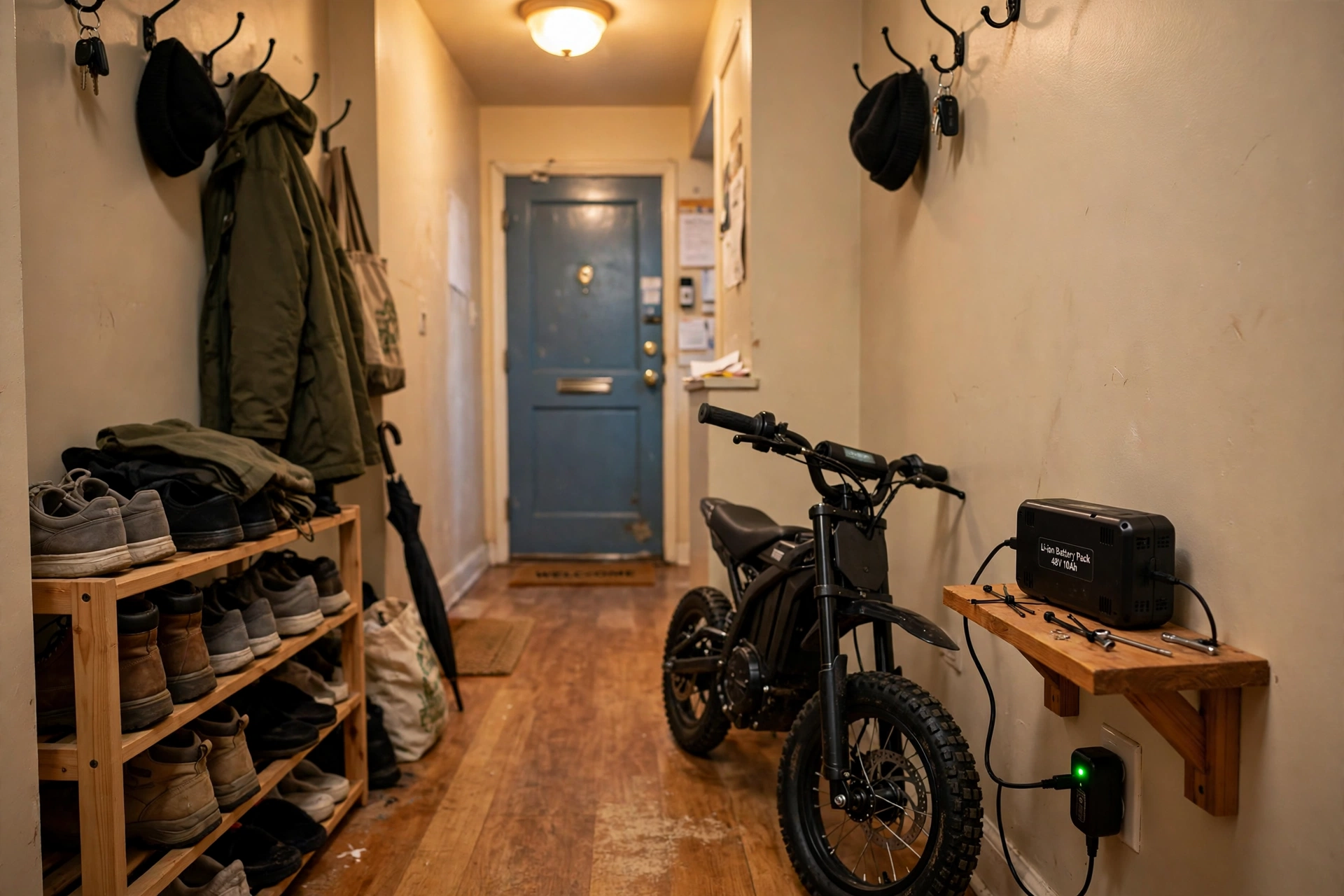
Batteries out, chargers in: compact electric dirt bike indoor charging rules
The removable battery is the single most city-friendly feature in this class, and it isn’t close. A pack you can carry to a kitchen counter turns any flat into a charging station. The Stacyc’s 20V pack clicks off like a power-tool battery and charges in 45–60 minutes; buy a second pack and ride time stops being a planning problem.
The IN10’s 48V 23.4Ah pack (1,123 Wh) slides out once you lift a retention bar and unplug a cable, as independent testers at MyPitShop’s IN10 review showed in their teardown of the charging options. The OSET packs lift out too. Kuberg is the odd one out: its own spec sheet lists a six-hour charge and no swappable pack, so plan on the whole bike living near a socket. That is the Kubergs’ one genuine city-living flaw.
Rules, because lithium deserves respect. Charge the pack on a hard, clear surface, not on carpet or bedding. Use the charger the maker supplied; the bargain no-name brick is how bad days start. Never charge in the hallway itself: that’s your escape route in a fire, and in many buildings it’s against the rules for exactly that reason. Charge while you’re home and awake where you can, and let a hot or freshly crashed pack cool and get inspected before it goes back on charge. If your building or city has specific e-bike battery rules, they win over anything written here.
Charging times, honestly framed: Stacyc, under an hour. OSET TXP-24, around two hours. IN10, five to six hours on its 48V 5A charger, so overnight is the rhythm. Kubergs, six hours. None of these will trouble a domestic socket, and the running cost is pennies: the IN10’s 1.1 kWh pack costs roughly 19 cents to fill at average US residential rates (est., at 17 cents per kWh). The charger is not the problem in this class. The staircase is.
Riding reality: small wheels, tested speeds, honest range
Performance comes last here, and it comes labelled. Yozma claims 40 mph and 53 miles for the IN10. Independent testing disagrees, politely but firmly. MyPitShop’s GPS-verified test recorded 33.3 mph at full throttle, with the bike’s own display flattering itself by 3–4 mph. Another hands-on test with a 195 lb rider found roughly 35 mph and about 15 miles of trail range. For a lighter teen rider, expect more; our planning figure is 15–20 miles of real trail use (est., from those tests). The claimed 53 miles belongs to the same genre of fiction as airline legroom.
The kids’ bikes play a straighter game because their currency is time, not miles. A Kuberg or OSET at trials pace (walking speed to a gentle jog, stop-start over obstacles) genuinely runs for the quoted one to four hours, because the motor is sipping, not gulping. The Stacyc’s three modes (5, 7.5 and 13 mph on the 16eDrive) are a training programme disguised as a throttle: start them at jogging pace and unlock speed as balance arrives. That’s smarter engineering than a big number.
One honest warning about small wheels. A 12- to 16-inch wheel drops into ruts and braking bumps that a 19-inch wheel rolls over, and short wheelbases (32 inches on the Kuberg Start, 41.7 on the IN10) turn quickly and forgive slowly. On groomed trails, garden tracks and practice fields, that’s a delight. On a rutted adult motocross track, the compact bikes get bullied. Ride them where they were designed to be ridden.
And a legal line that matters: none of these machines is a Class 1, 2 or 3 e-bike, and none belongs on bike paths or roads. They’re off-road vehicles for private land and designated trails. If what you actually want is legal path riding, that’s a different purchase entirely; start with our complete guide to Class 1 e-bikes. For the wider off-road landscape, our e-bike dirt guide covers the full-size end of the market too.
The verdict: which compact electric dirt bike earns the hallway corner?
OSET TXP-24: Our score: 8.7/10 (Range 8 / Charging 8 / Value 8). The only bike here an adult up to 198 lb can genuinely ride that still passes all three compact tests. The 2-in-1 seat-off trials conversion is clever, the power delivery is adjustable in four steps, and at 108 lb it’s a two-person carry rather than a machinery problem. Expensive, yes. It’s also the answer for grown-ups.
Stacyc 16eDrive Brushless: Our score: 8.6/10 (Range 6 / Charging 10 / Value 8). Twenty pounds, a one-hour charge, swappable packs, speed modes that teach. As a first powered bike for a 5-to-7-year-old it’s close to unbeatable, and it stores in a wardrobe. The $52.45 per pound stings until you watch a small kid pick it up alone.
Kuberg Trial Hero: Our score: 8.4/10 (Range 8 / Charging 5 / Value 7). The power-to-weight champion at 41.1 W/lb, with proper hydraulic brakes and parent-set speed limits. The six-hour, on-bike charge is the tax. For a 5-to-12-year-old learning real skills, it’s the keenest tool here.
Yozma IN10: Our score: 7.9/10 (Range 6 / Charging 5 / Value 10). $9.08 per pound, a removable 1,123 Wh battery, real hydraulic brakes and a tested 33.3 mph. The range claims are fiction and the five-to-six-hour charge is slow, but at $1,099 (checked October 25, 2026) nothing else gives a teen or smaller adult this much actual dirt bike for this little money, in a package that fits a hatchback diagonal.
Sur-Ron Light Bee X: Our score: 5.9/10 (Range 9 / Charging 7 / Value 4). Scored against this brief, not against its own. It’s a superb light motorcycle that fails the length test, demands a rack, and cannot live in a flat. Buy it with open eyes and a garage, and it’s a 9. Buy it as a compact, and you’ll be selling it by spring.
That verdict is why a compact electric dirt bike earns its place by storage and usability, not by power alone.
Compact electric dirt bike questions, answered straight
What is the lightest compact electric dirt bike I can buy? The Stacyc 12eDrive, at 17 lb with its battery, for the youngest riders. The 16eDrive Brushless at 20 lb is the sweet spot: light enough for a child to handle, quick enough (13 mph in its top mode) to stay interesting for a couple of seasons.
Will a compact electric dirt bike fit in a hatchback? Mostly, yes. Everything here except the Light Bee X fits a Golf-class hatchback, the IN10 on the diagonal with its bars turned (66.1 inches of bike, roughly 67 inches of diagonal, est.). The smallest bikes fit with the seats up. Measure your own car’s diagonal before ordering anything over 100 lb.
Can I charge the battery indoors? Yes, if the pack is removable, and most of these are. Charge it on a hard surface with the supplied charger, keep it out of the hallway itself, and follow any building rules. The bikes that charge on-board, like the Kubergs, need the whole bike near a socket for about six hours.
Are compact electric dirt bikes street legal? No. Every bike in this guide is an off-road machine for private land and designated trails. They aren’t Class 1, 2 or 3 e-bikes, they carry no road equipment, and their makers say so. Riding one to the trail on public roads is illegal in most US states.
How much can one person realistically carry up stairs? Honestly? About 46 lb is a comfortable two-handed carry for a few flights, 73–90 lb is a grind with rest stops, and past 100 lb you need a second person (est., practical guidance, not a medical standard). Weigh yourself holding the bike on bathroom scales before you commit to a fourth-floor flat and a 121 lb IN10.
Which compact electric dirt bike can an adult actually ride? Two. The OSET TXP-24 (rider limit 198 lb, seat up to 31.9 inches in seated trim) for trials-style riding, and the Yozma IN10 (265 lb load limit, riders up to about 5 ft 9 in per Yozma) for trail fun. Taller or heavier adults are into Light Bee territory, with the storage bills to match.