Last updated: October 25, 2026
Somebody in your house is fourteen. Somebody is forty. Both of you want the same Sunday: one trailer, two bikes, a forest loop, nobody waiting in the truck. That is the entire problem with choosing an electric dirt bike for teens and adults — the two riders differ by maybe 90 pounds, four inches of inseam and a decade of judgment, and the bike industry would love to sell you one machine that “does both.” It doesn’t exist. What exists is a ladder, and the families who get this right buy two rungs of it instead of one compromise.
Here is how the mistake usually happens. Dad buys the big bike “so the kid can grow into it,” then spends two seasons riding alone because a 260-pound motocross machine with a 38.9-inch seat is not a learning tool, it’s a hospital referral with a throttle. Or the family buys the cute mini moto, the teen outgrows it by spring, and the adult never rides at all because a 28-inch seat puts his knees somewhere around his ears.
So this guide answers the only question that matters: who rides what, in what order, at what cost — rung by rung, sized by inseam instead of birthdays, tested numbers separated from brochure fiction, and the legality last, because since January 1, 2026, California law has a specific name for most of these machines, and it isn’t “e-bike.”
One rule before any numbers: fit first, skill second, watts last. Confidence comes from feet on the ground and a bike you can pick up alone. Anyone who reverses that order is shopping for styling, not a riding partner.
Choosing an electric dirt bike for teens and adults is therefore a sizing decision first and a power decision second, and this guide keeps that order throughout.
The ladder: five rungs of electric dirt bike for teens and adults
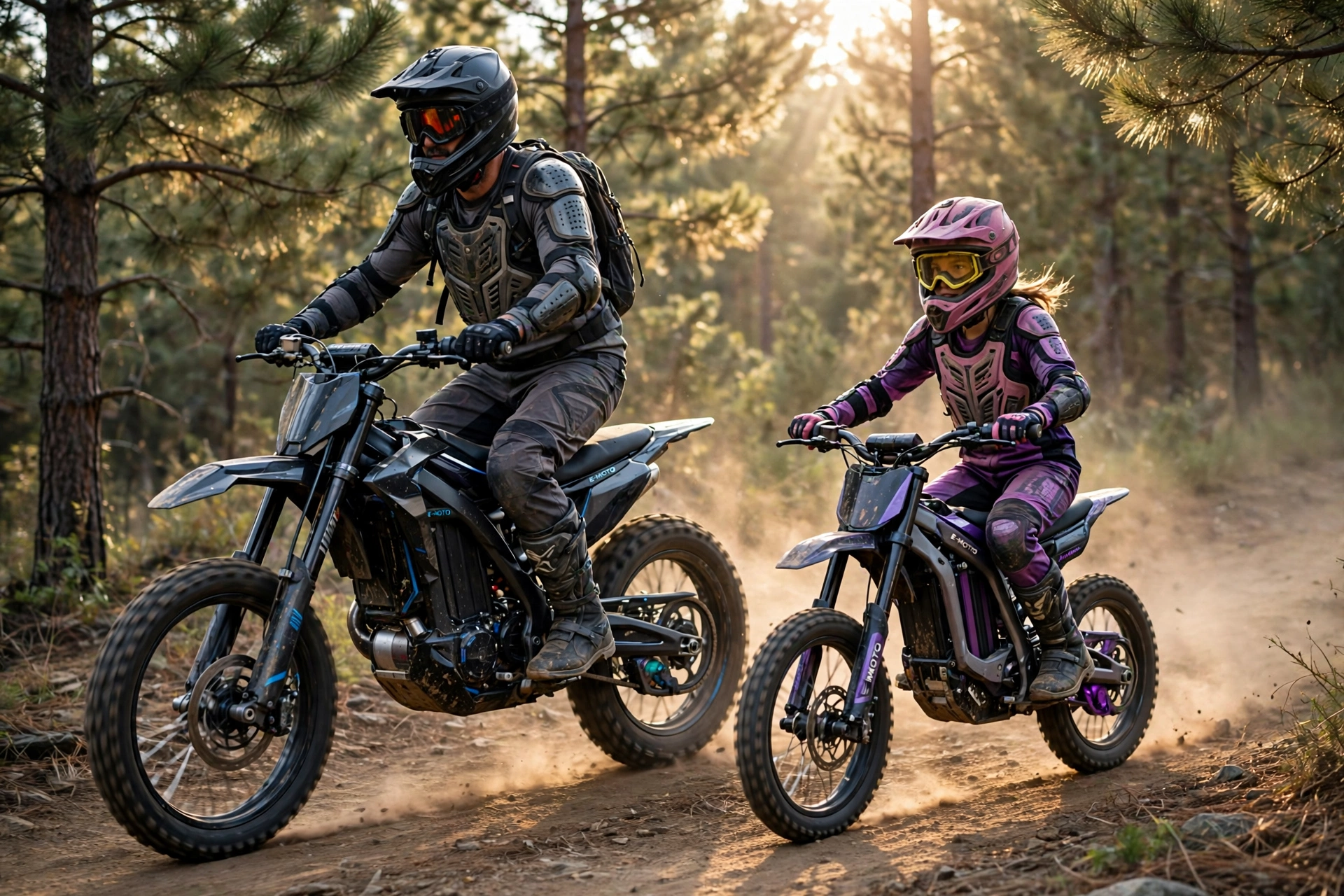
Every electric dirt bike for teens and adults sold in the US lands on one of five rungs. The rungs are defined by seat height, weight and peak watts — in that order — because those are the three numbers that decide whether a rider controls the bike or the bike schedules the crash.
| Rung | Example bikes | Price (checked Oct 25, 2026) | Peak power | Seat height | Weight | Real top speed | Who it fits |
|---|---|---|---|---|---|---|---|
| 1. Balance | Stacyc 12eDRIVE / 16eDRIVE / 20eDRIVE | $799 / $1,049 / $1,599 | Under 0.5 kW | 13–23 in | 17–33 lb | 9–20 mph | Ages 3–12 |
| 2. Toy-class mini | Razor MX350 / MX650 | $330 / $650–$750 | 0.35–0.65 kW | ~25 in (est.) | 66–106 lb | 14–17 mph | Backyard, light teens |
| 3. Mini moto | Yozma IN10, Riding’times GT73 | $1,079–$1,099 / $1,549–$1,599 | 2.6 kW / 2.4 kW | 28 in / ~33.4 in (measured) | 121 lb / 126 lb (weighed) | 33–35 mph (tested) | Teens 13+ and smaller adults |
| 4. Mid-size eMoto | Sur-Ron Light Bee X, Talaria Sting R MX4 | $4,000 / $4,499.99 | 8 kW | 32.7 in / ~33 in (est.) | 126 lb / 143 lb | 47 mph / ~50 mph (claimed) | Older teens 16+ and most adults |
| 5. Full-size motocross | Stark VARG MX 1.2 | $13,490–$14,490 (US, incl. $1,000 tariff) | 60–80 hp | 38.9 in | 260 lb | Track-limited, 450-class pace | Experienced adults. Full stop. |
Rungs 1 and 2 are childhood, and we won’t pretend otherwise. A Stacyc teaches balance and throttle better than anything else on this page; a Razor MX650 is a 17-mph lead-acid toy that costs less than a Light Bee battery. Fine machines — neither belongs in a conversation about an adult riding along.
Rung 3 is where family riding actually starts. The Yozma IN10 packs a 1,200W rated / 2,600W peak mid-drive, a removable 48V 23.4Ah pack and a 28-inch seat into 121 pounds for $1,079–$1,099, and Yozma itself rates it for riders 14 and up, 4’0″ to 5’9″. The Riding’times GT73 takes the other route: a 1,200W rated / 2,400W peak rear hub, two 48V 18.2Ah batteries (1,747Wh total), motorcycle-size 25-inch tyres and a long bench seat at $1,549–$1,599. Our full breakdown of the mini-moto class, sizing included, is in our electric mini bike guide.
Rung 4 is the sweet spot for the second bike in the garage. The Sur-Ron Light Bee X — 8 kW peak, 60V 40Ah, 126 pounds, 32.7-inch seat, $4,000 at US dealers — is the machine a competent 16-year-old and a 45-year-old can genuinely share across a weekend, one riding it while the other takes the mini. The Talaria Sting R MX4 answers with a bigger 60V 45Ah (2.7 kWh) pack and a gearbox instead of a belt at $4,499.99, and Talaria’s own dealers market it for riders 16 and older. Sur-Ron’s 2026 North American revision adds a 10 kW motor and 72V pack at $4,390–$4,499; the extra kick is real, the parts shelf underneath is identical.
Rung 5 is one bike: Stark’s VARG MX 1.2, 60 hp in Standard trim and 80 hp as the Alpha, 7.2 kWh, KYB suspension, 260 pounds, $12,490/$13,490 MSRP plus a $1,000 US tariff charge. It is a 450-class motocross weapon that happens to run on electrons. It is also the most-handed-down bike in America right now — a problem we’ll deal with under legality.
Sizing an electric dirt bike for teens and adults: inseam beats age
Age ratings are liability documents, not fit guides. A 5’8″ thirteen-year-old and a 5’2″ thirty-year-old need the same rung, and no sticker on a box knows either of their inseams. Size an electric dirt bike for teens and adults with three measurements, all taken in riding boots.
Feet. Sitting on the bike, suspension sagging under the rider, the rider should plant the balls of both feet hard, or flat-foot one side with the other side’s ball down. Fingertip toes on both sides means the first off-camber stop becomes a tip-over, and on a 126-pound bike a tip-over is a lesson; on a 260-pound bike it’s an injury. The seat-height column in the table above is the whole game: 28 inches (IN10) fits most riders from about 4’10” up; 32.7 inches (Light Bee X) wants a 30-inch inseam or real skill; 38.9 inches (VARG) is a 34-inch-inseam motorcycle.
Pickup weight. The trail test nobody does in the showroom: can the rider deadlift the bike back upright, alone, on a slope, after the third drop of the day? If not, the bike is too heavy for that rider, whatever its ride modes promise. This single rule eliminates the VARG for every teen and most new adults, and it’s why the 121-pound IN10 and 126-pound Light Bee punch so far above their spec sheets.
Rider weight against the chassis. Read the payload line, not the marketing. The IN10 caps at 265 pounds and its little chassis feels it past 200. The Light Bee X is rated to carry 220 pounds — a 230-pound dad in gear is already over, and the suspension will tell him so on the first whoop section. The GT73 claims 286–330 pounds of payload depending on which of its listings you read — remember that when we reach the claims section.
Claimed speed, tested speed: the numbers that survive a GPS
Dirt-bike brochures are written in a dialect where range means “downhill, 130-pound rider, eco mode, tailwind” and top speed means “once, briefly, on a stand.” Here is what independent testing does to the ladder, because an electric dirt bike for teens and adults should be bought on the second number, never the first.
The IN10 claims 40 mph and 53 miles. GPS-verified reviews put it at 33.3–35 mph, and honest trail range is 15–20 miles from its 1,123Wh pack. Still a good bike at $1,099 — just a 35-mph, 18-mile bike wearing a 40-mph costume. The GT73 is worse: the product page promises 68 miles on throttle and 155 miles with pedal assist from 1,747Wh, and BikeRide’s expert test roundup measured 35 mph with a rider aboard and about 19 miles of off-road range using both batteries. Nineteen. The 155-mile figure would require the bike to sip 11.3 Wh per mile on dirt, a number a pedal cyclist would struggle to match. Ignore it completely.
(If outright velocity is the purchase reason, our fastest e-bike guide ranks the speed claims that hold up.)
At the top of the ladder, Stark quotes the VARG’s range in hours — 1.3 to 6 — which sounds evasive and is actually the most honest format on this page. Cycle News’ instrumented test of the VARG EX found 30–35 miles over 2–3 hours of aggressive trail riding, 35–40 miles at intermediate pace and 40–50 at beginner pace; pro-pace motocross use drains the 7.2 kWh pack in roughly 18 miles. Miles are a pace-dependent fiction on dirt. Hours are the truth. Every brand on rungs 3 and 4 should be forced to copy Stark’s homework.
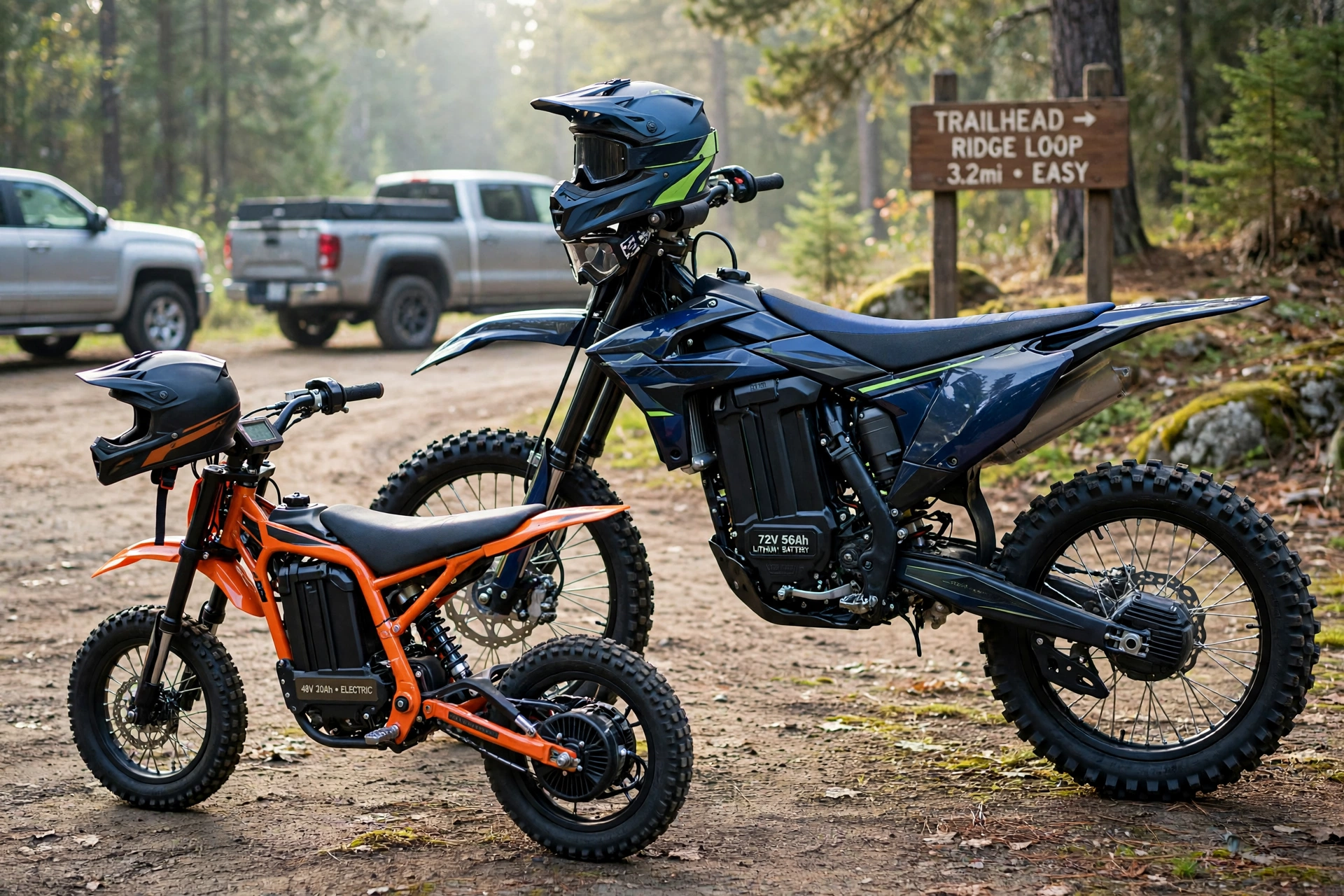
Where an electric dirt bike for teens and adults can legally go
Now the part that decides whether your Sunday ends with a ranger’s ticket book open. Start with the wall every one of these bikes hits: the e-bike classes. Class 1, 2 and 3 top out at 750 watts and 20 or 28 mph. An 8,000-watt Light Bee is not a fast e-bike; it is not an e-bike at all, and no bike path, rail trail or MTB singletrack in America is legal for it. Neither is a sidewalk. Neither, in most towns, is the street — they ship without the lighting, mirrors and title that road registration requires.
California closed the guessing game this year. SB 586, signed October 10, 2025 and in force since January 1, 2026, added Section 436.1 to the Vehicle Code and defined the “off-highway electric motorcycle” — the eMoto: two wheels, handlebars, a straddle seat, designed for off-highway use, and no pedals fitted by the manufacturer. An electric dirt bike for teens and adults that matches that definition is legally an off-highway motor vehicle, same as a petrol dirt bike. Consequences, precisely: it needs DMV Green Sticker identification displayed, the rider needs a helmet, and it lives under full OHV rules wherever it goes. Most other states reach the same place through their existing OHV registration; the sticker’s name changes, the logic doesn’t.
Two traps hide in that definition. First, pedals: the GT73 ships with a pair fitted, which is exactly why its sellers whisper “e-bike” — but a 2,400W, 35-mph machine fails every e-bike class test in every state, so the pedals buy it nothing. Pedals are a costume. Rangers know it. Second, venue minimums: OHV parks layer their own rules on top (supervision requirements for younger riders, spark-arrestor checks the electrics pass trivially since there’s no exhaust), and private land with permission remains the one venue where a 13-year-old on an IN10 needs nothing but a helmet and a sensible parent.
And the hand-me-down rule, stated once, without a hedge: do not hand a teen your full-size adult bike “turned down.” The VARG’s app lets a parent cap output at 10 hp, and teenagers have opposable thumbs and phones. A 260-pound bike also stays 260 pounds at 10 hp — the mass, the 38.9-inch seat and the momentum don’t care which map is selected. The same applies to a 72V Ultra Bee-class machine or any grey-import 12 kW build. If the rider can’t flat-foot it and pick it up, the rider doesn’t ride it. Our broader explainer on what counts as an electric dirt bike and where each type belongs goes deeper on the access rules.
Range and charging when two bikes share one garage
Forget miles; budget ride time. On the tested numbers above, a family pair — IN10 for the teen, Light Bee X for the adult — delivers about 1.5 to 2.5 hours of trail riding before the small bike calls it a day, and the Light Bee’s 2.4 kWh pack works out to roughly 25–32 miles of real trail use (est., from its capacity and the 75–95 Wh/mile that trail riding at pace consumes). The VARG changes the shape of the day rather than lengthening it: two hours of hard riding, then a two-hour charge on 240V (about four hours on 120V, per Cycle News’ test) before lap two. Plan the loop around the smallest battery.
Charging two machines is where garage electrics get real. The IN10’s charger sips about 240W and refills in 5–6 hours. The Light Bee’s removable pack pulls roughly 1 kW and turns 20–80% in about 2 hours — and because the pack lifts out, it can charge in the house while the bike stays muddy in the truck bed. The VARG’s 3.3 kW charger wants its own 240V circuit. Total energy for a full refill of both family bikes: 1.12 + 2.4 = 3.52 kWh, about 60 cents at $0.17/kWh. Run everything off one tired 15-amp garage circuit and you’ll meet your breaker panel; stagger the plugs or give the big charger a dedicated line.
One more rule with no exceptions: removable packs charge on a hard floor where an adult can see them, never in a kid’s bedroom overnight.
The two-bike garage maths for an electric dirt bike for teens and adults: ladder versus one shared bike
Here is the arithmetic, because the shared-bike idea survives on vibes and dies on a receipt. Prices checked October 25, 2026; gear and registration figures are estimates, basis shown.
Option A — two rungs, bought right. Teen bike, Yozma IN10: $1,099. Adult bike, Sur-Ron Light Bee X: $4,000. Bikes total: $1,099 + $4,000 = $5,099. Gear for two riders (helmets 2 × $159 = $318; boots 2 × $149 = $298; gloves 2 × $39 = $78; goggles 2 × $35 = $70) = $764 (est., mid-range gear at current US retail). California Green Sticker identification for two OHVs: 2 × $54 = $108 (est., biennial fee). A hitch carrier rated for two bikes: $329 (est.). Garage total: $5,099 + $764 + $108 + $329 = $6,300.
Option B — one shared full-size bike. Stark VARG MX 1.2 Alpha at the US price including tariff: $14,490. Same gear for two: $764 (est.). One Green Sticker: $54 (est.). Total: $14,490 + $764 + $54 = $15,308 — and only one of you rides at a time, on a bike the teen can’t legally or physically use at most venues anyway.
The ladder costs $15,308 − $6,300 = $9,008 less, puts both riders on the trail simultaneously, and leaves nine grand for a second season’s upgrade when the teen earns rung 4. The shared-bike plan isn’t a compromise. It’s the expensive option wearing a sensible face.
Moving up a rung: four tests, no exceptions
Progression is where an electric dirt bike for teens and adults earns its keep as a multi-year plan instead of a single purchase. A rider moves up when all four tests pass — not when a birthday arrives, and not because a sibling did.
- Ground test: on the next rung’s seat, in boots, balls of both feet planted firmly with the suspension sagged.
- Pickup test: the rider lifts the new bike from its side, alone, twice in a row. Adrenaline doesn’t count; the second lift is the honest one.
- Hours test: roughly 40 hours on the current rung, including wet rides and climbs, with zero whiskey-throttle incidents in the last ten.
- Limit test: the rider is limited by the bike on climbs and technical sections — not on straights. Anyone can hold a throttle open. Running out of suspension and ground clearance is the real graduation signal.
Pass all four and the step from rung 3 to rung 4 is the best money in family riding: sell the IN10 (mini motos resell fast — every family behind you needs one), hand the Light Bee down, and the adult shops rung 4’s twin or — with seasons of skill banked — the VARG. Skip a test and you’re not saving time; you’re prepaying for a cast.
Verdict: our scores for the rungs that matter
Yozma IN10 (rung 3, teen seat) — Our score: 7.3/10 (Power: 6/10 · Range: 5/10 · Value: 9/10). The honest starter motorcycle: real mid-drive torque, a seat a young teen can flat-foot, and a price that survives being dropped. The 53-mile claim is fiction; the bike underneath it isn’t.
Riding’times GT73 (rung 3, big-bench alternative) — Our score: 6.3/10 (Power: 8/10 · Range: 4/10 · Value: 7/10). Strong pull and a roomy seat, dragged down by the most dishonest range claim in the class. Buy it for the motor, never for the miles.
Sur-Ron Light Bee X (rung 4, the shared bike) — Our score: 7.9/10 (Power: 8/10 · Range: 6/10 · Value: 8/10). The default answer. Light enough to forgive, strong enough to keep an adult entertained, and backed by the deepest parts shelf in the category. If your family buys one “good” bike, this is it.
Stark VARG MX 1.2 (rung 5, adult only) — Our score: 7.4/10 (Power: 10/10 · Range: 6/10 · Value: 5/10). The finest electric motocross bike on sale — and as a family purchase it’s a solo toy at a two-bike price. Magnificent. Buy it last, for the rider who passed every test, who is almost certainly you.
For families still weighing the ladder, an electric dirt bike for teens and adults bought on the right rung will outlast any single compromise bike, because fit and pickup weight decide how often it actually gets ridden.
Frequently asked questions
Can one electric dirt bike for teens and adults really suit both riders?
No — and that’s the point of the ladder. The overlap zone is rung 4: a Light Bee X fits a tall 16-year-old and most adults honestly. Below that, an adult is cramped; above it, a teen is a passenger on their own motorcycle. Two correctly sized bikes cost less than one flagship, as the garage maths above shows.
What age can a teen legally ride an electric dirt bike on trails?
There’s no single national age. On private land with permission, the manufacturer’s guidance rules (Yozma says 14+ for the IN10; Talaria dealers market the MX4 at 16+). At OHV parks, the bike needs OHV identification — a California Green Sticker since SB 586 took effect on January 1, 2026 — plus a helmet, and many parks add supervision rules for younger riders. Check your state OHV program before the first trip, not at the gate.
Is a Sur-Ron Light Bee an e-bike?
No. At 8,000W peak it exceeds the 750W e-bike class ceiling by more than ten times, and it has no pedals, which in California makes it an off-highway electric motorcycle under Vehicle Code Section 436.1: OHV rules, Green Sticker, helmet, no bike paths, no sidewalk, no street without full registration equipment it doesn’t have.
How far will these bikes actually go on one charge?
Tested, not claimed: IN10 about 15–20 trail miles; GT73 about 19 off-road miles on both batteries; Light Bee X roughly 25–32 trail miles (est., consumption-based); VARG 30–35 miles of aggressive trail or about 18 miles of pro-pace motocross, per Cycle News’ test. Think in ride hours — 1.5 to 3 hours covers nearly every bike here.
Should I buy the bigger bike now so my teen can grow into it?
No. Growth is measured in months; a broken wrist is measured in seasons. Buy the rung the rider fits today, sell it when the four progression tests are passed — mini motos and Light Bees resell fast precisely because the next family is standing exactly where you stood.
For any family still deciding, an electric dirt bike for teens and adults chosen by inseam and pickup weight, rather than by claimed range, is the purchase most likely to be ridden every weekend.