Last updated: October 25, 2026
If you typed avington e bikes into a search bar this week, you are in very good company, and you deserve a straight answer before anything else: there is no e-bike brand called Avington. No factory, no dealer network, no model range, nothing to buy. What almost certainly happened is a small slip of the fingers. The brand you mean is Aventon, the California company whose cargo bikes have quietly become the default school-run machine in a lot of American suburbs — and honestly, that is good news, because the bikes behind the misspelling are exactly the ones worth your attention if your real question is “what carries my kids, my groceries, and my Tuesday?”
I checked this properly rather than assuming. Searches for avington e bikes return Aventon results all the way down: Aventon’s own site, its 1,800-plus dealer shops, its Wikipedia page. There is an Avington in England — a village in Hampshire with a very pretty stately home — and it does not sell bicycles. So this guide does the honest thing. It answers the name question in the open, then spends its words on the Aventon family range: the Abound LR and Abound SR long-tail cargo bikes, with the Aventure 3 fat-tyre bike as the weekend option. Prices below were checked October 25, 2026, on Aventon’s own store and dealer listings.
What “avington e bikes” actually means: the Aventon mix-up
Aventon has been around since 2012, founded in Brea, California, and it now sells through its own website plus a large network of local bike shops where you can test ride before you pay. That dealer network matters more than any spec in this article. A cargo bike is a five-year member of the household, and you want a shop ten minutes away that will true its wheels and adjust its brakes, not a cardboard box and a helpline.
The family end of the range is the Abound line. Both Abounds share the same bones: a 750W rear hub motor peaking at 1,188W with 80 Nm of torque, a 733Wh battery built from LG cells, a total payload rating of 440 pounds, Class 2 running with a throttle, hydraulic disc brakes, and Aventon’s ACU smart unit with GPS tracking, geofencing, a remote lock and a startup passcode. They are UL 2849 certified, which is the safety standard I tell every parent to look for first. The differences are length and money, and we will get to those.
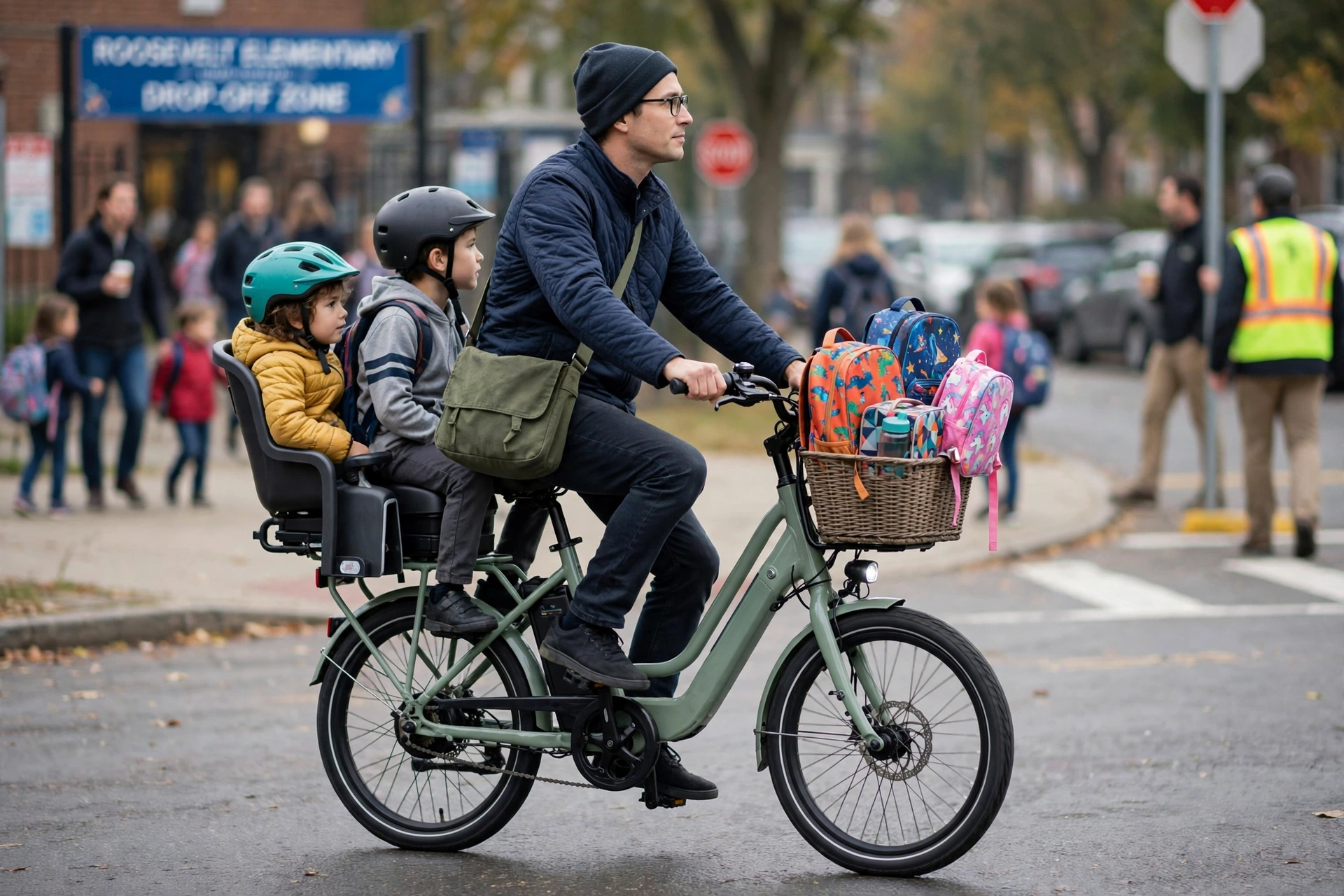
Thing 1: Start with the cargo bikes — the Abound LR and Abound SR
The Aventon Abound LR costs $1,999 (checked October 25, 2026) and is the full-size family hauler: a long rear deck, 88 pounds of bike, room for two children plus the weekly shop. The Abound SR costs $1,899 (checked October 25, 2026), weighs 80 pounds, and trims the rear deck from 29 inches to 22. Same motor, same battery, same brains — just a shorter tail for tighter hallways and smaller garages.
My opinion, plainly: buy the LR unless your storage space genuinely forbids it. Those extra 7 inches of deck are the difference between a calm school run and a daily game of luggage Tetris. One hundred dollars buys you out of that game for five years. The SR is a lovely bike for one child and a bag; the LR is the one that swallows two kids, a violin case and a forgotten science project without complaint.
Both bikes arrive with the family hardware already fitted: full fenders, a rear rack, footboards for little passengers, and on the LR a lockable frame storage bag that swallows the Allen keys, a pump and the emergency fruit snacks. When people picture avington e bikes — the ones from the advert, the school gate, the neighbour’s garage — this is the machine they are actually picturing. Fit is one-size, rated for riders from 4’11” to 6’3″, so two parents of different heights really can share one bike — the quill stem adjusts through 140mm of height, which is the unglamorous detail that makes sharing work in practice.
Thing 2: Two kids fit — here is exactly how
This is the section most cargo bike reviews fudge, so let me be specific. The Abound’s total payload is 440 pounds, rider included. The rear rack has its own, lower rating: 143 pounds. That rack number is the one that governs your family, because everything your children sit on hangs off it.
For a child under about five, Aventon’s own family guidance points to the Thule Yepp Nexxt 2 Maxi, a rack-mounted child seat that clicks directly onto the Abound’s rear rack — around $280 (est., typical US retail, October 2026). An older child, five and up, rides on the long rear seat pad with feet planted on the footboards and hands on the grab handles, roughly $120 (est.) for the pad and rail kit. Two panniers at about $110 (est.) the pair take the school bags or 40–60 pounds of groceries. A 170-pound parent, a 45-pound six-year-old in the seat and a 70-pound nine-year-old on the pad comes to 285 pounds all-in: 155 pounds of payload margin left, and the passengers’ combined 115 pounds sits inside the rack’s 143-pound limit. It works, with room for the grocery stop on the way home.
What does not work: three children. There is no third secure spot on that rack, and no honest reviewer should pretend otherwise. If you have three kids under ten, the answer is two trips, a second adult on a second bike, or keeping the car for that one run. Grace’s rule in our house: every bottom on the bike gets a seat, a footrest and something to hold. If a child has none of the three, they do not ride.
One more practical note. These are Class 2 bikes — pedal assist plus a throttle, up to 20 mph — which is the configuration I recommend for family hauling without hesitation; if you are weighing it against Class 1, our Class 1 e-bike complete guide lays out the legal differences. The throttle is not a toy. Pulling away from a stop sign with 300 pounds rolling behind you is the hardest moment of any cargo ride, and a twist of throttle turns it from a wobble into a non-event.
Thing 3: Range with a load aboard, not the brochure number
Aventon quotes up to 60 miles for both Abounds. Read the fine print and that figure assumes a 165-pound rider, flat pavement, Eco mode. Your life has a hill, two children and a bag of library books in it, so plan around the tested numbers instead. Outdoor Gear Lab’s instrumented testing measured 33.4 miles from the Abound LR and 28.4 miles from the SR, and named the LR its Best Overall Cargo Bike; Electric Bike Review’s testers saw 38 miles at maximum assist and 75 at minimum on mostly flat ground. Loaded with kids and ridden the way parents actually ride — Tour mode, throttle at junctions — my planning figure is 28–35 miles per charge (est., based on those published tests adjusted for passenger weight).
Hold that against a real family week. Nobody buys avington e bikes to chase range records; they buy them to do the school run in the rain without thinking about the battery. A 2.4-mile round-trip school run twice a day, three grocery or errand trips of 4 miles, and a 6-mile weekend ride to the park totals about 37 miles a week. You are charging once a week, maybe twice in a heavy week, and the 5-hour charge happens overnight while the bike sits in the garage. Range anxiety, for this job, is a solved problem. And because the battery is shared across the Abound SR, Aventure 3, Level 3 and Pace 4, a household that later adds a second Aventon can swap packs between bikes — a small thing that feels enormous the first morning one bike is flat and school starts in twenty minutes.

Thing 4: The second-car maths — what five years really cost
Here is the computation I run for every family that asks me whether a cargo bike can retire a second car. It uses the pattern above — about 1,300 family miles a year (est., from the school-run, errand and weekend pattern above) — over five years, so 6,500 miles either way.
The Abound LR, five years: bike $1,999 + child seat, seat pad and panniers about $510 (est.) + electricity 27 dollars (6,500 miles ÷ 30 miles per charge = 217 charges × 0.733 kWh × $0.17/kWh, est. US average rate) + maintenance at $120 a year (est., tyres, brake pads, chain, one annual tune) = $600 + one replacement battery reserve of $550 (est.). Total: $3,686, which is $0.57 per mile. For more on what those charges cost per kilowatt-hour, our breakdown of how much it costs to charge an electric bike does the penny-by-penny version.
A cheap second car, same five years, same 6,500 miles: buy a used runabout for $6,500 (est.) and sell it five years later for $3,200 (est.), so $3,300 of depreciation + insurance at $1,150 a year (est.) = $5,750 + fuel: 6,500 miles ÷ 25 mpg = 260 gallons × $3.45 (est.) = $897 + maintenance and repairs at $550 a year (est.) = $2,750 + registration and inspection at $90 a year (est.) = $450. Total: $13,147, which is $2.02 per mile.
The car costs about three and a half times more per mile, and the five-year gap — roughly $9,460 — is a family holiday, or a year of music lessons, or most of a bathroom refit. I am not going to pretend the bike replaces the car for the motorway trip to grandparents. It does not, and our family kept one car for exactly that. What it replaced was the second car, the one that existed mostly to do 2-mile trips with the engine cold. Those are the most expensive, most miserable miles a car ever does, and they are the miles a cargo bike was born for.
Thing 5: Safety, weight and the honest limits
Three things to face before you buy. First, weight: the LR is 88 pounds before a single child climbs on. You will not carry it up apartment stairs, full stop. Ground-floor storage, a garage corner or a covered porch is a requirement, not a preference — measure your space before the box arrives. Second, children wear helmets on the back of my bike, every ride, no negotiation, and you should check your state’s passenger rules because they vary. Third, the ACU security kit — GPS tracking, geofence alerts, a kickstand lock that stops the bike being rolled away while you load it — reads like a gimmick on a spec sheet. Parked outside a school twice a day, every day, it is the feature you will be most grateful for. The 4G connection is free for the first year; budget for a paid plan after that (est., pricing not yet published by Aventon for year two).
The brakes deserve their own sentence: Tektro hydraulic discs with a big 203mm rear rotor, sized for stopping a loaded bike, and they are paired with integrated lights and turn signals. Whoever specced this bike has clearly done a wet school run.
Thing 6: The Aventure 3, for when the kids ride their own bikes
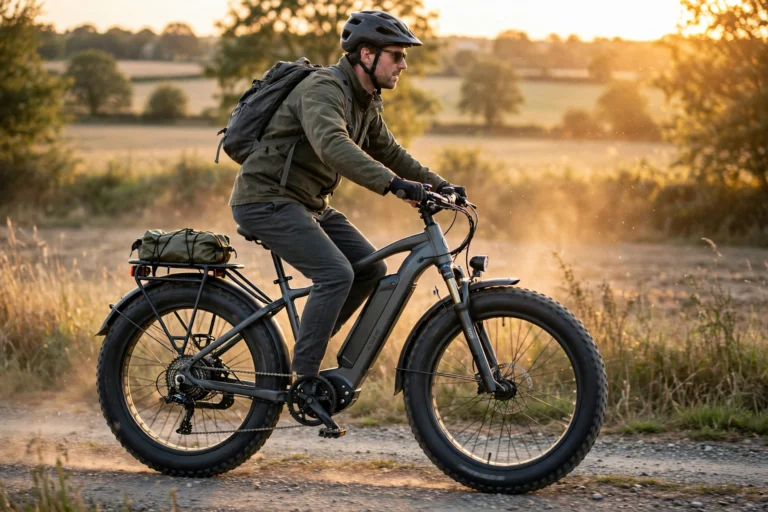
Once your children are on their own bikes, the family equation changes, and this is where the Aventure 3 earns its mention: $1,999 (checked October 25, 2026), the same 750W motor family and ACU brains, 4-inch fat tyres, a suspension fork and up to 65 miles of claimed range. It is the bike for the parent who escorts kids to school then keeps going — gravel paths, beach weekends, the longer way home. Our electric bike trekking guide covers that kind of riding properly. What it is not: a two-child hauler. Its rear rack is a standard short rack, fine for one child seat or panniers, and I would not put two passengers on it. Buy it as the family’s adventure bike, not as a cut-price Abound.
Thing 7: Our verdict on the bikes behind avington e bikes
Aventon Abound LR — Our score: 8.8/10 (Range 8/10 · Charging 7/10 · Value 10/10). The default family answer. Two kids, a week of groceries, a 440-pound ceiling you will never trouble, and a price that undercuts most of the long-tail field. The 5-hour charge is the only everyday irritation.
Aventon Abound SR — Our score: 8.4/10 (Range 7/10 · Charging 7/10 · Value 9/10). Everything good about the LR in a shorter, 8-pounds-lighter package. The right call for one-child families, narrow storage and tight drop-off zones; the wrong call if a second child is even a rumour.
Aventon Aventure 3 — Our score: 7.9/10 (Range 8/10 · Charging 7/10 · Value 8/10). A strong, likeable fat-tyre all-rounder that happens to share a battery with the cargo bikes. It scores lowest here only because this article judges through a family-cargo lens, and hauling children is not its job.
The short version: the name you searched for does not exist, and the name you meant builds the cargo bike I would buy with my own money. Of all the avington e bikes questions that land in my inbox, this is the one with the happiest ending. Start with the Abound LR, add the child seat before the accessories catalogue seduces you into anything shinier, and let the second car go.
FAQ: avington e bikes questions, answered straight
Are avington e bikes a real brand I can buy? No. There is no e-bike company called Avington — no products, no dealers, no website selling bikes under that name. It is a misspelling of Aventon, the California brand founded in 2012, and every search result for the term points at Aventon’s range. If a site ever offers you an “Avington” bike for sale, treat it as a red flag and walk away.
How many children can an Aventon Abound carry? Two, comfortably and safely: one under-five in a rack-mounted child seat such as the Thule Yepp Nexxt 2 Maxi, and one older child on the rear seat pad with footboards. The rear rack is rated to 143 pounds, which is the limit that matters, and there is no secure third spot — three children is a no.
How far will an Abound LR really go with two kids aboard? Plan on 28–35 miles (est., from published instrumented tests adjusted for load). Outdoor Gear Lab measured 33.4 miles in its range testing, against Aventon’s 60-mile claim, which assumes a 165-pound rider on flat ground in Eco mode. For school runs and errands inside a five-mile radius, you will charge about once a week.
Can an Aventon cargo bike actually replace a second car? This is the question behind most avington e bikes searches, once the spelling is sorted. For the trips a second car usually exists for — school runs, groceries, sports practice, errands under five miles — yes, and our five-year maths above puts the saving at roughly $9,460 against a cheap used runabout. It will not replace a car for motorway trips or a long commute, which is why most families, ours included, go from two cars to one rather than one to none.
What does it cost to charge an Abound battery? The 733Wh pack costs about 12 cents to fill from empty at $0.17/kWh (est. US average residential rate): 0.733 kWh × $0.17 ≈ $0.12. A year of school-run charging came to roughly five dollars in the maths above. Charging itself takes about 5 hours on the supplied 4A charger.
Abound LR or Abound SR — which suits a family better? The LR, for almost everyone: the 29-inch rear deck takes two children plus bags without juggling, for $100 more. Choose the SR if storage is genuinely tight or you will only ever carry one child — it is 8 pounds lighter and noticeably easier to thread through a crowded drop-off zone. Independent testers at Outdoor Gear Lab’s cargo bike tests rated both highly, with the LR taking their Best Overall award.