Last updated: October 25, 2026
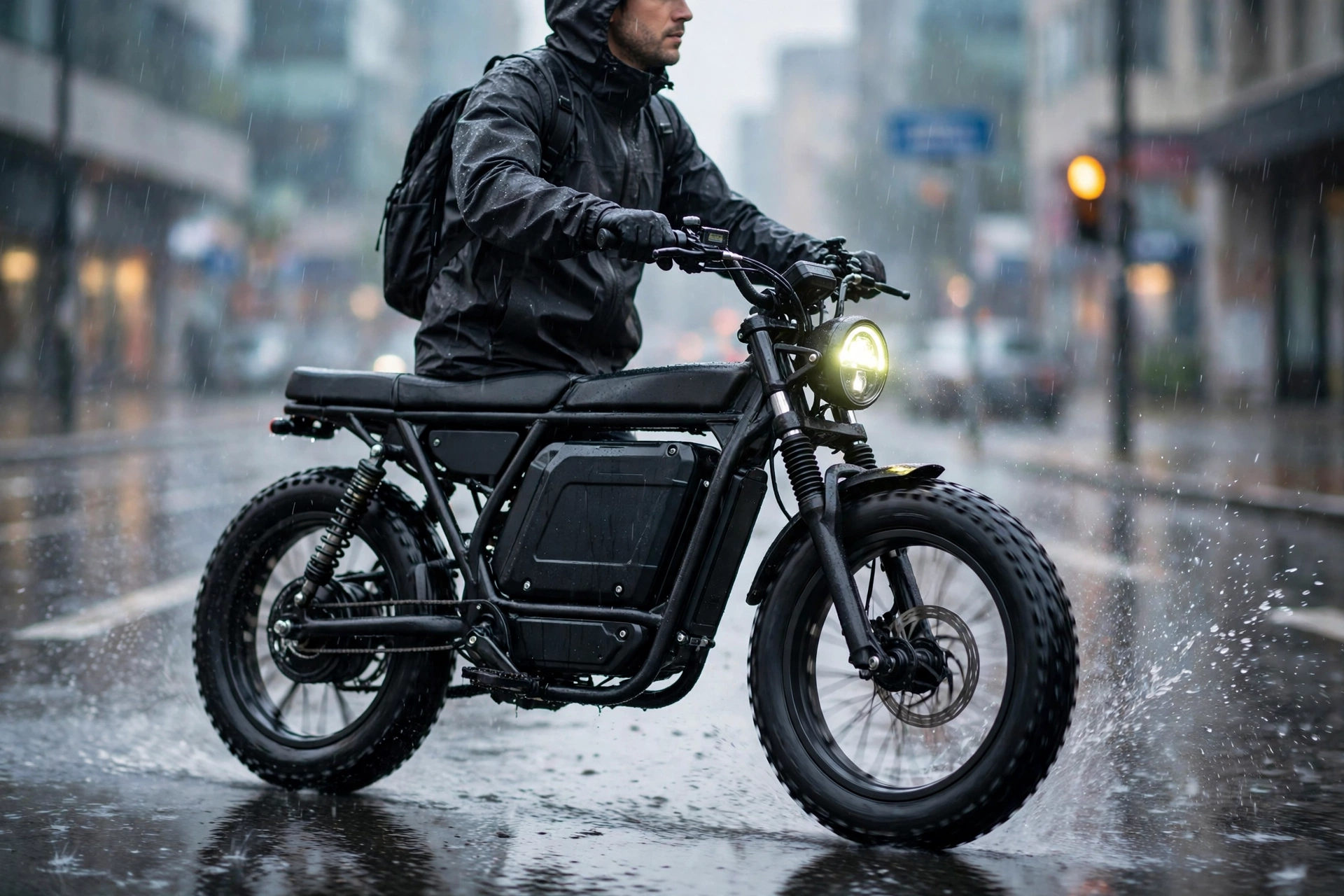
A ridstar electric bike is what happens when a moped and a fat-tyre bicycle share a shipping container. The formula is consistent across the range: a retro motorcycle-style frame, 20×4-inch knobby tyres, a long bench seat, a round headlight, full suspension and a motor with more watts than the law in most places allows. Prices start where respectable commuter bikes end, which is exactly why people buy them. The catch is equally consistent: the spec sheet writes cheques the battery can’t cash. This guide decodes the lineup, does the range maths the listings won’t, and says plainly which one — if any — deserves your money.
Ridstar sells mostly through Amazon and a shifting cast of brand storefronts. That matters more than any single spec. The same Q20 appears with a 1,000W motor in one listing and a 1,500W motor in another, at prices that wander by hundreds of dollars depending on the week and the warehouse. One Canadian retailer that stocks the brand reports that five different websites claim to be the official Ridstar store, and the factory itself disowns all of them.
Treat every number attached to a ridstar electric bike — in this article and everywhere else — as a claim until it’s labelled tested.
What follows uses three sources: the brand’s own manuals and catalogue listings (prices checked October 25, 2026), independent expert testing where it exists, and owner reports for the things spec sheets never mention, like whether anyone answers the support inbox. Where a figure is our estimate rather than a published or tested number, it’s marked (est.) with the basis shown.
The short version, for readers in a hurry: the standard Q20 is the only one that makes sense, the range claims are roughly double the throttle-only truth, and at somewhere between 70 and 88 pounds this is a ground-floor bike. If your commute involves carrying anything up stairs, close the tab now. Still here? Good. Let’s take the range apart properly, because that is where Ridstar ownership is won and lost.
For shoppers comparing options, a ridstar electric bike stands out mainly on battery size per dollar, not on dealer support. That trade-off is worth weighing before you buy a ridstar electric bike for daily commuting. In short, choosing a ridstar electric bike means prioritising battery value over after-sales certainty.
The ridstar electric bike lineup, decoded
Q20 Lite. The entry point. A 1,000W rear hub motor, a 48V 15.6Ah removable battery (about 749Wh), 20×4 fat tyres, dual suspension and a Shimano 7-speed drivetrain. The manual caps it at roughly 25 mph and claims up to 35 miles on pedal assist or 25 miles electric-only. It weighs 66 pounds and uses a high-carbon steel frame. US listings cluster around $999–$1,099 (est., checked October 25, 2026; marketplace prices move weekly).
Q20. The one everyone means. A 1,500W hub motor (85 Nm claimed) and a 48V 20Ah battery — 960Wh, the biggest single number in this price class. Hydraulic dual disc brakes, dual suspension, the same 7-speed Shimano setup and a claimed top speed of 33 mph.
The catalogue listing for the Q20 puts the US list price at $969 (checked October 24, 2026). Most listings claim 50 miles of range; the manual is bolder still, quoting up to 80 miles in the lowest assist mode and 35 miles electric-only. Hold those numbers up to the light in the next section.
Q20 Pro. Two of everything: dual 1,000W motors (2,000W total) and two 52V 20Ah batteries for 2,080Wh. Claimed top speed rises to about 35 mph, and US prices sit around $1,799–$1,849 (est., checked October 25, 2026). It also gains mirrors and all-wheel drive you can toggle between front, rear or both motors. Note that the same bike is now also sold under a second badge, YVY C20 Max — same hardware, different sticker.
H20 and H20 Pro. The folding branch of the family. The H20 pairs a 1,000W motor with a 48V 15Ah battery; the H20 Pro goes to a claimed 2,000W and a 48V 23Ah pack (1,104Wh), which is a lot of battery for a folder. The brand’s own store showed the H20 Pro at $799 (checked within the last 72 hours of writing). Folding a bike that weighs around 75 pounds (est.) is a technicality, not a feature.
S29. The outlier — a 1,000W, 48V 15Ah bike on 29-inch wheels that actually looks like a bicycle. If the moped styling puts you off, this is the Ridstar for you, and it’s the least popular model in the range, which tells its own story about why people buy these.
Every model ships about 90% pre-assembled, includes fenders, lights with brake activation, a phone holder and a small cargo bag. On paper, the value is startling. Paper is doing a lot of work in that sentence.
Claimed range vs real range: the ridstar electric bike maths
Range claims fail in a predictable way: they’re measured at the lowest assist level, at low speed, with a light rider, on the flat. Your commute has none of those properties. The honest way to check any claim is watt-hours divided by watt-hours per mile. A heavy fat-tyre bike on mixed throttle and assist work uses roughly 27–40 Wh per mile. Now watch the claims dissolve.
The Q20 carries 960Wh. Divide by the claimed 50 miles and you get 19.2 Wh/mile — a figure a lightweight road e-bike might manage at a gentle pace, not an 80-pound moped on 4-inch knobs. The manual’s 80-mile claim implies 12 Wh/mile, which is walking pace with a tailwind. Independent expert testing covered by BikeRide’s Ridstar Q20 review found the truth: about 35 miles on pedal assist and 25 miles throttle-only from the standard 960Wh battery. Our maths agrees with the testers. 960 ÷ 25 = 38.4 Wh/mile on the throttle; 960 ÷ 35 = 27.4 Wh/mile pedalling along.
Owner reports of 20–25 miles in normal use sit right on that throttle line.
Run the same maths across the range. The Q20 Lite’s 749Wh works out to roughly 19–20 miles throttle-only and 27 miles on assist (est., derived from the tested Q20 consumption figures above) — against claims of 25 and 35. The Q20 Pro’s 2,080Wh at a dual-motor 40 Wh/mile (est.) gives about 52 miles of throttle range, which is genuinely a lot, delivered at the price of charging two packs for 6–8 hours.
Now the comparison nobody at Ridstar will print. The Q20’s US list price of $969 divided by its 25 tested throttle miles is $38.76 per mile of real range. Divided by its 35 tested assist miles, $27.69. A mainstream fat-tyre rival — Aventon’s Aventure class at $1,999 with a 720Wh pack (est., brand list price and published spec) — costs $2.78 per watt-hour against the Q20’s $1.01 per watt-hour.
The Ridstar gives you more battery per dollar than almost anything with a warranty department. What it does not give you is the warranty department. Which brings us to everything else.
Speed claims, briefly: the Q20’s 33 mph is believable on a full charge on the flat — owners and reviewers both report low-30s. What the listings omit is the sag. A hub motor working hard on a long climb gets hot, and multiple owners report power fading halfway up sustained grades, with speed dropping from 30 mph toward 15. For a flat-city commute, irrelevant. For a hilly one, it’s the whole review. That is the ridstar electric bike pattern in miniature: loud headline numbers, honest hardware underneath.
Living with a ridstar electric bike on a commute: weight, rain and arriving presentable
Start with the number Ridstar can’t agree with itself about. The Q20’s own manual lists the bike at 88 pounds; the spec catalogue lists 70.1 pounds. Both documents are Ridstar’s. The truth (est., based on the battery, steel hardware and dual suspension) is nearer the top of that range once you’ve added the included accessories. Plan for a bike you do not lift. Not onto a train, not up two flights, not onto a roof rack. A ground-floor garage or a lift-served building is not a preference with this bike; it’s a requirement.
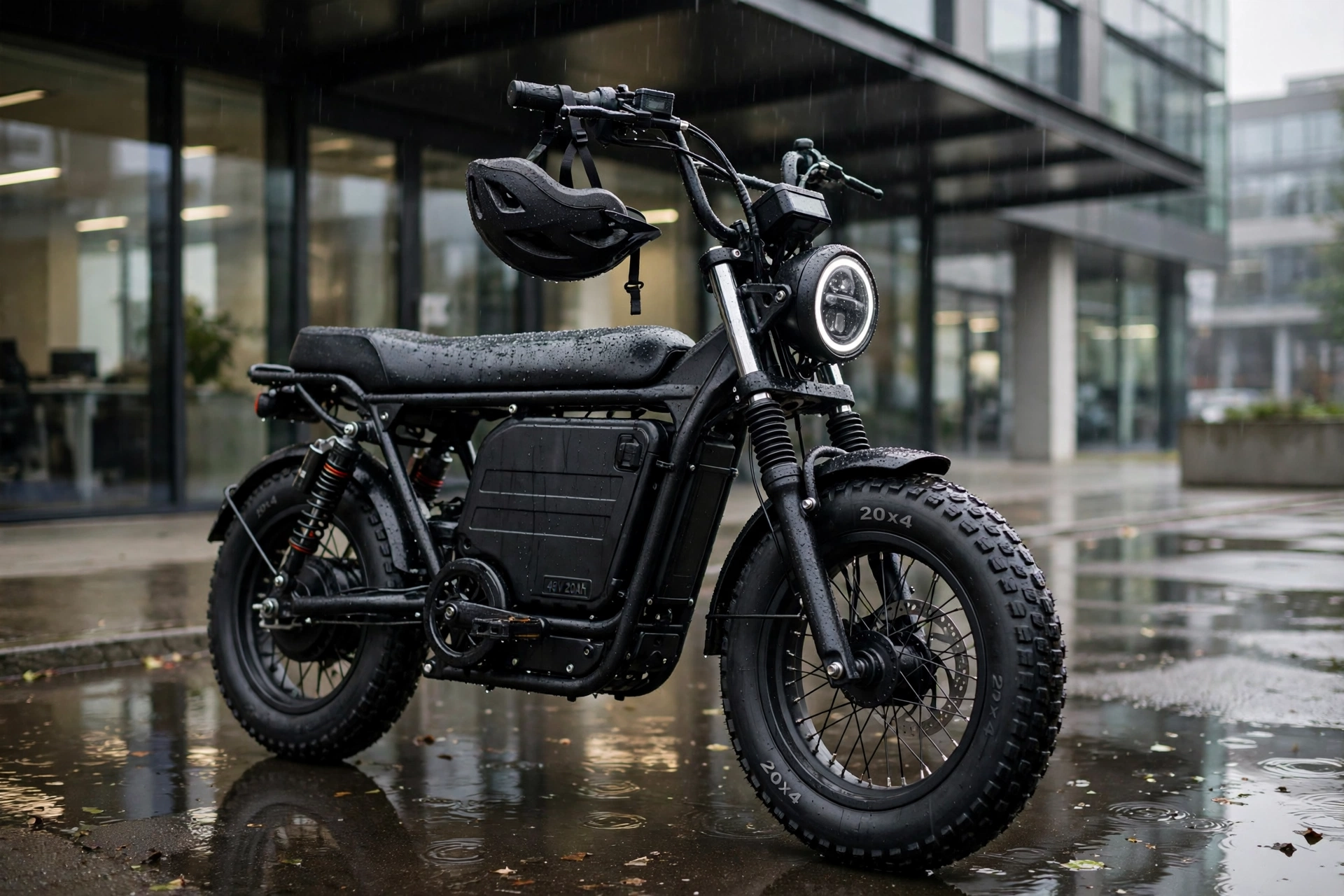
Rain is the second reality. The battery carries an IP54 rating in some listings — splash-resistant, not sealed — and other listings claim IP65 for components generally, which is not the same claim and not necessarily about the same parts. Practically: owners ride these in the rain without drama, and the electrics shrug off a wet commute. What doesn’t shrug it off is you.
The long bench seat is a sponge with a vinyl cover; park outside in a shower and you’ll sit in it all the way home. The fat tyres throw a rooster tail of road water up your back despite the included fenders. Arriving un-sweaty is effortless — the throttle sees to that. Arriving dry takes waterproof trousers and a spare layer, same as any bike.
Hills sort commuters into two camps. Short, sharp climbs are fine; the 85 Nm (claimed) hauls the bike and rider up city grades without pedalling. Long climbs are where the motor’s thermal limits show up, as covered above. If your route has a mile of continuous climbing, test-ride that exact hill before you commit, or choose a mid-drive bike instead.
Charging is the one area with no drama. The Q20’s 960Wh pack refills in a claimed 4–6 hours from its basic charger, it’s removable for indoor charging, and a full charge costs about 17 cents at average US household electricity prices. Our own guide to how much it costs to charge an electric bike runs the same sums for the rest of the market; the Ridstar sits at the cheap end even there. The Q20 Pro’s twin packs are the exception — 6–8 hours (est.) if you charge both from the included chargers, and two chargers to keep track of.
Running costs, at least, are painless. The 20×4 tyres are cheap generic rubber — a replacement is a fraction of what a name-brand fat tyre costs — and a chain, brake pads and a Shimano 7-speed cassette are all commodity parts any shop stocks. Electricity is the 17 cents a charge noted above. The expensive consumable is the battery, covered in the next section, and the second most expensive is your own time when a proprietary electrical part fails.
Security deserves one blunt paragraph. A $969 bike that looks like a small motorcycle attracts exactly the attention you’d expect, it cannot be carried into most offices, and it will live locked outside. Budget for a serious chain lock and accept that the bench seat and wheels are exposed to weather and worse. Riders who need to fold a bike into a flat or a small car boot should look at our e-bike dirt and off-road guide for lighter alternatives before they look at the H20 folder and its 75 pounds.
Build quality, parts and the after-sales lottery
The hardware on a ridstar electric bike is better than the price suggests. The Q20’s hydraulic brakes on 180mm rotors are genuinely good — reviewers single them out as stronger than the mechanical discs common at this money. The frame feels sturdy at speed, the saddle is wide and comfortable, and the included kit (lights, horn, fenders, phone mount) is generous. Assembly is an evening’s work with the supplied tools.
Then something small breaks, and the ownership experience changes character. Ridstar’s manual promises a 1-year warranty on components and lifetime technical support. Owner reports split sharply: some buyers describe responsive support and quick controller replacements; others report unanswered emails and long waits for parts.
The deeper problem is structural — outside a handful of dealers, nobody stocks Ridstar parts. The Canadian retailer mentioned earlier claims to be the only seller in its market holding parts inventory at all. A display, a controller, a throttle: expect to order from the seller and wait, or improvise with generic components and a local shop willing to touch an unfamiliar electrical system. Many shops won’t.
Battery longevity is the quiet risk. Owners in hot climates report noticeable capacity loss after the first year, and a replacement 960Wh pack is not a catalogue item with a stable price — budget $400–600 (est., based on comparable generic 48V 20Ah packs) if you ever need one, and treat that as a real possibility in year three rather than a hypothetical.
None of this makes the bike a bad purchase. It makes it a purchase where the low price is partly a transfer of risk from the manufacturer to you. Some buyers happily accept that trade. Daily commuters who cannot afford a dead bike on a Monday morning should think harder about it.
Is it actually an e-bike in the eyes of the law?
Mostly, no. The three-class system used across most US states caps an electric bicycle at 750W, with top assisted speeds of 20 mph (Classes 1 and 2) or 28 mph (Class 3). A ridstar electric bike like the Q20 ships with 1,500W and a claimed 33 mph.
That is not a rounding error; it places the bike outside the class system entirely in most jurisdictions, where it may be treated as a moped or off-road vehicle with registration, licensing and helmet rules to match. Our Class 1 e-bike guide explains where the legal lines sit and why they matter for trail and bike-path access.
Some Ridstar listings offer speed-limited or detuned configurations, and some riders restrict the bike through the display settings. A limiter you can remove in thirty seconds may or may not satisfy your local rules — that question belongs to your state’s vehicle code, not a product page. Ride it on bike paths at 30 mph and you are the reason paths get e-bike bans. Ride it as what it is — a small, quiet electric moped for roads where it’s permitted — and it’s a perfectly reasonable machine.
Verdict: our scores for the ridstar electric bike range
Our verdict on the ridstar electric bike range is simple: buy the standard Q20 and stop there. It is the sweet spot of the range: the big battery, the good brakes, the lowest price per watt-hour in its class. The Lite gives up too much battery to save too little money, and the Pro doubles the motors, the charging faff and the legal exposure to solve range anxiety that 960Wh already answers for most commutes.
Ridstar Q20 — Our score: 6.8/10 (Range 6/10 · Charging 7/10 · Value 9/10). Tested range is honest-average; the value per watt-hour is anything but average.
Ridstar Q20 Pro — Our score: 6.4/10 (Range 8/10 · Value 7/10 · Charging 5/10). Real 50-mile throttle range (est.) is impressive; twin-pack charging and 2,000W of legal ambiguity are not.
Ridstar Q20 Lite — Our score: 6.1/10 (Range 5/10 · Charging 7/10 · Value 8/10). Cheaper and lighter, and the maths in this guide shows how quickly its smaller battery runs out of road.
The scores assume a flat-to-rolling commute, ground-floor storage and a rider who treats the support network as a bonus rather than a plan. Change any one of those and the verdict changes with it.
Frequently asked questions
How far does a ridstar electric bike really go? For the standard Q20, independent testers recorded about 35 miles on pedal assist and 25 miles throttle-only from its 960Wh battery. Claims of 50–80 miles assume the lowest assist level at low speed. Plan your commute around the tested numbers and you’ll never be caught out.
Can I ride a Ridstar Q20 in the rain? Yes, with ordinary care. The battery is splash-rated (IP54 in most listings), and owners commute in the rain routinely. Dry the bike afterwards, keep the charge port cover seated, and don’t store it wet for weeks. Your clothes are the weak point, not the electrics.
Why do listings disagree about the Q20’s weight and motor? Because Ridstar sells through many storefronts with inconsistent spec sheets — the manual says 88 pounds, the catalogue says 70.1 pounds, and motor ratings vary between 1,000W and 1,500W by listing. Confirm the exact configuration on the page you buy from, and screenshot it.
What happens when something breaks? The warranty is 1 year on components. Some owners report fast, helpful support; others report silence, and few dealers stock parts. A competent local shop can handle the bicycle parts (brakes, gears, tyres) even if it won’t touch the electrics.
Is the Q20 Pro worth the extra money over the Q20? For most riders, no. You pay roughly double for a second motor and battery, a longer charge, and more weight. If your round trip genuinely exceeds 40 miles of throttle riding, the Pro earns its price. Otherwise the standard bike is the rational buy.