Last updated: October 25, 2026
Big month for anyone shopping chevy ev cars. The federal $7,500 clean vehicle credit is gone — the IRS closed it to vehicles acquired after September 30, 2025 — and Chevrolet answered in the most Chevrolet way possible: it brought back the Bolt. The 2027 Bolt reaches dealers early in 2026 as a limited run, starting at $28,995 including destination. Add the 2026 Equinox EV, Blazer EV and Silverado EV, and the bowtie now covers electric driving from under $29,000 to $91,295.
Four nameplates. Three body styles. One very wide price ladder. This guide tracks what each model costs right now (prices checked October 25, 2026), what the EPA says about range, how fast each one charges, and where the value actually sits. Short version up front: the Equinox EV is the volume story, the Bolt is the price story, and the Silverado EV Max Range is the range story — 493 EPA-estimated miles in Work Truck trim.
What changed for chevy ev cars this month
First, the credit. Any deal math you ran in the summer is stale. With the federal credit gone, sticker prices have to stand on their own, and Chevrolet has started leaning on its own cash offers instead — a $1,000 cash discount was showing on the Blazer EV SS on Chevrolet’s site this month. Read the fine print, then negotiate like the credit never existed.
Second, the Bolt is real, and it is not a 2026 model. Chevrolet announced it in October 2025 as a 2027 model, shipping to customers early next year on a limited-run basis. GM’s reveal price was $29,990 including the $1,395 destination charge; the on-sale sticker settled at $28,995 including destination for the LT. Either way, it undercuts everything else in the showroom.

Third, the truck lineup got reshuffled. The Silverado EV drops the launch-era RST trim for 2026 and adds a Trail Boss with 35-inch tires and a factory lift. The Blazer EV quietly dropped its rear-wheel-drive version. The Equinox EV took a small price bump — the base car is about $1,500 up on last year at $36,495 including destination — and picked up two style packages, a $595 Midnight Package and a $3,595 Tech Bronze Package, in place of any hardware changes.
Fourth, a warning buried in the trade press: Kelley Blue Book reported this month that Chevrolet may trim Bolt production below early plans. A limited run that gets more limited is a buying-timing story, and it shapes our advice further down this page.
Chevy ev cars at a glance: price, range and the cost of a mile of range
Here is the full ladder, base trims first, every price including destination (checked October 25, 2026). The last column is our own computation — sticker price divided by EPA-estimated range — because it exposes which badges charge you for style and which charge you for battery.
| Model | Base price (incl. destination) | EPA-est. range | Price per mile of range |
|---|---|---|---|
| 2027 Bolt LT | $28,995 | 262 miles | $111 |
| 2026 Equinox EV LT FWD | $36,495 | 319 miles | $114 |
| 2026 Blazer EV LT FWD | $46,095 | 312 miles | $148 |
| 2026 Silverado EV Work Truck Standard Range | $54,895 | 286 miles | $192 |
| 2026 Silverado EV Work Truck Max Range | $76,295 | 493 miles | $155 |
| 2026 Blazer EV SS | $62,095 | 302 miles | $206 |
The arithmetic is simple enough to do on a napkin. Bolt: $28,995 ÷ 262 miles = $110.67, call it $111 per mile of range. Equinox EV: $36,495 ÷ 319 = $114.40. Now look at the Silverado EV. The Standard Range Work Truck works out to $192 per mile of range; the Max Range version, despite costing $21,400 more, drops to $155 per mile because the big battery adds 207 miles. If you genuinely need a long-range truck, the Max pack is the honest buy. The Standard pack is a fleet price point wearing a big truck’s clothes.
Running costs tilt the same way. Chevrolet’s official electric vehicle page lists the lineup, and the EPA’s ratings at fueleconomy.gov put the 2026 Equinox EV AWD at 33 kWh per 100 miles, a $750 annual fuel cost and $1.22 to drive 25 miles. Run 12,000 miles a year at a $0.17 per kWh home rate (est., close to the current US residential average) and the Equinox EV drinks 12,000 × 0.33 = 3,960 kWh, about $673 a year. The Silverado EV’s 70 MPGe rating works out near 48 kWh per 100 miles: 12,000 × 0.48 = 5,760 kWh, roughly $979 a year (est.). Still cheap next to gasoline. Just not equally cheap. Our electric car cost per mile breakdown shows where your own rate lands.
The 2027 Bolt: the cheapest of the chevy ev cars, back for a limited run
Status first, precisely. The Bolt is a 2027 model. Chevrolet announced it in October 2025, production runs at Fairfax Assembly in Kansas City, Kansas, and cars ship to customers early in 2026 — “for a limited time,” in GM’s own words. It is on sale during 2026, it wears a 2027 badge, and nobody should plan on it being around forever. An 18-month production window has been reported (est.), and October brought word that GM may build fewer than first planned.
The hardware is a proper reboot, not a reheating. A 65 kWh lithium iron phosphate (LFP) battery replaces the old pack, feeding a 210 hp front motor borrowed from the Equinox EV’s parts bin. EPA-estimated range is 262 miles. DC fast charging peaks at 150 kW — roughly triple the old Bolt’s rate — with a 10–80% charge in about 26 minutes. And the Bolt is the first Chevy EV with a native NACS port, so Tesla Superchargers plug straight in, no adapter in the glovebox.
Trims are simple. LT at $28,995 including destination. RS from $31,600, with gloss black wheels and available Super Cruise. A fully loaded RS can wander past $38,000, at which point you should walk across the lot and look at the Equinox EV instead. Seriously. The Bolt’s magic lives within a few thousand dollars of its base price.
Home charging math is friendly: 65 kWh × $0.17 = $11.05 for a full battery (est. at that home rate), good for 262 EPA miles. For an apartment dweller with workplace charging or a short commute, that is close to the cheapest new-car running cost in America right now.
Our score: 8.7/10 — Range: 7.5/10 · Charging: 8.5/10 · Value: 9.8/10
The verdict is blunt. This is the best value in the entire Chevrolet electric lineup, and it is the one with an expiry date. If a sub-$30,000 EV fits your life, the time to move is when allocation opens, not after a season of reviews.
Equinox EV: the volume seller among chevy ev cars
The Equinox EV is the Chevrolet electric story in 2026. It has been the best-selling non-Tesla EV in the US, and the formula is boring in the best way: an 85 kWh battery, 319 miles of EPA-estimated range in front-wheel drive, and a $36,495 starting price including the $1,395 destination charge (checked October 25, 2026).
Three trims: LT, LT 2 and RS. Front-wheel drive is standard; all-wheel drive adds $5,300 and trims range to 307 miles. Front-drive cars make about 220 hp; dual-motor AWD versions reach roughly 300 hp. Every trim gets the same huge 17.7-inch center screen with Google built in. No Apple CarPlay. No Android Auto. That omission still annoys people daily, and Chevrolet still has not budged.
What changed for 2026 is modest. Prices crept up about $1,500 at the base. Two appearance packages arrived. Nothing about the battery, motors or charging curve moved. Read that as confidence, or read it as a model coasting on a strong hand — either way, the spec sheet that won last year is the spec sheet on sale now.
Charging is the one middling number. DC fast charging peaks at 150 kW, adding roughly 70–80 miles in 10 minutes, and Chevrolet quotes about 35–42 minutes for a 10–80% session depending on conditions. Home charging runs at 11.5 kW for most versions, which refills the 85 kWh pack overnight without drama; fueleconomy.gov also lists an AWD variant with a higher-output charger, and that version’s range rating drops to 288 miles, so check the window sticker of the exact car you are buying. A full home charge costs 85 × $0.17 = $14.45 (est. at that rate).
Cargo space is 57.2 cubic feet with the rear seats folded. There is no front trunk. Families cross-shopping a Tesla Model Y will notice the missing frunk; families cross-shopping a gas Equinox will notice the flat floor and the silent school run instead.
Our score: 8.9/10 — Range: 9.2/10 · Charging: 7.4/10 · Value: 9.4/10
Our position, no hedging: if your budget is $35,000–$45,000 and you are buying one EV this year, start here and make the rivals argue you out of it. The Equinox EV is the default answer in this class until somebody beats $114 per mile of range with a badge this easy to service.
Blazer EV: style, an SS badge, and the weakest value case in the range
The Blazer EV is the looker of the chevy ev cars family — low, wide, Camaro-ish around the nose — and the lineup changed shape for 2026. The rear-wheel-drive RS is gone. What remains: LT and RS in front-wheel drive or all-wheel drive, plus the SS, AWD only.
Prices (checked October 25, 2026): LT starts at $44,700 before destination, $46,095 with it. RS starts at $50,500, or $51,895 delivered. SS starts at $60,700, or $62,095 delivered. All-wheel drive adds $3,000 to LT and RS. Range: 312 EPA-estimated miles for FWD LT and RS, 283 miles for AWD versions, and 302 miles for the SS, which carries a bigger 102 kWh battery.
Charging splits by trim. LT and RS use the 85 kWh pack with 150 kW DC fast charging, good for about 83 miles added in 10 minutes on the FWD car. The SS steps up to 190 kW and roughly 78 miles in 10 minutes. Home charging is 11.5 kW across the board. A dual-level charge cord is now standard on every 2026 Blazer EV — a small thing that saves real money, since it covers both 120V and 240V outlets out of the box.
The SS is the headline and the problem. Yes: 615 hp and 650 lb-ft in Wide Open Watts mode, 0–60 mph in 3.4 seconds, Brembo front brakes, Super Cruise standard for 2026 with a three-year OnStar plan included. Also yes: $206 per mile of EPA range on our computation, the worst figure in this entire guide, and the SS is not rated to tow at all — the LT and RS manage 1,500 lb. You are paying sports-car money for a straight-line party trick in a family crossover.
Skip the RS. That is our second blunt call of the day. The LT gives you the same 312-mile FWD range and the same 17.7-inch screen for $5,800 less delivered; the SS gives you a genuine performance machine for about $10,000 more than an AWD RS. The trim in the middle is the worst seat in the house.
Our score: 7.8/10 — Range: 8.6/10 · Charging: 8.2/10 · Value: 6.9/10
Buy the Blazer EV because you love how it looks and you want the SS’s shove, or buy the LT as a roomy, stylish family EV. Buy it for value and you bought the wrong Chevrolet — the Equinox EV exists.
Silverado EV: the heavy lifter of the chevy ev cars lineup
The Silverado EV got simpler and tougher for 2026. Three trims — Work Truck, LT and the new Trail Boss — and the launch-era RST is being sunset. Prices include the $2,095 destination charge (checked October 25, 2026), and they start at $54,895 for a Standard Range Work Truck with 286 EPA-estimated miles.
The battery menu is the whole story. Work Truck: Standard Range, 286 miles, $54,895; Extended Range, 424 miles, $68,295; Max Range, 493 miles, $76,295 — that 493 is EPA-estimated, the longest range of any electric truck on sale. LT: Standard, 283 miles, $62,995; Extended, 410 miles, $71,195; Max, 478 miles (GM-estimated), $91,295. Trail Boss: Extended, 410 miles, $72,095; Max, 478 miles (GM-estimated), $88,695.
Trail Boss is the new face: a factory lift, 35-inch all-terrain tires, red tow hooks, a Terrain Mode and auxiliary switches for lights and gear. With the Max pack it makes up to 725–760 hp depending on configuration and hits 60 mph in about 4.5 seconds. Towing tops out at 12,500 lb across the range (est. for the best-equipped versions), and every trim can push up to 10.2 kW of offboard power to a job site, a campsite or a house during an outage. The Multi-Flex Midgate — the folding bulkhead that stretches the bed into the cab, Avalanche-style — is available on LT and Trail Boss.
Charging is where this truck humiliates its stablemates. DC fast charging peaks at 350 kW, adding up to 100 miles in about 10 minutes. Level 2 charging reaches 19.2 kW, roughly 37 miles of range per hour at home or the depot. The Work Truck also gets the big 17.7-inch screen as standard for the first time in 2026, which quietly fixes the cheapest truck’s biggest cabin complaint.
One honest caveat: the LT Max Range at $91,295 is a lot of money for a pickup, however clever the Midgate is. Fleets and high-mileage drivers should run their own numbers with our EV total cost of ownership calculator before signing — fuel and maintenance savings close some of that gap, not all of it. For the model’s full spec history, see our Chevy Silverado EV deep dive.
Our score: 8.5/10 — Range: 9.9/10 · Charging: 9.6/10 · Value: 6.7/10
If you tow, haul or road-trip a truck, nothing else in this guide is even in the conversation. If you do not, the Silverado EV is an expensive way to buy range you will never use.
Charging speeds across the chevy ev cars range, without the brochure fog
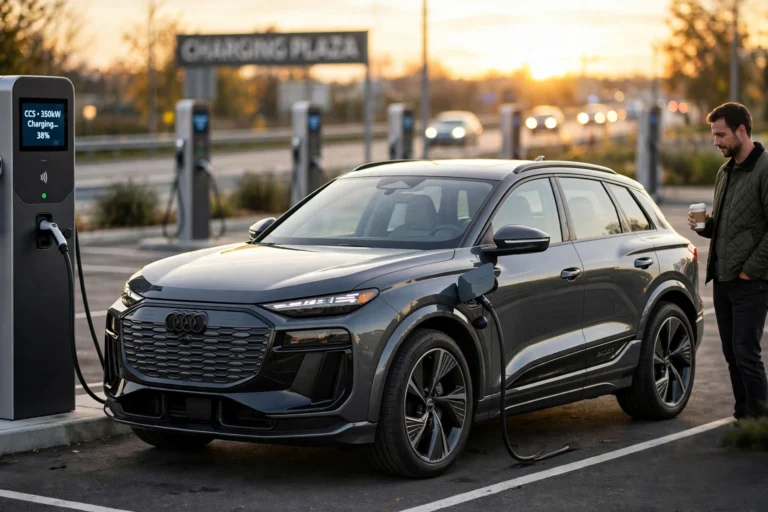
Three numbers matter. DC fast-charging peak: Bolt 150 kW, Equinox EV 150 kW, Blazer EV 150 kW (190 kW on SS), Silverado EV 350 kW. Home charging: 11.5 kW on the crossovers, up to 19.2 kW on the truck. And the port: every 2026 model uses an adapter for Tesla Superchargers today, while the 2027 Bolt skips the adapter entirely with a native NACS port — expect the rest of the range to follow.
What does that mean on a real trip? The Bolt’s 10–80% stop runs about 26 minutes. The Equinox EV needs roughly 35 minutes for the same window under good conditions. The Silverado EV can add 100 miles in around 10 minutes at a charger that can actually deliver 350 kW — and that “can actually deliver” is doing heavy lifting, because plenty of installed hardware cannot. Plan stops around 350 kW-rated sites for the truck or you will charge at crossover speeds in a vehicle with a battery more than twice the size.
LFP versus nickel chemistries matter here too. The Bolt’s LFP pack tolerates being charged to 100% daily far better than the nickel-based packs in the crossovers and truck, which are happiest living between 20% and 80%. Small detail. Big long-term consequence.
Buying timing: what to do this quarter
Three moves, in order. Bolt shoppers: act early in the run. It is limited, production may be trimmed, and the $28,995 LTs will not be the ones sitting on lots in month six. Equinox EV shoppers: the car is carryover for 2026 with a small price rise, so a leftover 2025 at a discount is the same hardware for less money — negotiate on that basis, and check the prices and specs yourself against the manufacturer’s sheet before you trust any dealer’s numbers. Everyone else: the credit is gone, manufacturer cash is replacing it unevenly, and month-end is when that cash gets bigger. Patience is a pricing strategy again.
FAQ: chevy ev cars questions we keep getting asked
How many chevy ev cars are on sale for 2026?
Three 2026 models — Equinox EV, Blazer EV and Silverado EV — plus the 2027 Bolt, which goes on sale during 2026 as a limited run. Chevrolet also sells electric commercial vehicles through GM Envolve, but for personal buyers the lineup is these four nameplates, spanning $28,995 to $91,295 including destination (checked October 25, 2026).
Did the $7,500 federal EV tax credit really end?
Yes. The IRS ended the New Clean Vehicle Credit for vehicles acquired after September 30, 2025. Any 2026 purchase math that includes a $7,500 federal credit is wrong. State, local and utility incentives still exist in places, and Chevrolet has been substituting its own cash offers on some models — the Blazer EV SS showed a $1,000 cash discount this month.
Which Chevy EV has the longest range?
The Silverado EV Work Truck with the Max Range battery: 493 EPA-estimated miles at $76,295 including destination. Among the crossovers, the Equinox EV leads at 319 miles, ahead of the Blazer EV’s 312. The Bolt’s 262 miles is the shortest figure in the range and still more than the old Bolt ever managed.
Is the new Bolt a 2026 or a 2027 model?
A 2027 model, officially. Chevrolet announced it in October 2025, builds it in Kansas City, Kansas, and ships it to customers early in 2026 on a limited-run basis. If a listing calls it a 2026 Bolt, the listing is wrong.
Can Chevy EVs use Tesla Superchargers?
Yes. The 2027 Bolt has a native NACS port and plugs straight in. The 2026 Equinox EV, Blazer EV and Silverado EV use a GM-approved NACS adapter, which opens up more than 20,000 Supercharger stalls through the myChevrolet app. Either way, Supercharger access is part of the deal now, not a workaround.
Which Chevy EV should a family buy first?
The Equinox EV, and it is not close. It pairs the longest crossover range here (319 miles) with the second-lowest price per mile of range ($114) and a $36,495 starting sticker. The Bolt wins only if the budget is hard-capped under $30,000; the Blazer EV wins only on looks and SS speed; the Silverado EV is a tool, not a family car. Start with the Equinox EV and make something else earn the upset.