Last updated: October 25, 2026
Your electricity meter is now the most honest gauge you own. Not the dashboard estimate. Not the charger app. The grey box on the side of your house records every kilowatt-hour your EV actually pulls from the wall — and, as of this month, the price of each one depends on when it spins.
Two things changed in October. On October 23, the EIA published the newest national average residential price: 18.16 cents per kWh for August 2026, up from 17.57 cents a year earlier. And on October 1, Southern California Edison’s winter time-of-use prices took effect. Overnight off-peak power on its EV plan, TOU-D-PRIME, jumped from 24 cents to 30 cents per kWh. Same car. Same charger. A 25% price rise, hiding in a meter most owners never look at.
That is the new reality of EV running costs. The car decides how many kilowatt-hours you need. The meter — and the clock inside it — decides what you pay for them. Read yours properly and you can prove your true cost per mile to the cent. Ignore your electricity meter and you are guessing with your own money.
So tonight, before you plug in, give the meter sixty seconds. Here is exactly what to look for.
The 60-second electricity meter read
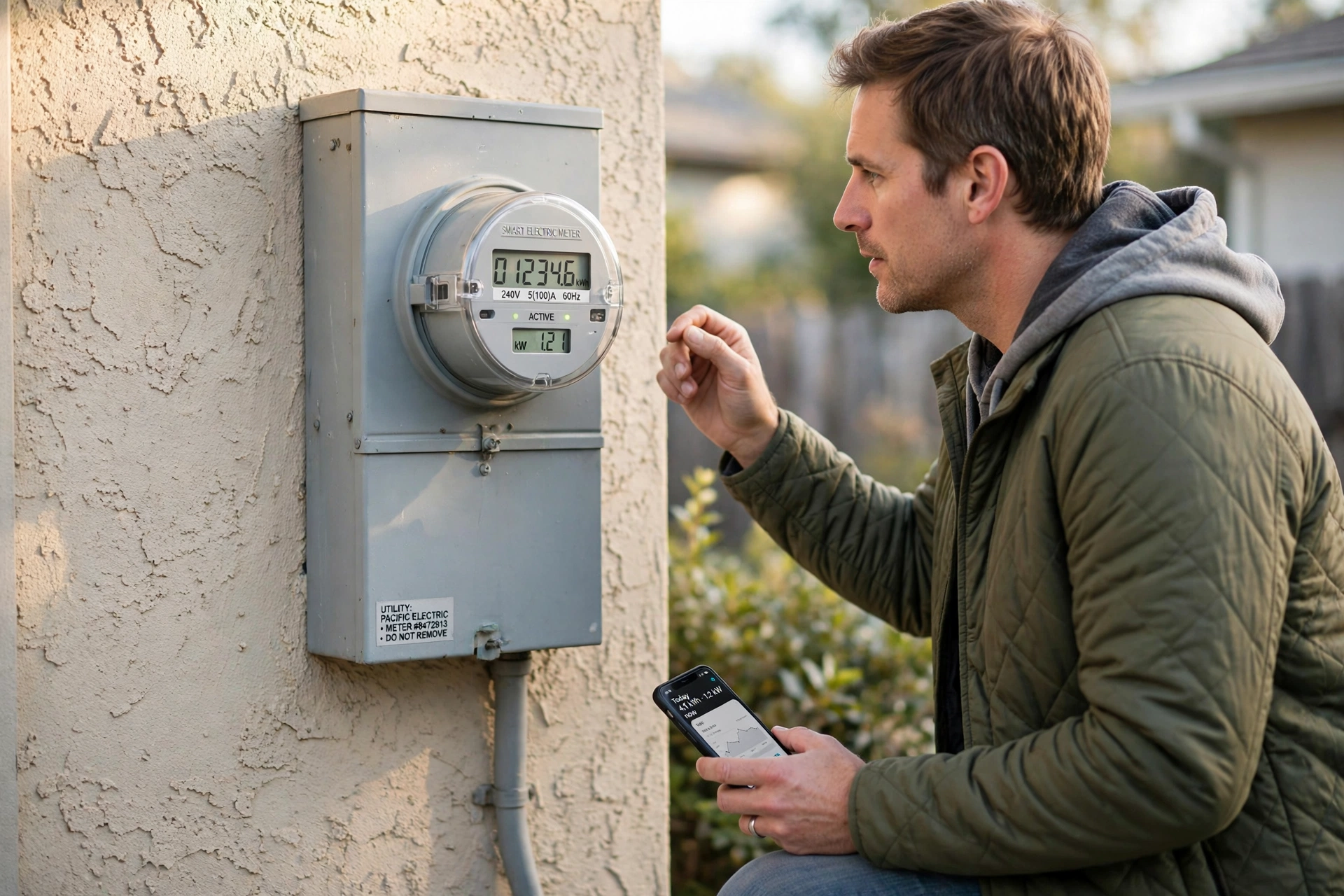
Find the meter first. It usually sits on an outside wall near your breaker panel, about five feet up. In a duplex or an apartment block, match the meter number printed on the case to the meter number on your bill. Reading the neighbour’s meter is the classic rookie error, and it produces terrifying numbers.
Now read the display. A digital or smart meter shows a running total in kWh, and the display may cycle through several screens — wait for the one labelled kWh and write down every digit before the decimal point, leading zeros included. Photograph it with your phone, so the timestamp does the note-taking for you.
That is the whole skill. One reading is a number; two readings are data. Everything in this guide — your EV’s real consumption, your true cost per mile, whether your bill is flat-out wrong — starts with subtracting yesterday’s number from today’s.
Reading your electricity meter this way also builds a habit that pays off every month. A quick electricity meter check before bed can reveal a charger left running or a load you forgot.
Electricity meter types, decoded: dials, digital, smart
Dial meters are the antiques: four or five little clock faces under glass, driven by a spinning aluminium disc. They still serve millions of older US homes, and they still catch people out, because neighbouring dials rotate in opposite directions. The US Department of Energy’s meter-reading guide lays out the rules: when a pointer sits between two numbers, record the lower one; when a pointer looks dead-on a number, check the dial to its right — if that dial has passed zero, the number stands; if it hasn’t, drop one. Read carefully and a dial meter is accurate. Read it casually and you’ll be out by exactly 1,000 kWh.
Digital meters swap the dials for a plain LCD total. No interpretation, no traps. Many are still one-way AMR units, though: a meter reader or a drive-by radio ping collects the total once a month. You get a bill, not a data feed.
Smart meters (AMI) are the ones that changed the game. They record usage at least hourly — most log every 15 minutes — and report it to the utility daily or faster. That interval data is what makes time-of-use pricing, EV rate plans and hourly usage apps possible.
The Edison Foundation counted roughly 128 million smart meters installed across the US by the end of 2023, around 80% of customers, with the total projected near 135 million — roughly 85% — by the end of 2025. Check which electricity meter you actually have before you shop for rates: if your home still has dials in 2026, you’re in a shrinking minority, and your rate options shrink with it. No hourly data, no EV plan.
Time-of-use rates: the clock inside the meter sets your fuel price
A flat rate charges the same for every kWh. A time-of-use (TOU) rate splits the day into windows — peak, off-peak, sometimes super off-peak — and prices each window separately. None of it works without an electricity meter that knows what time it is. The meter’s clock does the sorting; your only job is to make sure the car drinks inside the cheap windows.
SCE’s TOU-D-PRIME is the cleanest example in the country right now, built for homes with an EV, a battery or a heat pump. Its winter prices — October to May, checked October 25, 2026 — look like this:
| Window | Hours | Price per kWh |
|---|---|---|
| Peak | 4 p.m. – 9 p.m. | 45¢ |
| Off-peak | 9 p.m. – 8 a.m. | 30¢ |
| Super off-peak | 8 a.m. – 4 p.m. | 24¢ |
On top of that sits a base services charge of $0.79 a day. Summer flips the pain upward: off-peak drops to 26¢, but the weekday peak hits 61¢. SCE is not an outlier, either — PG&E’s EV2-A plan in Northern California drops to roughly 23¢ overnight against a summer peak near 54¢.
Now compare the flat alternative. On SCE’s own tiered rate page, Tier 1 costs 30¢ per kWh up to 384 kWh a month, then Tier 2 jumps to 39¢. An EV’s extra 300 kWh lands almost entirely in Tier 2. Flat-rate EV charging in SCE country effectively costs 39¢ a kWh, every hour of every day.
My take is blunt: if your utility offers a genuine EV time-of-use plan and you’re still charging on a flat tiered rate, you’re donating money every single night. Switch first. Optimise later. One caution before you jump — on SCE you can’t switch back for 12 months, so pull one month of hourly data from your utility portal first and check your evenings can stay quiet.
Home is where the cheap windows live. Out on the road you pay whatever the network asks, which is why knowing how to find EV charging stations with honest per-kWh pricing matters — but no public charger will ever beat your own off-peak window.
Electricity meter math: what your EV really drank last night
Run this test once and you’ll never trust an app estimate again. Read the meter at the moment you plug in. Read it again when you unplug. Subtract. Then subtract the house’s background draw, which you measure the same way on a night you don’t charge, over the same hours.
Worked example, from a real charging pattern. Plug in at 9:04 p.m.: reading 41,208.6 kWh. Unplug at 6:12 a.m.: reading 41,252.9 kWh. Total movement: 44.3 kWh. The house idles at about 0.41 kW overnight — fridge, router, standby loads — which over 9.1 hours accounts for roughly 3.7 kWh (est.). So the car circuit took about 40.6 kWh.
The charger app logged 40.4 kWh for the session: agreement within half a percent. The car’s own screen showed roughly 36.5 kWh added to the battery (est.). That missing tenth is charging loss — heat in the cable, the onboard charger and the battery itself. The meter counts what you pay for. The car counts what it kept. Only one of those numbers appears on your bill.
Now scale it up. Say you drive 1,000 miles a month and your car needs 27 kWh per 100 miles at the battery. At roughly 90% charging efficiency (est.), the meter sees 30 kWh per 100 miles — 300 kWh a month. Here is what that month costs at SCE prices, checked October 25, 2026:
| How the 300 kWh is bought | Rate | Per month | Per year |
|---|---|---|---|
| Flat tiered plan (Tier 2) | 39¢ | 300 × $0.39 = $117.00 | $1,404 |
| TOU-D-PRIME, charged at peak | 45¢ | 300 × $0.45 = $135.00 | $1,620 |
| TOU-D-PRIME, overnight off-peak | 30¢ | 300 × $0.30 = $90.00 | $1,080 |
| TOU-D-PRIME, midday super off-peak | 24¢ | 300 × $0.24 = $72.00 | $864 |
Moving the same 300 kWh from the evening peak to the overnight window saves $45 a month — $540 a year. Beating the flat tiered rate with the midday super off-peak window saves the same $540. Per mile, that’s 9.0 cents off-peak against 13.5 cents at peak. Nothing about the car changed. Only the clock did. Our guide to the electric car cost per mile sets these meter numbers next to petrol, and the gap gets wider still.
Charger logs, submeters and utility EV plans
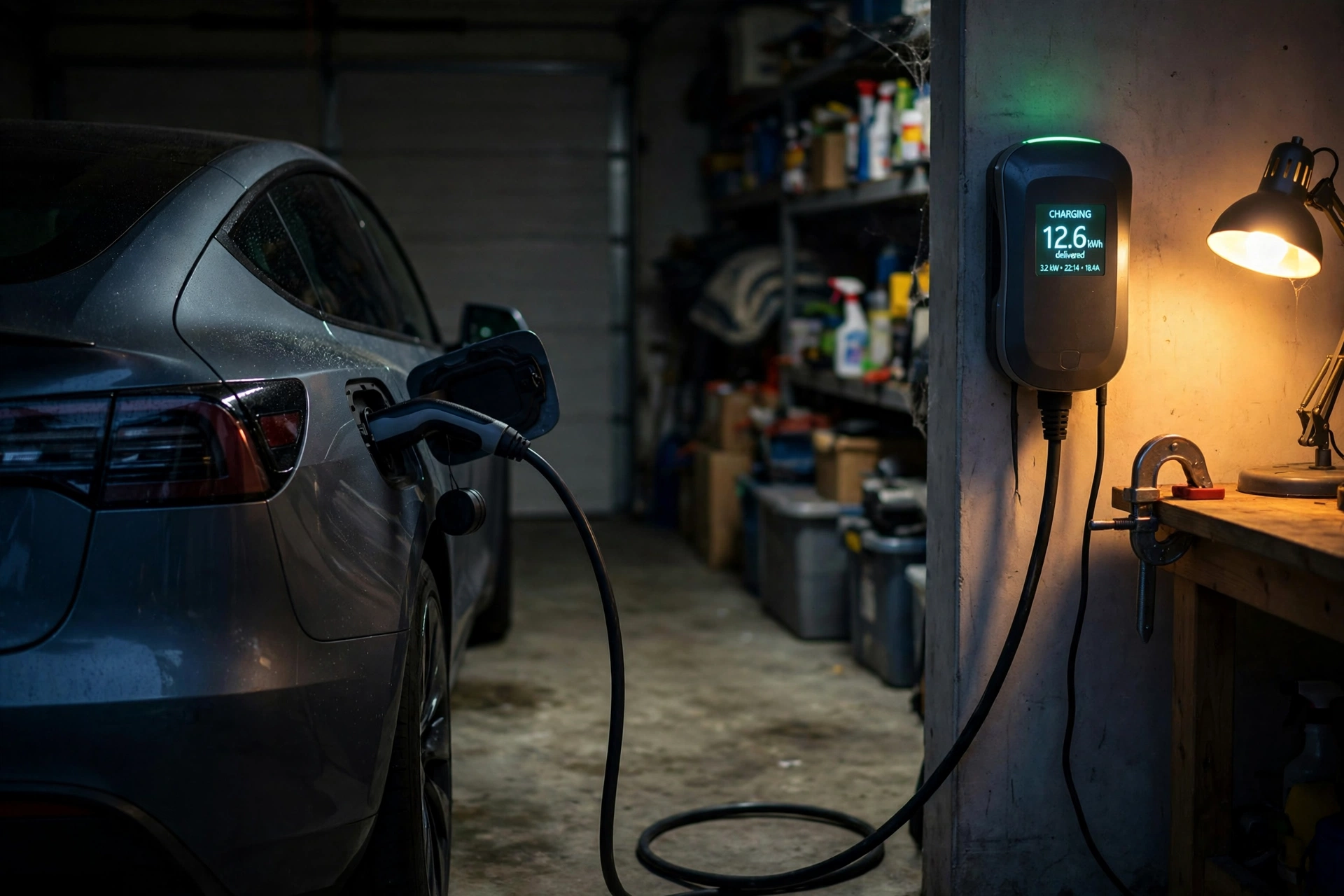
Your wall charger keeps its own log, and it’s genuinely useful: session start and stop times, session energy, even cost estimates if you’ve told it your rate. What it proves: how much energy passed through that charger, usually within about 1–2% (est.). What it can’t prove: anything billing-grade. It isn’t a certified revenue meter, its clock can drift, and it knows nothing about the rest of the house. If a number is ever disputed, the electricity meter on the wall wins.
Some utilities close the gap by accepting charger or vehicle data instead of hardware. You enrol the car or the wallbox, they read its sessions directly, and your EV energy gets the special rate without a second meter on the house. Others still offer a dedicated EV meter: a second utility meter on its own service, feeding only the car circuit. That route is accurate and beautifully clean — and often poor value.
The meter itself is cheap; the second service drop and panel work typically run $500 to $2,000 or more (est.), which eats years of off-peak savings before you’ve saved a cent. Run your own 300 kWh maths before you sign anything.
And skip the clip-on home energy monitor, at least for this job. It will show you the same 11 p.m. spike your utility’s hourly portal already shows for free — and the portal data comes from the meter itself, the one number nobody can argue with. If you’re charging from a regular outlet, expect the wall-to-battery gap to widen, too: Level 1 charging loses more energy as heat than Level 2 does, and only the meter-delta test will show you exactly how much.
Solar homes: two registers on your electricity meter, one direction that pays
With rooftop solar, the meter runs both ways and keeps two totals: delivered (grid to house) and received (house to grid). Your net use is the change in delivered minus the change in received. Read the wrong register and your panels look broken. They aren’t.
The money rule changed in April 2023. California’s Solar Billing Plan — the NEM 3.0 successor — cut export credits by roughly 75% compared with the old net metering deal. Exported solar now earns a low avoided-cost rate, often just a few cents per kWh, while imports still cost full retail.
So the winning move is self-consumption: park the sunshine in the car. Notice how neatly that fits SCE’s winter prices — the super off-peak window, 8 a.m. to 4 p.m. at 24¢, is exactly when your panels peak. Midday is the new midnight for solar homes. Export at a few cents, or charge the car and dodge a 24–45¢ import later: the meter makes the right choice obvious.
When the bill can’t be right: faulty-meter checks
Bills jump for boring reasons far more often than broken ones. Work the list in order before you accuse the meter:
- Estimated reads. If the bill says “estimated,” the utility guessed — and the true-up lands later, all at once.
- Wrong meter. In multi-unit buildings, meters get crossed: you’re paying for the neighbour’s water heater. The number on your bill must match the number on the case outside.
- A new load you forgot. The EV itself is the usual suspect. An extra 300 kWh a month looks exactly like a faulty-meter spike — until you run the delta test above.
- Weather. Energy.gov’s advice is old and correct: compare your use against the heating or cooling degree days for the same period, this year against last.
Still convinced something’s wrong? Two field tests settle it. First, switch off your main breaker: the meter should stop dead. If it keeps counting with the house dark, something is wired wrong or the meter has genuinely failed — call the utility that day.
Second, ask for an accuracy test. Utilities will bench-test or swap the meter on request; the rules and fees vary by state, and if the meter lands outside its accuracy tolerance — typically ±2% — the test is usually free and the bill gets adjusted. One comfort: ageing dial meters overwhelmingly fail slow, in your favour, because their bearings drag. Meters that rob you blind are rare. Bills that confuse you are not.
The verdict: three ways to know what your EV really costs
Rely on the utility electricity meter and its hourly portal. Our score: 9/10 — Accuracy 10/10 · Cost 10/10 · Convenience 7/10. It’s the billing source, the data is free, and the delta test takes one overnight charge. The only hassle is a walk outside with a phone.
Trust the charger app’s log alone. Our score: 7/10 — Accuracy 7/10 · Cost 9/10 · Convenience 9/10. Effortless, and close enough for budgeting. But it misses the household context, it isn’t billing-grade, and it will never catch a crossed meter or an estimated bill.
Join a utility EV plan — TOU-D-PRIME and its cousins. Our score: 8/10 — Accuracy 8/10 · Cost 8/10 · Convenience 6/10. The savings are real: $540 a year in the worked example above. But the whole house moves onto the new price clock, peak discipline included, and switches usually lock you in for 12 months. Do it with your eyes open and a month of portal data in hand.
A buying-timing note to finish. Rate schedules reset on fixed dates — SCE’s winter prices run through May 31, and the next EIA national average lands in late November. If you’re EV shopping right now, don’t ask the dealer what the car costs to run. Ask your meter. It already knows.
Electricity meter questions EV owners keep asking
Can my electricity meter tell me exactly what my EV costs to run? Yes — to within a fraction of a percent. Read it at plug-in and again at unplug, subtract the house’s background draw measured on a non-charging night, and multiply by your rate for that window. That’s your true session cost, charging losses included, because the meter bills the wall, not the battery.
Why does the car’s screen show fewer kWh than the meter moved? Because roughly a tenth of the energy (est.) turns into heat on its way into the pack — more on a 120V outlet, less on a good Level 2 setup. The charger app should land within a percent or two of the meter, since it measures the same side of the cable. The battery display is the honest outlier: it reports what the car kept.
Do I need a second meter to get an EV rate? Usually not. Most utilities move your whole house onto a time-of-use plan and let the meter’s clock do the sorting; a growing number accept data from the car or charger instead. A dedicated second meter exists in places, but at an install cost of $500–$2,000+ (est.) it rarely pays for itself.
Can a faulty electricity meter overcharge me? It can happen, but it’s the least likely explanation for a high bill — estimated reads, crossed meters and your own new EV are all far more common. If the main-breaker test shows the meter moving with the house dark, or an accuracy test finds it outside tolerance, the utility has to fix the meter and adjust the bill.
I still have a dial meter. Can I get time-of-use pricing? No. TOU billing needs interval data, and a dial meter has no clock and no memory. You’d need a smart meter upgrade, which most utilities now install free as their rollouts finish. Until then you’re on a flat or tiered rate — and reading those dials correctly (lower number; check the dial to the right) is a genuinely useful skill.