Last updated: October 25, 2026
Most family SUVs get measured in cubic feet and seat counts. Around here we measure them in folded strollers, car seats and school-run miles, and by that yardstick the Cadillac Escalade IQ electric SUV is the biggest family tool ever plugged into a wall. It is 18 feet 8 inches long, it weighs 9,061 pounds, and it costs from $130,300 including destination (checked October 25, 2026). It also goes further on a charge than any other electric SUV you can buy.
Here is the short version for busy parents. The Escalade IQ is Cadillac’s gas Escalade, rebuilt as an EV around a giant 205 kWh battery. Cadillac estimates up to 465 miles of range, independent testers have run it both much further and much shorter than that, and it swallows seven people plus their stuff in a way no other electric SUV manages. The longer IQL version adds $3,000 and the one thing the standard car is short on: a third row grown-ups can actually sit in.
The catch is size, and it shows up in ordinary places. Your garage, for one. A parking space at school pickup, for another. And your electricity bill, because a battery this big takes real time and real money to fill. None of that makes it a bad family vehicle. It makes it a vehicle you buy with your eyes open and a tape measure in your hand.
So this guide does the family math properly. We look at the specs, the tested range rather than the brochure range, how many strollers and car seats it really holds, what it costs to charge at home and on a road trip, and how it stacks up against the Kia EV9 and Rivian R1S. Then we score it, no fence-sitting.
What is the Cadillac Escalade IQ electric SUV?
The Cadillac Escalade IQ electric SUV is the all-electric flagship of the Escalade line, built on GM’s truck-based BT1 platform with dual motors and standard all-wheel drive. Think of it as the gas Escalade’s quieter, heavier twin: same three-row brief, same upright presence, but a battery where the fuel tank used to be and a smooth, closed face with an illuminated crest and a full-width light signature up front. It looks like an Escalade that has been gently ironed.
Two lengths are on sale for 2026. The standard IQ runs 224.3 inches bumper to bumper. The IQL stretches that to 228.5 inches, and nearly all of the extra length lands behind the second row, which is exactly where families need it. Both seat seven. Both share the same battery, motors and 136.2-inch wheelbase, and both come standard with Super Cruise hands-free highway driving, a curved 55-inch pillar-to-pillar display, air suspension and four-wheel steering.
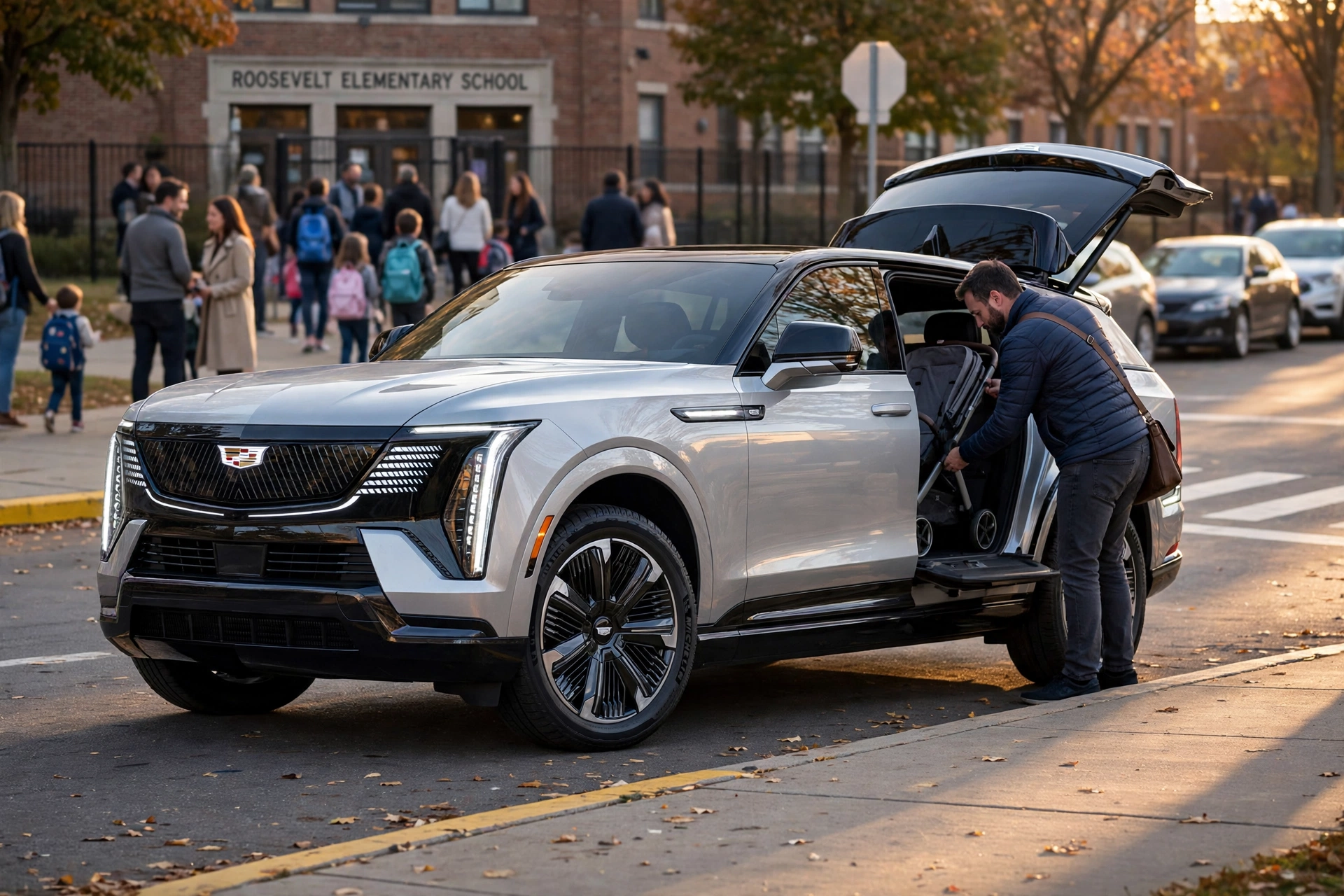
It is not a paper tiger, either. MotorTrend named it its 2026 SUV of the Year, and Cadillac’s own line-up puts it a full size class above the three-row Optiq’s bigger siblings in price and footprint. If the IQ is the flagship, it is a flagship you will feel every inch of in a school parking lot. Four-wheel steering cuts the turning circle to 39 feet 4 inches, which is minivan territory, and that single feature will save your dignity at pickup more often than the 750 horsepower ever will.
Cadillac Escalade IQ electric SUV specs that matter to families
Brochures bury you in numbers. These are the ones that change daily life, with the full 2026 line-up priced from $130,300 for the IQ Luxury to $154,100 for the IQL Premium Sport (prices checked October 25, 2026, including destination).
| Specification | Escalade IQ | Escalade IQL |
|---|---|---|
| Battery | 205 kWh | 205 kWh |
| Power | 680 hp (750 hp in Velocity Max) | 680 hp (750 hp in Velocity Max) |
| Torque | 615 lb-ft (785 lb-ft in Velocity Max) | 615 lb-ft (785 lb-ft in Velocity Max) |
| 0–60 mph | 4.7 sec (Cadillac est.); 4.6 sec tested by MotorTrend | 4.7 sec (Cadillac est.) |
| Range | Up to 465 miles (Cadillac est.) | Up to 460 miles (Cadillac est.) |
| DC fast charging | 800V, up to 350 kW; up to 116 miles in ~10 minutes | 800V, up to 350 kW; up to 116 miles in ~10 minutes |
| Home charging | 11.5 kW standard; 19.2 kW on Premium trims | 11.5 kW standard; 19.2 kW on Premium trims |
| Length | 224.3 in | 228.5 in |
| Third-row legroom | 32.3 in | 36.7 in |
| Cargo behind 3rd row | 23.6 cu ft | 24.2 cu ft |
| Maximum cargo | 119.1 cu ft | 125.2 cu ft |
| Front trunk (eTrunk) | 12.2 cu ft | 12.2 cu ft |
| Towing | 8,000 lb | 7,500 lb |
| Curb weight | 9,061 lb (as tested) | About 9,200 lb (est.) |
| Starting price | $130,300 | $133,300 |
Two numbers deserve a second look. First, there is no EPA range rating for this vehicle. At over 9,000 pounds it sits outside the weight class the EPA tests, so the government never publishes a figure, and fueleconomy.gov lists no rating for it. Every range number in this article is therefore either Cadillac’s estimate or an independent test result, and we label which is which. Second, the towing split: the shorter IQ pulls 8,000 pounds, the longer IQL 7,500. If a boat or a camper is part of your family summers, that 500-pound gap matters more than the extra cargo room.
Real-world range: how far the Cadillac Escalade IQ electric SUV actually goes
Cadillac’s headline is 465 miles for the IQ and 460 for the IQL. Treat those as best-case numbers earned at gentle speeds, because the tested results spread wider than on any EV we cover. In Edmunds’ real-world range test, an Escalade IQ ran 558 miles, beating its estimate by nearly 100 miles. In Car and Driver’s 75-mph highway test, the same vehicle managed 380 miles. Both results are real. The difference is speed: push a vehicle this tall and heavy through the air at 75 mph and physics sends you the bill.
MotorTrend’s long-term test car splits the difference in the most useful way. Over six months and 10,695 miles it averaged 1.8 miles per kWh and recorded a 395-mile road-trip range at 70 mph. Multiply that efficiency by the 205 kWh pack and you land right around 370 to 395 miles of honest, loaded-up, air-conditioning-on family range. Plan your road trips around 350 miles between confident stops and you will never white-knuckle it.
Now the trade-off nobody puts in the advert. That range comes from brute force, not efficiency. At 1.8 miles per kWh, the Cadillac Escalade IQ electric SUV uses more than twice the electricity per mile of a smaller family EV, and it hauls 9,061 pounds everywhere it goes, including the two-mile run to school. Tyres, brakes and your electricity meter all feel it. The range is genuine and genuinely useful. It is just bought the expensive way, with a battery roughly the size of two Kia EV9 packs welded together.
Family fit: three rows in the cadillac escalade iq electric suv, measured in strollers and car seats
Front and second rows are the easy part. There is stretch-out space everywhere, the second row slides and reclines, and two car seats fit across it without the door-panel wrestling you get in narrower SUVs. The available Executive Second Row package swaps practicality for thrones, stowable tables and screens. Lovely for executives. For school runs, take the standard bench or captain’s chairs and keep the flexibility.
The third row is where the two models part company, so let’s be blunt about it. In the standard IQ, third-row legroom is 32.3 inches. That is fine for kids up to about age twelve, tolerable for a teenager on a short hop, and unkind to any adult past the twenty-minute mark.
In the IQL, legroom grows to 36.7 inches with an extra inch of headroom, and that changes the car completely: grandparents, adult friends and tall teenagers can ride back there on a real journey. If your third row carries grown-ups more than twice a month, buy the IQL and do not talk yourself out of it. The $3,000 difference is the cheapest comfort upgrade in the whole catalogue.
Cargo, translated into family units. With all three rows up, the IQ offers 23.6 cubic feet behind the third row and the IQL 24.2. A big folded stroller takes up roughly 8 to 9 cubic feet (est., based on typical full-size stroller dimensions), so you are looking at two folded strollers plus a diaper bag, or one stroller and a full weekly grocery run, with the third row still in use. That is a trick almost no other three-row EV can do. Then there is the 12.2-cubic-foot eTrunk under the hood, which swallows a stroller on its own and keeps muddy boots away from the groceries. Fold everything flat and the IQL’s 125.2 cubic feet will take a crib, a dresser and the boxes your last move left behind.
One honest warning, from our side of the fence: check your garage before you fall in love. The IQL is 228.5 inches long. A typical garage is about 240 inches deep (est.), which leaves under a foot of total clearance, before shelves, bikes and the water heater take their share. Plenty of these will live on driveways. Make sure yours is allowed to.
Charging a 205 kWh battery: home first, road trips second
Here is our firmest advice in this whole guide: do not buy this vehicle unless you can charge it at home on a proper 240-volt circuit. A 205 kWh battery is not a phone battery. On the standard 11.5 kW home setup, a completely empty pack needs about 17.8 hours to fill (205 ÷ 11.5). Nobody runs to empty, of course. Plug in at 30 percent after dinner and you are full well before morning, with roughly 22 miles of range added per hour. The Premium trims’ 19.2 kW charging cuts a full charge to about 10.7 hours and adds up to 36 miles per hour, which is the version to get if your household drives a lot.
The maths of a normal week is friendlier than the headline numbers suggest. A family covering 250 miles a week (est., school runs, commutes and weekend errands) uses roughly half the pack. Two overnight sessions a week, or one long Sunday-night charge, covers it entirely. You will visit public chargers on road trips only, which is exactly how a big family EV should live.
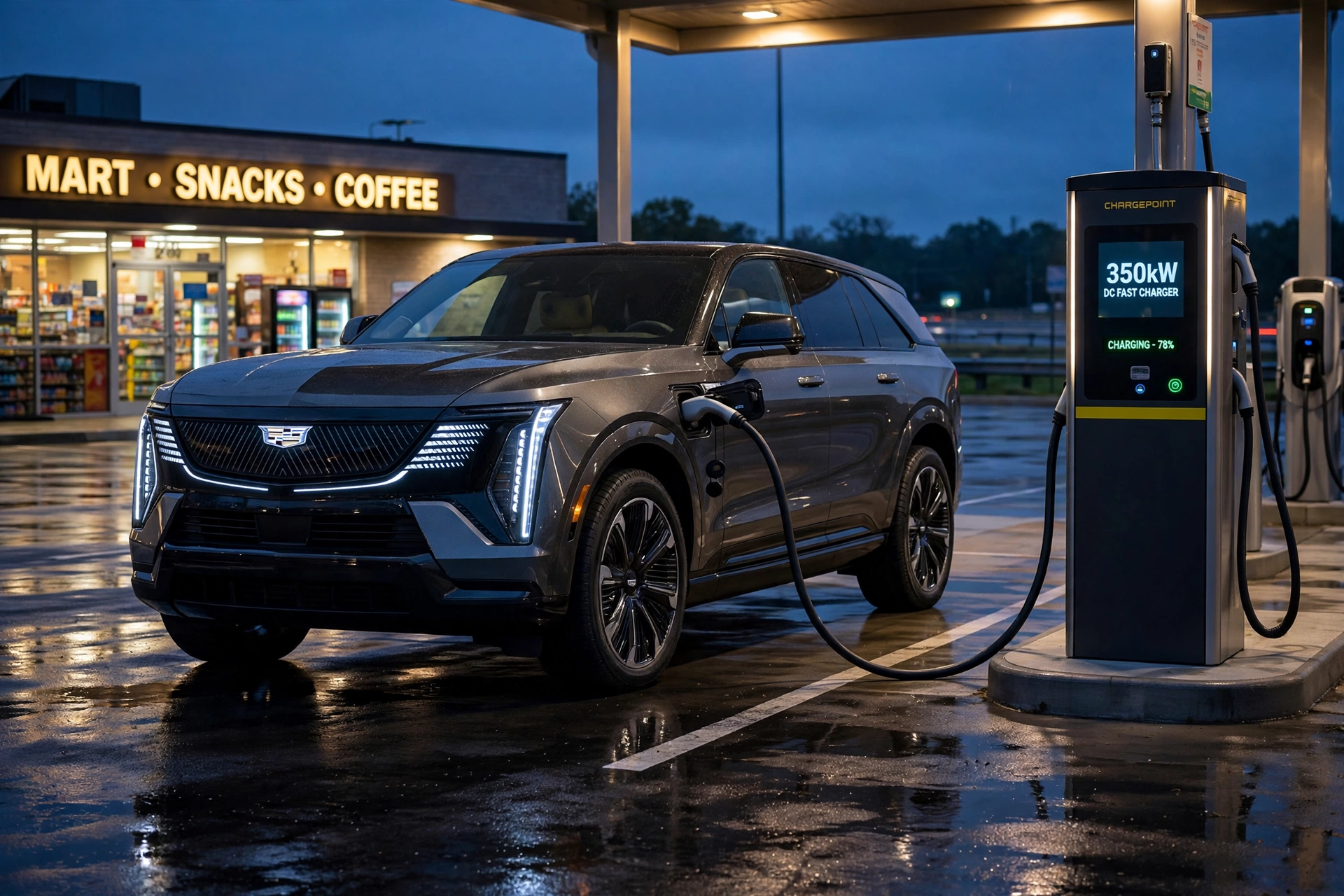
On the road, the 800-volt system and 350 kW peak rate earn their keep. Cadillac quotes up to 116 miles added in about 10 minutes, and MotorTrend’s fast-charge test measured 137 miles in 15 minutes and 220 miles in 30. In parent terms: one bathroom-and-snacks stop buys you another three hours of driving. The kids will need to stop before the car does. Just know that the top of the pack fills slowly, so charge to 80 percent, get moving, and let the big battery do the rest.
The Cadillac Escalade IQ electric SUV can also send power the other way. With GM Energy’s available vehicle-to-home equipment, it can run household essentials during an outage. Cadillac does not bundle that hardware in the purchase price (est. installed cost runs into the thousands), and it turns a school-run vehicle into a 205 kWh insurance policy for storm season. For families in outage country, that is a real selling point, not a gimmick.
Running costs and our original analysis: dollars per mile of range
Filling the battery at home costs about $35: 205 kWh multiplied by a typical US residential rate of $0.17 per kWh (est.). At MotorTrend’s observed 1.8 miles per kWh, that works out near 9.4 cents per mile. A gas Escalade at roughly 16 mpg combined (est.) on $3.20-a-gallon fuel (est.) costs about 20 cents per mile. Over 12,000 family miles a year, home charging saves roughly $1,270 (est.). Road-trip fast charging at around $0.50 per kWh (est.) flips the maths to about $72 for a 10-to-80 percent fill, so think of DC charging as the convenience you pay for, and home charging as the reason the numbers work.
Our guide to what an electric car costs per mile shows the same arithmetic across the wider market, and the site’s total cost of ownership calculator will run these numbers against your own mileage.
Now the comparison we run on every three-row EV: what you pay for each mile of range.
- Escalade IQ: $130,300 ÷ 465 miles = $280 per mile of range. Measured against Car and Driver’s 380-mile highway result, it is $343 per tested highway mile.
- Escalade IQL: $133,300 ÷ 460 miles = $290 per mile of range.
- Rivian R1S (Dual, Large pack): $83,990 ÷ 329 miles = $255 per mile of range.
- Kia EV9 (Light Long Range): $57,900 ÷ 304 miles = $190 per mile of range.
The Cadillac is the most expensive way to buy a mile of range in this class, and it is not close. What the extra money buys is the miles themselves: 465 of them, in a vehicle that can also tow 8,000 pounds and carry seven people in genuine quiet. Whether that trade suits your family depends on how many of those miles your life actually uses.
The rivals: EV9 and R1S do the family job for less
The Kia EV9 is the family-value benchmark and the comparison that should make Cadillac shoppers pause. It seats seven, charges from 10 to 80 percent in about 24 minutes, tows up to 5,000 pounds, and the longest-range version costs $57,900, less than half an Escalade IQ. Its third row is tighter and its interior is nice rather than luxurious. As pure family transport per dollar, nothing else in this article touches it.
The Rivian R1S is the outdoorsy middle path: up to 410 miles with the Max pack, 7,700 pounds of towing, and a smaller footprint that fits more garages. It gives up the Cadillac’s hushed ride, its third-row space and its sheer presence. If your weekends involve trailheads rather than valet stands, cross-shop it seriously. Shoppers stepping down within the brand should also read our look at the smaller Cadillac Optiq to see how much of the Cadillac EV experience survives at a far lower price. And if you are comparing running costs across the whole three-row class, our overview of today’s EV cars, range and running costs puts them side by side.
Our scores for the class, family priorities first:
Kia EV9 — Our score: 8.6/10 (Range: 7/10, Charging: 9/10, Value: 9/10). The sensible family’s three-row EV, full stop.
Escalade IQL — Our score: 8.3/10 (Range: 10/10, Charging: 8/10, Value: 5/10). The one to buy if adults ride in row three.
Escalade IQ — Our score: 8.1/10 (Range: 10/10, Charging: 8/10, Value: 5/10). Magnificent range and presence; kids-only third row at this price.
Rivian R1S — Our score: 8.0/10 (Range: 8/10, Charging: 7/10, Value: 7/10). The adventure pick, and the easiest of the four to park.
Our verdict on the Cadillac Escalade IQ electric SUV
Full details, trims and build options live on Cadillac’s official Escalade IQ page, and it is worth a browse before any dealer visit. Our verdict from the family seat is this. The Cadillac Escalade IQ electric SUV does the one thing no rival can: it carries a big family a very long way, in near silence, without a single range-anxiety conversation. The range is real, the cabin is superb, Super Cruise genuinely lowers the stress of a long highway day with sleeping kids in the back, and four-wheel steering makes it far less of a handful than its dimensions promise.
Two things hold it back, and we will not soften either. First, the value maths above: at $280 per mile of range, you are paying luxury money for capability the EV9 delivers at $190.
Second, there is no Apple CarPlay or Android Auto on any trim, in a $130,000 family vehicle, in 2026. Parents run their lives through their phones. GM’s built-in system is decent, and decent is not good enough at this price. Know both facts, and if they do not move you, the IQL is our pick of the pair: same battery, same power, a third row that treats adults like adults, for $3,000 more. Buy the charger install first, measure the garage twice, and enjoy the quietest school run in the neighbourhood.
Frequently asked questions
Is the Cadillac Escalade IQ electric SUV too big for a normal garage?
Measure before you buy. The IQ is 224.3 inches long and the IQL is 228.5 inches, against a typical garage depth of about 240 inches (est.). The IQ leaves you roughly 15 inches of total slack; the IQL leaves under a foot. Height matters too, at just over 6 feet tall with the antenna. Many owners will park it on the driveway, so check local rules and your home charger placement.
How long does the Escalade IQ take to charge at home?
From empty, about 17.8 hours on the standard 11.5 kW setup and about 10.7 hours with the Premium trims’ 19.2 kW charging. In real life you will plug in at night with 30 to 50 percent remaining and wake up full. Expect roughly 22 miles of range per hour at 11.5 kW and up to 36 miles per hour at 19.2 kW.
What range will I actually see on a family road trip?
Plan on 350 to 395 miles. Car and Driver measured 380 miles at a steady 75 mph, MotorTrend’s long-term car recorded a 395-mile road-trip range at 70 mph and averaged 1.8 miles per kWh over six months, and Edmunds’ gentler test produced 558 miles. Loaded with kids, luggage and a roof box, work from the lower figures and you will be pleasantly surprised rather than stranded.
Can adults sit in the third row?
In the IQL, yes: 36.7 inches of legroom and an extra inch of headroom make it a genuine adult seat for long drives. In the standard IQ, 32.3 inches of legroom makes the third row a kids’ row, fine through about age twelve and for short trips after that. If grandparents ride with you regularly, that difference alone justifies the IQL.
Does the Escalade IQ have Apple CarPlay?
No. Neither the IQ nor the IQL offers Apple CarPlay or Android Auto on any trim. The 55-inch display runs GM’s Google-based system with its own navigation and apps. For many families this is the single biggest daily irritation in an otherwise excellent cabin, and it is worth experiencing on a test drive before you sign anything.
How much does it cost to charge the Escalade IQ?
A full 205 kWh charge at home costs about $35 at a typical residential rate of $0.17 per kWh (est.), and most families will charge overnight two or three times a week rather than from empty. A 10-to-80 percent session at a public fast charger runs about $72 at typical prices (est.). Per mile, home charging works out near 9.4 cents against roughly 20 cents for a gas Escalade (est.).
For families weighing up a big three-row EV, the cadillac escalade iq electric suv stands out for its tested range and seven-seat space. Choosing the cadillac escalade iq electric suv also means planning for home charging and a large garage, as this guide explains. In short, the cadillac escalade iq electric suv is best judged on real-world range, charging and family space rather than its headline figure alone.