Last updated: October 25, 2026
A lithium battery is a rechargeable battery that stores and releases energy by moving lithium ions back and forth between two electrodes. That is the complete answer to what is a lithium battery, and also an incomplete one: the term covers a family of chemistries that behave quite differently from one another. The pack under an electric car, the cell in your phone and the battery in a cordless drill share the same operating principle. They do not share the same materials, lifespan or safety profile.
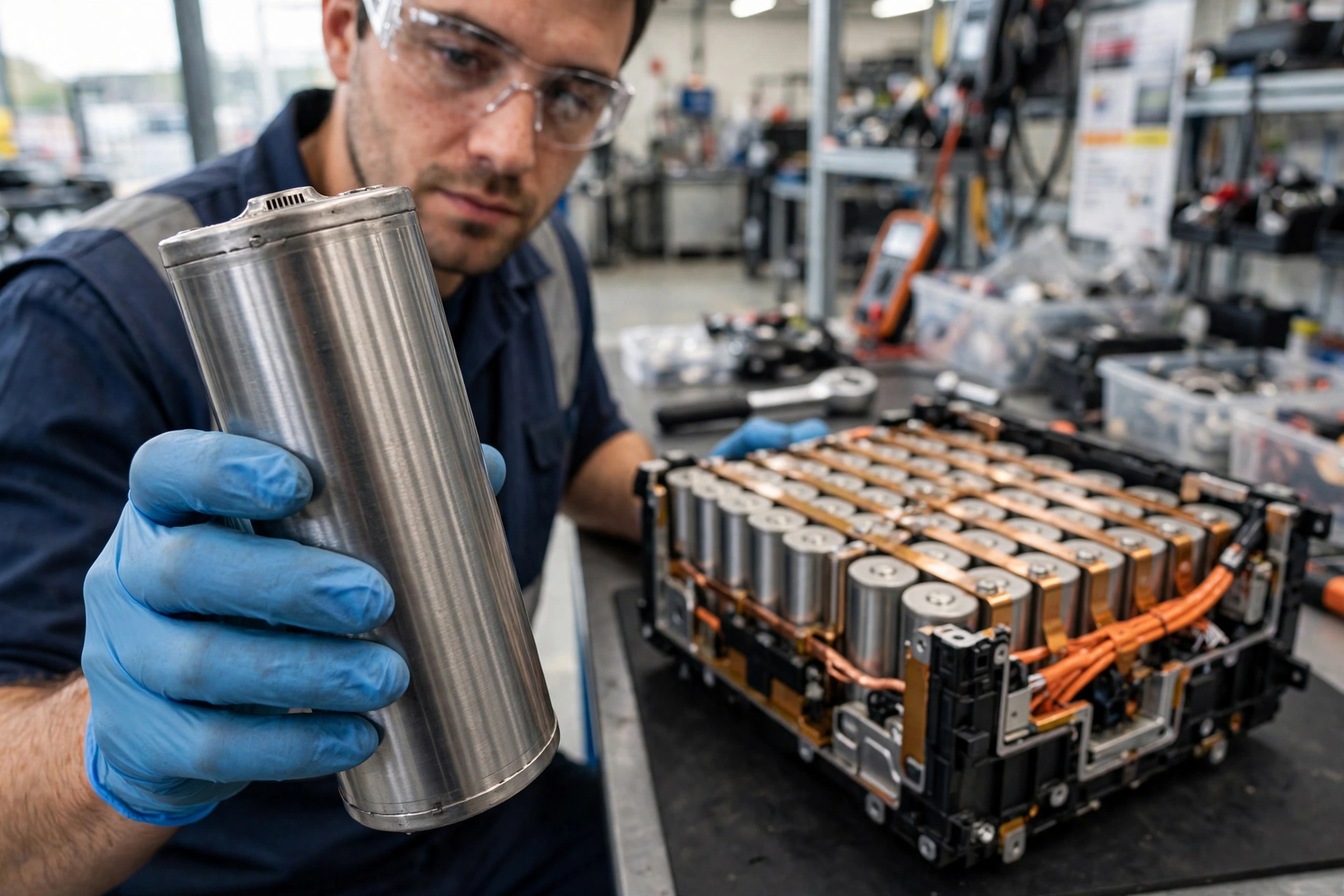
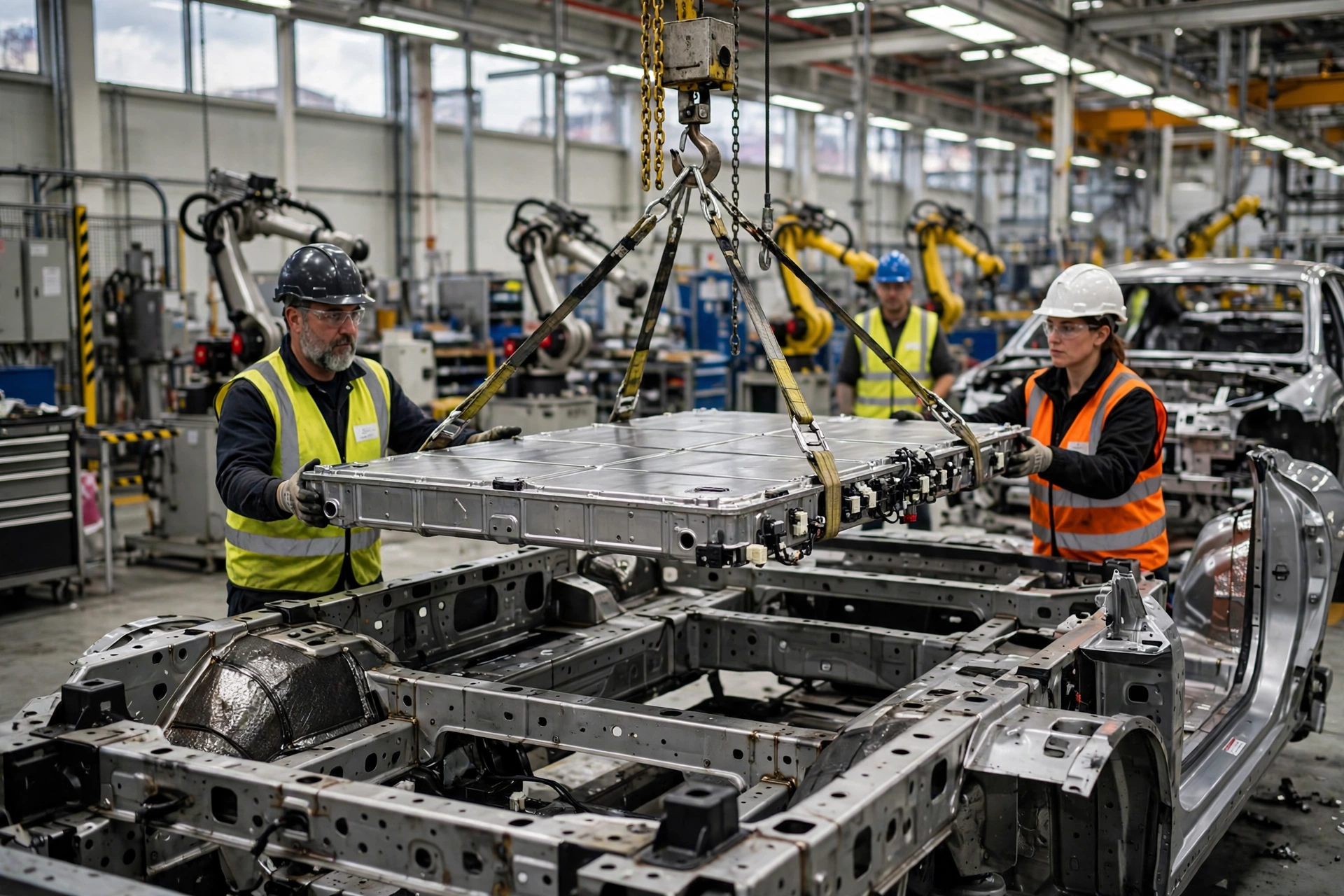
Precision matters here, because “lithium battery” names a technology family rather than a single product. Strictly, engineers distinguish lithium-ion cells, which are rechargeable, from primary lithium cells, which are not; the coin cell in a key fob belongs to the second group. Everything in an electric vehicle is lithium-ion. Thousands of individual cells are wired together into modules, and the modules into a pack, which adds a steel or aluminium case, cooling circuits and a battery management system, the computer that watches every cell group and keeps it inside safe limits.
Lithium earned its place for two measurable reasons. It is the lightest metal in the periodic table, and a single lithium-ion cell delivers roughly 3.2 to 3.7 volts, against 1.2 volts for a nickel-metal hydride cell and 2.0 volts for lead-acid. Fewer cells are needed to reach the 400 or 800 volts an EV drivetrain wants, and each kilogram of battery stores more energy. The US Department of Energy’s battery explainer puts the storage mechanism plainly: electricity is converted into chemical potential, held, then converted back on demand.
One European observation before we proceed. A battery is rated in kilowatt-hours on both sides of the Atlantic, yet the range printed beside it is not the same measurement. The European WLTP test cycle routinely returns figures 15 to 25 percent higher (est., based on paired ratings for identical models) than the US EPA cycle for the same car and the same pack. The battery has not changed. The yardstick has. Keep that in mind whenever a brochure quotes a range that looks generous: ask which test produced it.
What is a lithium battery made of? The four parts inside every cell
Strip any lithium-ion cell down and four components appear, a list Argonne National Laboratory’s Batteries 101 guide uses as well. First, the cathode: the positive electrode, a metal oxide coating on aluminium foil. Its chemistry gives the battery its name, and it determines cost, energy density and lifespan more than any other part. Second, the anode: the negative electrode, usually graphite coated on copper foil. Third, the separator: a porous plastic film, thinner than a human hair is wide, which keeps the electrodes from touching while letting lithium ions pass. Fourth, the electrolyte: a lithium salt dissolved in an organic solvent, the medium the ions travel through. It conducts ions and blocks electrons, which is why the electrons are forced around the external circuit, doing useful work on the way.
Two further details belong in any serious answer. The electrodes store lithium by intercalation: the ions slot into layered crystal structures rather than plating out as raw metal, which is what makes the reaction reversible thousands of times. And within a few cycles a thin film called the SEI, the solid electrolyte interphase, forms on the graphite. It protects the anode and quietly consumes a small amount of lithium as it grows. That film is the seed of all battery ageing, a point we will return to.
How the rocking chair works
Ask an electrochemist what is a lithium battery’s central trick and the answer is the rocking chair. During discharge, lithium ions leave the graphite anode, cross the electrolyte and the separator, and settle into the cathode. Simultaneously the electrons they leave behind travel the long way round, through the motor controller and the motor, and that electron flow is the electricity that moves the car. Charging reverses the traffic: the charger pushes ions back into the graphite, where they wait for the next discharge. Nothing is burned and nothing is consumed in the ideal reaction. Regenerative braking simply runs the same exchange in miniature, thousands of times per journey.
The chemistries compared
Two cars can both give “lithium-ion” as the answer to what is a lithium battery they carry and share almost nothing chemically. The cathode is the difference. Nickel-rich chemistries store more energy per kilogram; iron-based chemistry trades some of that density for longevity, stability and a lower bill. Prices checked October 25, 2026 illustrate the gap: BloombergNEF’s 2025 survey put the average lithium-ion pack at $108 per kWh, with LFP packs near $81 per kWh and NMC packs near $128 per kWh (figures checked October 25, 2026).
| Chemistry | Energy density (cell) | Cycle life to 80% capacity | Thermal runaway onset | Where you will find it |
|---|---|---|---|---|
| NMC (nickel manganese cobalt) | 150–300 Wh/kg | 1,000–2,000 cycles | ~210°C | Most long-range European and Korean EVs |
| NCA (nickel cobalt aluminium) | 200–260 Wh/kg | ~1,000 cycles (est.) | ~150°C | Tesla long-range models with Panasonic cells |
| LFP (lithium iron phosphate) | 90–180 Wh/kg | 3,000–6,000 cycles | ~270°C | Standard-range Tesla, BYD Blade Battery, Mach-E standard range, Volvo EX30 in Europe |
| LMO (lithium manganese oxide) | 100–150 Wh/kg | 500–1,000 cycles (est.) | ~250°C (est.) | Early Nissan Leaf, often blended with NMC; power tools |
| LTO (lithium titanate anode) | 50–80 Wh/kg | 10,000–20,000 cycles | Very high; extremely stable | Niche buses and a few Japanese models; tolerates very fast charging |
My position, stated plainly: for the majority of buyers, LFP is the correct default, and the industry should retire the habit of presenting it as the budget compromise. It contains no cobalt and no nickel, it tolerates a 100 percent charge as a daily routine, and it outlasts the car around it. Nickel-rich packs keep one genuine advantage, energy density, and it decides the question only for long-range and performance models. A regional footnote: Volvo sells the EX30 with an LFP pack in Europe and ships only the NMC version to the United States, a choice that says more about American driving distances than about the chemistry. Solid-state cells, which replace the liquid electrolyte with a ceramic or sulfide layer, belong in this table only as a footnote for now. As of October 2026 no all-solid-state battery is fitted to a car you can buy; semi-solid packs are on sale in China in the NIO ET7 and MG4. Toyota targets its first solid-state cars for 2027–2028 after several earlier dates slipped, Samsung SDI targets mass production in the second half of 2027, QuantumScape is at pilot and sample stage, and CATL rated its own programme at level 4 of 9 on its readiness scale in mid-2026. Treat every date as provisional.
A neighbouring technology deserves one precise sentence. Sodium-ion cells replace lithium with sodium, an abundant and cheap element, and early versions are entering Chinese city cars and grid storage at energy densities near 140 to 160 Wh/kg (est.), comparable to entry-level LFP. They are not lithium batteries, and no European or American EV uses them yet. Watch the space, and do not let a salesman blur the names.
Formats: cylinders, pouches, prisms and blades
Chemistry is half the answer to what is a lithium battery in a given car; format is the other half. Cylindrical cells are small steel cans with the electrode sheets wound inside like a Swiss roll. The naming is dimensional: an 18650 measures 18 mm across and 65 mm long, a 2170 measures 21 by 70 mm, and Tesla’s 4680 measures 46 by 80 mm with a tabless electrode design that shortens the internal current path. Prismatic cells are rigid rectangular blocks, the format most European makers favour. Pouch cells are sealed foil packets, light and easy to shape, with no rigid case of their own. BYD’s Blade Battery stretches the prismatic idea into long, thin LFP cells that span the pack and double as structure, a cell-to-pack layout that skips modules entirely. Format rarely appears on a spec sheet, yet it shapes crash behaviour, cooling design and repair costs for a decade. The complete answer to what is a lithium battery in a specific car therefore has two halves, a chemistry and a shape, and the shape is the half the brochure hides.
What is a lithium battery’s spec sheet really telling you?
Four numbers do the real work. Capacity in kilowatt-hours is the size of the tank: usable energy, calculated as voltage multiplied by amp-hours, divided by 1,000. Distinguish gross capacity from usable capacity, because makers hold back a buffer at the top and bottom; a “82 kWh” pack may offer 77 kWh to the driver. Amp-hours alone, quoted without voltage, tell you almost nothing, a trick familiar from European e-bike listings. C-rate describes speed relative to capacity: 1C empties or fills the pack in one hour, so a 60 kWh pack charging at 150 kW is working near 2.5C. Depth of discharge is the share of the pack you actually cycle; using the middle 70 percent is far gentler than swinging between empty and full. Our guide to EV battery facts, specs and real-world range applies these numbers model by model.
What is a lithium battery’s lifespan? Ageing, in two forms
Batteries fade by the calendar and by the mile, and the two processes are distinct. Cycle ageing comes from use: each charge and discharge swells and shrinks the electrode materials microscopically, grows the SEI film, and can plate metallic lithium onto the anode if the pack is fast-charged while cold. Calendar ageing proceeds in a parked car. It accelerates with heat and with time spent at a high state of charge, which is why a car stored at 100 percent in a hot climate loses capacity faster than one stored at 60 percent in a cool garage. Fleet telematics analyses put average real-world loss near 1.8 percent per year (est., based on published fleet studies), and most makers now warrant the pack for 8 years or 160,000 km in Europe, 100,000 miles in the US, to at least 70 percent of original capacity.
Three habits follow from the physics. Keep a nickel-rich pack near 80 percent for daily use and charge fully only before long journeys. Charge an LFP pack to 100 percent regularly, since its flat voltage curve leaves the management system estimating the state of charge with little to go on. And treat DC fast charging as a tool for travel rather than a daily routine, particularly in winter, when a cold pack plates lithium most readily.
Run the cycle arithmetic and a useful conclusion appears. Take a 60 kWh pack cycled at 80 percent depth of discharge, so 48 kWh per cycle, and a consumption figure of 0.30 kWh per mile. An LFP pack rated at 3,000 cycles delivers 3,000 × 48 = 144,000 kWh, which divided by 0.30 gives roughly 480,000 miles (est.). An NMC pack rated at 1,500 cycles delivers 1,500 × 48 = 72,000 kWh, or roughly 240,000 miles (est.). Both figures exceed the working life of the vehicle around the battery. Cycle count is not what ends most EV packs; the calendar is. The weight arithmetic is equally instructive. Storing 75 kWh takes 75,000 ÷ 250 = 300 kg of NMC cells at 250 Wh/kg, against 75,000 ÷ 160 = 469 kg of LFP cells at 160 Wh/kg, a difference of 169 kg before either pack gains its case and cooling. That is the honest price of LFP’s durability, paid in kilograms.
Safety and thermal runaway, in proportion
Thermal runaway is the failure that matters: a damaged or defective cell heats itself, the reaction feeds on the cathode’s oxygen, and the heat ignites neighbouring cells in a chain. It is violent, difficult to extinguish and capable of reigniting hours later. It is also rare, and rarer than the petrol alternative. An analysis of US incident and registration data found roughly 25 fires per 100,000 battery-electric vehicles against roughly 1,530 per 100,000 petrol cars. Sweden’s Civil Contingencies Agency recorded 23 fires among about 611,000 EVs in 2022, against about 3,400 among 4.4 million petrol and diesel cars. Those ratios, not the individual headlines, are the correct way to judge what is a lithium battery’s fire risk. Chemistry shifts the odds further: LFP’s runaway threshold near 270°C, and its refusal to release oxygen as it decomposes, make propagation substantially harder than in NCA at roughly 150°C. The datasets are imperfect and EV fleets are younger than petrol fleets, so read the ratios as direction rather than gospel. Should the worst happen out of warranty, our page on Tesla battery replacement cost shows what a pack actually costs, and the battery replacement cost estimator runs the same calculation for other models.
After the car: second life and recycling
A pack retired from a car at 70 to 80 percent of its original capacity is worn out for driving and perfectly serviceable for stationary storage, where weight matters little and cycles are gentle. Second-life installations already buffer solar farms and office buildings. At true end of life, the pack is a concentrated ore: modern hydrometallurgical recycling recovers over 95 percent of the cobalt and nickel (est., based on recycler disclosures), and lithium recovery is climbing as processes improve. Argonne’s ReCell Center works on direct recycling, which regenerates cathode material without dissolving it back to raw metal, cutting both cost and waste. Europe has regulated ahead of the market, as usual: the EU Battery Regulation requires a digital battery passport for EV packs from February 2027 and sets recycled-content targets for new batteries. Lead-acid car batteries, recycled at roughly 99 percent in the US, prove the loop can close when the economics and the law point the same way. Lithium is not there yet. It is moving.
Our verdict: scores for the chemistries you can actually buy
LFP — Our score: 8.7/10 (Lifespan 10/10 · Energy density 6/10 · Value 9/10). The default choice for standard-range cars, fleets and anyone who keeps a vehicle for a decade.
NMC and NCA — Our score: 7.9/10 (Lifespan 7/10 · Energy density 10/10 · Value 7/10). Still the answer when range per kilogram decides the purchase, provided you accept the 80 percent daily charging habit.
Solid-state, as of October 2026 — Our score: 4.5/10 (Lifespan 5/10 (est., unproven in production cars) · Energy density 9/10 · Value 2/10). Excellent laboratory numbers, pilot-line prices, and no car in a showroom. A second firm opinion, then: do not postpone an EV purchase in expectation of solid-state. The technology may well lead the market in 2030. It has not earned a place in a 2026 buying decision, and the lithium battery described on this page, LFP or NMC, is a mature product with a decade of fleet data behind it.
Frequently asked questions
What is a lithium battery’s biggest weakness?
Calendar ageing in heat. A pack kept near full charge in a hot climate loses capacity year by year regardless of mileage. Cold is the second weakness, and it is temporary: a cold pack delivers less power and accepts a slower charge, then recovers as it warms. LFP packs feel the cold more sharply than NMC ones, a real consideration for Scandinavian winters and Canadian ones alike.
Is a lithium battery the same as a lithium-ion battery?
Not quite. Lithium-ion is the rechargeable branch of the family, and it is what powers every EV, phone and laptop. Primary lithium cells, such as coin cells, cannot be recharged. In everyday speech the terms are used interchangeably, and in an automotive context “lithium battery” always means lithium-ion.
How long does an EV lithium battery last?
Expect 15 to 20 years of service life in typical use (est., extrapolated from fleet degradation data), with capacity gradually declining to around 80 percent. Warranties of 8 years to 70 percent capacity are the floor, not the forecast. Our cycle calculation above shows why: even a mid-life chemistry offers more full cycles than the car can consume.
Can a lithium battery be recycled?
Yes. Shredding and hydrometallurgical processing recover cobalt, nickel, copper and an increasing share of the lithium, and direct recycling aims to reuse the cathode itself. Recycling rates lag lead-acid because collection systems and pack designs are still maturing, and because most EV packs have not reached end of life yet. The volume arriving at recyclers this decade will change that quickly.
Why do European and American range figures differ for the same battery?
Because the tests differ. Europe’s WLTP cycle uses gentler acceleration and a different speed mix than the US EPA cycle, so the identical pack earns a higher number in Europe, typically 15 to 25 percent higher (est.). Neither is a lie; they are different measurements. Convert WLTP figures downward before comparing them with an American review, and treat EPA figures as the more realistic guide to motorway range.