Last updated: October 25, 2026
If an electrician has just quoted you $3,400 to upgrade electrical panel service before your new EV can plug in, take a breath before you sign anything. That quote might be exactly right for your house. It might also be the most expensive way to solve a problem a $599 charger solves on its own. This guide walks you through the decision the way a good electrician would: check the panel, run the numbers, look at all three routes, then spend money only where it earns its keep.
Here is the honest headline first. A large share of homes on 100-amp service can charge an EV at full speed tonight, with no panel work at all. Industry surveys keep landing in the same place: J.D. Power’s EVX research found only about 28 percent of EV owners actually needed panel work, even though roughly 65 percent had been told they did (figures as reported in industry coverage, checked October 25, 2026). Being told you need a panel upgrade and needing one are two different things, and the gap between them is worth about $2,900. Let’s find out which side of that gap your house sits on.
Step one, triage: do you need to upgrade electrical panel capacity at all?
Start with the grey metal box itself. Open the panel door and find the main breaker, the big switch at the top or bottom. Its handle is stamped 100, 150 or 200. That number is your service size, the total amps your home can draw from the utility at once. Take a photo of the label inside the door too. A surprising number of “you need an upgrade” conversations happen because nobody looked at this label first.
Next, think about what already runs on electricity in your home. Gas furnace, gas water heater, gas stove? Then your 100 amps are mostly loafing, and a charger fits easily. All-electric everything, with a range, dryer, water heater and air conditioner stacked on 100 amps? Your panel is genuinely busy, and you may need to upgrade electrical panel hardware or manage the load instead. Neither answer comes from the age of the house or the size of the breaker box door. It comes from a load calculation, which is the next step. One reassurance while you wait for numbers: plenty of drivers cover their daily miles on a plain 120-volt outlet, and our guide to charging an electric car with a regular outlet shows when that is genuinely enough.
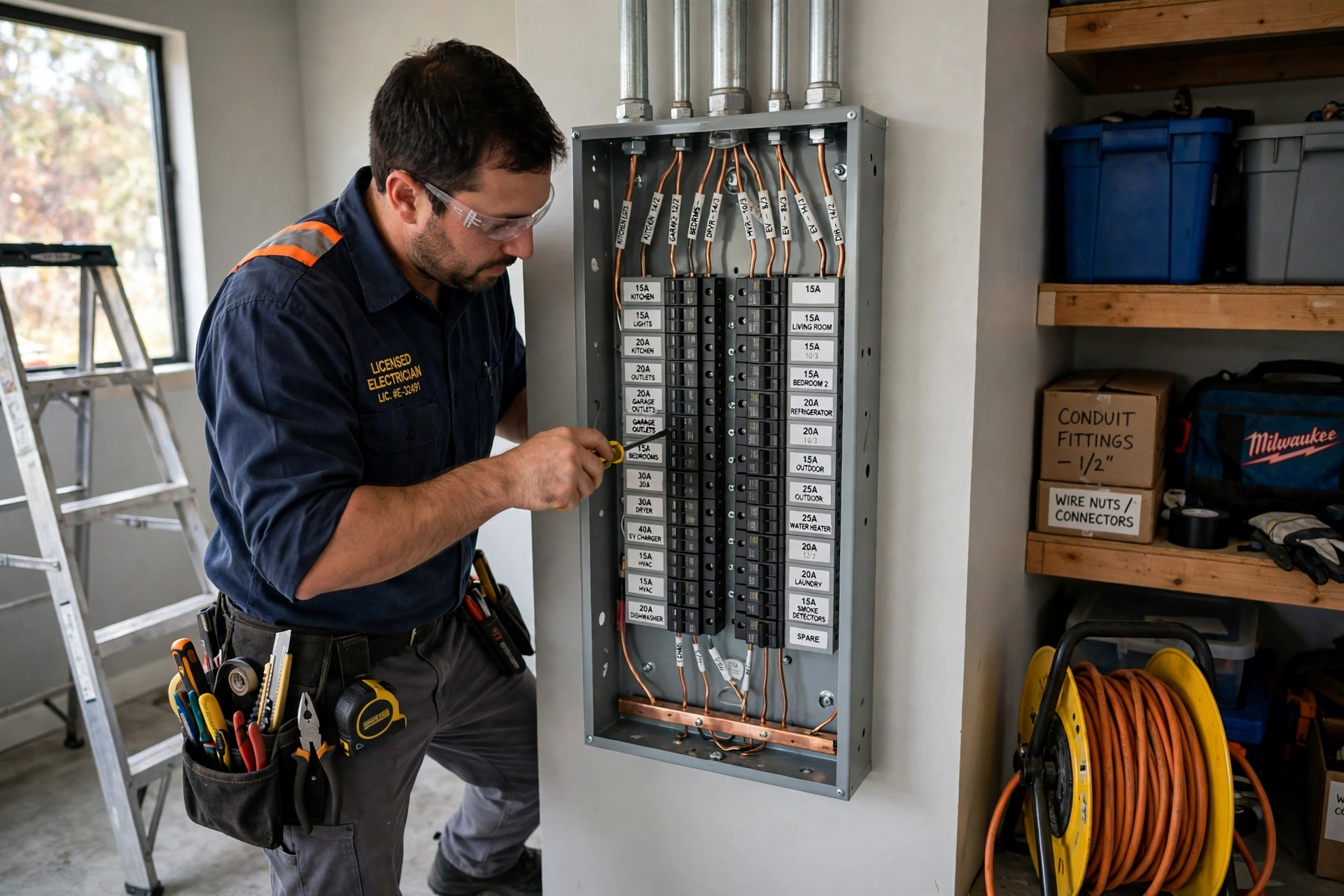
A few quick tells before the maths. You probably do need more capacity or load management if your lights dim when the air conditioner starts, if breakers trip on ordinary weeks, or if you are adding a heat pump and a second EV in the next few years. You probably do not if your 100-amp panel has four or more empty breaker spaces, your big appliances burn gas, and the car is your only planned addition. Treat those as hunches to check, never as answers.
The load calculation: the maths behind every upgrade electrical panel decision
A load calculation is a worksheet, not a guess. Your electrician follows Article 220 of the National Electrical Code (NEC), and for an existing home adding a charger, the method in NEC 220.83 is the one that usually applies. The logic is friendlier than it sounds. The code knows your range, dryer and water heater almost never run flat-out at the same moment, so it applies demand factors: the first chunk of household load counts in full, and the rest counts at a reduced percentage. Big heating and cooling equipment counts in full. The worksheet turns a scary pile of nameplate ratings into one honest number.
Here is a worked example, a 1,600-square-foot home with gas cooking and a gas furnace blower, an electric dryer, an electric water heater and a 3-ton air conditioner (figures are a representative example, est.). Add up the raw nameplates and you get roughly 26,200 volt-amps, which sounds hopeless on a 100-amp service. Run the demand factors the way the code allows and the counted load lands near 19,100 volt-amps, which is about 79 amps. That is the number that matters. This house has about 21 amps of honest headroom.
Now add the car. The code treats EV charging as a continuous load and counts it at full value: a 48-amp charger on a 60-amp circuit counts as 48 amps, all of it, all night. 79 plus 48 is 127 amps on a 100-amp service, and the worksheet says no.
This is the exact moment most homeowners get the panel upgrade quote. Hold on to that moment, because the code offers a second door. Recent NEC editions (220.70 and 625.42) recognise a listed energy management system, often labelled EVEMS. If a listed device watches the house and caps the charger so the total never passes the service rating, the charger counts at its managed level instead of its maximum. The load calculation passes, the permit passes, and nobody touched the panel. Ask your electrician one question before anything else: “Show me the load calculation, and tell me what changes if the charger is load-managed.” A good electrician answers both halves happily.
Route 1: the full swap, upgrade electrical panel service to 200 amps
The traditional fix replaces your panel and service with a 200-amp setup: new panel with 30 to 42 breaker spaces, new main breaker, usually a new meter base and service cable, and room for everything you might add for the next thirty years. If you are planning a heat pump, an induction range, a hot tub and a second EV, this is the grown-up answer, and it only has to be done once.
Cost, checked October 25, 2026: most US homeowners pay between $1,500 and $4,500 for a 100-to-200-amp upgrade, with typical quotes clustering around $2,500 to $3,500 (est., based on national installer pricing roundups). Quotes climb past that when the meter has to move, the service is buried and needs trenching, or the utility requires work on its side of the meter. Get the quote itemised: panel, labour, permit, and utility fees on separate lines.
Full panel upgrade: Our score: 7.4/10. Cost: 4/10. Disruption: 4/10. Future-proofing: 10/10. Nothing else on this page buys you three decades of headroom. Nothing else on this page costs this much or turns your house off for a day either. Choose it when the future loads are real and dated, not hypothetical.
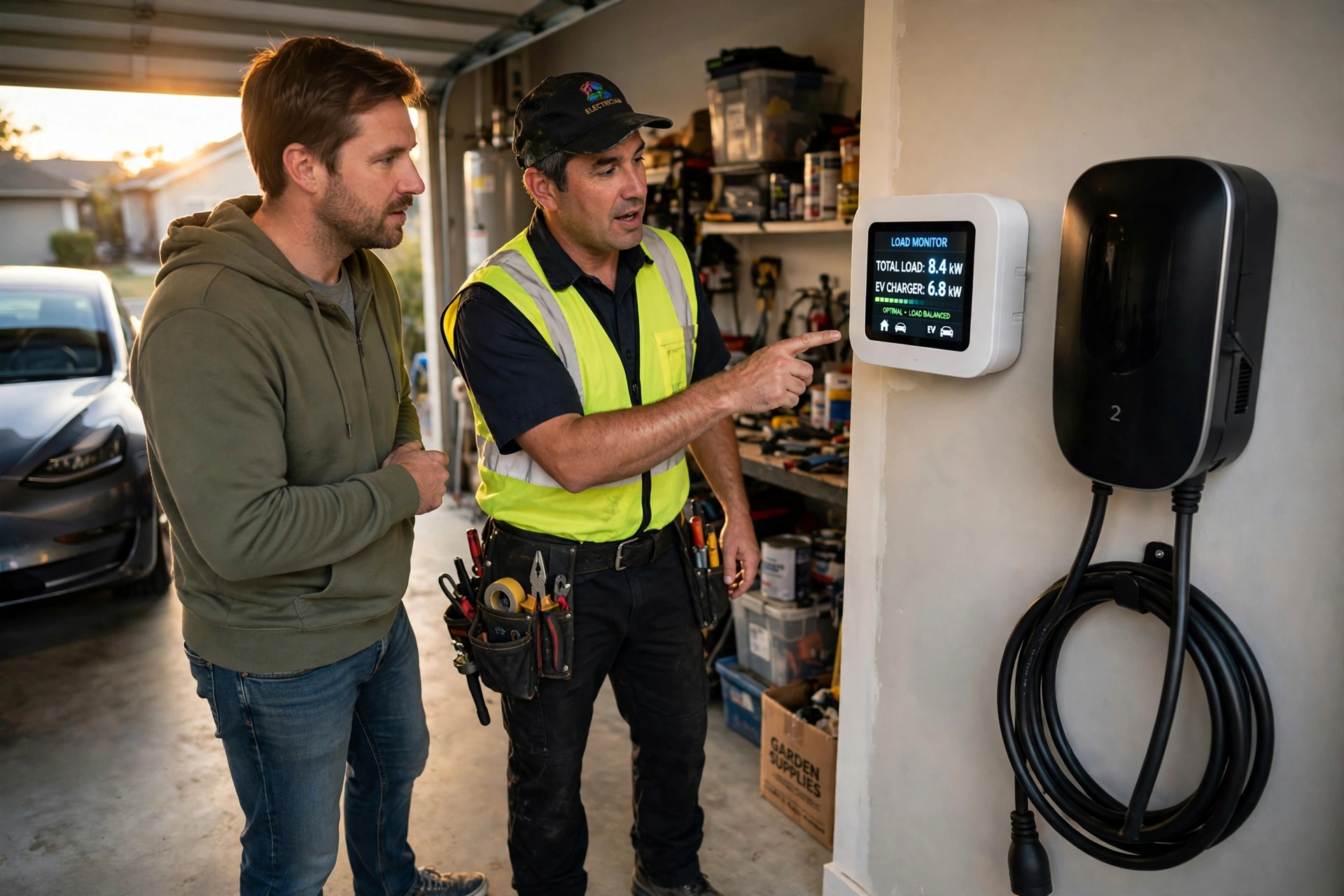
Route 2: load management, the $599 answer to the upgrade electrical panel question
A load-management system puts a pair of sensor clamps (current transformers) on the main cables feeding your panel. The sensors report the whole house’s draw, second by second. When the house is quiet, your car charges at full speed. When the dryer, oven and air conditioner pile on at 6 p.m., the charger eases off for a while, then speeds back up on its own. You never touch anything. The car simply drinks when the house is not thirsty.
The cleanest example is the Emporia Pro at $599 (checked October 25, 2026), which pairs the charger with Emporia’s Vue home monitor and its PowerSmart load management, so the sensing hardware comes in the same box. See the current lineup on Emporia’s EV charger page. Tesla owners can add a Neurio meter (around $250, est.) to a Wall Connector ($475 to $550) for the same dynamic trick, and multiple Wall Connectors can also power-share one circuit between two cars. Renters and dryer-outlet households have an even simpler cousin: the NeoCharge Smart Splitter, $399 to $449, which lets an EV and a dryer take turns on one 240-volt outlet. Every one of these routes skips the upgrade electrical panel project entirely, and your electrician still runs a proper, permitted circuit for the charger itself.
Now the part people worry about: how much does the throttling actually cost you in miles? Very little, and here is the arithmetic. Even if dinner-hour chaos pins the charger at 16 amps for a stretch, that is 3.8 kW, roughly 12 miles of range per hour. Across a 10-hour night, the worst realistic case still returns about 100 miles, and the typical American driver covers about 37 miles a day. Most of the night, while you sleep and the house idles, the charger runs at its full 48 amps and 11.5 kW. You wake to a full car. The throttle costs you nothing you would ever notice.
Load management: Our score: 8.8/10. Cost: 9/10. Disruption: 9/10. Future-proofing: 6/10. For a one-EV household on a 100-amp panel, this is simply the correct purchase. It solves the exact problem you have, this week, for about a fifth of the panel quote, and the device keeps working fine if you do upgrade the panel years later.
Route 3: the smart panel, an upgrade electrical panel project with an app attached
The third route replaces the whole panel with a computerised one, most famously the SPAN Panel. Every circuit gets monitored and can be switched from an app, loads are prioritised automatically, and SPAN’s PowerUp feature does load management for the entire house rather than one charger. Paired with solar and a battery, it sheds loads gracefully during an outage and stretches backup power for hours.
The invoice is the problem. The panel itself runs about $3,500, and installed totals typically land between $4,500 and $6,500 (est.), with some big-city quotes sailing past $8,000. That is more than a plain panel swap, to end up with the same 200 amps or, in many installs, the same 100-amp service managed more cleverly. If you have solar, a battery and a real outage problem, the smart panel earns its premium. If your only goal is charging a car, you are paying thousands to watch your dishwasher’s wattage in real time.
Smart panel: Our score: 6.9/10. Cost: 3/10. Disruption: 5/10. Future-proofing: 9/10. A wonderful answer to a question most households have not asked. Buy it for the solar-and-backup life you are actually building, never as a charger accessory.
Panel swap day, step by step: what actually happens
If you do choose the full swap, the day itself is calm and well rehearsed. Knowing the sequence removes most of the dread.
- Weeks before: your electrician pulls the permit and books the utility. This waiting period, typically one to four weeks (est.), is most of the timeline.
- Morning of: the utility pulls the meter and the house goes dark. Charge your phone the night before, and keep the fridge and freezer shut; a full fridge holds safe temperatures for about four hours, a full freezer for about 48.
- Midday: the old panel comes out, the new one goes in, every circuit is reconnected and labelled. This is the slow, careful part, usually three to six hours of the day.
- Afternoon: the inspector checks the work. In many areas the inspector’s sign-off lets the utility reseal the meter and restore power the same day; in others, reconnection lands the next morning. Ask your electrician which pattern your city follows, before swap day.
- Power back on: expect to reset clocks and check that the fridge, furnace and water heater restarted cleanly. Total time without power is usually four to eight hours.
From first quote to a charging car, plan on two to six weeks for Route 1, most of it spent in permit and utility queues (est.). Route 2 usually finishes inside a week, because the utility never gets involved. If your car is already in the driveway and the wait matters, our guide to finding EV charging stations near home will bridge the gap comfortably.
The three routes, costed on one real house
Same house as the load calculation above: 100-amp service, counted load about 79 amps, one EV, and a driver who wants full 48-amp charging. Here is every route on one table, with hardware and labour separated so you can compare like with like (project totals are our worked example, est.; charger circuit installation held at $750 in all three).
| Cost item | Route 1: full 200A swap | Route 2: load management | Route 3: smart panel |
|---|---|---|---|
| Panel hardware and swap labour | $3,000 | $0 | $5,500 |
| Charger | $500 | $599 (Emporia Pro, monitor included) | $500 |
| Charger circuit installation | $750 | $750 | $750 |
| Total project | $4,250 | $1,349 | $6,750 |
| Federal tax credit in 2026 | $0 | $0 | $0 |
| Days without power | 1 (about 4–8 hours) | 0 | 1 (about 4–8 hours) |
Now the analysis we wish every quote came with. Route 2 saves $4,250 minus $1,349, which is $2,901, against the full swap. Look closer and the real surprise appears: a plain, unmanaged install in this house would cost $500 for the charger plus $750 for the circuit, or $1,250, assuming the panel had room. The Emporia route costs $1,349. The load-management premium is $99. Ninety-nine dollars is the entire price of making a full panel “fit” a 48-amp charger it supposedly could not handle.
There is no energy payback hiding anywhere in this table, and anyone who promises you one is selling. All three routes deliver the same kilowatt-hours at the same price, which is why the cost per mile of driving an electric car barely moves whichever route you pick.
What the Route 1 premium buys is capacity insurance: the swap adds 100 amps of service, which works out to $3,000 divided by 100, or $30 per added amp. That insurance pays off only if big new loads actually arrive. If a heat pump or second EV forces the swap within five years anyway, choosing Route 2 first costs you nothing extra, because the Emporia carries over to the new panel and keeps managing loads there. If those loads never arrive, you kept $2,901. The load manager is not the cheap compromise. On these numbers, it is the route with no losing scenario for a one-EV home.
Permits, inspections and the tax credit that ended
Paperwork first, because skipping it is the one expensive mistake left. Panel work needs a permit in effectively every US jurisdiction, with fees typically running $75 to $500 (est.), and an inspection before the utility reconnects you. A service upgrade also needs utility coordination: the utility owns everything up to the meter, schedules the disconnect and reconnection, and occasionally flags a transformer or service drop that is too small, which can add cost in rare cases. The Department of Energy’s Alternative Fuels Data Center keeps a useful overview of EV charging codes, ordinances and panel capacity rules if you want to read your local requirements before the electrician arrives. Load-management installs need a permit for the new charger circuit too; the device itself is what makes the load calculation pass.
Now the tax credit, stated exactly, because old articles all over the internet still promise it. The federal Energy Efficient Home Improvement Credit (Section 25C) used to pay 30 percent of a panel upgrade, capped at $600, when it accompanied other efficiency work. Public Law 119-21 ended that credit for any property placed in service after December 31, 2025. The separate charger credit (Section 30C, 30 percent up to $1,000 for homes in eligible census tracts) ended on June 30, 2026. For a project completed now, in late 2026, the federal contribution is zero dollars. If your panel went in during 2025, claim what you are owed on your 2025 return and keep the paperwork.
Money has not vanished entirely; it has moved. Many utilities still pay charger or load-management rebates in the $250 to $1,500 range (est., varies widely), and the federal Home Energy Rebates program, run through state energy offices, still offers income-qualified households a point-of-sale rebate of up to $4,000 toward a panel upgrade in participating states. Eligibility depends on household income and your state, so check your state energy office and your utility’s rebate page before you sign a quote, not after.
Our verdict: which route earns your money
Scores recap: load management 8.8/10, the full panel upgrade 7.4/10, the smart panel 6.9/10. One EV, 100-amp panel, no dated plans for a heat pump or second car? Take Route 2 and spend the $2,901 you saved on something you will actually use. Planning to electrify the whole house within five years? Take Route 1 once, cry once, and enjoy thirty years of headroom. Solar-plus-battery household that loses power a few times a year? Route 3 finally makes sense. Whichever route you pick, run it through the same whole-house budget lens as the car itself; our EV total cost of ownership guide puts charging hardware in its proper place, as a rounding error next to five years of fuel savings.
Before you book any work, ask for a written load calculation and a load-managed quote side by side, so you can see whether you need to upgrade electrical panel capacity at all. If you do decide to upgrade electrical panel service, compare itemised panel, labour, permit and utility costs against the load-management route in this guide.
Upgrade electrical panel questions, answered
How much does it cost to upgrade electrical panel service from 100 to 200 amps?
Most homeowners pay $1,500 to $4,500, with typical quotes around $2,500 to $3,500 (est., checked October 25, 2026). Meter relocations, buried service lines and utility-side work push quotes higher. Always ask for an itemised quote and the load calculation behind the recommendation.
Can I charge an EV on a 100-amp panel without any upgrade?
Often, yes. If your counted load is low (gas appliances help enormously), a charger may fit outright, possibly at a reduced setting like 24 or 32 amps, which still returns 90 to 180 miles overnight. If the worksheet fails at full speed, a load-managed charger passes it legally by capping its draw. The load calculation, not the panel’s age, decides.
How long does a panel swap actually take?
The swap itself is one day, with power off for roughly four to eight hours. The full project runs two to six weeks (est.), because permits and utility scheduling happen first. A load-management install usually wraps up within a week and never cuts your power for more than a few minutes at a time.
Is there a federal tax credit for a panel upgrade in 2026?
No. The Section 25C credit, which covered 30 percent of a panel upgrade up to $600, ended for property placed in service after December 31, 2025, and the Section 30C charger credit ended June 30, 2026. Look instead to utility rebates and your state’s Home Energy Rebates program, where income-qualified households can still receive up to $4,000 toward a panel in participating states.
Does a load-management charger need a permit?
The charger circuit does, yes, in most jurisdictions. The good news is that a listed energy management system is recognised by the NEC, so the permit and inspection proceed on the managed load figure. Your electrician handles the filing; keep the final inspection sticker with your panel paperwork.
Will load management leave my car half-charged in the morning?
Realistically, no. Throttling happens during the early-evening peak, when cooking, drying and cooling overlap. Overnight, the house sleeps and the charger runs at full speed. Even a heavily throttled night returns roughly 100 miles, against an average daily drive of about 37 miles.