Last updated: October 25, 2026
Every golf cart charger argument starts with the wrong number. Buyers shop the wattage on the box — 650 watts, 1,050 watts, a starburst that says FAST — and ignore the two figures that actually decide their evening: the amp-hours stamped on the battery pack and the DC amps the charger delivers at that pack’s voltage. A 48V, 170Ah lead-acid pack on a 15A charger needs about 7.7 hours to recover from half charge. The same pack on a 22A charger needs roughly 5.7. Neither number appears in large type on any listing. This guide works from the numbers outward: identify your system, understand the charge curve, compare real chargers, and do the time and cost math before you spend anything.
One blunt fact up front. The golf cart charger that came free with your cart — the heavy transformer brick — is the slowest, thirstiest way to fill a pack, and the $99 no-name “smart” replacement is often worse. On a lead-acid cart the charger is not an accessory. It is the single biggest factor in whether a $1,100 battery pack lives six years or dies in three.
Identify your system before you buy any golf cart charger
Voltage first, because voltage is not negotiable. Count the batteries under the seat and multiply by the voltage on each case. Six 6V batteries make a 36V cart. Six 8V batteries, or four 12V batteries, make 48V. Six 12V batteries make 72V, found on newer performance carts and older industrial machines. Get this wrong and the damage is fast: a 48V charger pushes absorption voltage near 58V into a 36V system built for roughly 44V, and it will cook the pack. There is no adapter and no menu setting that fixes a voltage mismatch. Match the number or buy nothing.
Chemistry second, because chemistry sets the charge profile. Flooded lead-acid batteries have removable caps and liquid electrolyte you can see and top up. AGM and gel batteries are sealed — no caps, no watering, ever. A lithium conversion announces itself: one or two large, light boxes under the seat. A 51V 105Ah lithium pack weighs about 103 lbs; the six lead-acid batteries it replaces weigh roughly 420 lbs (est., based on typical 6V and 8V case weights). Each chemistry wants a different charge curve, a different finishing voltage, and a different definition of full. A charger that cannot tell them apart will mistreat at least two of the three.
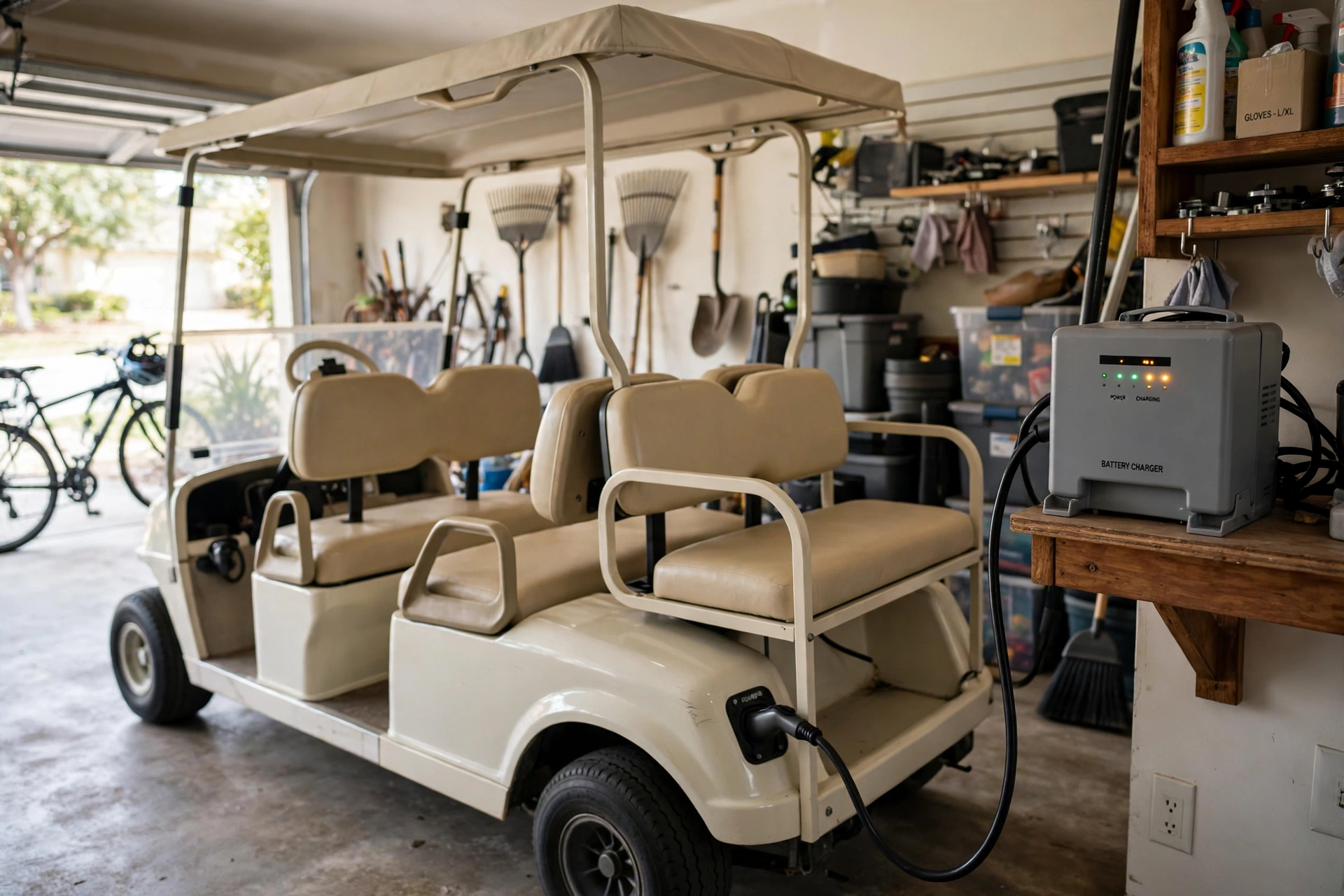
Last identification check, and it saves a lot of returns: the plug. Club Car, E-Z-GO and Yamaha each use a different DC connector, and 48V Club Car carts route charging through an on-board computer that a replacement charger must either cooperate with or bypass. Confirm the connector shape and the on-board computer question for your exact cart before ordering. The right specs with the wrong plug make an expensive paperweight.
How a golf cart charger actually charges: bulk, absorption, float
Lead-acid charging runs in three stages, and the amp rating on the box only describes the first one. During bulk, the charger pushes its full rated current and pack voltage climbs steadily; this stage restores about 80% of the charge. Then voltage reaches the absorption ceiling — roughly 57.6V to 58.8V on a 48V flooded pack — and the charger holds that voltage while current tapers away, sometimes down to 3A or 4A, over two to four hours. The taper is not a fault and it is not the charger “slowing down.” It is the chemistry accepting charge more slowly as it fills. Any charge-time figure that skips the taper is fiction.
After absorption, a smart golf cart charger drops to float: a holding voltage around 52.8V to 54.4V on a 48V pack (est., exact setpoints vary by profile) that keeps the pack full without boiling off water. Then it shuts down or sips. Compare the old ferro-resonant bricks sold under names like PowerDrive and PowerWise: no stages, no logic, a taper produced by transformer physics instead of a microprocessor. They hum, they run hot, and they throw away 20% to 25% of the wall power as heat. Their one virtue is durability. Some are still charging after 20 years, badly, but charging.
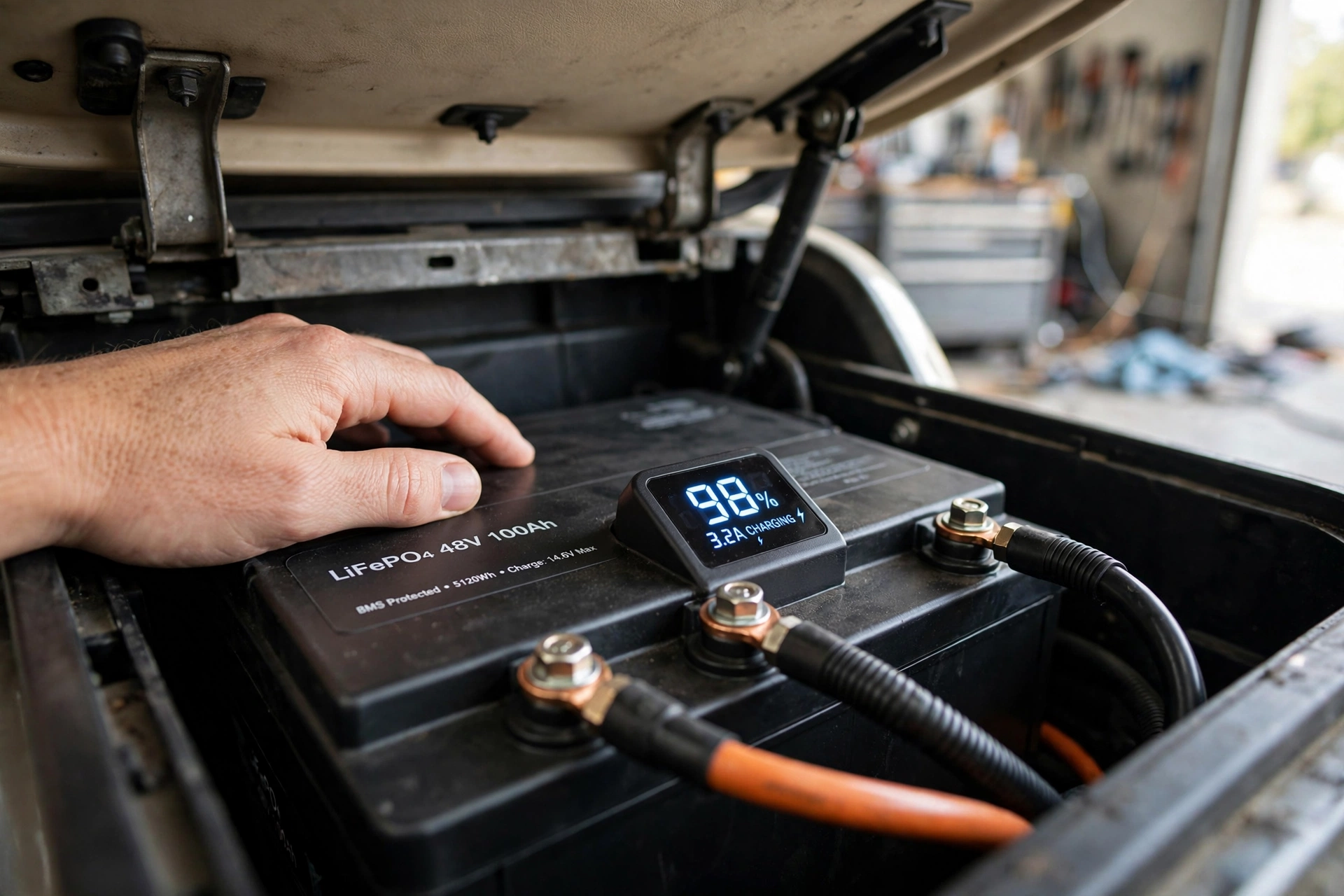
Lithium follows a flatter, faster curve. A LiFePO4 pack accepts near-full current until it is almost full, holds a constant voltage briefly at the top — about 58.4V for a 16-cell pack sold as “48V” (est., the pack’s battery management system makes the final call) — and then stops dead. No float stage. No equalization. No four-hour taper. That is why a lithium cart on a plain 15A charger still finishes hours ahead of a lead-acid cart on the same outlet: nearly all of its charging time is spent at full current.
Golf cart charger types compared
Four families of charger cover nearly every cart in North America, and they are not interchangeable. Prices below were checked October 25, 2026.
| Charger type | Named examples | Real output at 48V | Price (checked Oct 25, 2026) | Best for |
|---|---|---|---|---|
| Stock ferro-resonant | Club Car PowerDrive, E-Z-GO PowerWise class | 15–17A, tapering by design | $250–$400 replacement (est.) | Nothing, really — it came with the cart |
| Budget smart (high-frequency) | MODZ Max48 class | 15A | $200–$300 (est.) | Lead-acid carts on a budget |
| Premium smart, multi-voltage | Lester Electrical Summit Series II, 650W and 1,050W | 13.5A (650W) / 22A (1,050W) | $530–$600 (650W); $600–$800 (1,050W) | Mixed garages, flooded/AGM/gel/lithium profiles |
| Lithium kit charger | Eco Battery 51V CAN charger, bundled in conversion kits | 15A | Included in $2,672–$3,100 bundles | Lithium conversions, only |
| Onboard | Delta-Q QuiQ class | 18A | $370–$650 (est.) | Carts that charge wherever they park |
Study the Lester line in that table, because it exposes the industry’s favourite trick. The Summit Series II is a genuinely good charger — sealed IP66 case, no fan, selectable profiles for flooded, AGM, gel and lithium, and Lester publishes the profile documentation to prove it; Lester Electrical’s support and documentation library lists battery-profile bulletins for everything from Trojan lithium to AGM conversions. But read its own datasheet instead of the box. The 650W model delivers 18A at 36V and only 13.5A at 48V. Watts divided by volts is amps, and no badge changes the arithmetic. At 48V, the 1,050W version’s 22A is the one that earns the word fast. Bluetooth monitoring is a toy. Amps are the feature.
Onboard chargers such as the Delta-Q QuiQ mount inside the cart, so the charger travels and any wall outlet becomes a charge point. Output is honest — about 18A at 48V — and the sealed, fanless case shrugs off vibration and wash-downs. You pay for the packaging: output per dollar is the worst in this table. The Eco Battery kit charger sits at the opposite pole. It is a plain 15A unit, but it talks to the pack’s management system over a CAN bus and follows the lithium curve exactly, which is the entire point. Judge a charger by the curve it delivers to your chemistry, not by the size of the box.
The charge-time math, done properly
Here is the analysis nobody prints on a product page. Three real setups, recharged from the depth of discharge their owners actually use — 50% for lead-acid, because deeper cycling shortens flooded life sharply, and 80% for lithium, which tolerates it. Electricity is priced at $0.17 per kWh throughout. Two losses apply to every lead-acid figure: the pack only accepts about 85% of the amp-hours pushed into it, and the charger itself converts wall power at 78% efficiency for a ferro-resonant unit, about 90% for a high-frequency smart unit, and about 92% for the lithium kit charger.
Setup one: 36V flooded, 18A ferro-resonant charger. Six 6V batteries at 225Ah give an 8.1 kWh pack. Half discharged means 112.5Ah to replace, or 4.05 kWh of stored energy. Bulk restores 90Ah at the full 18A: 5.0 hours. Absorption crawls through the last 22.5Ah at a tapering average near 6A: about 3.6 hours. Total, roughly 8.6 hours — an overnight charge, every night. Wall energy: 4.05 ÷ 0.85 ÷ 0.78 = 6.1 kWh, which costs $1.04.
Setup two: 48V flooded, 15A smart golf cart charger. Six 8V batteries at 170Ah give 8.16 kWh. Half discharged is 85Ah, or 4.08 kWh stored. Bulk: 68Ah at 15A = 4.5 hours. Absorption: 17Ah at a tapering average near 5A = 3.2 hours. Total, about 7.7 hours. Wall energy: 4.08 ÷ 0.85 ÷ 0.90 = 5.3 kWh, costing $0.91. Run this cart daily, 300 days a year, and the annual charging bill lands near $273 (est., scaled from the per-charge figure).
Setup three: 48V lithium, 15A kit golf cart charger. A 51V 105Ah LiFePO4 pack holds 5.38 kWh. At 80% depth of discharge you replace 84Ah, about 4.3 kWh. Lithium barely tapers, so the time is nearly pure division: 84 ÷ 15 = 5.6 hours, plus a short constant-voltage tail, call it 5.9 hours total. Wall energy: 4.3 ÷ 0.98 ÷ 0.92 = 4.8 kWh, costing $0.81. Fit a 25A charger instead and the same recharge lands near 3.5 hours.
Read the three totals again. The electricity costs are within 23 cents of each other — energy is energy, and no charger chemistry changes that. What changes is the clock: 8.6 hours against 7.7 against 5.9, and the spread widens from a full discharge, where the lead-acid setups stretch to roughly 15–17 hours (est.) and lithium stays near 7.4. Golf cart chargers are sold on speed claims. Buy them on amp-hours per hour, at your voltage, into your chemistry.
What charging really costs
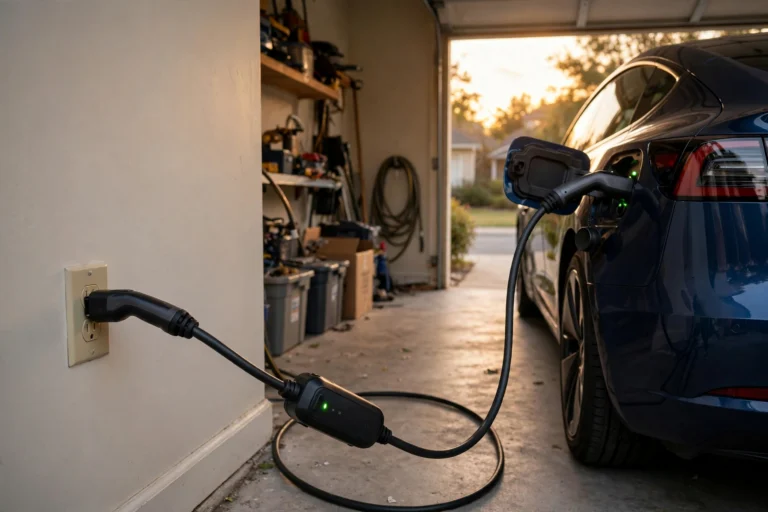
The power bill is the smallest number in this article, and it is worth proving. A dollar a charge, give or take a quarter, is $25 to $30 a month for a cart charged daily. Every charger here runs on an ordinary 120V household outlet, by the way — the same arrangement we break down for full-size cars in our guide to charging an electric car with a regular outlet. The per-charge arithmetic also matches the pattern in our cost to charge an electric bike analysis: small packs, small bills, and the hardware choices matter more than the tariff.
The real money sits in the battery tray. A set of six quality flooded batteries runs $1,000 to $1,200 (est., typical US retail for name-brand 6V and 8V deep-cycle units, checked October 25, 2026). Chronic undercharging sulfates those plates and can halve the pack’s life; chronic overcharging boils off water and corrodes them. A $550 premium charger that keeps a pack alive for six years instead of four has paid for itself before the second replacement cycle. A $99 charger that kills a pack in three years is the most expensive charger in this guide, whatever the receipt says.
Habits that kill packs, and the two that save them
Watering, done wrong or not at all. Flooded batteries lose water as they charge, and exposed plates sulfate permanently. Trojan Battery’s own quick battery watering guide sets the routine: check levels monthly, add distilled water only after charging — levels rise during the charge, so watering first invites an acid overflow — and fill to 1/8 inch below the bottom of the vent well. Distilled water, never tap. The minerals in tap water are a slow poison dose with every top-up. Skip watering for a single hot summer and you can take a third off the pack’s capacity.
Skipped equalization. In a series string, cells drift apart. An equalization charge — a deliberate, controlled overcharge to roughly 62–65V on a 48V pack (est., about 15.5V to 16.2V per 12V battery) — stirs stratified acid and pulls lagging cells back into line. Trojan-class guidance puts it at every 30 to 60 days, or whenever a hydrometer shows specific gravity spread wider than 0.030 between cells; a fully charged cell reads about 1.277. Equalize flooded batteries only. Running an equalize cycle into AGM, gel or lithium is abuse with a menu setting.
Storage sins. A flooded pack self-discharges 4% to 5% a month and sulfates while it sits low, so storing a cart discharged for winter is a death sentence carried out slowly. Charge fully before storage and refresh every 30 to 45 days, or leave a smart charger with a proper maintenance mode connected. Lithium storage is the mirror image: park it near 50% charge and disconnect it. And ventilate. Flooded packs vent hydrogen gas while charging, hardest during equalization. Charge in a ventilated space, keep sparks and pilot lights away, and never equalize in a sealed room. The gas is odourless, invisible, and entirely unforgiving.
Our verdict: golf cart charger scores
Scores use three sub-ratings out of 10 — Speed, Battery Care and Value — weighted toward battery care, because packs cost more than chargers.
Stock ferro-resonant charger — Our score: 5.0/10. Speed 4/10, Battery Care 5/10, Value 6/10. It was free and it refuses to die; it also wastes a quarter of your electricity and guesses at the finish. Replace it when the pack is replaced, if not before.
Budget smart 15A charger (MODZ class) — Our score: 6.7/10. Speed 5/10, Battery Care 7/10, Value 8/10. A real three-stage profile at a fair price. The 15A ceiling is the ceiling — no setting makes it fast.
Lester Summit Series II — Our score: 7.7/10. Speed 7/10, Battery Care 9/10, Value 7/10. Documented profiles for four chemistries, sealed case, honest datasheet. Buy the 1,050W version for 48V carts; at 13.5A the 650W is a 36V charger wearing a 48V badge.
Lithium kit charger (Eco Battery CAN class) — Our score: 8.0/10. Speed 6/10, Battery Care 10/10, Value 8/10. Inside a lithium conversion, nothing else is acceptable: it follows the pack maker’s curve and talks to the BMS. The score applies to lithium carts only — it will not charge your lead-acid pack, and that is correct behaviour.
Onboard charger (Delta-Q QuiQ class) — Our score: 6.7/10. Speed 6/10, Battery Care 9/10, Value 5/10. Superb engineering, poor output per dollar. Buy it for the travelling, not the charging.
Golf cart charger FAQ
How long should a golf cart charger take to fill a 48V pack?
From the 50% discharge a lead-acid pack should live at, expect 7.5 to 8.5 hours on a 15A charger and roughly 5.5 to 6.5 hours at 22–25A. A 105Ah lithium pack at 80% discharge takes about 5.9 hours at 15A. Any claim of two hours for a full lead-acid charge is measuring something other than a full charge.
Can I use a 48V charger on a 36V cart?
No. The 48V unit’s absorption voltage, near 58V, massively overcharges a 36V pack built to finish around 44V. The result is boiled electrolyte, warped plates and a ruined pack, possibly within one cycle. Voltage must match exactly.
Can my old lead-acid charger charge a lithium pack?
No, and the reasons are in the curve. A lead-acid profile holds a long absorption tail, floats indefinitely, and may run an equalization voltage that a lithium pack should never see. A lithium pack needs a charger with an explicit lithium profile and, in kit systems, a CAN connection to its management system. Some premium multi-voltage chargers offer genuine lithium profiles; confirm yours by profile number, not by a sticker.
How often do flooded batteries need water?
Check monthly until you learn your pack’s thirst, then on that rhythm. Add distilled water after charging, to 1/8 inch below the vent well, and never let the level fall below the top of the plates. Hot climates and frequent equalization both increase water use.
Should I leave the charger plugged in between uses?
With a modern smart golf cart charger that has a true maintenance or storage mode, yes — that is what the mode exists for, and a stored pack kept full sulfates far more slowly. With an old ferro-resonant brick, unplug when charging finishes; it has no off state worth trusting. For lithium, park the cart near half charge for long storage and follow the pack maker’s guidance.
Can I charge my cart away from home?
Yes, if the charger travels — that is the whole case for an onboard unit — or if you carry a portable one. Any standard wall outlet works; your cart will never need a public charging network of the kind drivers hunt for with our guide to finding EV charging stations. A receptacle at the marina or the campground is the entire infrastructure requirement.