Last updated: October 25, 2026
Start with the uncomfortable part: dirt bikes that are electric are the most lied-about machines in motorcycling. The lies run in both directions. Sellers inflate range until it reads like fiction, and petrol diehards dismiss 914 Nm of rear-wheel torque as “a toy.” Both camps are wrong, and the numbers below show exactly where each one is bluffing.
Torque is the story here, not top speed and not styling. An electric motor makes its peak twist from zero rpm, which is the only rpm that matters when you’re clawing out of a rutted corner or lofting the front wheel over a log. A petrol 250F needs revs and clutch slip to find its power; these bikes just hand it over. That’s why a 130 lb play bike can embarrass full-size machinery on tight trails.
The market has sorted itself into clear classes in late 2026, from $799 kids’ balance bikes to a $14,490 race bike that out-powers a 450. Prices in this guide were checked October 25, 2026. Where a figure is a maker’s claim, it’s labeled a claim; where testers have run a battery flat and published the result, that number wins. Every time.
One warning before the classes: almost nothing in this guide is a legal e-bike, whatever the ads imply. The legality section near the end is precise about what you can ride where, because getting that wrong costs riders trails and tickets.
The classes of dirt bikes that are electric, decoded
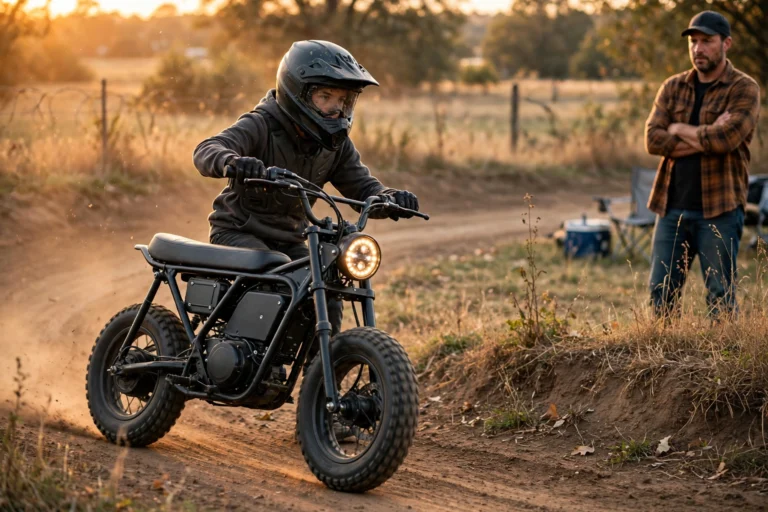
Kids and balance bikes. The Stacyc range is the honest end of the business. The 12eDRIVE costs $799, the 16eDRIVE Brushless $1,049, the 20eDRIVE $1,599 (checked October 25, 2026). The 16e weighs 20 lbs, tops out at 13 mph and runs 30 to 60 minutes on a 20V 4Ah pack — about 72 Wh, less than a power-tool battery. Plenty, when the job is teaching a six-year-old throttle control.
Mini motos. The Riding’times GT73 is the class clown with a serious sales chart: $1,599 on sale against a $2,099 list, a 1,200W rated hub motor (2,400W peak), twin removable 48V 18.2Ah batteries totaling 1,747 Wh, pedals, and a claimed 37 mph. Yozma’s IN10 Pro sits nearby at about $1,899. These are heavy, soft, fun backyard machines. They are not motocross bikes, and the GT73’s claimed 68-mile throttle range is the single most dishonest number in this entire guide — the math section below buries it.
Play bikes. This is the class that built the segment. The 2026 Sur-Ron Light Bee X runs a 10 kW peak motor, 295 Nm at the wheel, a 72V 35Ah pack (2,520 Wh) and weighs about 130 lbs, at $4,499 (checked October 25, 2026). Talaria’s Sting R MX4 counters with an 8 kW motor, a bigger 2,700 Wh pack, a proper gearbox instead of a belt, and a $4,500 price; the Sting MX5 Pro steps up to 13.4 kW and 2,880 Wh for around $4,700 (est.). The Light Bee X is the default answer, and everything else in the class needs an excuse to exist. The Talaria’s excuse is torque and a stronger frame feel; it’s a good excuse.
Mid-size. The Sur-Ron Ultra Bee is the grown-up: 12.5 kW peak, 440 Nm at the wheel, a 74V 55Ah pack (4,070 Wh), 187 lbs, and up to 62 claimed miles, at $6,599 from US dealers (checked October 25, 2026). It’s a real motorcycle chassis with 240 mm of travel at both ends, priced against used petrol 250Fs.
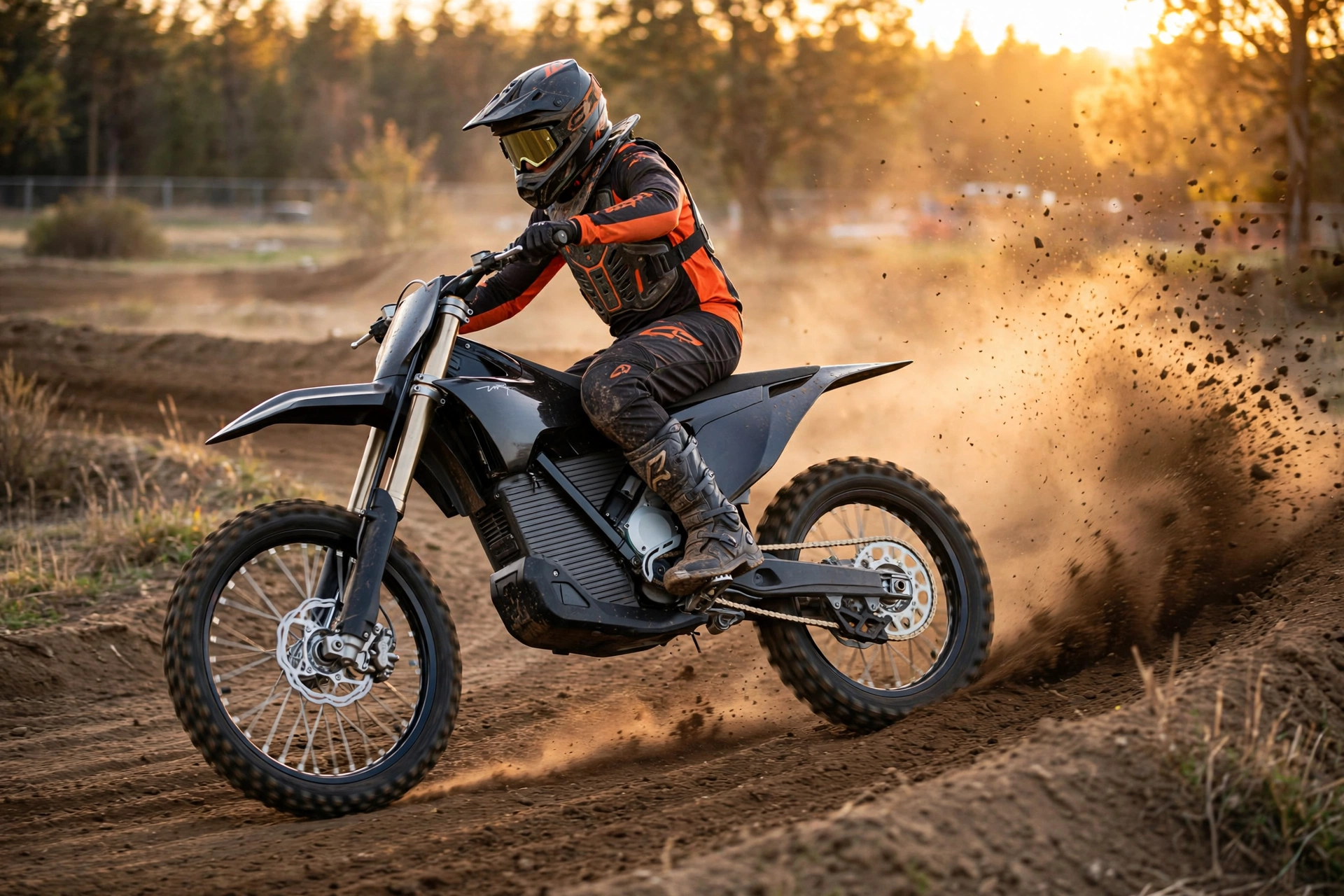
Full-size race bikes. One name. The Stark VARG MX 1.2 comes in Standard (60 hp) and Alpha (80 hp) forms. Stark’s official VARG page lists the MX 1.2 at $12,490 and $13,490 — and US buyers pay a $1,000 tariff charge on top, so $13,490 and $14,490 before tax (checked October 25, 2026). For that: a 7.2 kWh pack, KYB suspension, Brembo brakes, a two-year warranty and 914 Nm at the rear wheel in Alpha trim. The street-legal VARG EX enduro starts lower, from $12,900 in earlier listings, with the same tariff caveat (est.).
The casualties. Cake, the Swedish brand that made electric dirt bikes fashionable, filed for bankruptcy in February 2024 after raising over $70 million and selling roughly 6,000 bikes. Norway’s Brages Holding bought the brand and IP; a small team under Cake’s former CTO reopened the Stockholm store, and the Kalk and Bukk are still listed — but it’s a caretaker operation, not a growth story. Alta Motors has been gone since 2018. KTM’s Freeride E vanished during KTM’s financial restructuring, then returned as a 2027 model: 19.2 kW peak, swappable 5.5 kWh pack, 50-state street legal, £8,999 in the UK with US pricing not yet announced (est. — expect five figures, based on the UK price). Blunt lesson: check the company will exist to sell you a battery in 2029.
Torque and power: the numbers that actually matter
Ignore headline horsepower until you’ve sorted the torque figures, because this industry quotes three different things under one word. KTM quotes motor torque: the Freeride E’s 37.6 Nm is measured at the motor shaft, before gearing. Sur-Ron and Talaria quote wheel torque — after the reduction gearing multiplies it — which is how a Light Bee X claims 295 Nm and an Ultra Bee 440 Nm. Stark quotes 914 Nm at the VARG Alpha’s rear wheel. None of these numbers are fake — but comparing KTM’s 37.6 against Sur-Ron’s 440 without knowing which is which is how buyers get fooled. Compare like with like, at the same end of the drivetrain.
In horsepower, the ladder looks like this. Light Bee X: 10 kW, about 13 hp. Ultra Bee: 12.5 kW, about 17 hp. Talaria MX5 Pro: 13.4 kW, about 18 hp. Freeride E: 19.2 kW, about 26 hp. VARG Standard: 60 hp. VARG Alpha: 80 hp — more than a petrol 450 motocrosser makes, in a bike weighing 260 lbs with its power adjustable from 10 hp to 80 hp through the handlebar display. If those figures interest you, our fastest e-bike guide tracks the outright speed merchants.
Claimed vs tested range: dirt bikes that are electric tell two stories
One rule separates the honest makers from the brochure merchants: a range figure means nothing without a speed attached. Sur-Ron’s 46.6-mile Light Bee X figure is measured at a steady 25 mph — real, and useless for trail planning, because nobody rides trails at a steady 25 mph. The table below puts the claim and the reality side by side.
| Bike | Battery | Claimed range | Tested or realistic range |
|---|---|---|---|
| Stacyc 16eDRIVE | ~0.07 kWh | 30–60 minutes | 30–60 minutes — honest, because it’s quoted in minutes |
| Riding’times GT73 | 1.75 kWh | 68 miles (throttle only) | 22–29 miles (est., from our consumption math below) |
| Sur-Ron Light Bee X (2026) | 2.52 kWh | 46.6 miles at a steady 25 mph | 25–35 miles of mixed trail riding (widely reported by owners and testers) |
| Talaria Sting MX5 Pro | 2.88 kWh | Low-speed figures up to ~62 miles (est.) | 28–38 miles of trail riding (est., scaled from its pack size and class consumption) |
| Sur-Ron Ultra Bee | 4.07 kWh | 87 miles at 25 mph | 40–55 miles of trail riding (est., from our consumption math below) |
| KTM Freeride E (2027) | 5.5 kWh | 2–3 hours of enduro riding | Not yet independently tested — too new |
| Stark VARG MX 1.2 | 7.2 kWh | 1.3–6 hours | 32 minutes at pro pace to 65 minutes at steady amateur pace on one charge (Hangtown test, earlier 6.5 kWh bike); 33.8 miles in 2 hours 11 minutes of trail riding (tested) |
The VARG numbers deserve a paragraph of their own, because Stark did something rare: it let people run the bike flat in public. In the Hangtown range test reported by GateDrop, three riders attacked the same hardpack track on the 48 hp setting until the battery died: pro rider Cole Seely emptied it in 31 minutes 40 seconds, an intermediate lasted 55 minutes 31 seconds, and a steady local rider stretched it to 1 hour 5 minutes. At Thunder Valley, a pro running mostly 50 hp covered about 18 miles before hitting 10% charge. Former world champion Sébastien Tortelli, Stark’s own tester, puts it at 35 minutes at full Grand Prix intensity. So the “up to six hours” claim and the 32-minute reality are both true — they’re describing different sports. Plan your purchase around the tested column; our complete guide to e-bike dirt riding has more background.
The math nobody prints: what dirt bikes that are electric actually consume
Time for our own arithmetic, built from the tested figures above. Consumption in watt-hours per mile is the one number that lets you compare any two dirt bikes that are electric honestly. Divide the pack by the miles.
Stark VARG, trail pace: the tested trail ride covered 33.8 miles on a 6.0 kWh pack. 6,000 ÷ 33.8 = 178 Wh per mile. Stark VARG, track pace: about 18 miles used roughly 90% of that pack before the 10% warning — 5,400 ÷ 18 = 300 Wh per mile. Same bike, same battery, nearly double the burn. That’s the whole range argument in one line: your right hand is the range figure.
Sur-Ron Light Bee X: 2,520 Wh ÷ 46.6 claimed miles = 54 Wh per mile at the steady 25 mph test pace. At the 30-mile midpoint of reported trail range, 2,520 ÷ 30 = 84 Wh per mile. Apply that to the Ultra Bee’s 4,070 Wh and you get 4,070 ÷ 84 ≈ 48 trail miles — right inside the 40–55 mile realistic band in the table.
Riding’times GT73: its claim implies 1,747 ÷ 68 = 26 Wh per mile, throttle only, at up to 37 mph. That is step-through scooter consumption at bicycle speeds, and it is not happening on a 116 lb machine with knobby tires. At a believable 60–80 Wh per mile (est.), the GT73’s real throttle range is 22–29 miles. The 155-mile pedal-assist figure requires you to pedal a 116 lb motorcycle like a bicycle for six hours. Enough said.
Cost per hour — electric vs a petrol 250F. Take electricity at $0.17 per kWh (est., roughly the US residential average). A Light Bee X at trail pace draws about 84 Wh per mile at maybe 12 mph average — call it 1.0 kWh per hour, or $0.17 per hour. A VARG at pro moto pace emptied 6.5 kWh in 31.7 minutes, a 12.3 kW average draw: $2.09 per hour — the thirstiest case here. Now the petrol 250F (all est.): fuel at 0.6–1.0 gallons per hour × $3.15 a gallon = $1.89–$3.15; engine oil at about $15 a liter changed every 10 hours = $1.50; oil and air filters ≈ $0.95. Total: $4.34–$5.60 per hour, before pistons, valves and clutch plates. Even the VARG at full pro pace burns less money per hour than a 250F burns in fuel alone at track pace. The play bikes run for pocket change. our electric mini bike and motorcycle guide runs the same cost logic on smaller machines.
Charging in the real world: packs, generators and spares
Two charging philosophies divide dirt bikes that are electric. The play bikes and the Freeride E use removable packs: the Light Bee X, both Talarias, the Ultra Bee and the KTM all let you lift the battery out — KTM says under 10 minutes — and charge it in a garage, a flat or a hotel room. The VARG’s 7.2 kWh pack is fixed in the frame, and the bike charges through a 3.3 kW stand charger: about 2 hours on 240V, about 3.5 hours on 120V. Removable packs win for apartment dwellers and spare-pack owners; fixed packs win on chassis stiffness and sealing.
Charge times, honestly stated: the Light Bee X takes roughly 2 hours for a 20–80% top-up. The Ultra Bee needs about 4.5 hours for a full charge. The Freeride E’s stock 660W charger takes an embarrassing 8 hours; KTM’s optional 3.3 kW unit cuts that to about 1.5 hours, and you should budget for it on day one. The VARG’s 2-hour 240V charge is the best in this guide.
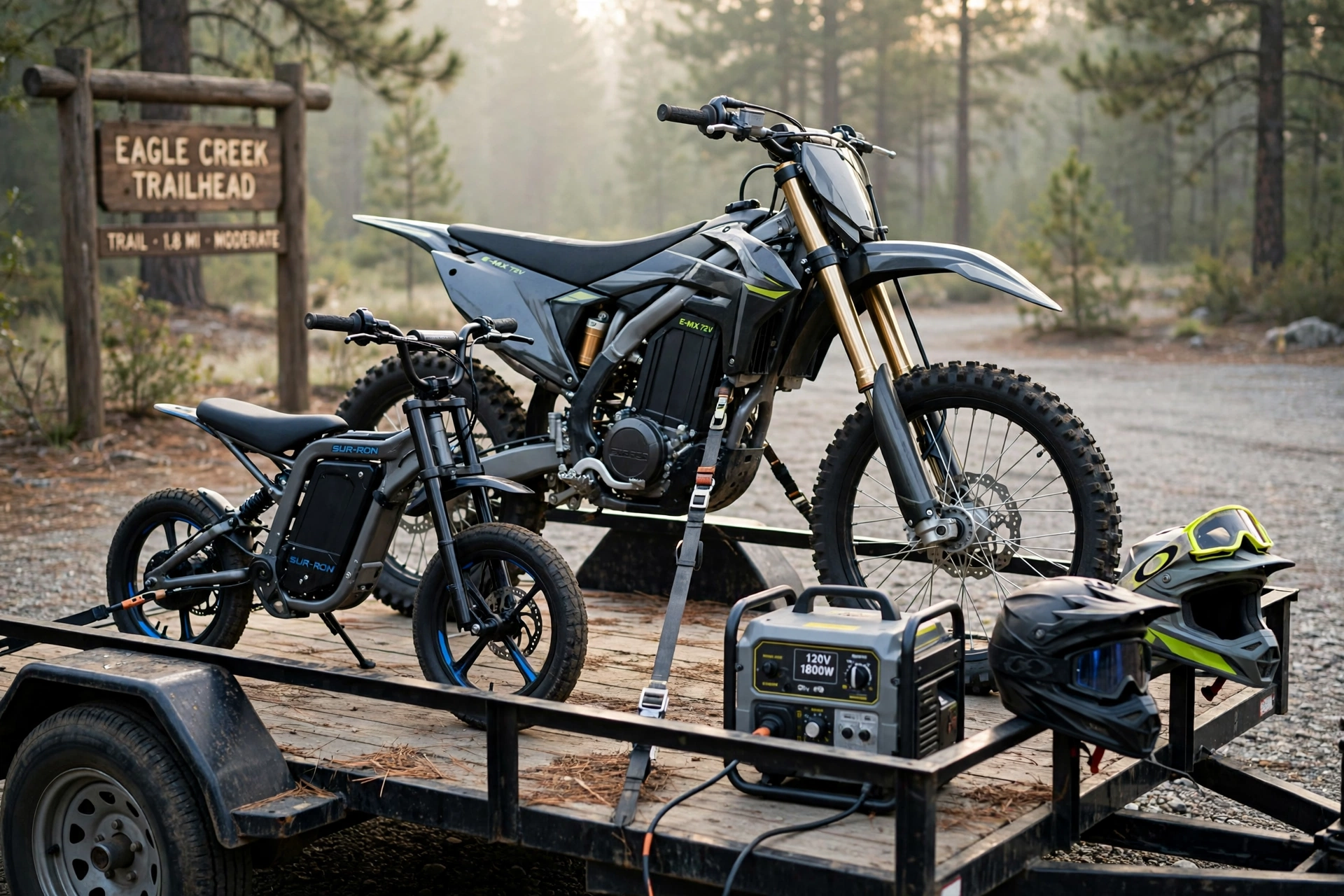
Spare packs are the real range extender, and they aren’t cheap: replacement packs for the mid-size bikes run roughly $1,300–$2,000 (est.), which is why most owners charge at the trailhead instead. A 2,000W inverter generator will happily feed one play-bike charger; two bikes, or one VARG pulling 3.3 kW, need a 3,500W-plus 240V-capable generator or proper paddock power. Generator at breakfast, second pack after lunch — that’s the rhythm of an electric ride day.
Legality and trail access: dirt bikes that are electric are not e-bikes
Precision time, because this section keeps people out of trouble. US federal e-bike classes 1, 2 and 3 cap motors at 750W, require working pedals, and top out at 20 or 28 mph. A 10 kW Light Bee X with no pedals is not a Class anything. Neither is a GT73: pedals and lights don’t save a 2,400W bike that does 37 mph, whatever the product page claims about “e-bike classification.” These are off-highway motorcycles in the eyes of the law.
What that means in practice. On public land in most states you’ll need the same OHV registration or sticker a petrol dirt bike carries — California’s green/red sticker system is the famous example, and California’s SB 586 created a dedicated “eMoto” classification from January 1, 2026. Note the wording: it classifies these machines. It does not make them street legal, and it does not open bicycle trails. On Forest Service and BLM land, an electric dirt bike is a motor vehicle, full stop: legal on designated motorized trails and roads, illegal on non-motorized and mountain bike trails no matter how quiet it is. Riding an e-moto on an MTB trail is the fastest way to get electric bikes banned from places they were never allowed in the first place.
Two genuine advantages do exist. Spark arrestors: agencies require them on combustion engines because exhaust sparks start fires; an electric motor has no exhaust, so that inspection failure doesn’t exist. Noise: most OHV areas cap around 96 dB, and every bike here passes at a whisper — which is why they get ridden near houses at dawn, where a 450 would bring the police by the second lap. Quiet is a real access tool. It is not a permit.
The exceptions are the street-legal pair. The 2027 KTM Freeride E is homologated as a 50-state-legal dual sport, and the Stark VARG EX is a road-legal enduro. Both need a motorcycle license, registration and insurance, and both can legally connect trails on public roads. Everything else in this guide belongs on private land, at OHV parks, or on motorized trails.
Who should buy which class — with our verdict scores
Kids learning throttle control: Stacyc 16eDRIVE — Our score: 8.6/10 (Power 6 / Range 5 / Value 8). Sized right, speed-limited, 20 lbs. Skip the mini motos for young kids; a 116 lb GT73 is a teenager’s machine, whatever the marketing photos show.
Backyard and pit-bike fun on a budget: Riding’times GT73 — Our score: 6.9/10 (Power 5 / Range 4 / Value 8). Cheap, cheerful, dual batteries, and a range claim you should ignore entirely. Buy it for the $1,599 sale price and 25 honest miles, not the 68 on the box.
The default play bike: Sur-Ron Light Bee X — Our score: 8.5/10 (Power 7 / Range 6 / Value 10). The 2026 update to 10 kW and 295 Nm fixed its weakest points, the aftermarket is enormous, and nothing touches it for trail smiles per dollar. Its one real flaw: 25–35 honest trail miles ends the day early.
The play bike with more bite: Talaria Sting MX5 Pro — Our score: 8.3/10 (Power 8 / Range 6 / Value 9). More peak power (13.4 kW) and a gearbox instead of a belt for roughly Light Bee money (est. around $4,700). Dealer coverage is thinner than Sur-Ron’s; the bike itself is arguably better.
All-day trail riders: Sur-Ron Ultra Bee — Our score: 8.4/10 (Power 7 / Range 8 / Value 9). The 4.07 kWh pack and full-size chassis make it the trail pick of this guide. At $6,599 it costs used-250F money and then runs for cents an hour.
Racers and 450 converts: Stark VARG MX 1.2 Alpha — Our score: 8.7/10 (Power 10 / Range 6 / Value 7). Eighty horsepower, 914 Nm, the best suspension and brakes here, a two-year warranty — and a tested 32 minutes at pro pace. Vet your moto length before buying: two 20-minute motos plus practice, yes; a 45-minute pro national, bring the charger and a generator. At $14,490 in the US it’s dear, and it’s still the only one of the dirt bikes that are electric that argues with a factory 450 on merit.
Trail riders who need a plate: KTM Freeride E — Our score: 7.4/10 (Power 6 / Range 7 / Value 5). Street legality and a swappable pack are worth real money; 26 hp and an unconfirmed US price (est.) are the brakes on that enthusiasm. The VARG EX is the faster legal option if your budget stretches.
Frequently asked questions
Are dirt bikes that are electric street legal? Almost never in stock form. Of the bikes in this guide, only the KTM Freeride E and Stark VARG EX are homologated road-legal motorcycles, needing a license, registration and insurance. Everything else is an off-highway vehicle for private land, OHV parks and designated motorized trails.
How far do they really go on a charge? For dirt bikes that are electric, by class, in honest trail miles: play bikes 25–35 miles, mid-size bikes 40–55 miles (est.), and the Stark VARG about 34 miles of trail riding or 32–65 minutes of motocross depending on pace. Any claim quoted at a steady 25 mph should be halved for trail planning.
Do I need a license or registration to ride one? On the road, yes — a motorcycle license, for the two street-legal models. Off-road, most states require an OHV registration or sticker for public land, and age and supervision rules for young riders vary by state. Private land is the landowner’s call.
Can I ride an electric dirt bike on mountain bike trails? No. Land managers classify them as motor vehicles regardless of noise, and motor vehicles are barred from non-motorized trails. The quiet motor changes how neighbors feel; it doesn’t change the regulation.
How long do the batteries last, and what does a replacement cost? Stark and KTM both rate their packs at 1,000+ charge cycles to about 80% capacity — years of weekend riding. Replacement packs for mid-size bikes run roughly $1,300–$2,000 (est.): a long-term wear item, not a consumable.
Electric or petrol 250F for a first dirt bike? Electric, if your riding is trails, play tracks or anywhere near houses: cheaper per hour by a factor of ten on consumables, no clutch to learn, no oil to change, and torque that arrives without drama. Petrol still wins for long remote rides and all-day race formats, because a fuel can refills in 30 seconds and a battery doesn’t.
When you compare dirt bikes that are electric side by side, the tested range matters more than any headline claim. For most riders, dirt bikes that are electric make most sense as a second, trail-focused machine rather than a do-everything motorcycle. And if you are still deciding, remember that dirt bikes that are electric reward careful battery and charging planning more than raw horsepower.
Charging is another practical test for dirt bikes that are electric, because a removable pack can turn a long lunch stop into useful range. Buyers should also check dealer support before choosing dirt bikes that are electric, since parts and battery service matter more over time than a small price gap. In short, the best dirt bikes that are electric are the ones whose tested range, charging setup and trail access fit the riding you actually do.