Last updated: October 25, 2026
An evercross electric scooter is the scooter you buy when the budget is real and the commute is short. EVERCROSS sells more budget scooters on Amazon than almost anyone, prices start around $250, and the spec sheets read like they were written by someone who has never ridden the product uphill. An evercross electric scooter can be genuinely good value — or a 44-pound disappointment with a folding latch that develops play in month two. The difference is picking the right model and ignoring roughly a third of the numbers on the box.
So here are the seven things that decide whether one works for you: the lineup split, what the motor badges hide, honest range, hills, the tire compromise, owner nitpicks, and what a mile really costs. Prices and listings were checked October 25, 2026, and estimates are marked (est.) with the reasoning attached.
One warning before the details. EVERCROSS reuses names, changes battery sizes between production runs, and lets listings contradict each other — the same model can show two different batteries on two pages. We flag every place that happens below, because on a $650 scooter that sloppiness should cost the model your money.
The short version: buy the EV10K Pro if your ride is flat and under five miles each way, buy the H5 for the only air-filled tires and properly tested range, and don’t pay H9 money for a battery the A1 sells for far less. The long version follows — your hill, your weight and your staircase will vote on this purchase too.
Thing 1: The evercross electric scooter lineup is two families wearing seven name tags
Strip the marketing away and every model is one of two machines. The lightweights run a 36V battery and a 350W or 500W motor, weigh 28 to 36 pounds, and fold small enough to carry up stairs and onto a bus. The heavyweights run a 48V battery and an “800W” motor, weigh 44 to 55 pounds, come with a detachable seat, and are small seated runabouts pretending to be commuter scooters. Same brand, same app, completely different jobs.
| Model | Motor (peak) | Battery | Claimed range | Top speed | Tires | Weight | Max load | Price |
|---|---|---|---|---|---|---|---|---|
| EV08S | 350W | 36V 6Ah (216Wh) | 12–15 miles | 15 mph | 8-inch solid | 27.6 lbs | 220 lbs | ~$240 (est.) |
| EV85F | 350W | 36V 7.8Ah (281Wh) | 15–19 miles | 18.6 mph | 8.5-inch solid | ~29 lbs | 220 lbs | $249.99 |
| EV10K Pro | 500W | 36V 11.4Ah (410Wh) | 22 miles | 19 mph | 10-inch honeycomb solid | 35.3 lbs | 330 lbs | $299.99 |
| H5 / HB24 | 800W | 48V 10Ah (480Wh) | 31 miles (25 tested) | 28 mph | 10-inch pneumatic | 44 lbs | 330 lbs | $499 |
| A1 | 800W | 48V 14Ah (672Wh) | 31 miles | 28 mph | 10 × 2.75-inch honeycomb solid | 48.7 lbs | 264 lbs | ~$455 |
| H9 | 800W | 48V 14Ah (672Wh) | 28 miles (manual admits 18–28) | 28 mph | 10-inch solid | ~44 lbs | 330 lbs (220 recommended) | ~$665 (est.) |
| H7 | 800W | 48V 15Ah (720Wh) | 28 miles | 28 mph | 10-inch solid off-road | 54.4 lbs | 330 lbs | $569.99 |
Prices checked October 25, 2026 across the brand’s storefronts and marketplaces; EVERCROSS street prices swing weekly with coupons — treat any figure as a snapshot, not a promise. The brand also lists smaller machines (the EV06C kids’ scooter, the seated ES2) — the seven above are the adult lineup that matters.
Notice the pattern — it’s the whole brand strategy: money buys battery, and battery buys everything else. The jump from the EV85F’s 281Wh to the EV10K Pro’s 410Wh is the most useful $50 in the catalogue; the jump to the 672Wh pair (A1, H9) roughly doubles realistic range; the H7’s 720Wh is the biggest pack, on the heaviest frame. There is no lightweight long-range EVERCROSS — physics doesn’t allow one at these prices — so the range claims do the pretending instead.
Thing 2: That 800W badge is peak power — plan around 500W
Every 48V model is sold as an “800W” scooter. The H9’s own manual is more honest than its product page: rated power 500W, peak power 800W. Peak is a few seconds of burst pulling away; rated is what it can hold. The tested H5 tells the same story: sustained output around 500W under the 800W headline. This is the whole budget industry, not an EVERCROSS scandal — but shop accordingly: compare these against other brands’ 500W machines, not their 800W ones.
What does honest 500W feel like? On flat ground, plenty — the 48V family reaches 28 mph without drama, and the 36V EV10K Pro holds 19 mph happily. The gap shows up the moment the road tilts or the rider is heavy. Sustained watts are what drag 200 pounds of rider and scooter up a grade, and 500 sustained watts is a modest number doing that job. Over about 220 lbs, read the rated figure, not the badge — and treat the 350W lightweights as flat-ground-only.
The EV10K Pro plays a smaller version of the same trick: it ships limited to 15 mph, and the advertised 19 mph arrives only after you unlock it in the app or press the power button six times. That’s a shipping-compliance workaround, documented in the manual — if yours feels slow out of the box, that is why. It isn’t broken.
Thing 3: Claimed range is fiction — here is what an evercross electric scooter actually does
Every range figure in the table above was produced the same way: a light rider, eco mode, flat ground, warm battery, no stops. Your commute has a heavier rider (you), traffic lights and a headwind — so the claim is a ceiling, not a plan. The good news: EVERCROSS claims are less inflated than most of the bargain bin. When EScooterNerds put the H5 through a real range test for their hands-on evercross electric scooter review, it covered 25 miles against a 31-mile claim — 81 percent, which is honest by budget-scooter standards. They also measured top speed right at the claimed 28 mph and braking at about 5 metres (16 feet) — an unusually honest spec sheet.
A separate hands-on review of the 22-mile-claim commuter models landed where physics says it should: about 21 miles in eco on flat ground (150 lb rider), roughly 17 in mixed riding (180 lbs), and just 12 in sport mode with hills (220 lbs) — call it 16 to 18 for an average commute. Our planning rule: take 70 to 75 percent of the claim if you weigh around 180 lbs, less if you’re heavier or your route climbs. That gives realistic planning ranges (est.) of about 13 miles for the EV85F, 16 for the EV10K Pro, 25 tested for the H5, 23 for the A1, 22 for the H9 and 21 for the H7.
The H9 earns a specific callout. Its listings shout 28 miles; its own manual quietly prints a range of 18 to 28 miles. Credit where due, it’s the most honest line in any EVERCROSS document — but plan around the bottom half: at 28 to 30Wh per mile, the low 20s is all the math allows. If your round trip is longer than about 18 miles with no charging at the far end, nothing in this lineup is your scooter; you need a bigger battery class entirely, and our guide to the Segway Ninebot Max G30P covers the cheapest step up that commuters usually cross-shop.
Thing 4: Hills, honestly — degrees are not percent, and 500W has limits
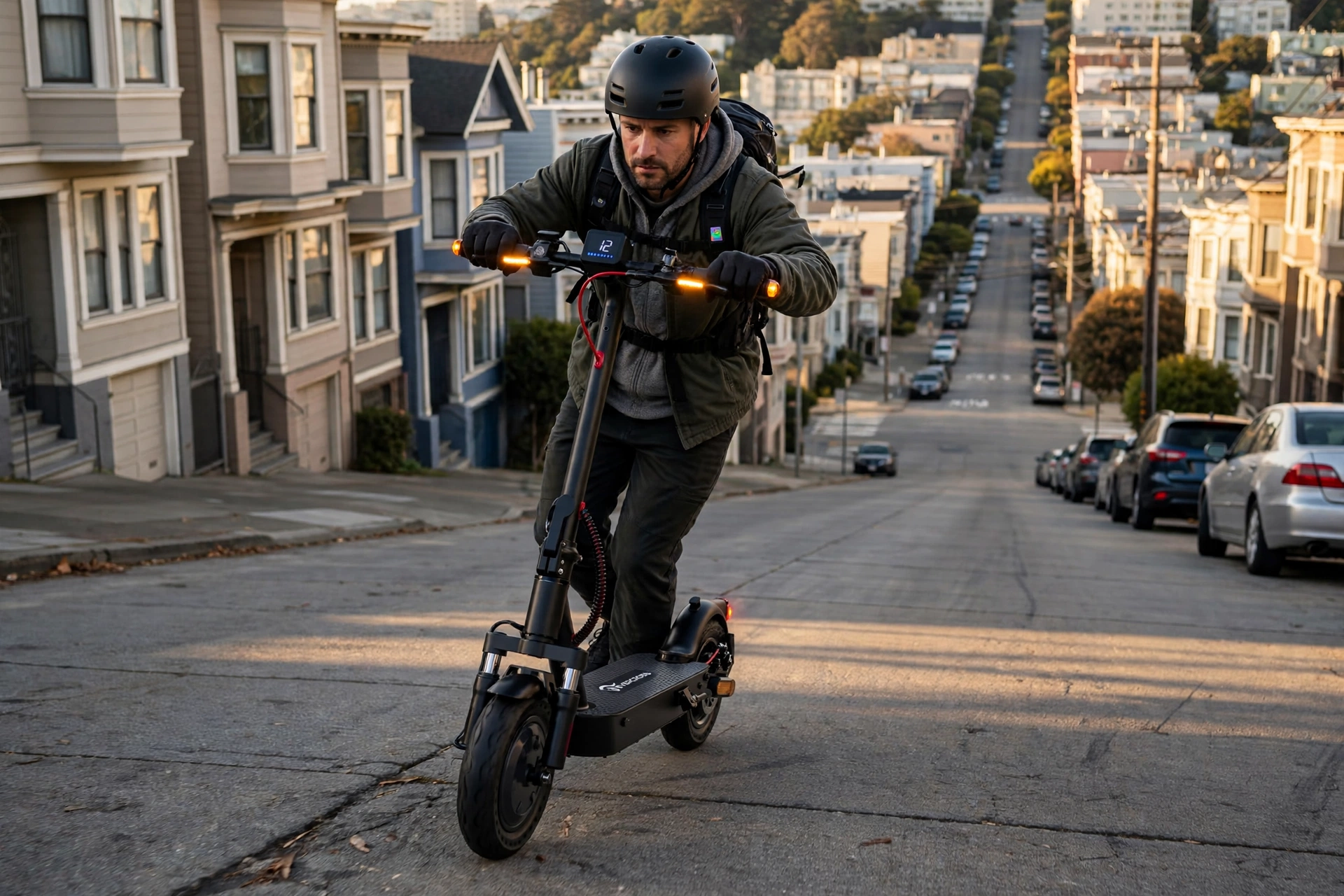
Climbing claims are where the spec sheets get creative. The EV10K Pro claims it climbs slopes of 10 to 15 degrees. Fifteen degrees is a 27 percent grade — steeper than almost any paved city street — and a 500W-peak scooter will not cruise up it. What it will do (est., from the motor’s rated output and owner reports) is hold a reasonable pace on 4 to 8 percent grades, slow to walking-plus pace on a 10 percent pitch, and ask for a kick or a dismount on anything steeper. Workable for a rider under 180 lbs with one short, sharp hill; not workable for a 220 lb rider in a genuinely hilly city.
The tested H5 climbed grades its testers estimated at around 20 degrees at maximum effort. The useful commuting fact is simpler: an 800W-peak evercross electric scooter holds roughly 10 to 13 mph on a 10 percent grade with an average rider (est.), instead of dying to a crawl. That difference — jogging speed at the top versus pushing — is the entire reason to buy the heavier family. On a truly steep climb this whole price class tops out quickly — hill specialists live in a different bracket, as our Kaabo King GTR guide shows at ten times the price.
One more hill habit: speed sags as the battery drains — EV10K Pro owners report it below half charge, testers noted it on the H5 near empty — so put your climb early in the route, or keep the charger at work.
Thing 5: Solid and honeycomb tires are the biggest compromise
Count the air-filled tires in the whole lineup: two, both on the H5. Everything else rolls on solid rubber or honeycomb tires that can never go flat. As a commuting decision that’s correct for most buyers: a puncture is a missed shift, and solid tires delete the failure mode entirely. The EV10K Pro’s honeycomb pattern is the smart version — its cutouts flex a little over cracked pavement — and the A1’s wide 10 × 2.75-inch honeycombs are the best of the solids.
Solid tires transmit buzz that pneumatic tires absorb, and on broken sidewalks a solid-tired scooter at 19 mph is a genuinely tiring ride — EVERCROSS fits dual suspension to nearly everything for exactly this reason, and it helps, but springs are not air. The H5 is the exception that proves the rule: testers singled out its ride comfort, its pneumatic tires doing work no spring can copy, and it ships with tire sealant in the box. The trade: flats are back on the menu. Glass-strewn route? Pick the honeycomb and accept the buzz. Smooth pavement and a bad back? Pick the H5 and carry a pump.
Wet grip is the quieter compromise: solid rubber lets go earlier than pneumatic tread on wet paint, metal covers and polished concrete. Slow down in the rain, and treat the H7’s “off-road” tread as styling — hard rubber knobs are not a trail feature.
Thing 6: Build-quality nitpicks — latches, bolts, sag and slow chargers
Now the stuff that never makes a product page. Start at the stem. Budget folding mechanisms loosen with use, and EV10K Pro owner reviews include the two reports you never want to read about a steering column: folding-latch play that needs periodic re-tightening, and a few reports of snapped stem bolts. Neither is universal, both are checkable in ten seconds, and the fix is a habit: squeeze the latch, wiggle the stem, glance at the bolts. Skip it for six months and you’ll meet the wobble owners complain about.
Read the fine print that contradicts the headlines. The H9’s manual rates maximum load at 330 lbs, then lists the recommended load as 100 to 220 lbs — heavier riders are technically allowed and practically out of spec. The same manual prints range as 18 to 28 miles while listings round it to 28. The H9’s app pairing PIN ships as 888888, printed in the manual for anyone to read — change it before a coworker pairs with your scooter as a joke. Warranty terms wander too: 12 months is the documented norm on the H-series, while one EV10K Pro listing claims a 2-year limited warranty (est. — screenshot the promise before you pay).
Charging is slow across the brand — one EV10K Pro spec sheet quotes up to 8 hours for a 410Wh battery, a feeble charger doing feeble work; plan on 5 to 6 in practice (est.). The H9’s manual says 6 to 8 hours for its 672Wh pack, the A1’s spec sheet says roughly 7 to 8, and the H7’s 720Wh is an overnight commitment of 7 to 9 hours (est.). None fast-charges, none has a swappable battery, and a forgotten plug on Sunday night is a bus ride on Monday. The routine that works is boring: plug in when you get home, every time.
Thing 7: The commuter math — what a mile actually costs
Here is our own computation, the one product pages never run: price divided by realistic range from Thing 3 — not the claim — plus electricity at $0.17 per kWh (rough US residential average) with about 15 percent charging losses (est.).
| Model | Price | Realistic range | Price per realistic mile | Cost per full charge | Electricity per 100 miles |
|---|---|---|---|---|---|
| EV85F | $249.99 | ~13 miles (est.) | $19.23 | ~6 cents | ~46 cents |
| EV10K Pro | $299.99 | ~16 miles (est.) | $18.75 | ~8 cents | ~50 cents |
| A1 | ~$455 | ~23 miles (est.) | $19.78 | ~13 cents | ~59 cents |
| H5 / HB24 | $499 | 25 miles (tested) | $19.96 | ~10 cents | ~38 cents |
| H7 | $569.99 | ~21 miles (est.) | $27.14 | ~14 cents | ~67 cents |
| H9 | ~$665 (est.) | ~22 miles (est.) | $30.23 | ~13 cents | ~61 cents |
Two conclusions fall out of that table. First, electricity is a rounding error: the thirstiest scooter here runs 100 miles on about 67 cents of power, roughly a third of a single bus fare — charging cost should never drive this purchase. Second, the value ranking is not the price ranking. The EV10K Pro is the cheapest mile in the brand, the H5’s tested range makes its $499 look fair, and the H9 is the outlier — the same 672Wh battery as the A1 at roughly $200 more (est.), the worst value in the current evercross electric scooter lineup by our math. The H9 is a good scooter wearing the A1’s battery at a flagship price.
The listings behind this guide sit on the official EVERCROSS store — compare its numbers against marketplace listings before buying; it’s the fastest way to spot which battery a production run ships with.
Who should buy which evercross electric scooter
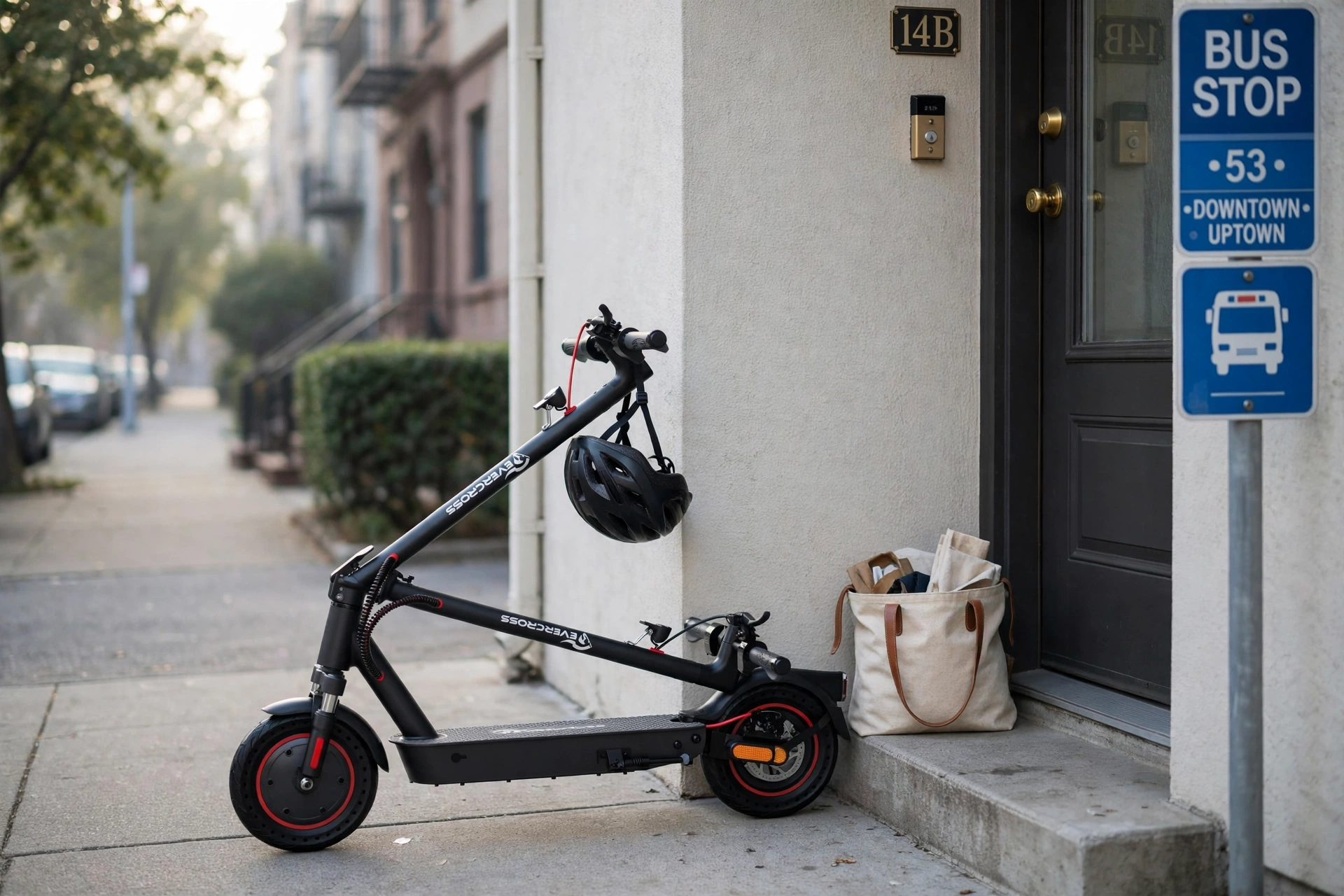
Flat route, under five miles each way, stairs or a bus in the middle: the EV10K Pro. At 35.3 lbs it’s the heaviest thing we’d still call carryable, the 330 lb rating is real, and the turn signals are a safety feature most rivals skip. The default recommendation, full stop.
Light rider, tiny budget, short hops: the EV85F — if you weigh under 200 lbs and your round trip is under 10 miles. Cross the 220 lb limit or the 13-mile realistic range and it stops being cheap and starts being a chore. Seat-wanters in this price zone should check our A3 Aero electric scooter guide before deciding.
Rough pavement, longer route, comfort matters: the H5 / HB24. It’s the only model with pneumatic tires and a properly tested 25-mile range, and the seat makes 40-minute rides reasonable. At 44 lbs it lives in a garage or by the door, not on a bus.
You want the big battery without the H9 tax: the A1 — same 672Wh, wide honeycomb tires, IP54 rating, around $455 through third-party sellers. The compromises are a 264 lb load limit and patchier US availability, so buy it from a seller whose returns policy you’ve actually read.
Seated comfort is the whole point: the H7 — biggest battery, proper sprung seat, UL2272 certification on its listing — if 54.4 lbs never has to be lifted and the route is under about 18 miles a day. And the H9? Only on a deep discount that closes most of the gap to the A1. At full price our math says no.
Our verdict: scores by model
EV10K Pro — Our score: 7.4/10. Range: 5/10 (16 realistic miles is a short leash). Charging: 5/10 (slow, and the quoted times can’t agree with each other). Value: 9/10 (nothing else at $300 carries 330 lbs, folds this small and signals its turns). The brand’s best budget commuter.
H5 / HB24 — Our score: 7.8/10. Range: 8/10 (25 miles, tested — the lineup’s high-water mark). Charging: 6/10 (5.5 to 6.5 measured hours). Value: 8/10 ($499 buys the only pneumatic tires and the only verified spec sheet).
A1 — Our score: 7.6/10. Range: 7/10 (23 realistic miles). Charging: 5/10 (7 to 8 hours). Value: 8/10 (the H9’s battery for roughly $200 less (est.)).
H7 — Our score: 6.9/10. Range: 7/10 (720Wh, ~21 realistic miles). Charging: 4/10 (the biggest battery on the slowest class of charger). Value: 7/10 (fair for a certified seated machine — if you never lift it).
EV85F — Our score: 6.4/10. Range: 4/10 (13 miles, and that’s the plan, not the worst case). Charging: 6/10 (small battery, mercifully quick to fill). Value: 8/10 ($249.99 for a real, app-connected scooter).
H9 — Our score: 6.2/10. Range: 7/10 (same 672Wh as the A1). Charging: 5/10 (6 to 8 hours, per its own manual). Value: 5/10 ($30.23 per realistic mile — the worst figure we computed for this brand). Competent scooter, indefensible price gap — wait for a sale or buy the A1.
Evercross electric scooter FAQ
Which evercross electric scooter is best for a hilly commute?
The H5 or the A1. Both run the 48V system, the H5’s testers measured serious climbing ability, and the A1 matches it for less. Skip every 36V model if your route has a real hill — the EV10K Pro’s 10 to 15-degree claim collapses to single-digit grades at commuting speeds (est.).
How long does an evercross electric scooter take to charge?
Budget 5 to 6 hours for the EV10K Pro (est.; one spec sheet quotes up to 8), 6 to 8 hours for the H9 per its manual, about 7 to 8 for the A1, and 7 to 9 for the H7 (est.). The H5 was measured at 5.5 to 6.5 hours in testing.
Is the 330 lb weight limit real?
On the EV10K Pro and H7, yes — no contradicting fine print we’ve found. On the H9, read carefully: recommended load is 100 to 220 lbs despite the 330 lb maximum. Heavier riders also see range fall — weight is the biggest range variable after hills.
Are solid tires really that bad?
No — they’re a trade, not a defect. You give up cushion and some wet grip; you get a tire that cannot puncture, ever. For a commuter that’s usually the right trade, which is why the honeycomb-tired EV10K Pro scores as the brand’s best value despite the buzz. Rough route or bad back? The pneumatic-tired H5 exists.
Can I ride one in the rain?
Light rain, carefully, on the rated models: the A1 is IP54 and the H5 tested fine in heavy rain at IPX5. Most others publish no rating — treat them as splash-resistant (est.), slow down, and never charge a wet scooter.
EV10K Pro or H5 — which one should I actually buy?
Decide by distance and surface, not price. Under five flat miles each way with carrying involved: EV10K Pro, and keep the $200. Longer rides, broken pavement, or a hill that matters: H5, for the tested range and the air-filled tires. That $200 is the cheapest comfort upgrade in the lineup.
For a short, flat commute, an evercross electric scooter is easy to justify on price alone, and an evercross electric scooter with the larger 48V battery is the better choice when hills or longer rides are part of the route. Before buying, compare the tested range of an evercross electric scooter against your actual round trip, not just the claimed figure.