Last updated: October 24, 2026
If standing on a two-wheel scooter feels wobbly, or a long walk to the shops has quietly become the hardest part of your week, a 3 wheel electric scooter deserves a serious look. Three wheels give you a seat, a stable platform, and a machine that stays upright when you stop — no balancing act, no kickstand shuffle at the kerb. This guide walks through the real models on sale in 2026, what they cost, how far they actually go, and which one fits which kind of rider.
One promise before we start. Comfort and stability come first here. Speed figures get a mention, because you deserve the whole picture, and then we will spend most of our time on the things that decide whether a scooter makes your life easier or harder: the seat, the turning circle, the weight of the heaviest piece, and what a full charge really costs.
What counts as a 3 wheel electric scooter?
The name covers four quite different machines, and mixing them up is the most common buying mistake we see.
Travel mobility scooters are the small ones. They pull apart into light pieces, ride in a car boot, and handle pavements, shopping centres and cruise-ship decks. The Pride Go-Go Elite Traveller 3-Wheel is the classic example: 4 mph, a tight 33-inch turning radius, and a heaviest piece of just 29.5 lb.

Full-size recreational scooters look more like a slim motorcycle with a seat. The eWheels EW-36 is the best known — a captain’s chair, mirrors, lights, a rear basket, and a claimed top speed that would make some mopeds blush. These live in garages, not car boots.
Heavy-duty models from makers like Afikim carry 450 to 500 lb, ride on big pneumatic tyres, and shrug off gravel paths and retirement-village roads. They cost serious money and they earn it in build quality.
Pedal-assist trikes are the fourth group. The Liberty Trike is a bicycle at heart — pedals, a 750-watt hub motor helping up to 12 mph, and a frame that splits in two for transport. If you can still pedal a little and want to keep doing it, this group is yours.
What ties all four together? One wheel at the front, two at the back, a proper seat, and tiller or handlebar steering you operate with both hands resting. Nobody balances. Nobody puts a foot down at the lights.
3 wheel electric scooter stability: the honest version
Three wheels are more stable than two. That part is simple physics, and it is the whole reason these machines exist. A 3 wheel electric scooter will not topple sideways when you mount it, it will not roll away when you pause on a slope, and anti-tip wheels behind the rear axle catch you on steep kerb ramps.
Now the part brochures skip. A three-wheeler can still tip if you take a sharp turn too fast, because two of its wheels sit at the back and the front can lift in a hard, fast corner. Four-wheel scooters resist that better. Three-wheelers fight back with a much tighter turning circle — the Pride turns in 33 inches where its four-wheel sibling needs 44 — and for indoor life, turning circle wins arguments. Hallways. Elevator cars. Bathroom doors. That is where your scooter earns its keep.
Three habits keep you safe on any of them. Slow right down before turns, not during them. Lean your body slightly into the turn. And treat wet leaves, painted road markings and loose gravel with respect, because a single driven front wheel can spin on slick surfaces.
Riders ask us whether a trike layout feels odd at first. For most people, an afternoon of slow practice in an empty car park is enough. The tiller steers like bicycle handlebars, the throttle is a gentle twist or thumb lever, and letting go of the throttle on medical models brings you to an automatic stop.
The 2026 line-up compared
Prices below were checked on October 24, 2026, at US retailers. Scooter prices move around with sales and seasons, so treat these as today’s snapshot, not a promise.
| Model | Type | Price | Top speed | Claimed range | Capacity | Turning radius |
|---|---|---|---|---|---|---|
| Pride Go-Go Elite Traveller 3-Wheel | Travel mobility | $1,260 | 4 mph | 7.3 mi (10.5 mi with 18Ah battery) | 300 lb | 33 in |
| eWheels EW-36 | Recreational | From $2,999 | Up to 18 mph claimed | 43 mi | 350 lb | 50 in |
| Afikim Afiscooter SE | Heavy-duty | $4,635.88 | 9.3 mph | 28 mi | 500 lb | 45 in |
| Liberty Trike | Pedal-assist trike | $1,998 | 12 mph | 8–20 mi in reviews | 400 lb | Splits in two to transport |
A note on that EW-36 speed figure, because honesty matters more than tidy tables. Dealer spec sheets list the EW-36 at 13 mph, several retailers say 15 mph, and the owner’s manual says up to 18 mph. We have shown the manual’s figure and flagged the disagreement rather than quietly picking the middle one. Whichever number is right, it is far faster than a pavement scooter needs to be, and the EW-36 has a speed control dial for exactly that reason.
Pride Go-Go Elite Traveller 3-Wheel: the one that fits in your car
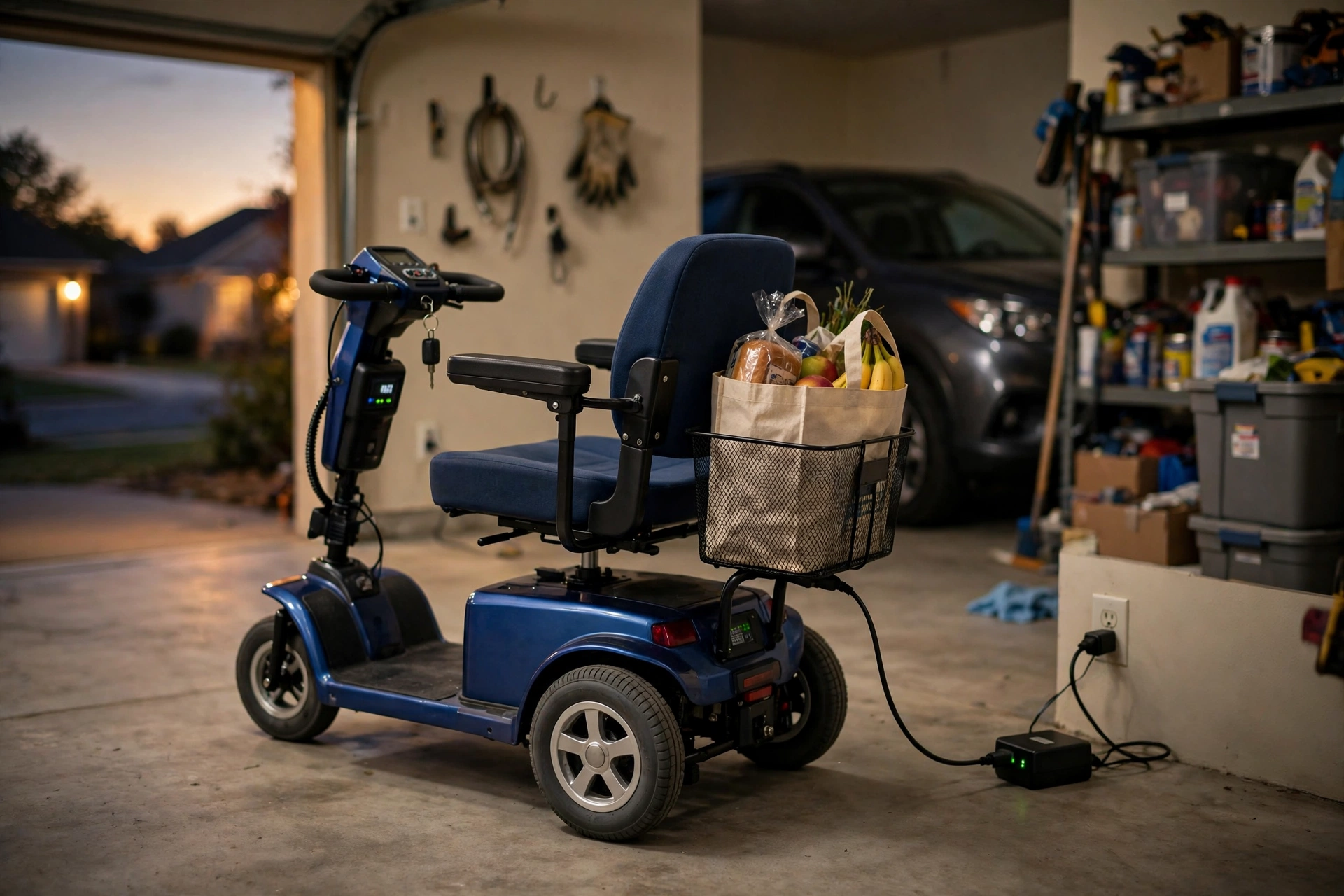
Pride Mobility has built Go-Go scooters for decades, and the Elite Traveller 3-Wheel (model SC40E) is the travel benchmark. It pulls apart into five pieces without tools — feather-touch disassembly, in Pride’s words — and the heaviest piece weighs 29.5 lb, about the same as a full suitcase. If a spouse or friend will be lifting it into a boot, that number matters more than any other on this page.
Range is the honest trade-off. The standard battery manages up to 7.3 miles per charge; the 18Ah upgrade stretches that to 10.5 miles. For a shopping centre, a museum day, or a neighbourhood loop, that is plenty. For a full day at a theme park, plan a midday top-up or rent their bigger machines instead.
Pride sells this scooter as an FDA Class II Medical Device, which can matter for insurance conversations. It carries 300 lb, the seat swivels to make getting on and off easier, and the solid tyres never puncture — though they do ride a little firmer than air-filled ones.
Our score: Pride Go-Go Elite Traveller 3-Wheel — 8.4/10. Range 5/10. Charging 8/10. Value 9/10. At $1,260 against a $1,680 list price (checked October 24, 2026), it is the cheapest route into a well-supported, dealer-backed scooter we found this year.
eWheels EW-36: the recreational cruiser
The EW-36 looks like it escaped from a motorcycle showroom — chrome-accented wheels, a big captain’s chair, mirrors, turn signals, even an anti-theft alarm with a key fob. Under the seat sits a 48-volt sealed lead-acid battery pack feeding a 500-watt brushless motor, and eWheels claims up to 43 miles per charge, the longest claim in this guide.
Plan your life around roughly 30 miles (est.). That estimate comes from the pattern every mobility scooter follows: claimed range is measured with a light rider on flat ground at modest speed, and real riders with shopping bags on real hills see about 70 percent of the headline figure. Thirty honest miles still covers a full day of errands for almost anyone.
Comfort is the EW-36’s real talent. Front and rear suspension, pneumatic tyres, an adjustable padded seat with flip-back armrests, and storage everywhere — a rear basket rated around 20 lb, a lockable under-seat compartment, and a second lockable box on the tiller. It weighs about 215 lb all-in, so it lives where it parks. A garage or ground-floor store room is part of the purchase, whether the listing mentions it or not.
Our score: eWheels EW-36 — 8.1/10. Range 9/10. Charging 6/10. Value 8/10. The big lead-acid pack takes an overnight charge (est., based on its 960 Wh size and the included smart charger), which suits a ride-it-daily, charge-it-nightly rhythm perfectly well.
Afikim Afiscooter SE: the heavy-duty choice
Israeli maker Afikim builds the Afiscooter line for riders who need strength first and everything else second. The SE carries 500 lb, rides on a 1,400-watt-class drivetrain with a top speed of 9.3 mph, and its two 12-volt 70Ah batteries return a claimed 28 miles per charge — call it roughly 20 miles (est.) at real-world pace, using the same 70 percent pattern as above.
The details reward a closer look. A 45-inch turning radius is remarkable for a machine this size. Ground clearance is 5 inches, the seat comes in 18-inch or a 33-inch dual width for couples, and Afikim backs the metal frame with a lifetime warranty. Wider still, the Afiscooter S3 wide-seat model starts at $6,529 (checked October 24, 2026) with a 35-mile claim, if two-up riding is genuinely on your list.
Our score: Afikim Afiscooter SE — 7.6/10. Range 7/10. Charging 6/10. Value 5/10. The $4,635.88 price (checked October 24, 2026) is steep, and we will not pretend otherwise. What it buys is capacity and durability that cheaper scooters simply do not offer.
Liberty Trike: the pedal-assist outlier
The Liberty Trike is not a medical device, and Liberty says so plainly. It is an electric tricycle for people who want to pedal — with help. A 750-watt front hub motor assists up to 12 mph across five levels, a twist throttle moves you without pedalling when your knees say no, and a speed-limited reverse (3 mph) gets you out of tight corners.
Its party trick is transport. The frame separates into two halves of about 25 lb each, the battery adds 6 lb, and the whole 56 lb machine fits in most car boots. The step-over height is just 12 inches, the lowest here by a wide margin. Liberty Trike’s own guide to choosing an electric trike for seniors walks through their reasoning on step-through height and portability, and it is a fair read even if you buy a competitor.
Range needs care. Liberty quotes average consumption of 19 to 28 watt-hours per mile, which works out to roughly 10 to 15 miles from the current 36-volt 8Ah pack (est., from the maker’s own consumption figures), and independent reviews quote 8 to 20 miles depending on how much the rider pedals. Pedal more, go further. That trade is the whole point of the design.
Our score: Liberty Trike — 7.9/10. Range 5/10. Charging 9/10. Value 7/10. A full charge takes about 3.5 hours per the manufacturer — fastest turnaround here — and at an MSRP of $1,998 it undercuts every seated scooter in this guide.
Running costs: the maths nobody shows you
Here is a computation we have not seen published anywhere else. Take each scooter’s price and divide it by its claimed range, and you get the cost of buying one mile of range. The EW-36 wins walking away: $2,999 ÷ 43 miles = $69.74 per mile of claimed range. The Pride costs $1,260 ÷ 10.5 miles = $120.00 per mile. The Liberty, at the kindest review figure of 20 miles, is $1,998 ÷ 20 = $99.90 per mile. The Afiscooter SE is $4,635.88 ÷ 28 = $165.57 per mile — you are paying for strength there, not distance.
Charging costs are smaller still. Using an average US residential electricity price of about 17 cents per kWh (est.), a full charge costs roughly 7 cents on the Pride with the 18Ah pack (0.432 kWh), 16 cents on the EW-36 (0.96 kWh), 29 cents on the Afiscooter SE (1.68 kWh), and 5 cents on the Liberty Trike (0.288 kWh). Five to twenty-nine cents. A coffee costs more than a month of charges.
Put a year on it. Ride the EW-36 a thousand miles in a year — a big year for most owners — and the electricity comes to roughly $4 to $5.50 (est.), depending on whether you believe the claimed range or our real-world estimate. Tyres and an annual service will cost more than a decade of charging. The U.S. Department of Energy’s guide to charging electric vehicles at home explains the same per-kWh maths for cars, and it works identically at scooter scale: small battery, small bill.
Charging at home, without the fuss
Every scooter in this guide charges from an ordinary household socket. No special wiring, no electrician, no apps. You plug the charger into the wall, plug the other end into the scooter or its removable battery pack, and wait.
Lead-acid batteries — the EW-36, the Pride, the Afiscooter — like being charged after every ride and never stored flat. Lithium packs like the Liberty’s are more forgiving and can be topped up at any level. Charge indoors, on a hard floor, away from soft furnishings, and let a hot battery cool before plugging in. Gentle habits, long battery life.
Who should buy which?
Buy the Pride if the scooter must travel in a car, if you live in an apartment with an elevator, or if a swivel seat and medical-device status matter. Its 33-inch turning radius is, in our view, the single most useful number in this entire guide for indoor life.
Buy the EW-36 if you have a garage, a neighbourhood or retirement community to roam, and no intention of lifting the thing. Nothing else at $2,999 goes as far per charge.
Buy the Afiscooter if you need the 500 lb capacity, ride rougher ground, or want the dual seat. Buy it once, keep it for years.
Buy the Liberty Trike if you can pedal a little and want to keep the exercise, with a motor as your safety net.
And a word for riders cross-shopping different shapes entirely. A standing two-wheeler like the Segway Ninebot Max G30P asks far more of your balance, and a high-powered off-road machine like the Segway Xyber asks more of everything. Seated oddballs exist too — our A3 Aero guide covers a self-balancing seated scooter that suits a different rider again. Three wheels remain the calm choice, and calm is underrated.
Is it legal? The US basics
Good news first. A mobility scooter used as a mobility device needs no driving licence, no registration and no insurance in the United States, and the Americans with Disabilities Act generally allows mobility devices wherever pedestrians may go. Medical models such as the Pride are FDA Class II Medical Devices, which is also why Medicare Part B can sometimes cover part of the cost when a doctor certifies the scooter is medically necessary for use inside your home.
Recreational machines sit in a greyer patch. A scooter capable of 13 to 18 mph, like the EW-36, does not match the slow mobility-device picture many state and city rules assume, and sidewalk and bike-path rules vary street by street. Pedal-assist trikes like the Liberty are usually treated as bicycles — no licence — though a few states now apply e-bike classes and equipment rules to them.
Our advice is boring and correct. Check your city and state rules before you buy, ride at pedestrian speed around pedestrians, and slow to walking pace in crowds. The scooter that gives you freedom should never become the reason somebody else loses theirs.
A short buying checklist
Measure your doorways and elevator before you measure anything else. Note the heaviest single piece, not the total weight, if anyone will lift it. Sit on the seat for ten full minutes in the showroom — comfort at minute one lies. Check the turning radius against your tightest corner. Ask who services the brand within driving distance of your home. And confirm the return policy in writing, because a scooter you cannot send back is a very expensive experiment.
Frequently Asked Questions
How fast does a 3 wheel electric scooter go?
It depends on the type. Travel mobility scooters like the Pride Go-Go Elite Traveller run at 4 mph, heavy-duty models reach 9.3 mph, the pedal-assist Liberty Trike assists to 12 mph, and the recreational eWheels EW-36 claims up to 18 mph in its owner’s manual, though dealer sheets list 13 to 15 mph.
Are three-wheel scooters less stable than four-wheel scooters?
They are different, not simply worse. A three-wheeler can tip in a fast, sharp turn if ridden carelessly, which a four-wheeler resists better. In return you get a much tighter turning circle — 33 inches on the Pride against 44 inches for its four-wheel version — which matters far more in daily indoor life. Ride turns slowly and the difference all but disappears.
How far can one go on a single charge?
Claimed ranges in this guide run from 7.3 miles (Pride, standard battery) to 43 miles (EW-36). Treat claims kindly but sceptically: plan around roughly 70 percent of the headline figure (est., based on how makers test with light riders at low speeds), and remember hills, cold weather and a heavier rider all take their share.
Do I need a licence or insurance?
For a mobility scooter used as a mobility device, no — no licence, registration or insurance is required in the US, and the ADA generally allows mobility devices in pedestrian areas. Faster recreational models and pedal-assist trikes follow local rules that vary by state and city, so check yours before riding on paths or roads.
Will Medicare pay for one?
Sometimes, for medical models. Medicare Part B can cover part of the cost of a scooter like the Pride when a doctor certifies it is medically necessary for use inside your home. Recreational machines — the EW-36 and the Liberty Trike — are generally not covered; Liberty states plainly that its trike is not a medical device.
Can I take one on a plane or a cruise?
Travel models are built for exactly that. The Pride breaks into five pieces with a heaviest piece of 29.5 lb, and the Liberty Trike splits into two halves. Airlines have their own battery rules — sealed lead-acid and smaller lithium packs are usually accepted when declared in advance — so call the airline before you book, not at the gate.