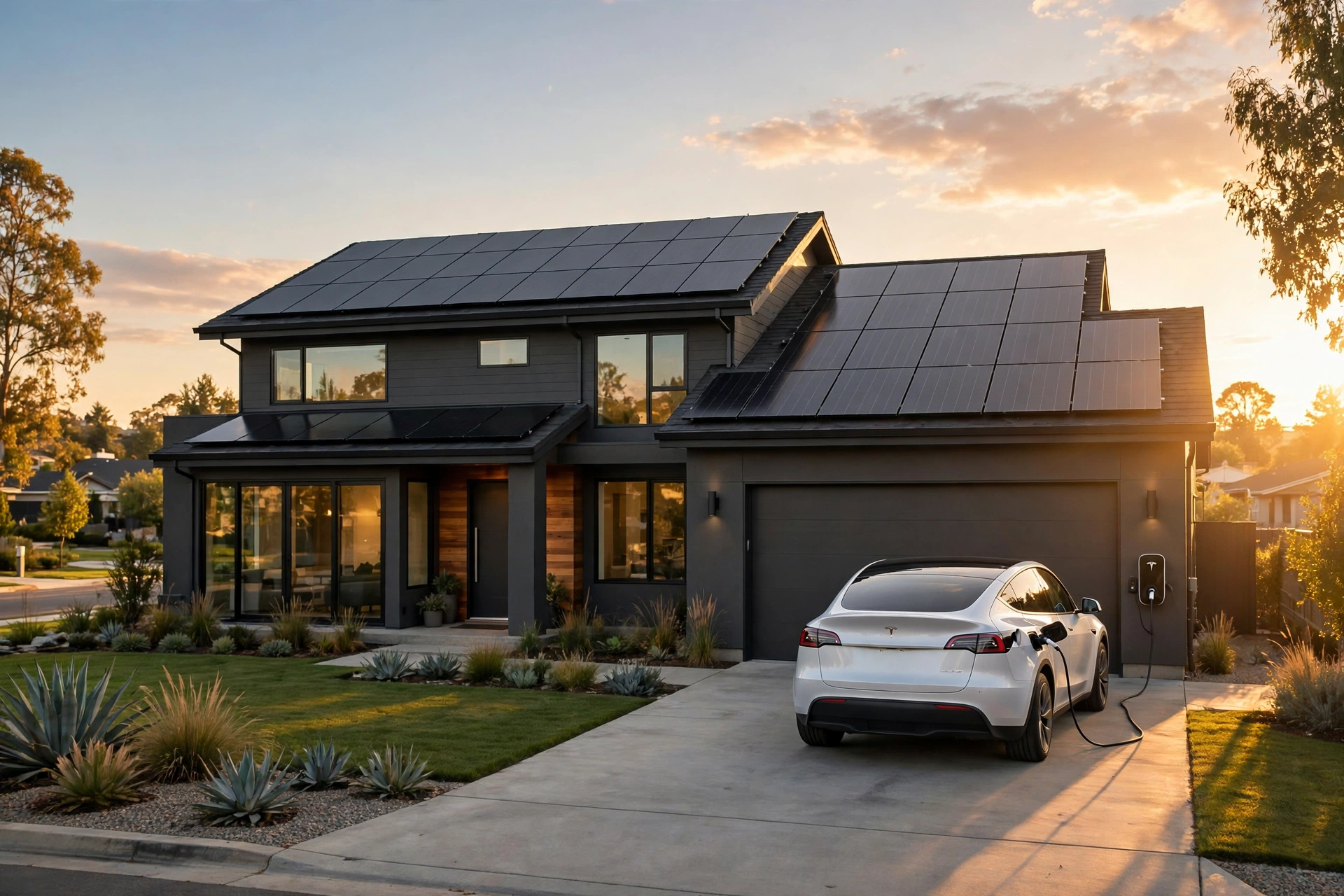

Tesla Solar is Tesla’s residential solar business: rooftop solar panels, the home-battery sidekick called Powerwall, and — until reports of its quiet exit in 2026 — the Solar Roof, a glass-tile roof that generated electricity. If you own a Tesla (or plan to), the idea is compelling: generate your own fuel on the roof and charge your car from it. But 2026 changed the picture in two big ways — the federal residential solar tax credit expired at the end of 2025, and Tesla reportedly stopped taking Solar Roof orders in August 2026. This guide walks through what Tesla Solar actually offers right now, what it costs, how much power it really produces, and whether pairing it with an EV pencils out.
Table of Contents
What Tesla Solar Actually Is (and Isn’t)
Strip away the branding and Tesla Solar is an installer, not a manufacturer. Tesla designs the system, sells it through an online quoting tool, and contracts installation — but the solar panels themselves are sourced from third-party manufacturers (in recent years, panels from companies like Qcells have appeared in Tesla installs). That’s a neutral fact, but it matters for expectations: the value proposition of Tesla Solar has never been unique panel technology. It’s been Tesla’s pricing strategy — aggressive per-watt prices subsidized by the company’s desire to attach a Powerwall to every install.
As of 2026, the product lineup looks like this:
- Tesla solar panels — conventional rack-mounted panels on your existing roof, sold in standardized system sizes.
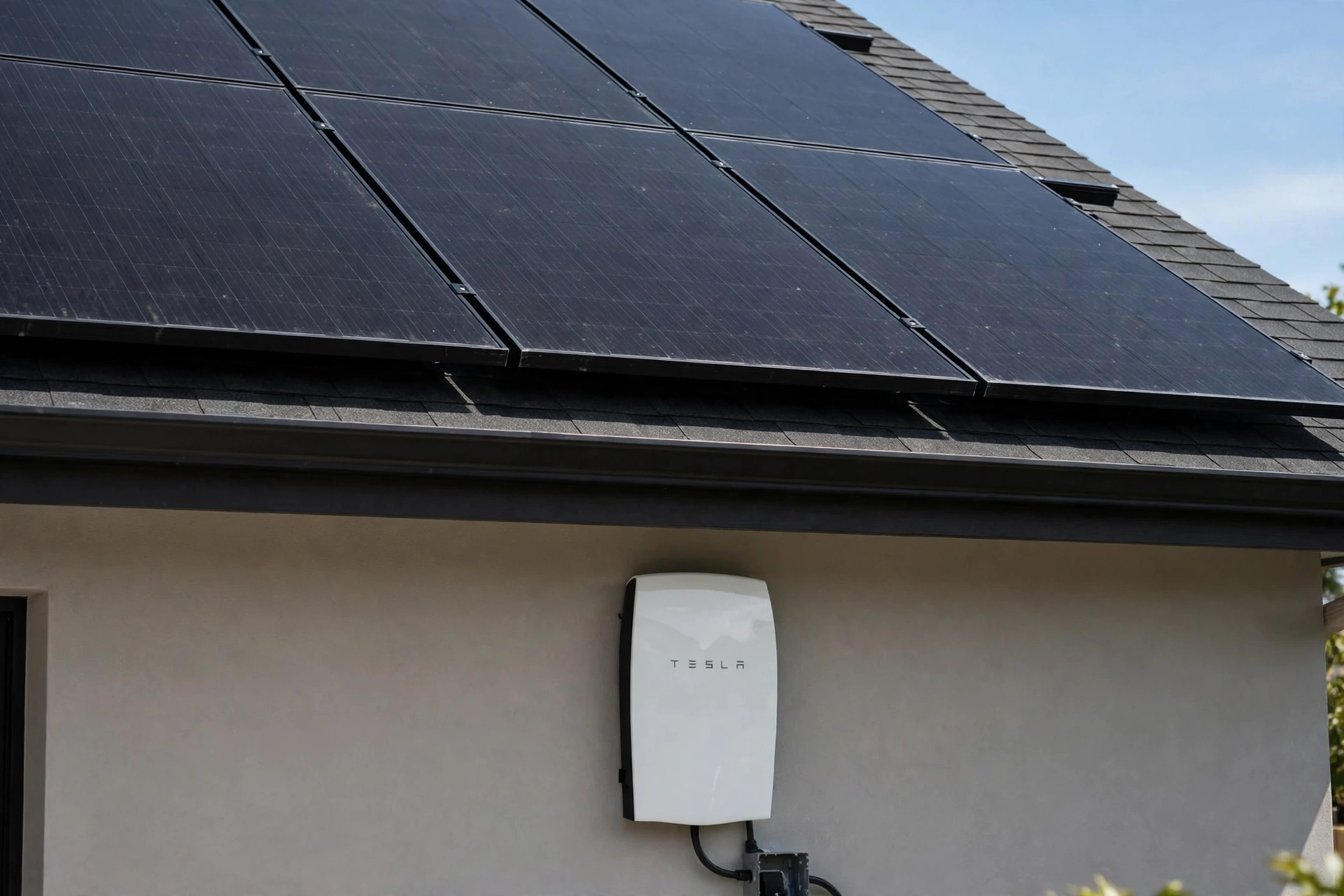
- Tesla Powerwall 3 — the home battery that stores daytime solar for nighttime use and backs up the house during outages.
- Tesla Solar Roof — glass solar tiles that replace your entire roof. Reportedly discontinued in August 2026 (more below).
- Tesla app — one dashboard that tracks home energy production, consumption, Powerwall state of charge, and, if you drive a Tesla, vehicle charging.
The Solar Roof: Reportedly Gone as of 2026
The Solar Roof was Tesla’s most ambitious energy product: a roof made of glass tiles, some containing solar cells, designed to look like a premium slate or textured-glass roof while generating power. It never got cheap. Tesla’s online estimates once suggested around $22 per square foot at launch, but real-world quotes landed closer to $62 per square foot — roughly $7 to $16 per watt depending on the roof — and average installed systems ran about $106,000, with complex jobs exceeding $200,000. Standard solar panels, for comparison, install for roughly $2.50 to $3.50 per watt nationally.
In August 2026, trade publications reported that Tesla stopped accepting new Solar Roof orders, and the product page was pulled from Tesla’s site (it now redirects to the solar panel page). Tesla has not issued a formal public statement; the discontinuation was confirmed through installer channels. If you already have a Solar Roof, the glass-tile warranty stands, and installers in Tesla’s certified network still service existing systems. If you were saving up for one, the practical replacement is a conventional panel system — either from Tesla or another installer — which will produce more power per dollar in nearly every scenario.
Tesla Solar Panel Pricing in 2026: What It Costs
Here’s where Tesla Solar still competes. In 2026, installed Tesla solar panel pricing typically runs $2.27 to $2.82 per watt depending on location and system size — at or slightly below the national average of $2.50–$3.50 per watt. Tesla also offers price matching: find a lower quote from a competing installer for a comparable system, submit it before your installation date, and Tesla will match it.
Translating per-watt into whole-system dollars (before any state or local incentives):
- ~6 kW system — roughly $13,600–$16,900 installed. Good for smaller homes or offsetting a modest bill.
- ~8 kW system — roughly $18,200–$22,600 installed. The most common size for an average US home.
- ~12 kW system — roughly $27,200–$33,800 installed. Sized for large homes, high air-conditioning use, or charging an EV.
Two things inflate the headline number beyond the panels. First, the Powerwall: Tesla quotes solar as a Solar Roof + Powerwall “complete energy system” style bundle mentality, and Tesla requires at least one Powerwall with some configurations. A Powerwall 3 costs $9,300 for the unit alone before taxes and installation; with professional installation and taxes, expect around $16,000. Many homeowners add two or three batteries ($23,000–$34,500 for 2–3 Powerwalls per recent analyses). Second, pre-install work: shading trees (roughly $3,000 per large tree removal in many markets) and an electrical panel upgrade (about $4,000) can land on top.
One more 2026 reality: the federal residential solar tax credit expired December 31, 2025, and is no longer available for homeowner-purchased systems. It previously covered 30% of system cost — losing it raises the effective price of a typical 8 kW system by about $5,500–$6,800. State and utility incentives still exist (check your state’s energy office), but the single biggest federal subsidy is gone. That pushes payback periods outward everywhere.
Powerwall 3: Specs That Matter
The Powerwall 3 is genuinely one of the better home batteries on the market, and it’s the part of the Tesla Solar package reviewers consistently rate highest. Key specs:
- Storage: 13.5 kWh usable per unit
- Max continuous output: 11.5 kW — enough to start most home air conditioners and run essential loads
- Expansion: up to three 13.5 kWh expansion packs per Powerwall, for 54 kWh total
- Integration: manages solar, grid, and EV charging through the Tesla app; supports time-based control (charge the battery when rates are cheap, discharge when they’re expensive)
The honest tradeoff: the battery is what makes the system expensive. An 8 kW panel system at $20,000 plus an installed Powerwall at $16,000 is a $36,000 project — and the battery rarely pays for itself on bill savings alone. You buy the Powerwall for backup power during outages and for energy independence, not as an investment with a clean payback line. If your utility has strong net metering, the battery adds less financial value; if your area has frequent outages or punishing time-of-use rates, it adds real lifestyle value.
Real-World Output: A Worked Example
Spec sheets are one thing; kilowatt-hours on your bill are another. A reasonable rule of thumb in the US is that each kilowatt of installed solar produces roughly 1,200 to 1,600 kWh per year, depending on your sun hours, roof angle, and shading.
Take a 10 kW Tesla solar system on a good, unshaded south-facing roof in a sunny state (Arizona, Texas, Florida, Southern California). Annual production lands around 14,000–16,000 kWh. The average American home uses about 10,500–11,000 kWh per year. So a 10 kW system covers the home’s usage with headroom to spare — the surplus either earns net-metering credits or fills a Powerwall.
Now the number every EV driver cares about: can it also fuel the car? A Tesla Model 3 consumes roughly 0.27 kWh per mile in mixed real-world driving — about 3.7 miles per kWh. The average American drives around 12,000 miles a year, so the car needs roughly 3,200 kWh per year. Add that to the home’s ~10,500 kWh and you’re at about 13,700 kWh — comfortably inside what a 10 kW system produces in a sunny climate. In cloudier regions (Pacific Northwest, New England), the same 10 kW system might produce closer to 11,000–12,500 kWh, and you’d size up to 12 kW or accept a residual grid bill.
How many panels is that, in concrete terms? Tesla sizes systems by kW, not panel count, and panel wattages vary by batch. But roughly: a 10 kW system needs about twenty-three 440-watt panels or twenty-five 400-watt panels — in the low-to-mid twenties, covering roughly 450–550 square feet of roof. Before ordering, Tesla’s online tool quotes your actual roof and usage, and an installer assessment confirms the layout.
Charging a Tesla With Tesla Solar: The Math
Running your EV on sunshine is the emotional core of the Tesla Solar pitch, and the math is straightforward. Per-mile fuel cost of a Model 3 charged on home solar: near zero marginal cost once the system is paid for (you already paid for the panels). Compare that to gasoline at $3.50/gallon and 30 mpg — about $0.117 per mile — or even to grid charging at the US average residential rate of about $0.17/kWh, which works out to roughly $0.046 per mile at 3.7 mi/kWh.
Over 12,000 miles a year, that’s about $1,400/year in gasoline avoided versus ~$550/year of grid electricity — and with solar, the electricity portion shrinks toward zero. The catch is timing: solar produces during the day, but most people charge their cars at night. Without a Powerwall, your daytime solar exports to the grid (earning whatever your utility’s net-metering rate pays) and your nighttime charging buys from the grid. Whether that nets out to “free fuel” depends entirely on your utility’s rate structure. Under California’s NEM 3.0, for example, export credits are a fraction of retail rates, so self-consumption via a battery matters more than it did under the old rules.
For more on what home charging actually costs day to day, see our breakdown of electric car cost per mile and whether you can charge an EV from a regular outlet.
Tesla Solar vs. Alternatives: Quick Comparison
How does Tesla stack up against the rest of the market in 2026?
- On price: Tesla is competitive — often slightly cheaper per watt than the national average, with price matching as a backstop. Local installers sometimes beat it once you get 3–5 bids.
- On equipment: Panels are third-party, not cutting-edge Tesla silicon. Microinverter-based systems (Enphase) or premium panels (Maxeon, REC) may offer slightly better efficiency and panel-level monitoring; Tesla’s Powerwall 3 is genuinely strong.
- On the app: Tesla’s ecosystem is the standout — one app for solar, battery, car, and charger is genuinely convenient and no competitor matches it end-to-end.
- On service: Tesla’s installation experience gets mixed reviews; permitting can take 3–8 weeks and total timelines run 3–6 months. Local installers often schedule faster and answer the phone.
The industry-standard advice holds for Tesla too: get at least three bids before committing. Tesla’s quote is a strong anchor price; a local installer may match the per-watt figure with faster service.
Who Should Buy Tesla Solar in 2026?
It makes sense if: you have a roof in good condition with at least 10+ years of life left, strong sun, high electricity rates (above ~$0.20/kWh), and you drive an EV or plan to — the EV pairing is where the payback math gets most attractive. A Tesla Solar + Powerwall system also makes sense if outages are common where you live; backup power is the battery’s real job.
Think twice if: your roof needs replacing soon (install panels after the re-roof, not before), your roof is heavily shaded, your utility pays pennies for exported solar, or you were specifically waiting for the Solar Roof — that product is reportedly done. And without the federal tax credit, payback periods that used to run 7–10 years now stretch toward 10–15 years in average-rate states. Solar remains a long-term play: you’re prepaying for 25+ years of electricity at today’s hardware prices.
If you’re still deciding between going electric and staying with a combustion engine, our guide to hybrid cars walks through the middle ground.
Frequently Asked Questions
Is the Tesla Solar Roof discontinued? Trade publications reported in August 2026 that Tesla stopped accepting new Solar Roof orders and removed the product page, with confirmation through installer channels. Tesla has not issued a formal public statement. Existing owners keep their warranties and can get service through certified installers.
How much does Tesla Solar cost in 2026? Panel systems typically install for $2.27–$2.82 per watt — about $18,000–$23,000 for a common 8 kW system before state or local incentives. A Powerwall 3 adds about $9,300 for the unit alone, or roughly $16,000 with installation and taxes.
Can Tesla Solar charge my electric car? Yes — an average 10 kW system in a sunny climate produces enough annual electricity (~14,000–16,000 kWh) to cover both a typical home and ~12,000 miles of Tesla Model 3 driving (~3,200 kWh). A Powerwall helps shift daytime solar to nighttime charging.
Does the federal solar tax credit still apply? No. The federal residential solar tax credit expired December 31, 2025, and is not available for 2026 installs. State and utility incentives vary — check your state’s energy office before buying. The US DOE’s homeowner’s guide to going solar is a solid, unbiased starting point for understanding current incentives and what to expect from an install.
The Honest Verdict
Tesla Solar in 2026 is a tale of two products. The Solar Roof — the thing that made Tesla’s energy ambitions famous — appears to be over, undone by economics: roughly $7–$16 per watt for a tile system that produced less power than $2.50–$3.50-per-watt panels was never going to scale. The solar panel business, though, is quietly one of the better-priced options in the US, especially once you factor in price matching and the genuinely excellent Powerwall 3.
The 2026 buyer’s math is less generous than it was three years ago: no federal credit, longer payback windows, and utilities paying less for exported power. That doesn’t make solar a bad purchase — it makes it a measured one. Get three bids (Tesla plus two local installers), size the system for your actual usage plus the EV you’ll charge, and buy the Powerwall for backup power and self-consumption rather than payback fantasy. If your roof, sun, rates, and driving habits line up, Tesla Solar can genuinely make your car run on sunlight. If they don’t, a good local installer with premium panels may serve you just as well.