Last updated: October 25, 2026
Right, whistle out, scorecards ready. The 2026 toyota bz4x walks into the ring with a new name, a bigger battery, 124 extra horsepower in all-wheel-drive trim and a price cut — and it still has to survive seven rounds against the toughest field in the business. I’m scoring every round as we go. No draws handed out for effort. If a claim doesn’t hold up against the spec sheet, it loses the round, and I’ll tell you exactly where it fell.
Here’s my promise before the bell. You will leave knowing which trim to buy, which trim to dodge, what a mile of range actually costs on this car versus its rivals, and whether the 2026 toyota bz4x finally beats the twin it shares a factory with. You bring the budget. I’ll bring the scorecard. Deal? Then let’s start with the thing that confuses every single shopper who walks onto a Toyota lot this year.
1. The badge changed: the 2026 Toyota bZ4X is now just the Toyota bZ
First point on the board, and it’s a free one for clarity. In North America, Toyota has dropped the “4X” for the 2026 model year. The car you knew as the bZ4X is sold in the United States and Canada simply as the Toyota bZ. Same e-TNGA platform, same basic silhouette, heavily reworked underneath. Europe and several other markets keep the bZ4X badge, which is why your search results will look like two different cars arguing with each other. They aren’t. One car, two nameplates, and the US version is the one badged bZ.
Check it yourself on Toyota’s official bZ page — the “4X” is gone from the US site entirely, and the starting MSRP sits at $34,900 (prices checked October 25, 2026). Why does this matter to you? Because dealer listings, insurance quotes and parts catalogues will use both names for at least another year. If a listing says bZ4X and the window sticker says bZ, nobody is scamming you. Probably. Verify the model year, not the badge, and you stay safe.
2. Range: the 2026 Toyota bZ4X finally clears 300 miles
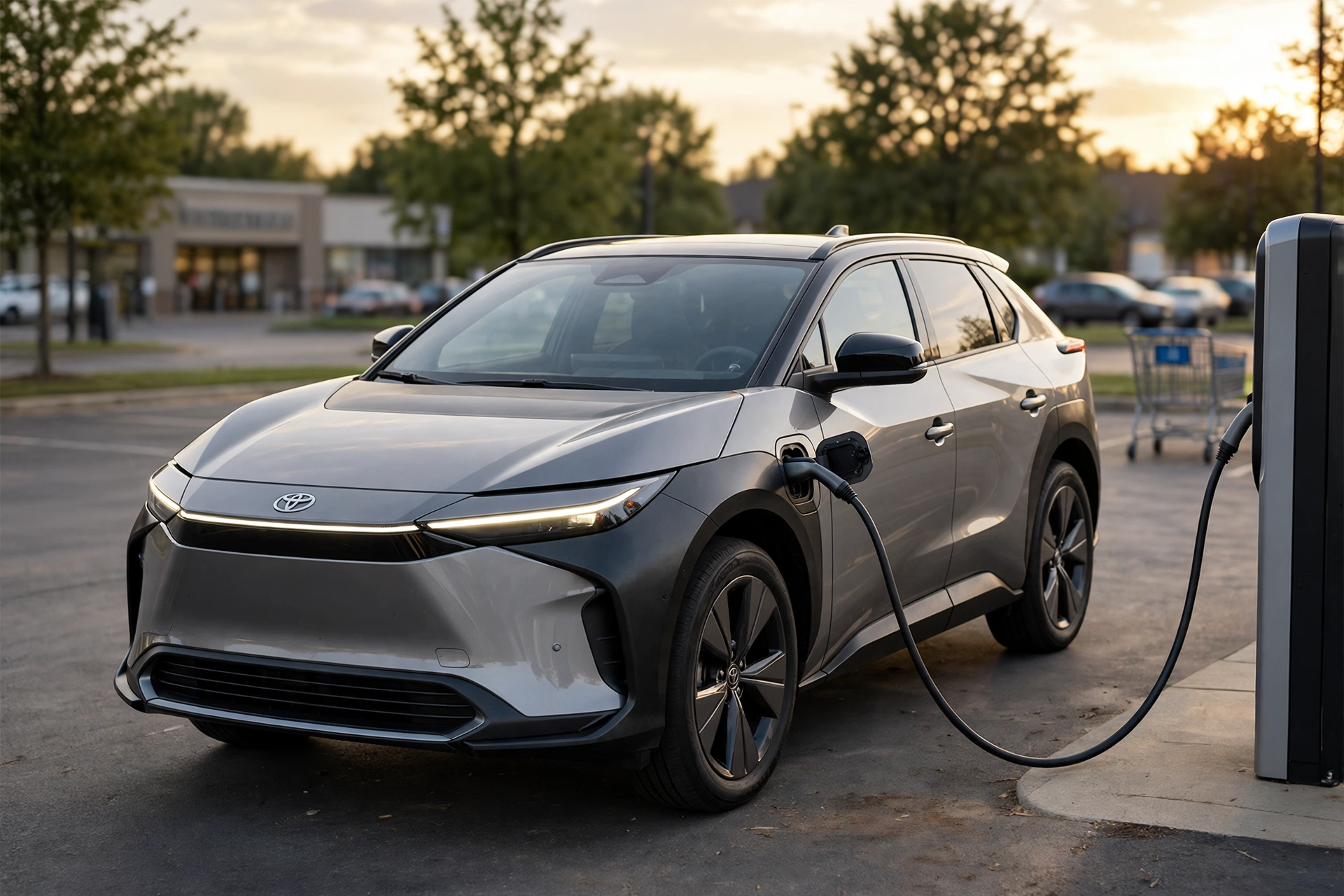
Round two is the one the old car used to lose in embarrassing fashion. Gone. The 2026 lineup offers two batteries: a 57.7 kWh pack in the base XLE front-wheel-drive car, and a 74.7 kWh pack in everything else. The big-battery front-drive XLE FWD Plus is the range hero at an EPA-estimated 314 miles. FuelEconomy.gov lists that version at 131 MPGe combined, with an EPA annual fuel cost estimate of $550 — the kind of number that used to belong to much smaller cars.
Here’s the full range ladder, because the spread inside this one model line is enormous and it decides your whole purchase:
- XLE FWD (57.7 kWh): 236 miles, 168 hp, $34,900
- XLE FWD Plus (74.7 kWh): 314 miles, 221 hp, $37,900
- XLE AWD (74.7 kWh): 288 miles, 338 hp, $39,900
- Limited FWD (74.7 kWh): 299 miles, 221 hp, $43,300
- Limited AWD (74.7 kWh): 278 miles, 338 hp, $45,300
Prices above are MSRP before destination (listed at $1,450 on Toyota’s price sheets), checked October 25, 2026. Compare that ladder with the outgoing 2025 car: 252 miles at best in front-drive, a miserable 222 miles with all-wheel drive. The new AWD figure of 288 miles is a 66-mile jump. That’s not a facelift tweak. That’s a different car wearing a familiar face. Round scored: bZ takes it, 10–8, and the 314-mile figure is the headline your salesperson will lead with. Let them. For once, the headline is honest.
My one-sided call, and I’ll defend it against anyone: skip the base 57.7 kWh XLE entirely. That 236-mile car exists to advertise a $34,900 starting price. The $3,000 step to the XLE FWD Plus buys you 78 extra miles and 53 extra horsepower. Cheapest range upgrade in the segment, full stop.
3. Power: 338 horsepower changes the conversation
The old all-wheel-drive car made 214 hp and felt it. The new one makes 338 hp from its dual motors — a 50 percent jump, courtesy of silicon-carbide semiconductors in the eAxles — and Toyota quotes 0–60 mph in 4.9 seconds for the AWD. Front-drive cars climb from 201 hp to 221 hp with the big battery. Curious how the twin-motor layout works on the Subaru side of the family? Our explainer on how many electric motors the Solterra has walks through the same hardware, axle by axle.
Does 338 hp make this a performance SUV? No, and I won’t pretend otherwise. It makes it a family SUV that merges onto a short on-ramp without a prayer meeting. That’s the correct target for this car, and Toyota hit it dead centre. Round: another point to the bZ, mostly because the power arrived without the range collapsing — the AWD car gained 124 hp and 66 miles in the same model year. Rivals usually make you pick one.
4. Charging and the NACS port: the 2026 Toyota bZ4X joins Tesla’s world
Now the round where I take points away. DC fast charging peaks at 150 kW. Toyota quotes roughly 28–30 minutes from 10 to 80 percent in ideal conditions, helped by a new battery preconditioning system that warms or cools the pack before you arrive — a feature the old car desperately needed and didn’t have. At home, an 11 kW onboard charger handles overnight fills without drama.
The genuine win here is the plug itself. Every 2026 toyota bz4x ships with a native NACS port, so it plugs straight into Tesla Superchargers with no adapter dance. That single change quietly fixes the ownership experience more than the range bump does, because the best charging network in North America is now your charging network. Ask yourself this: would you rather have 20 extra miles of range, or thousands of extra working chargers? Correct answer. The chargers.
Still, the scorecard is the scorecard. Hyundai’s Ioniq 5 charges at up to 350 kW on an 800-volt system and does 10–80 percent in about 20 minutes. Against that car, 150 kW is a lost round, 10–7, and no amount of referee generosity changes it. If your life is built around fast road trips with 15-minute stops, write that down now — it decides the final verdict later.
Head-to-head, Round 1: 2026 Toyota bZ4X vs Subaru Solterra
Time for the family fight. The Solterra is this car’s twin — same platform, same 74.7 kWh battery for 2026, same 150 kW charging, same NACS port, built in the same Toyota plant in Japan. Subaru fights back with standard all-wheel drive on every trim, 8.3 inches of ground clearance, and its own X-MODE tuning. Prices start at $38,495 for the Solterra Premium (checked October 25, 2026), with 288 miles of range and 233 hp, while the new Solterra XT trims match the Toyota’s 338 hp at $42,895 and up.
Scoring it round by round. Range: the Toyota’s 314-mile front-drive car has no Subaru answer — Solterra caps at 288. Point, Toyota. Price: the bZ starts $3,595 lower, and the 314-mile XLE FWD Plus at $37,900 undercuts every Solterra on the lot. Point, Toyota. All-weather hardware: Subaru’s standard AWD and ground clearance take this one cleanly — a front-drive Toyota is the wrong tool for a Vermont February. Point, Subaru. Charging: identical 150 kW hardware, identical port. Even round, no point awarded. That’s my rule, argue with the scorecard, not with me.
Solterra fight score: Toyota bZ 2 rounds, Solterra 1 round. Unless you genuinely need standard all-wheel drive, the Toyota wins its own family argument on price and range. Our score: Toyota bZ 8.2/10 (Range 8.5 / Charging 6.5 / Value 9.0). Our score: Subaru Solterra 7.8/10 (Range 7.5 / Charging 6.5 / Value 7.8).
5. Price per mile: our original analysis of the 2026 Toyota bZ4X
Here’s the computation nobody else in this segment publishes, and it’s the fairest way I know to referee value. Take the MSRP. Divide it by the EPA range. You get the price of one mile of range — what each mile on the sticker actually costs you. Lower wins the round.
- Toyota bZ XLE FWD Plus: $37,900 ÷ 314 miles = $120.70 per mile of range
- Hyundai Ioniq 5 SE RWD (84 kWh): $37,500 ÷ 318 miles = $117.92 per mile
- Tesla Model Y Standard RWD: $39,990 ÷ 321 miles = $124.58 per mile
- Subaru Solterra Premium AWD: $38,495 ÷ 288 miles = $133.66 per mile
- Tesla Model Y Premium RWD: $45,990 ÷ 357 miles = $128.82 per mile
- Toyota bZ XLE FWD (base): $34,900 ÷ 236 miles = $147.88 per mile
Read that table twice, because it convicts two cars. The base bZ — the one in the adverts — is the worst value in its own lineup at $147.88 a mile. The Ioniq 5 SE RWD edges the whole field at $117.92. And the bZ XLE FWD Plus at $120.70 beats both Teslas and its own twin. That’s a podium finish on value, earned with arithmetic, not adjectives. All prices MSRP before destination and incentives, checked October 25, 2026.
Running costs next, same treatment. A full charge of the 74.7 kWh pack at a home rate of $0.17/kWh costs 74.7 × $0.17 = $12.70. At the EPA consumption figure of 26 kWh per 100 miles, home driving costs about $4.42 per 100 miles. A 10–80 percent fast-charge session moves roughly 52.3 kWh; at a typical public DC rate of $0.48/kWh (est. — rates vary by network and state), that’s about $25.10 a session. Run your own numbers for your mileage and your warranty worries with our EV total cost of ownership calculator before you sign anything. Referee’s orders.
Head-to-head, Round 2: 2026 Toyota bZ4X vs Tesla Model Y
The champion enters. The 2026 Model Y Standard RWD starts at $39,990 with 321 miles of range, and the Premium RWD reaches 357 miles at $45,990 (prices checked October 25, 2026). Tesla’s charging network is the native home of the NACS plug the Toyota now borrows, and Tesla’s peak charging speeds and route planning remain the class standard. If you want the honest state of Tesla ownership before you cross-shop, read our rundown of common Tesla Model Y problems — the champion has bruises, and you should know where they are.
Scoring this one. Range: 357 beats 314. Point, Tesla. Charging: Tesla’s integration and speeds win it. Point, Tesla. Price of entry: the Toyota opens at $34,900, a full $5,090 below the cheapest Model Y, and its best-value trim undercuts Tesla’s on price per mile, $120.70 to $124.58. Point, Toyota, and it’s not close. Buying experience: Toyota will sell you this car at a dealership with a service desk, a loaner fleet and a human who answers the phone. For a lot of families that’s a round, so I’m awarding it. Point, Toyota.
Model Y fight score: 2 rounds each — and no, I don’t do draws. The tiebreak is the scorecard totals. Our score: Tesla Model Y 8.6/10 (Range 9.5 / Charging 9.0 / Value 7.5). Our score: Toyota bZ 8.2/10. Tesla keeps the belt on range and charging. The Toyota takes the value rounds and the undercard. And the Ioniq 5, watching from the front row, posts our score of 8.7/10 (Range 8.5 / Charging 10 / Value 8.5) — the quiet points leader of this whole division, thanks to that 20-minute charge. For the full field in one place, our guide to EV cars: range, charging costs and who should buy scores the wider market the same way.
6. Towing, cargo and the school-run test
Family duty, scored plainly. Cargo space is 27.7 cubic feet behind the rear seats, which swallows a weekly shop, a folded stroller and a hockey bag without Tetris. The cabin sits on a 112.2-inch wheelbase, so rear legroom is adult-honest, not adult-apologetic.
Towing needs a careful whistle. In global specification, the AWD car is rated to tow up to 1,500 kg — about 3,307 lb — double the old model’s figure, with the front-drive car at 750 kg. Toyota USA does not headline a comparable US tow rating for the bZ, so treat any US figure as (est.) until you confirm it in the US owner’s manual for your exact trim; towing a trailer on an unverified rating is how warranties go to die. Small utility trailer for garden waste? Sensible. Anything heavier, verify first, then hitch.
7. Cabin, tech and the ownership bet
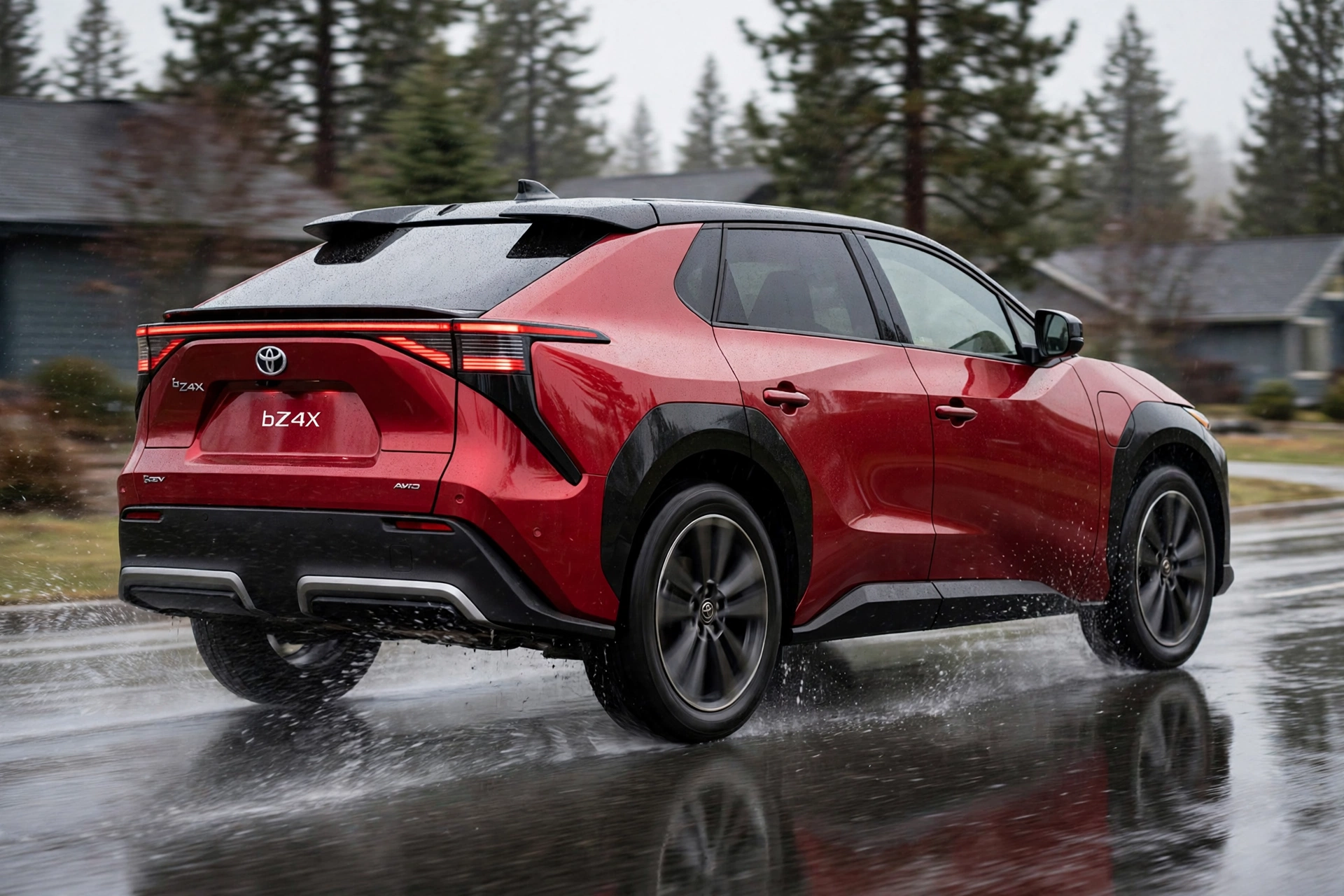
Inside, the 2026 car finally looks like it was designed this decade. A 14-inch touchscreen replaces the old 12.3-inch unit, there are two wireless phone chargers in a redesigned console, wireless Apple CarPlay and Android Auto are standard, and ambient lighting offers 64 colours you’ll set once and never touch again. Outside, the new hammerhead front end with its slim light bar replaces the old car’s startled expression, and the black fender cladding stays — love it or tolerate it, it shrugs off car-park dings better than paint does. Colours include Heavy Metal, Wind Chill Pearl, Elemental Silver Metallic and Supersonic Red, with two-tone roofs on selected trims.
The ownership bet is the real final round. Toyota covers the battery for 8 years or 100,000 miles, the dealer network is enormous, and the brand’s hybrid-era reputation for durability is the reason half the buyers in this segment are even reading this article. Against that, the federal $7,500 purchase credit ended on September 30, 2025, so the prices above are the prices — your negotiation happens at the dealership, not on your tax return. Toyota has been leaning on lease cash and finance offers to fill the gap (offers vary by region and month, checked October 25, 2026), which makes leasing the bZ a genuinely sharp play right now.
The final scorecard: should you buy the 2026 Toyota bZ4X?
Cards in. The 2026 toyota bz4x — the Toyota bZ, as your dealer will call it — fixes the three things that sank the old car: range, power and price. It posts our score of 8.2/10 (Range 8.5 / Charging 6.5 / Value 9.0), beats its Subaru twin on points, splits the rounds with the Model Y, and loses the charging round to the Ioniq 5 every single time. Buy the XLE FWD Plus at $37,900 if you charge at home and drive in a mild climate. Buy the XLE AWD at $39,900 if your winters are real. Walk past the base car, walk past the Limited unless the ventilated seats and 20-inch wheels matter more to you than $5,400. That’s the verdict, and the scorecard backs every word of it.
FAQ: 2026 Toyota bZ4X questions, answered straight
Is the 2026 toyota bz4x the same car as the Toyota bZ?
Yes. Toyota renamed the bZ4X to simply “bZ” for North America for the 2026 model year. Same vehicle, updated hardware. Other markets, including Europe, still sell it as the bZ4X.
What is the range of the 2026 Toyota bZ?
From 236 miles for the base XLE FWD with the 57.7 kWh battery, up to 314 miles for the XLE FWD Plus with the 74.7 kWh battery. AWD versions are rated at 288 miles (XLE) and 278 miles (Limited).
Can the 2026 bZ use Tesla Superchargers?
Yes, natively. Every 2026 bZ has a built-in NACS port, so it plugs directly into compatible Tesla Superchargers without an adapter. DC fast charging peaks at 150 kW, with a 10–80 percent charge in roughly 28–30 minutes under ideal conditions.
How much does the 2026 Toyota bZ cost?
MSRP runs from $34,900 (XLE FWD) to $45,300 (Limited AWD), before destination and options, checked October 25, 2026. The value pick is the XLE FWD Plus at $37,900 — $120.70 per mile of EPA range by our calculation.
bZ or Solterra — which twin should I buy?
The bZ, on points: it’s cheaper, and only the Toyota offers the 314-mile front-drive version. Pick the Solterra if standard all-wheel drive and 8.3 inches of ground clearance matter more to you than range and price. Either way you’re buying the same battery, the same motors and the same 150 kW charging.
What changed versus the 2025 bZ4X?
Nearly everything that mattered. Range jumped from 252 to 314 miles at best, AWD power leapt from 214 to 338 hp, the starting price dropped by $2,170 to $34,900, the NACS port and battery preconditioning arrived, and the cabin gained a 14-inch screen with dual wireless chargers. The name change is the smallest update on the list.