Last updated: October 25, 2026
Let’s get the awkward number out of the way first: the cheapest turbo levo electric mountain bike you can buy weighs 57.5 lb, and the range-topping S-Works still weighs 52 lb 4 oz. That’s the deal with the fourth-generation Turbo Levo. It’s a full-power trail weapon with a huge battery, a motor that got a surprise power bump for 2026, and a price ladder from $4,999.99 to $10,999.99 — and every single rung of that ladder asks your arms a serious question at the car park.
Quick orientation. The Turbo Levo 4 launched in April 2025 as Specialized’s flagship full-power e-MTB: 160 mm of fork travel, 150 mm at the back, mixed “mullet” wheels (29-inch front, 27.5-inch rear) and a whopping 840 Wh battery that slides out of the downtube. For 2026 it didn’t get a new frame. It got something sneakier — a free over-the-air software update that lifted the standard motor from 666 W to 810 W peak. Free speed. We’ll take it.
This guide does the practical stuff most reviews skip. How much does each trim actually weigh, in pounds, on a real scale where one exists? What does each dollar buy you in battery capacity? How far will the thing really go before you’re pedalling a 55 lb anchor home? And the apartment question nobody asks at the bike shop: can you charge it without hauling the whole bike indoors? (Yes. The battery pops out. It’s the best feature here and it isn’t even the motor.)
One more thing before the spec sheet. A turbo levo electric mountain bike is a Class 1 e-bike out of the box — pedal assist to 20 mph — which keeps it legal on the vast majority of US singletrack that allows e-MTBs at all. There’s also an unlockable 28 mph mode Specialized calls a commute setting. More on that below, because it matters for trail access. If the class rules are fuzzy for you, our complete Class 1 e-bike guide untangles them in plain English.
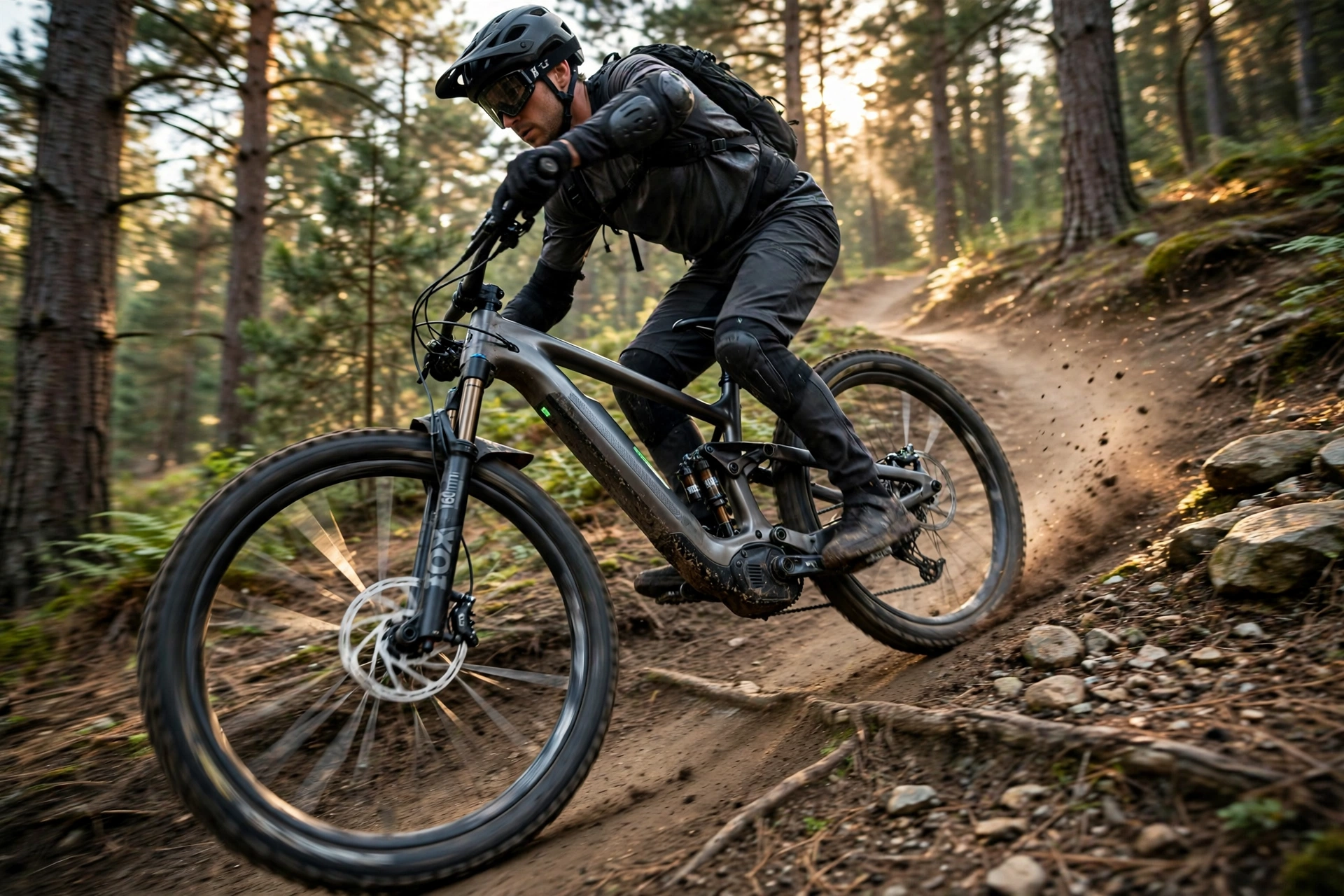
Right. Gloves on. Here’s everything that matters about the Levo 4 — motor, battery, trims, tested range, weights, scores — with the sums done for you.
Turbo Levo Electric Mountain Bike Specs: Motor, Battery and Travel
The headline act is the Specialized 3.1 motor, built with Brose. At launch it made 101 Nm of torque and 666 W of peak power. Then, in February 2026, Specialized pushed an over-the-air update: the standard 3.1 now delivers 105 Nm and 810 W peak, and those are the figures Specialized’s official Turbo Levo pages list today. The S-Works version of the motor runs its own tune: 111 Nm and 850 W peak, up from 720 W at launch. Same hardware, hotter software. Owners of early bikes got the upgrade free, which is exactly how this should work.
Numbers aside, the delivery is the point. Testers keep using the same words — smooth, quiet, natural — and the tune options explain why. MicroTune lets you trim assist in 10% steps, and the newer Dynamic MicroTune can be set to exactly double your own input, so a tired 120 W cruise becomes 240 W at the wheel. There’s Shuttle, Responsiveness and Overrun tuning too. It’s a lot of settings. You will fiddle for two rides, find your two favourites, and never open the app again. That’s fine.
The battery: 840 Wh standard, and it comes out
Every turbo levo electric mountain bike ships with an 840 Wh battery integrated into that fat downtube. Specialized claims up to 5 hours of ride time from it, which is an Eco-mode best case — the tested reality is in the range section below. The battery itself weighs 9.3 lb, and here’s the practical gold: it slides out sideways from the downtube in seconds.
Charge it in the kitchen. Store the bike in a cold garage without cooking the cells. Drop to the lighter 600 Wh battery (sold separately) for short rides and the carbon Comp drops to 50.7 lb. Or bolt on the 280 Wh range extender for a 1,120 Wh total and accept 56.8 lb. Your call, your shoulders.
Chassis, wheels and the bits that touch dirt
Travel is 160 mm up front and 150 mm at the rear, with Specialized’s GENIE air spring in the Fox Float X shock — plush for the first 70% of the stroke, then a firm ramp so big hits don’t fold the bike in half.
Geometry adjusts three ways: head angle (64.5° stock on an S4, within a 63.5–65.5° range), bottom-bracket height, and chainstay length via flip chips. An S4 runs a 480 mm reach, 435 mm chainstays and a 1,254 mm wheelbase. The mullet wheel setup pairs a 29-inch front with a 27.5-inch rear, both wrapped in 2.4-inch Butcher GRID Gravity T9 tyres. Brakes are SRAM Maven four-pots with a 220 mm front rotor on most trims — proper stoppers for a bike this heavy, and they need to be.
The MasterMind TCU display sits in the top tube: a 2.2-inch colour screen showing battery percentage, your own wattage, speed and mode. It talks to the Specialized app for tuning, ride recording and — theft-proofing fans, perk up — a Turbo System Lock that disables the motor for anyone but you, plus Apple Find My integration so the bike reports its own location. A $6,000 bike that helps you find it after a theft? Yes please. There’s also SWAT storage inside the downtube for a tube, pump and snacks.
| Spec | Turbo Levo 4 (standard trims) | S-Works Turbo Levo 4 |
|---|---|---|
| Motor | Specialized 3.1, 105 Nm, 810 W peak | S-Works 3.1, 111 Nm, 850 W peak |
| Battery | 840 Wh removable (600 Wh option, 280 Wh extender) | 840 Wh removable (same options) |
| Travel | 160 mm front / 150 mm rear, GENIE shock | 160 mm front / 150 mm rear, GENIE shock |
| Wheels | 29 in front / 27.5 in rear (mullet), 2.4 in tyres | 29 in front / 27.5 in rear (mullet), carbon wheels |
| Display | MasterMind TCU, 2.2 in colour | MasterMind TCU, 2.2 in colour |
| Charger | 4 A standard (12 A Smart Charger optional) | 12 A Smart Charger included |
| Weight (S4) | 57.5–58.1 lb depending on trim | 52 lb 4 oz (measured) |
| Sizes | S1–S6 (alloy), S2–S6 (carbon) | S2–S6 |
Every Turbo Levo Electric Mountain Bike Trim and Price, With the Sums Done
Five main trims, one motor family, one battery. That’s the Levo 4 ladder, and it’s refreshingly honest — Specialized didn’t reserve the big battery or the strong motor for the expensive bikes. Prices below are from specialized.com, checked October 25, 2026; several trims are on sale right now, so treat the sale figures as a snapshot, not a promise.
| Trim | Frame | Price (checked Oct 25, 2026) | Weight, S4 | Cost per Wh of battery |
|---|---|---|---|---|
| Levo 4 Alloy | M5 alloy | $4,999.99 | 57.5 lb (claimed) | $5.95 |
| Levo 4 Comp Alloy | M5 alloy | $6,799.99 | 58 lb 2.2 oz (official) | $8.10 |
| Levo 4 Comp | FACT 11m carbon | $5,999.99 on sale (list $7,999.99) | 53 lb 5 oz (measured) | $7.14 |
| Levo 4 Pro | FACT 11m carbon | $8,499.99 on sale (list $9,999.99) | 52.9 lb (est., Fox 38 build between Comp and S-Works) | $10.12 |
| S-Works Levo 4 | FACT 11m carbon | $10,999.99 on sale (list $11,499.99) | 52 lb 4 oz (measured) | $13.10 |
Now the original analysis, because the $/Wh column is doing quiet damage. Every trim carries the same 840 Wh, so dividing price by 840 tells you exactly what the badge, frame material and parts cost beyond the identical battery: $5.95 per watt-hour at the bottom of the range, $13.10 at the top. The motor and battery — the actual electric part of this electric bike — cost you $5.95/Wh on the base Alloy. Everything above that buys carbon, suspension and shifting.
The weight sums are ruder. Take the Comp Alloy as the baseline at 58 lb 2.2 oz. The S-Works saves 5.9 lb and costs $4,200 more: $713 for every pound saved. Steep, but at least the maths is normal.
The carbon Comp breaks the ladder entirely — at its current $5,999.99 sale price it’s $800 cheaper than the Comp Alloy and 4 lb 13 oz lighter, measured. Specialized is effectively paying you $166 per pound to take the lighter bike. And notice the base Alloy at 57.5 lb claimed undercuts the Comp Alloy’s official weight too, because its Marzocchi fork and simpler spec skip some grams. The Comp Alloy, at today’s prices, is the one trim we’d tell a friend to walk straight past.
Verdict scores for the three trims most people actually cross-shop:
Turbo Levo 4 Comp (carbon) — Our score: 8.8/10 (Range 8.6 / Charging 8.2 / Value 9.3). The sale price turns a great bike into the obvious buy: measured 53 lb 5 oz, Editors’ Choice at OutdoorGearLab, same motor and battery as everything above it.
S-Works Turbo Levo 4 — Our score: 8.5/10 (Range 8.6 / Charging 9.1 / Value 6.9). The lightest, strongest, fastest-charging Levo — 111 Nm, 850 W, the 12 A charger in the box. You’re paying $713 a pound for the privilege, and the score knows it.
Turbo Levo 4 Comp Alloy — Our score: 7.9/10 (Range 8.6 / Charging 8.2 / Value 7.2). Nothing wrong with the bike; everything wrong with its current price tag next to the carbon Comp. If the sale ends and list prices return, this score climbs back up.
For shoppers comparing the three, a turbo levo electric mountain bike in Comp trim offers the strongest balance of range, charging and value in this verdict.
In short, this turbo levo electric mountain bike verdict favours the Comp for most riders, with the S-Works for those chasing the lightest build.
Real-World Range: What a Turbo Levo Electric Mountain Bike Actually Delivers
Claims first, then evidence. Specialized rates the 840 Wh battery at up to 5 hours. That’s an Eco-mode, gentle-terrain, disciplined-rider number. Turbo mode tells a different story, and we have a proper standardised test to prove it: OutdoorGearLab’s Levo 4 Comp review ran its fixed test course in full Turbo, rider holding roughly 100 W of their own effort, and drained the 840 Wh battery in 27.2 miles with 5,485 feet of climbing. That’s the worst case, ridden deliberately hard — and it’s still a solid three hours of climbing-heavy trail for most riders.
Scale from that tested anchor and the picture gets friendlier. In Trail mode with sensible pedalling, expect 35–45 miles (est., based on the OutdoorGearLab Turbo figure and the motor’s lower draw in Trail). Eco on rolling terrain stretches to 50–65 miles (est.). Add the 280 Wh extender and Trail-mode days of 45–60 miles are realistic (est.) — the kind of distance where our e-bike trekking guide starts becoming relevant reading, because at that point you’re planning lunches, not laps.
Refilling a turbo levo electric mountain bike is cheap to the point of comedy. A full 0–100% charge of the 840 Wh pack costs about 18 cents (est., at a 19¢/kWh average US residential rate, allowing for charger losses) — run your own numbers with our e-bike charging cost breakdown if your tariff differs.
The standard 4 A charger needs roughly 4.5–5 hours for a full charge (est., based on its output class); the 12 A Smart Charger slashes that, with Specialized claiming 0–80% in under an hour. Overnight charging is a non-issue either way. Charge the battery indoors, by the way — lithium cells hate a freezing garage, and since this one slides out in seconds, there’s no excuse.
Weight, Lifting, Theft-Proofing: Living With a Turbo Levo Electric Mountain Bike
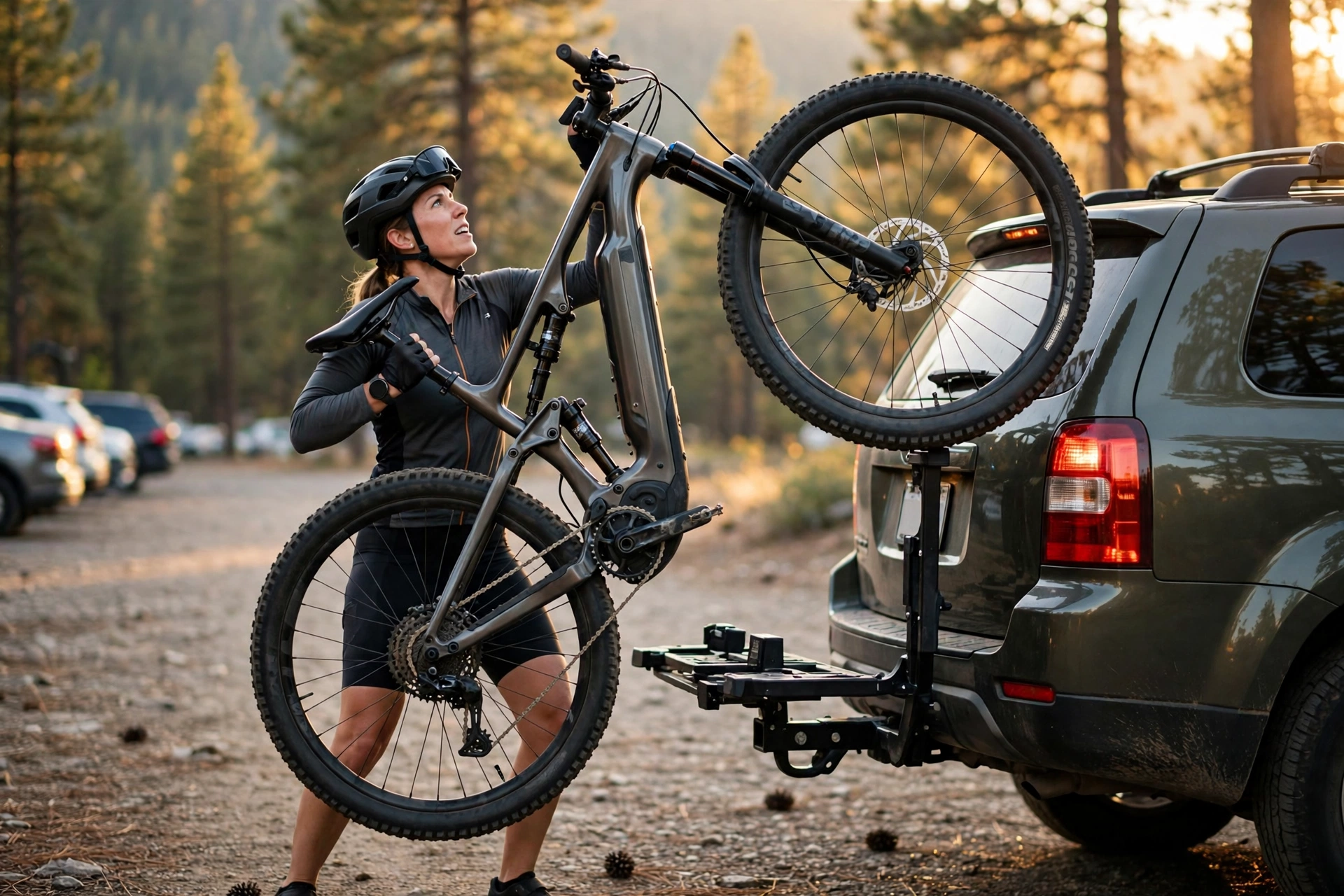
Here’s the section your back cares about. A turbo levo electric mountain bike does not fold, does not shrink, and does not get lighter because you bought the expensive one — even the S-Works is 52 lb 4 oz. So plan around it. A hitch rack rated for e-bikes (60 lb per tray minimum) is non-negotiable; roof racks are a hard no at this weight unless you enjoy hernias. One-bike lift technique matters: strip the battery first — that’s 9.3 lb gone in ten seconds, and on the Comp Alloy it takes the lift from 58 lb down to a merely grumpy 49 lb.
Stairs? Doable, grim, character-building. Apartment dwellers get the best of this bike, weirdly, because of that removable battery: ride down, pop the pack out, charge it by the sofa while the bike sleeps in a communal store. And lock it like you mean it. The Turbo System Lock kills the motor without your phone or PIN, Apple Find My tracks the frame, and the app raises an alarm — but electronics deter, they don’t defeat an angle grinder. Pair the tech with a heavy chain through the frame, every time, even at the trailhead café.
Who Should Buy a Turbo Levo Electric Mountain Bike?
Trail riders who want full power without full faff: the motor tune is the friendliest in the business, the geometry adjusts to your terrain, and the battery system bends around your life instead of the other way round. If your rides are 90 minutes after work, buy the Comp, run the stock 840 Wh, and pocket the change. If you regularly chase 5,000-foot days, the same Comp plus the range extender is the sweet spot — no other trim buys you more trail time per dollar.
Pick a turbo levo electric mountain bike over the lighter, weaker rivals if your local trails point uphill for an hour before they point down — that’s exactly the riding this platform was built around, and the 105 Nm motor turns fire-road slogs into warm-up laps. Riders coming from a Turbo Levo SL or another lightweight e-MTB will feel the extra 12 lb or so, honestly, but they’ll also feel the extra 55 Nm of torque. It’s not a subtle trade.
Skip the Levo if your riding is mostly jump lines and bike-park laps where you’ll feel every pound in the air, or if your storage situation involves three flights of narrow stairs and no lift — 55 lb gets old by the second week. And if the budget is firm at $5,000, the base Alloy is a genuinely good buy: same motor, same battery, $5.95 per watt-hour, just bring realistic expectations about that Marzocchi fork on rough descents.
Turbo Levo Electric Mountain Bike FAQ
How much does the turbo levo electric mountain bike weigh?
It depends on the trim, all in size S4: the base Alloy is 57.5 lb claimed, the Comp Alloy is 58 lb 2.2 oz on Specialized’s own spec sheet, the carbon Comp measured 53 lb 5 oz on OutdoorGearLab’s scale, and the S-Works measured 52 lb 4 oz in E-Mountainbike Magazine’s test. Swapping the 840 Wh battery for the 600 Wh unit takes roughly 2.6 lb off (est., from the measured 50.7 lb Comp figure with the smaller pack fitted).
How far can a Turbo Levo 4 go on one charge?
In the hardest standardised test we have, 27.2 miles with 5,485 feet of climbing in full Turbo mode. Trail mode should give you 35–45 miles (est.), Eco up to 50–65 miles (est.), and the optional 280 Wh range extender pushes total capacity to 1,120 Wh for genuinely all-day rides.
Can you remove the battery for charging and storage?
Yes — it slides sideways out of the downtube in seconds, no tools, no dropping the motor. The pack weighs 9.3 lb. Charge it indoors, store it at room temperature, and take it out before lifting the bike onto a rack to make the lift noticeably easier.
Is the Turbo Levo a Class 1 or Class 3 e-bike?
Class 1 as sold: pedal assist up to 20 mph, which is what most e-MTB-legal trails require. There’s an unlockable 28 mph setting Specialized pitches for commuting. Our honest advice: leave it locked on singletrack. Riding a 28 mph bike on Class 1 trails is how access gets banned for everyone.
How long does the Turbo Levo battery take to charge?
With the standard 4 A charger, roughly 4.5–5 hours from empty (est.). The optional 12 A Smart Charger — included with the S-Works — is claimed by Specialized to take the 840 Wh pack from 0–80% in under an hour, which makes a lunchtime top-up at the trailhead café a real option.
Should you buy the 600 Wh or 840 Wh battery?
The bike ships with the 840 Wh, and for big mountain days it’s the right default. But if most of your rides are under two hours, the 600 Wh pack is the smarter daily driver: it takes the carbon Comp down to 50.7 lb, and lighter bikes get lifted, carried and ridden more. Buy it as a second pack, keep the 840 for epic days.