Last updated: October 25, 2026
The Tesla Roadster 0-60 story changed again this month. Tesla finally showed the car in public on October 15, 2026, at a SpaceX test site in McGregor, Texas, nine years after the prototype first rolled onto a stage. The headline number moved. The delivery date moved further. And the price? Still missing.
Here’s the short version. The old 1.9-second claim from 2017 is no longer the pitch. Tesla now talks about sub-one-second launches with thrusters fitted, figures under 1.6 seconds for a Performance version, and a Rocket version that isn’t road legal. Every one of those numbers is a Tesla claim. None has an independent timing slip behind it.
Production is the other moving part. Elon Musk told the McGregor crowd that production starts in 2028, and he added the word “actually” with a laugh, according to reveal-night reporting from Car and Driver and Electrek. After six missed production dates since 2020, a laugh is honest, at least.
So where does that leave a buyer holding a reservation, or a reader who just wants to know if this is still the fastest car money can buy? This guide separates the claims from the timed cars you can purchase today, prices every tenth of a second, and scores the Tesla Roadster 0-60 package against rivals that have already faced a stopwatch.
Tesla Roadster 0-60: the number that keeps moving
Start with 2017, because that’s still the only version of this car with a complete spec sheet. At the Semi reveal in November 2017, Tesla promised 0-60 mph in 1.9 seconds, a quarter mile in 8.9 seconds, a top speed above 250 mph, and 7,376 lb-ft of wheel torque. The Tesla Roadster 0-60 figure of 1.9 seconds would have made it the quickest production car on Earth. It still hasn’t faced an independent test.
Then came the SpaceX package. In May 2021, a plaque beside the prototype at the Petersen Automotive Museum in Los Angeles stated that optional cold-gas thrusters, mounted at the rear, would cut the launch to 1.1 seconds. Musk repeated the 1.1-second figure the same week. Compressed-air thrusters push the car from behind, adding force the tyres can’t deliver on their own. The tanks need refilling, so the trick isn’t repeatable run after run.
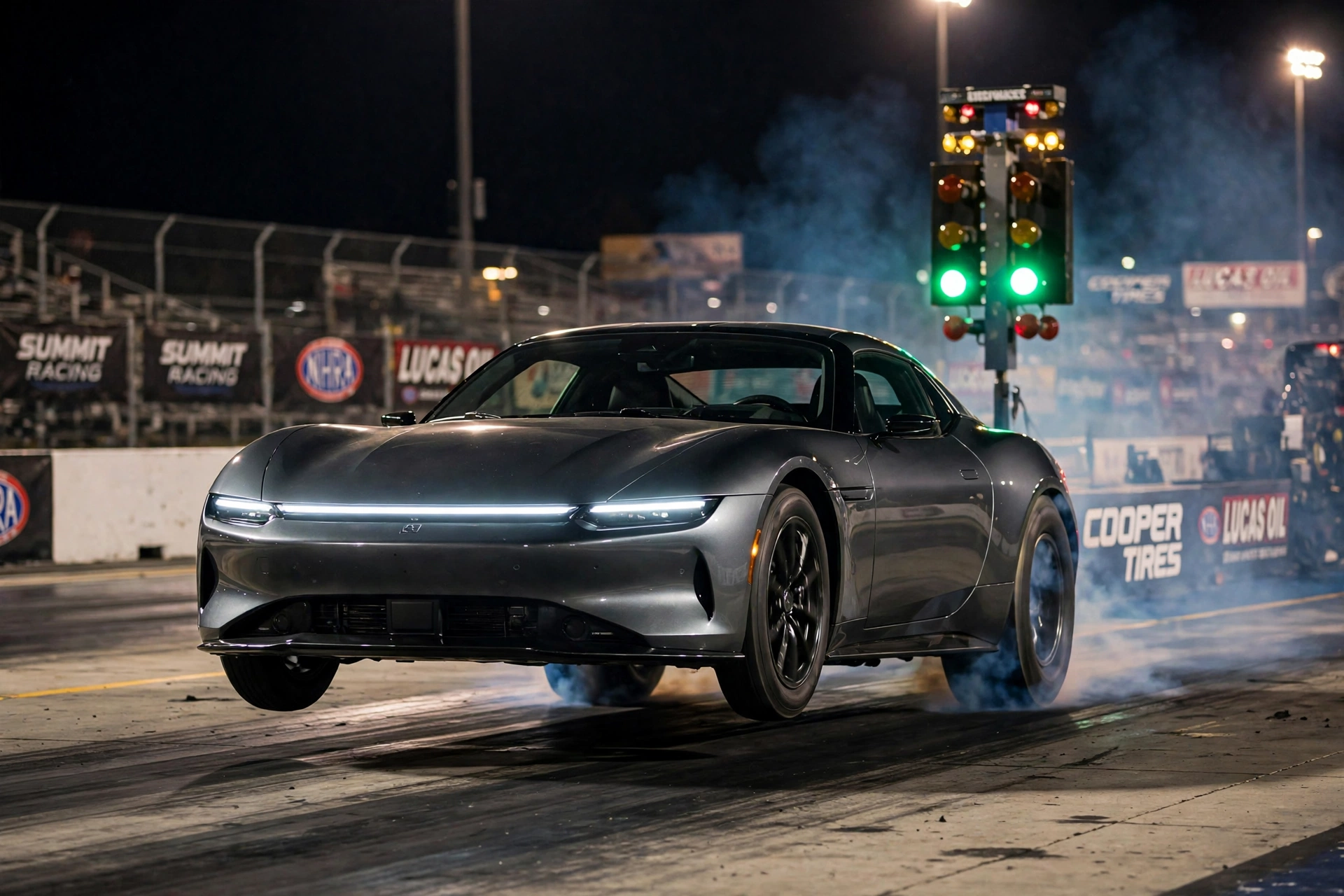
October 2026 moved the goalposts again. Reveal coverage reported three versions: a road-going Performance trim with a claimed launch under 1.6 seconds, a Thrust version with rear thrusters and claims under 0.9 seconds, and a Rocket version with thrusters around the car, claims under 0.6 seconds, and no approval for public roads. A live demo run on the night was reported at 0.81 seconds. Treat that as a stage number, not a test result. No independent outlet timed it, and stage demos run on prepared surfaces with factory crews.
Our position is simple. Until a production-spec Roadster runs in front of Car and Driver, Edmunds or MotorTrend timing gear, the Tesla Roadster 0-60 story is a claims story. Tesla has form here. Its own range and acceleration figures have a habit of shrinking under independent measurement, which is exactly why our breakdown of the Tesla Model Y speed and range test results separates claimed numbers from tested ones. Apply the same split here and the Roadster is, today, a promise with a deposit button.
What changed this month for tesla roadster 0-60: the October 15 reveal
The reveal itself kept slipping before it happened. The demo was first set for October 1, then pushed two weeks because of severe storms forecast for central Texas, and because the event had to run outdoors. The reason for the outdoor rule became clear on the night: the show included a hover demonstration using SpaceX cold-gas thrusters, per multiple reports from the site. A car that hops off the ground is a spectacular demo. It is not a delivery date.
Three concrete facts did land. First, production: 2028, per Musk, with no delivery month attached. Second, reservations: new bookings reportedly ask for $5,000 today and a further $45,000 within 10 days for the base Performance trim, a $50,000 total that matches the old deposit structure. Third, price: none. Reuters, CNBC and Wired all noted that Tesla announced no price at the reveal. Tesla’s official Roadster page remains the place the company points buyers to, and as of this update it functions as a reservation page rather than a price list.
That missing price matters more than any launch claim. The $200,000 base price and $250,000 Founders Series price are 2017 numbers. The Founders run was 1,000 cars, paid in full up front, and has long been reported sold out. Nothing in October confirmed that $200,000 survives to 2028. Nine years of inflation, a redesigned car and a thruster program say it probably doesn’t (est., based on the car’s expanded scope and 2017-to-2026 price rises across Tesla’s own range). Anyone quoting you a firm Roadster price today is quoting 2017.
Specs on paper: range, battery and top speed
The 2017 sheet was extraordinary. A 200 kWh battery, roughly double a Model S pack. A claimed 620 miles of range. Tri-motor all-wheel drive, one motor in front and two at the back. A 2+2 cabin with a removable glass roof panel that stows in the car. Top speed above 250 mph. No production EV has matched that combination since, because no production EV has tried to sell it at $200,000.
The October 2026 reports describe a different, narrower car. Range was quoted in reveal coverage at 300+ miles, less than half the 2017 promise. Seating drops to one or two, depending on version. Top speed for the Rocket version was claimed at 230+ mph, below the old 250 mph headline. Battery capacity for the production car hasn’t been published. Read those figures as reported claims from reveal coverage, not as a Tesla spec sheet, because Tesla hasn’t issued one.
There’s an ownership angle hiding in the old 200 kWh figure, too. A pack that large carries a serious out-of-warranty replacement bill, and our Tesla battery replacement cost guide shows what big Tesla packs already cost once the warranty ends. If the production Roadster keeps anything close to 200 kWh, budget for a five-figure pack decision somewhere in the car’s second decade.
Charging is the biggest blank on the page. Tesla has published no peak charge rate, no 10-to-80 percent time and no connector detail for the production car. A 2028 arrival should mean access to the Supercharger network and the NACS standard the rest of the range now uses, but that’s an inference, not a specification. For a car sold on the tesla roadster 0-60 headline, the charging spec decides whether owners can repeat the party trick twice in one afternoon. Score it as unknown until Tesla prints a number.
Tesla Roadster 0-60 vs the rivals that have actually been timed
Three electric cars have already done the thing the Roadster keeps promising. They’ve been bought, delivered and timed by people who don’t work for the manufacturer. This is the company the Tesla Roadster 0-60 claim has to join, and the gap between “claimed” and “timed” runs through every row.
The Tesla Model S Plaid is the awkward sibling. Tri-motor, 1,020 hp, and a factory claim of 1.99 seconds. Car and Driver tested it and recorded 2.1 seconds to 60 mph with a 9.4-second quarter mile, quick enough to embarrass supercars at a fraction of their price. Its EPA range figures are listed on fueleconomy.gov, with the 21-inch-wheel car rated at 348 miles. The Plaid launched at $129,990, and later price cuts took it lower. It seats five, it exists, and owners have been daily-driving it for years.
The Lucid Air Sapphire is the current sedan benchmark. Lucid claims 1.89 seconds from its 1,234 hp tri-motor setup, and it carries a $250,500 price (checked October 25, 2026) with a 427-mile EPA range. Edmunds put one through its U-Drag test and clocked 2.2 seconds to 60 on an unprepared surface, beating the Plaid in the same test. Prepared track, stickier surface, and the Sapphire gets closer to its claim. Either way, it’s a real number from a real car a customer can buy this month.
The Rimac Nevera sits at the top of the verified pile. Its 1.74-second 0-60 time was set during a record day that produced 23 performance records, and the car makes 1,914 hp from four motors. The catch is the invoice: around $2.1 million (est., based on reported launch pricing). The Nevera proves sub-1.8 is physically possible in a production car. It also proves what it costs when a company actually ships it.
| Car | 0-60 mph | Source of figure | Price | Range |
|---|---|---|---|---|
| Tesla Roadster | 1.9 s claimed (2017); under 1 s claimed with thrusters (2026) | Tesla claims only, never independently timed | Unconfirmed; $200,000 quoted in 2017 | 620 miles claimed (2017); 300+ miles reported (2026) |
| Tesla Model S Plaid | 2.1 s tested; 1.99 s claimed | Car and Driver instrumented test | $129,990 at launch | 348 miles EPA (21-inch wheels) |
| Lucid Air Sapphire | 2.2 s tested; 1.89 s claimed | Edmunds U-Drag test | $250,500 | 427 miles EPA |
| Rimac Nevera | 1.74 s verified | Rimac record-day timing, independently witnessed | ~$2.1 million (est.) | ~300 miles (est.) |
Read the first row against the other three and the problem is obvious. Every rival earned its number in public. The Roadster’s numbers have nine years of stage time and zero independent timing slips. That doesn’t make the car slow. It makes its speed unpriced and unproven, which is a strange place for a flagship to sit in 2026.
Our original analysis: what each tenth of a second costs
Here’s a calculation we run on every fast EV, and nobody else publishes it in this form: the price of the car divided by its 0-60 time in tenths of a second. It shows what you’re actually paying for straight-line speed.
The Model S Plaid, at its $129,990 launch price and Car and Driver’s tested 2.1 seconds, works out to $129,990 ÷ 21 tenths = $6,190 per 0.1 second. The Lucid Air Sapphire, at $250,500 and Edmunds’ tested 2.2 seconds, is $250,500 ÷ 22 tenths = $11,386 per 0.1 second. The Rimac Nevera, at roughly $2,100,000 (est.) and a verified 1.74 seconds, is $2,100,000 ÷ 17.4 tenths = $120,690 per 0.1 second. Speed gets expensive fast at the top of the table.
Now the Roadster. Using the only price Tesla has ever attached to it, $200,000 from 2017, and the original 1.9-second claim: $200,000 ÷ 19 tenths = $10,526 per 0.1 second. That lands between the Plaid and the Sapphire, which looks like fair value until you remember both inputs are unverified. The price is nine years old and the time has never been timed. If the production car lands at $250,000 (est.) and matches 1.9 seconds, the figure rises to $13,158 per tenth, Sapphire money for a number Lucid nearly matches in a five-seat sedan you can buy today.
Run the same maths on range and the 2017 promise looks even stranger. Price per mile of claimed range: the Roadster at $200,000 ÷ 620 miles = $323 per mile. The Sapphire: $250,500 ÷ 427 miles = $587 per mile. The Plaid at launch: $129,990 ÷ 348 miles = $374 per mile. On 2017 paper, the Roadster was the range bargain of the group. On the 300+ mile figure reported from the 2026 reveal, it becomes $200,000 ÷ 300 = $667 per mile, the worst of the three, and that’s before any price rise. The range cut is the single most damaging change in the whole program, and it got the least stage time.
Tesla Roadster 0-60 verdict: our scores
Scoring an unbuilt car means scoring the evidence, and the evidence is thin. These Roadster scores are provisional and will be revised the day a production car is priced and timed.
For buyers weighing the claims, the tesla roadster 0-60 story remains the deciding factor, even though no independent test has confirmed it yet.
Tesla Roadster — Our score: 6.1/10. Range: 5/10. The signature 620-mile claim has reportedly halved, and no official figure exists. Charging: 5/10. No published rate, no published curve, pure inference from the rest of the range. Value: 5/10. There is no price to judge, so value sits at neutral until Tesla prints one. The Tesla Roadster 0-60 claims would top this table if verified; unverified, they’re worth half credit and not a point more.
Tesla Model S Plaid — Our score: 8.8/10. Range: 8/10. Charging: 9/10. Value: 9/10. A tested 2.1 seconds, five seats, a hatchback, and a national charging network, at a price that undercut every supercar it embarrassed. This is the car the Roadster has to beat inside its own company, and on evidence it hasn’t yet.
Lucid Air Sapphire — Our score: 8.9/10. Range: 9/10, the best here. Charging: 8/10. Value: 6/10, because $250,500 is serious money even for the fastest sedan Edmunds has timed. If your priority is a verified number and a car in your garage this year, the Sapphire is the strongest buy on this page.
Rimac Nevera — Our score: 8.3/10. Range: 6/10. Charging: 7/10. Value: 3/10, because $120,690 per tenth of a second is collector economics, not value. As an engineering proof it stands alone. As a purchase it’s a different hobby entirely.
Buying timing: reserve now or wait?
This is a timing question, so let’s time it. Production reportedly starts in 2028. That’s two more years of waiting on top of nine, with no price, no final spec sheet and a deposit structure that asks for $45,000 of follow-up money within 10 days of a $5,000 reservation.
Our advice is blunt: don’t send the second payment until Tesla publishes a price and a delivery window you can circle on a calendar. A refundable-feeling reservation is one thing. Fifty thousand dollars parked against an unpriced car with a laughed “actually” attached to its production date is another. Reservation holders from 2017 have already funded this wait once.
None of this makes the tesla roadster 0-60 project a fantasy. It makes it an option contract on a spec sheet, and options should be priced like options. If the money is burning a hole and the goal is speed now, the Plaid and the Sapphire are sitting in showrooms with tested numbers attached, and our guide to today’s EV cars, their range and their running costs covers what they cost to live with. The Roadster becomes a rational reservation on exactly one day: the day Tesla prints a price, a range figure and a production month in the same document. Watch for that document. It’s the real reveal.
Frequently asked questions
What is the Tesla Roadster 0-60 time?
Tesla claimed 1.9 seconds in 2017 for the standard car and 1.1 seconds with the SpaceX thruster package in 2021. At the October 2026 reveal, reported claims went below 1.6 seconds for the Performance version and under one second for thruster versions. None of these figures has been independently tested on a production car.
When does Tesla Roadster production start?
Elon Musk said 2028 at the October 15, 2026 reveal in McGregor, Texas. Previous targets ran from 2020 through 2027 and all slipped, and Tesla’s own quarterly updates had listed the car as in design development before the reveal. Plan around 2028 as a claim, not a schedule.
How much does the new Tesla Roadster cost?
Nobody knows, including, publicly, Tesla. No price was announced at the 2026 reveal. The $200,000 base and $250,000 Founders Series figures date from 2017, and the Founders run of 1,000 cars is reported sold out. Prices in this article were checked October 25, 2026, and the honest entry for the Roadster is “unconfirmed.”
What is the SpaceX package on the Roadster?
It’s a set of cold-gas thrusters, developed with SpaceX, that fire compressed air to help the car launch, brake and corner beyond what tyre grip allows. Tesla’s Petersen Museum display credited it with a 1.1-second 0-60 time in 2021, and the 2026 reveal reportedly built thrusters into dedicated Thrust and Rocket versions, the latter not approved for public roads. The air tanks need refilling, so the full effect isn’t repeatable on demand.
Is the Roadster faster than a Model S Plaid?
On claims, yes, easily. On evidence, the Plaid is faster, because the Plaid has been timed at 2.1 seconds by Car and Driver and the Roadster has never been independently timed at all. The day a production Roadster beats 2.1 seconds in front of third-party timing gear, this answer changes.
How far will the production Roadster go on a charge?
The 2017 promise was 620 miles from a 200 kWh battery. Reveal coverage in October 2026 reported a figure of 300+ miles for the production car. Tesla hasn’t published an official range or battery size for the car it unveiled, so treat both numbers as claims from different eras of the program.