Last updated: October 27, 2026
Every season asks something different of a Tesla’s drive unit. Summer heat works on its coolant seals. Winter salt creeps along its underbody. Spring miles pile onto its bearings. So when owners search for tesla motor repair, the weather is usually part of the story, even if nobody says so out loud. This guide follows that calendar, because the conditions that kill a drive unit arrive on a schedule, and most of them can be spotted before they strand you.
First, the vocabulary. A Tesla has no separate engine and gearbox in the petrol sense. Each driven axle carries one drive unit: an electric motor, a single-speed reduction gearbox and the inverter that feeds it power, sealed inside one housing about the size of a suitcase. When that housing fails, the whole assembly is the part. There is no cheap little component swap waiting at the end of the diagnosis, and that single fact explains every price in this article.
Now the core truth, stated once and plainly. Tesla service centres do not repair drive units. They remove the failed one and bolt in a remanufactured unit, a factory-rebuilt assembly that began life in somebody else’s car. Your old unit goes back into that remanufacturing stream. Genuine internal repair, bearings, seals, cleaning, a proper rebuild, exists only at independent EV specialists. Anyone budgeting for tesla motor repair is really choosing between three routes: Tesla’s remanufactured swap, a specialist rebuild of your own unit, or a salvage unit of unknown history.
The seasons matter because the failure modes are seasonal in their causes, if not their timing. Heat cycles age the rotor coolant seal in the large drive unit fitted to early Model S and Model X cars. Road salt and standing water attack connections and underbody hardware. Cold weather thickens lubricants and exposes weak 12-volt batteries, which then masquerade as drive unit faults. And high mileage, the slowest season of all, wears bearings in every model. We take them in order.
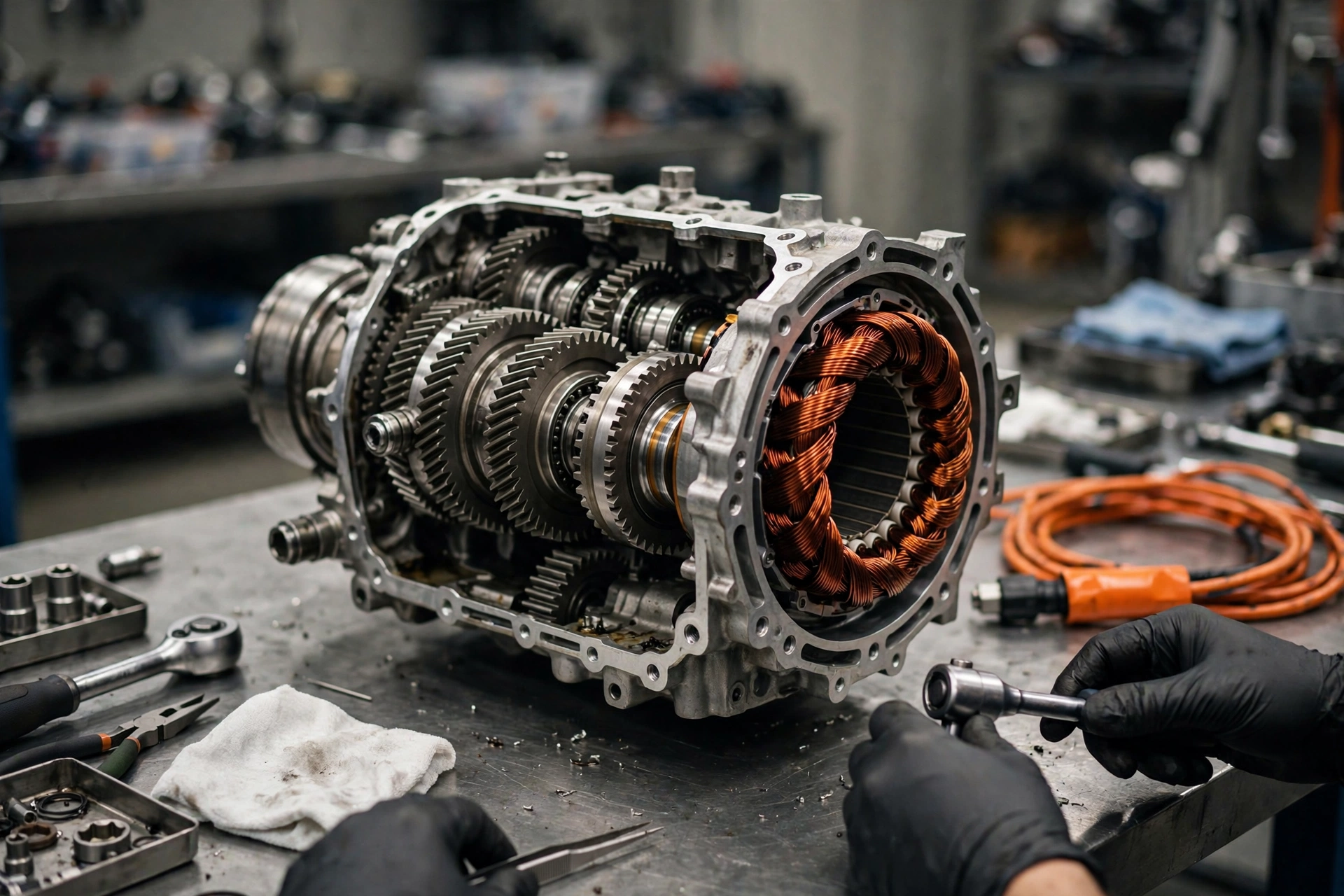
One safety line before any of this becomes practical. A drive unit is wired directly into a high-voltage system that can kill. Nothing in this guide is a how-to for opening one, and no part of tesla motor repair is driveway work. Owners detect symptoms, check warranty dates and choose a shop. The spanners belong to trained high-voltage technicians.
Tesla motor repair in practice: replacement first, rebuild second, questions always
Start with what Tesla itself offers. A failed drive unit at a service centre means a remanufactured replacement, programmed to the car, with fluids and an alignment in the same visit. The process is clean, quick and expensive. Owners of older Model S cars also report that the replacement is the later “U” revision unit where fitment allows, which matters, because the newest revision quietly removes the coolant path that caused the classic failure in the first place.
Independent specialists work the opposite way. Shops such as ELMOB in the United States publish their large drive unit rebuild process openly: remove the unit, open it, clean coolant contamination from the stator and inverter, replace bearings and seals, and fit a revised coolant manifold. Electrified Garage in Florida has quoted owners around $4,000 for drive unit replacement work on early Model S cars, a figure consistent with what rebuild shops charge when a unit is salvageable. Gruber Motors in Arizona built its name on component-level Tesla electronics repair and takes the same strip-and-fix approach to out-of-warranty cars. The pattern is consistent: Tesla swaps, specialists rebuild.
My position, without hedging: for a car inside its drive unit warranty, Tesla is the only correct answer, because the work is free. The moment the warranty expires, get a specialist quote before you accept Tesla’s. The price gap, shown in full further down, is routinely several thousand dollars for the same rolling result.
Summer: heat, coolant and the large drive unit’s one real weakness
The defining failure of early Tesla motoring lives in the large drive unit, the LDU fitted to rear-wheel-drive and Performance Model S and Model X cars built from 2012 to 2020. Its rotor is liquid-cooled, and the seal that keeps coolant inside the rotor circuit wears with heat cycles and age. Specialist ELMOB states the point without softness: all large drive units installed in Model S and Model X cars from 2012 to 2020 have issues with coolant leaks. Tesla’s own later revision deleted rotor coolant flow entirely, which tells you the manufacturer reached the same conclusion.
What follows a leaking seal is a slow chain reaction. Coolant washes the grease out of the rotor bearings, so they run dry and begin to disintegrate. It floods the motor windings and ruins their insulation. It reaches the inverter electronics, corrodes the circuitry and shorts it. Tesla coolant is electrically conductive, so the car’s isolation monitoring notices early, often as BMS isolation alerts on the instrument cluster, and the car may disable itself to protect the main battery. An owner who keeps driving through those warnings is spending a rebuildable unit and buying a dead one.
The earliest large drive units had a different flaw. Their steel rotor bearings became the path of least resistance for stray electrical energy in the rotor, which arced through the balls and races and pitted them. The symptom was noise, a whine or milling sound, long before any failure. Later units moved to hybrid ceramic bearings, then traded that problem for the weaker coolant seal described above. Two generations, two different diseases, one shared organ.
There is one genuinely useful inspection here, and it is cheap. A technician can remove the rotor speed sensor and check it with a borescope. A wet sensor means coolant is already inside the unit, caught early, when cleaning, bearings and a manifold still fix it. Dry means you have time. On any 2012–2020 Model S or X with the large drive unit, that inspection is the single highest-value hour of labour you will ever buy.
Autumn: the symptoms an owner can actually catch
Drive units rarely fail in silence. The warning signs arrive weeks or months early, and an owner who knows the list has a real chance of converting a catastrophe into a planned repair. Listen for a whine that rises and falls with road speed rather than motor load. Listen for a milling or groaning note from the rear on early Model S cars, the bearing signature. Feel for a clunk on take-up of power, or a new shudder under gentle acceleration.
Watch the screen as carefully as the road. Isolation alerts, “power reduced” messages and repeated unexplained deaths of the 12-volt battery all belong on the list. That last one surprises people. When the drive unit’s electrical condition deteriorates, the car can keep the main high-voltage battery disconnected for safety, and the 12-volt battery then drains supporting the car’s systems alone. A Tesla that keeps eating 12-volt batteries is sometimes a drive unit asking for help, not an electrical gremlin.
Coolant tells its own story. A sweet smell after driving, a low-coolant warning, or pink-blue residue around the rear underbody on an early Model S or X deserves a same-week appointment, not a note to self. Compare that discipline with how owners treat the battery side of the car: our guide to Tesla battery replacement cost shows the same pattern, where early attention is worth thousands. Motors are no different. Symptoms are a discount, if you use them.
Winter: salt, slush and the water question
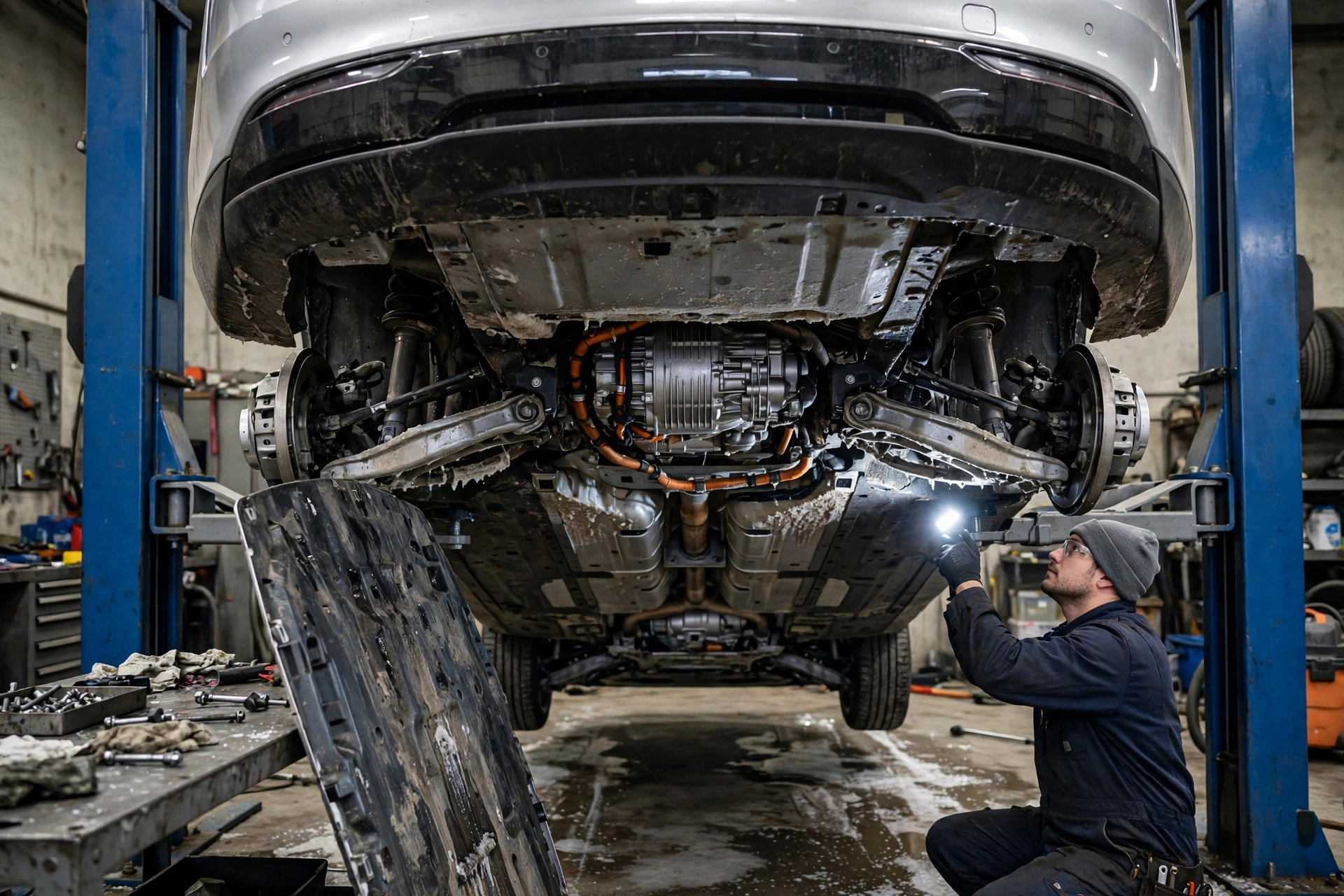
Winter does not attack the motor directly. It attacks everything around it. Salt brine coats the underbody, finds its way into connectors and half-shaft joints, and accelerates corrosion on the hardware a technician will later need to remove. A car that lives on salted roads should get an underbody wash when the thaw comes, the same spring ritual our guide to electric car winter range loss recommends for the battery’s sake. Ten minutes with a hose lance is the cheapest corrosion insurance in this entire article.
Standing water deserves a flat rule. Do not drive a Tesla through deep water. The drive units are sealed, not submarine-rated, and flood damage sits outside warranty cover, as Tesla’s warranty exclusions for environmental damage make clear. Owners in flood-prone streets should treat a submerged car park as a reason to move the car, not a test of ground clearance. A drive unit that has ingested water through a vent or a damaged seal joins the same rebuild queue as a coolant-leak car, with worse internals.
Cold storage, the other half of winter, is gentler on drive units than on batteries. A stored Tesla wants to stay plugged in, at a moderate charge level, with tyre pressures checked, and that is the whole list as far as the motor is concerned. The drive unit has no fluids that freeze at any temperature a garage will see. Winter’s real motor risk is the road, not the rest.
Tesla motor repair and the 8-year warranty, read by model, not by rumour
Every figure in this section comes from Tesla’s official vehicle warranty page, checked October 27, 2026. The battery and drive unit are covered together under one warranty. Model S and Model X get 8 years or 150,000 miles, whichever comes first. Model 3 and Model Y in rear-wheel drive get 8 years or 100,000 miles. Long Range and Performance versions of Model 3 and Model Y get 8 years or 120,000 miles. The 70 percent minimum capacity retention you will see quoted belongs to the battery; a drive unit claim rests on the unit failing, not on a percentage.
Two details decide real claims. First, the clock starts at the car’s original delivery, not at the day a used buyer collects it. A 2019 Model S bought today may have months of cover left, or none, and the in-service date in the Tesla account settles it. Second, “whichever comes first” is unforgiving to high-mileage drivers: a Model 3 at 121,000 miles is out of drive unit cover even if it is only five years old. Anyone shopping used should price the car as if the warranty ends at the earlier of the two limits, because it does. Our research method page explains how we verify figures like these before publishing them.
What tesla motor repair costs: three routes, totalled
Prices checked October 27, 2026. Tesla publishes no rate card, so the Tesla figure below is a documented owner invoice, and the specialist figures are published shop pricing. Treat regional labour rates as the variable they are.
Route one, Tesla remanufactured replacement. A 2014 Model S P85D owner documented the full invoice in Grassroots Motorsports: the remanufactured rear drive unit itself was $7,043.04, installation $962.50, fluids about $125 and an alignment $235. Add those: 7,043 + 963 + 125 + 235 = $8,366 before tax, and $8,959.10 out the door as invoiced, with a parts warranty on the unit. That is the honest anchor price for a large drive unit at Tesla: plan around $9,000.
Route two, independent rebuild of your own unit. ELMOB publishes its large drive unit rebuild pricing openly on its Tesla LDU coolant leak repair page: from around $2,000 in the best case, caught early, rising to $4,500 or more when coolant has damaged the stator, bearings and inverter. Take the midpoint, $3,250 (est., our midpoint of the published range), and the saving against the Tesla invoice is 8,959 − 3,250 = $5,709 (est.). The rebuild also fixes the cause, because the revised manifold removes the leak path. A Tesla remanufactured unit fixes the symptom with factory parts and a warranty, and on early revisions can carry the same seal design that failed.
Route three, a salvage unit. Used large drive units sell for $2,500 to $4,000, and salvage rear units for Model 3 and Model Y run $1,300 to $4,000 for the part alone. Fit one at, say, $3,250 for the unit (est., mid-range) plus roughly five hours of high-voltage labour at $185 an hour (est.), $925, and the total is about $4,175 (est.). The catch is structural: every unmodified used large drive unit carries the same coolant seal that failed in yours. It is the cheapest route and the only one that can hand you the identical bill twice.
Model 3 and Model Y owners should expect kinder numbers, because their units are smaller, common and rarely afflicted by a systemic flaw. Reported out-of-warranty replacement totals cluster around $6,000 to $7,500 (est., from published owner reports and specialist pricing), and salvage supply is deep. The arithmetic for these cars is less about routes and more about timing: inside 8 years or the mileage cap, the repair is Tesla’s problem and costs you nothing.
Spring: prevention, coolant honesty and the service calendar
Tesla’s published position is that the battery and motor coolant is a lifetime fill with no scheduled replacement interval, checked when a warning appears. Owners should know that is the manufacturer’s line, and also know where specialists differ. Rebuild shops that open these units daily recommend coolant condition checks at high mileage and treat the coolant delete manifold on large drive units as a preventive retrofit, not a repair. The two positions are not equal. Tesla’s line costs nothing until it costs $9,000. The specialist line costs a modest inspection (est., typically an hour of labour) and tells you whether your seal is still dry inside. That is tesla motor repair done on your schedule instead of the car’s, and it is the version worth paying for.
On a large drive unit car, the preventive package writes itself: speed sensor inspection for coolant, the revised manifold fitted before the seal fails, fresh drive unit fluid during any rebuild, and axle seals renewed while the unit is out. On Model 3 and Model Y, prevention is thinner and simpler, because there is no systemic flaw to pre-empt: keep the underbody washed after salt season, fix coolant warnings promptly, and do not ignore a new whine at motorway speed. Owners weighing the wider cost picture can run their own numbers with our EV battery replacement cost estimator, since battery and drive unit risks are the two big-ticket lines in any older Tesla budget.
Storage closes the calendar. A Tesla stored for a season wants a plugged-in cable, a mid-level charge, and dry air around it. Rodents do more drive unit damage in stored cars than cold ever will: they chew wiring looms in the underbody. A stored car on a lift or over a clean, lit floor, checked monthly, is the specialist-grade answer, and it costs nothing but attention.
Our verdict
Our score: 6/10 — Failure risk by model era: 4/10 for 2012–2020 Model S and X large drive units, 8/10 for Model 3 and Model Y units · Repair cost fairness: 5/10 · Prevention value: 9/10. The low fairness score is not about Tesla’s invoice being dishonest; it is itemised and the unit carries a warranty. It is about a system where a wearing seal can turn into a five-figure-adjacent bill because the manufacturer will not sell you the seal, the bearings or an hour of internal labour. The prevention score is the highest in this guide for a reason. A one-hour inspection and a manifold are cheap. Everything else in this article is what happens when you skip them.
Second clear opinion, and the one to keep: an early Model S or X with an uninspected large drive unit is not the bargain it looks like at $15,000. Price in the inspection, price in the manifold, and hold the rebuild figure in reserve. Do that, and it can be a fine car. Skip it, and you have bought a lottery ticket with a coolant seal printed on it. Known Model Y ownership patterns, covered in our Tesla Model Y problems guide, show how much calmer the newer cars are by comparison.
Frequently asked questions
How much does tesla motor repair cost out of warranty?
For an early Model S or X large drive unit, a documented Tesla remanufactured replacement invoiced at $8,959.10 out the door. An independent rebuild of your own unit runs $2,000 to $4,500 at published specialist pricing, depending on how far the coolant damage has spread. Model 3 and Model Y replacements are reported around $6,000 to $7,500 (est.). Inside the 8-year warranty, the cost is zero.
Can a Tesla drive unit actually be repaired, or only replaced?
Both, depending on who you ask. Tesla service centres only replace, using remanufactured units. Independent specialists genuinely repair: they open the unit, clean coolant damage, replace bearings and seals, and fit revised manifolds that remove the original leak path. The rebuild is usually cheaper and fixes the cause; the replacement is faster and carries Tesla’s parts warranty.
Is my Tesla’s drive unit still under warranty?
Check the in-service date and the odometer against your model’s cap: 8 years or 150,000 miles for Model S and X, 8 years or 100,000 miles for rear-wheel-drive Model 3 and Y, and 8 years or 120,000 miles for Long Range and Performance Model 3 and Y. Whichever limit arrives first ends the cover, and the warranty shown in your Tesla account is the record that counts.
What are the earliest warning signs of drive unit failure?
A whine that tracks road speed, a milling or groaning note from the rear, isolation alerts on the cluster, “power reduced” messages, a low-coolant warning, and a car that keeps draining its 12-volt battery. On 2012–2020 Model S and X cars, add one proactive step: ask a specialist to pull the rotor speed sensor and check for coolant before any symptom appears.
Should I fit the coolant delete manifold before anything fails?
On a large drive unit car you plan to keep, yes. The manifold removes the coolant path that destroys these units, and fitting it to a dry, healthy unit is far cheaper than rebuilding a flooded one. Tesla’s own later revision made the same change at the factory. It is the rare preventive job where the manufacturer has already agreed with the diagnosis.
Can I repair a Tesla drive unit myself?
No. The drive unit connects directly to the high-voltage battery, and opening it without high-voltage training, insulated tooling and the correct isolation procedure is genuinely dangerous. Owners should diagnose symptoms, check warranty status and choose between Tesla and a qualified independent specialist. That is where owner involvement correctly ends.