Last updated: October 27, 2026
Let’s clear the big lie out of the way first. A surron electric dirt bike is not an e-bike. It has no pedals, it makes between 2 kW and 24.5 kW depending on the model, and not one machine in this range fits any US e-bike class. These are electric dirt bikes — light, quiet, torque-heavy dirt bikes — and they are sold for off-road use. Keep shopping for a pedal-assist commuter and you will buy the wrong machine and get a ticket with it.
The current range has five models that matter. The Hyper Bee is the youth bike at $2,799. The Light Bee S is the smaller, older youth-and-beginner machine at roughly $3,200 (est., US stock is thin). The Light Bee X is the one everyone means when they say “a Surron”: $4,499 for 2026. Above it sits the Ultra Bee, $5,799 to $6,499 depending on the dealer, and at the top the full-size Storm Bee at $8,499 listed — when you can find one in stock at all.
All prices here were checked against US dealer listings on October 27, 2026, and every unconfirmed figure is marked (est.) with its basis, following the process on our research method page: dealer listings and published tests first, brochure claims last.
Range claims need the same treatment. Sur-Ron quotes the 2026 Light Bee X at 46.6 miles. That number comes from a WMTC-style test run at roughly 25 mph. A published range test by Voro Motors — a dealer that sells a rival bike, so weigh its motives yourself — ran an X in mixed trail and road riding with a 165 lb rider and the battery died at 28 miles. Both numbers are real. Only one of them describes how you will actually ride. This guide plans around tested numbers and treats brochure range as a ceiling, not a promise.
Who should keep reading? Trail riders who want torque without a clutch, parents pricing a first real dirt bike for a kid, and anyone cross-shopping these against the machines in our electric dirt bike guide. Who should stop? Anyone who needs to ride on the street to reach the trail. No surron electric dirt bike solves that problem in stock form, and the legal section below explains exactly why.
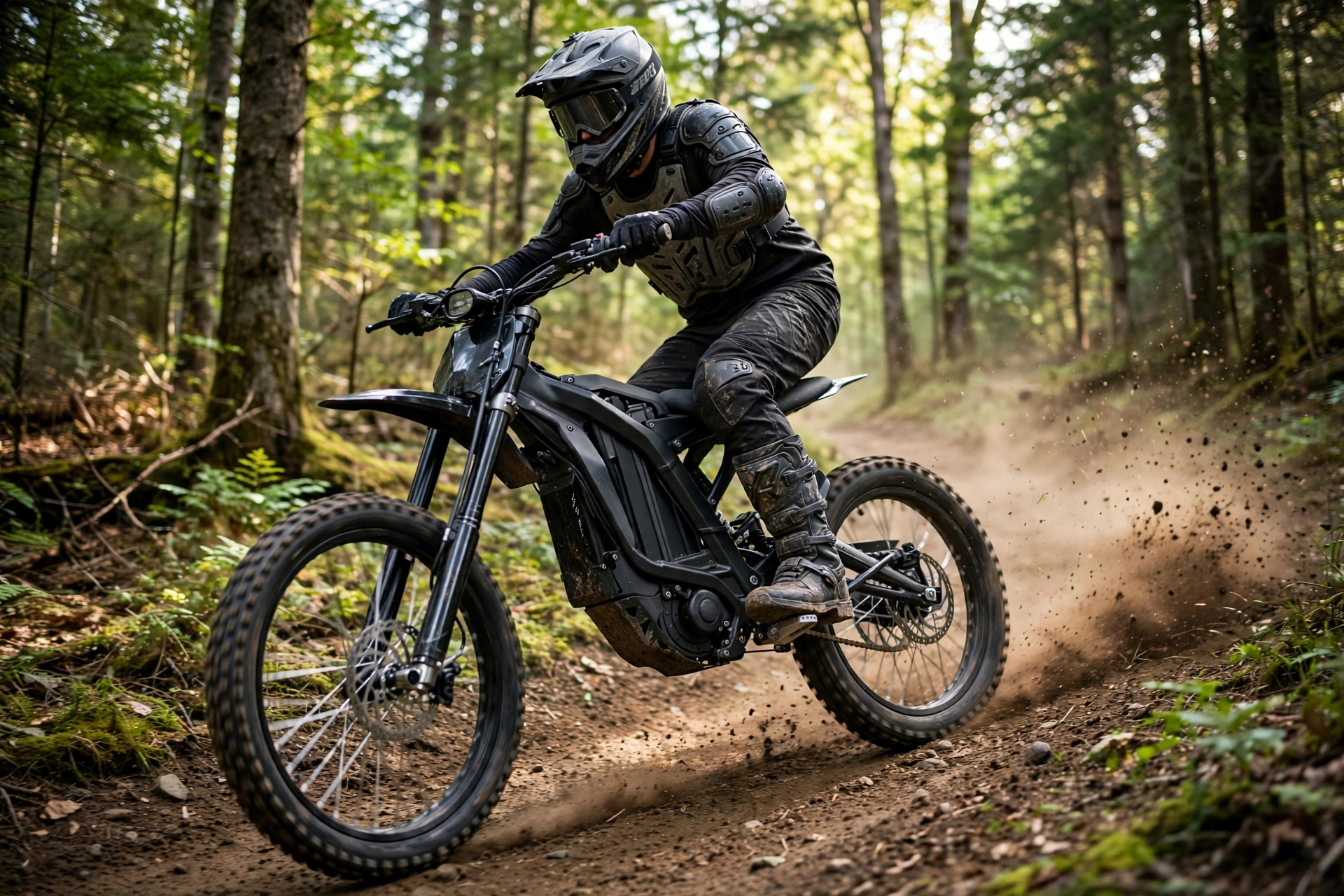
The surron electric dirt bike range at a glance
Five models, five different jobs. The spread is wider than most people realise: the smallest bike here weighs 86 lbs and the largest weighs 280 lbs. Torque here is quoted at the rear wheel, which is why the numbers dwarf crank-torque figures from pedal e-bikes — 295 Nm at a wheel is not the same measurement as 85 Nm at a bicycle crank, and anyone comparing them directly is selling you something.
| Model | Peak power | Battery | Weight | Claimed range | Price (USD) |
|---|---|---|---|---|---|
| Hyper Bee | 8 kW | 58V 22Ah (1.28 kWh) | 86 lbs | ~35 miles at 25 mph | $2,799 |
| Light Bee S | ~3 kW (est.) | 48V 20Ah (0.96 kWh) | 106 lbs | ~43 miles at 12 mph | ~$3,200 (est.) |
| Light Bee X (2026) | 10 kW | 72V 35Ah (2.52 kWh) | ~130 lbs | 46.6 miles (WMTC) | $4,499 |
| Ultra Bee HP (2026) | 21.5–24.5 kW | 74V 60Ah (4.44 kWh) | 195 lbs | 71 miles (Eco, steady 31 mph) | $5,799–$6,499 |
| Storm Bee | 22.5 kW | 104V 55Ah (5.72 kWh) | 280 lbs | 75 miles at 31 mph | $8,499 listed |
Hyper Bee: the kids’ bike that adults keep stealing
The Hyper Bee is the entry point: 86 lbs, an adjustable seat height of roughly 26 to 27.8 inches, 14/12-inch wheels on the common version, and a parental remote that can cut power from up to 300 metres away. For 2026 it steps up to an 8 kW peak motor with 185 Nm at the wheel and a 58V 22Ah pack. Top speed is around 40 mph derestricted, which is far too much for a first bike — the three ride modes and the remote exist precisely so a parent can dial it back to something sane.
Range is quoted at up to 56 km (about 35 miles) cruising at 25 mph. A child circulating a track or a family trail loop will see a good chunk of that; a teenager pinning it everywhere will not. Charging runs about 2 hours from 20% to 80%, and the pack swaps in seconds, so a spare battery is the practical range extender here. At $2,799 it undercuts a 65cc petrol race bike by about $1,700 and needs no clutch lessons, no premix, no air filters soaked in oil.
Our score: 8.0/10 — Range 6/10 · Charging 8/10 · Value 9/10. For the job it is built to do, this is the easiest recommendation in the range.
Light Bee S: the smaller Bee, now squeezed from below
The Light Bee S is the older, smaller sibling: a 48V 20Ah pack (0.96 kWh), a motor of roughly 2 kW rated and about 3 kW peak (est., no clean factory peak figure exists), 17-inch wheels, 106 lbs, and a top speed near 31 mph. This guide gives it one short section on purpose — we cover the S in depth in its own model guide — because the honest summary is that the Hyper Bee has eaten its lunch. The S is bigger and heavier than the Hyper Bee, costs about $400 more (est.), charges slower at 4 to 4.5 hours, and its headline range figure is recorded at 12 mph, which is jogging pace.
Buy the S only if the rider is too big for the Hyper Bee’s frame and too new for the X, and you find one actually in stock. That window is narrow and getting narrower.
Our score: 6.8/10 — Range 5/10 · Charging 6/10 · Value 6/10. A decent bike outclassed by its own little brother.
Light Bee X (2026): the default surron electric dirt bike
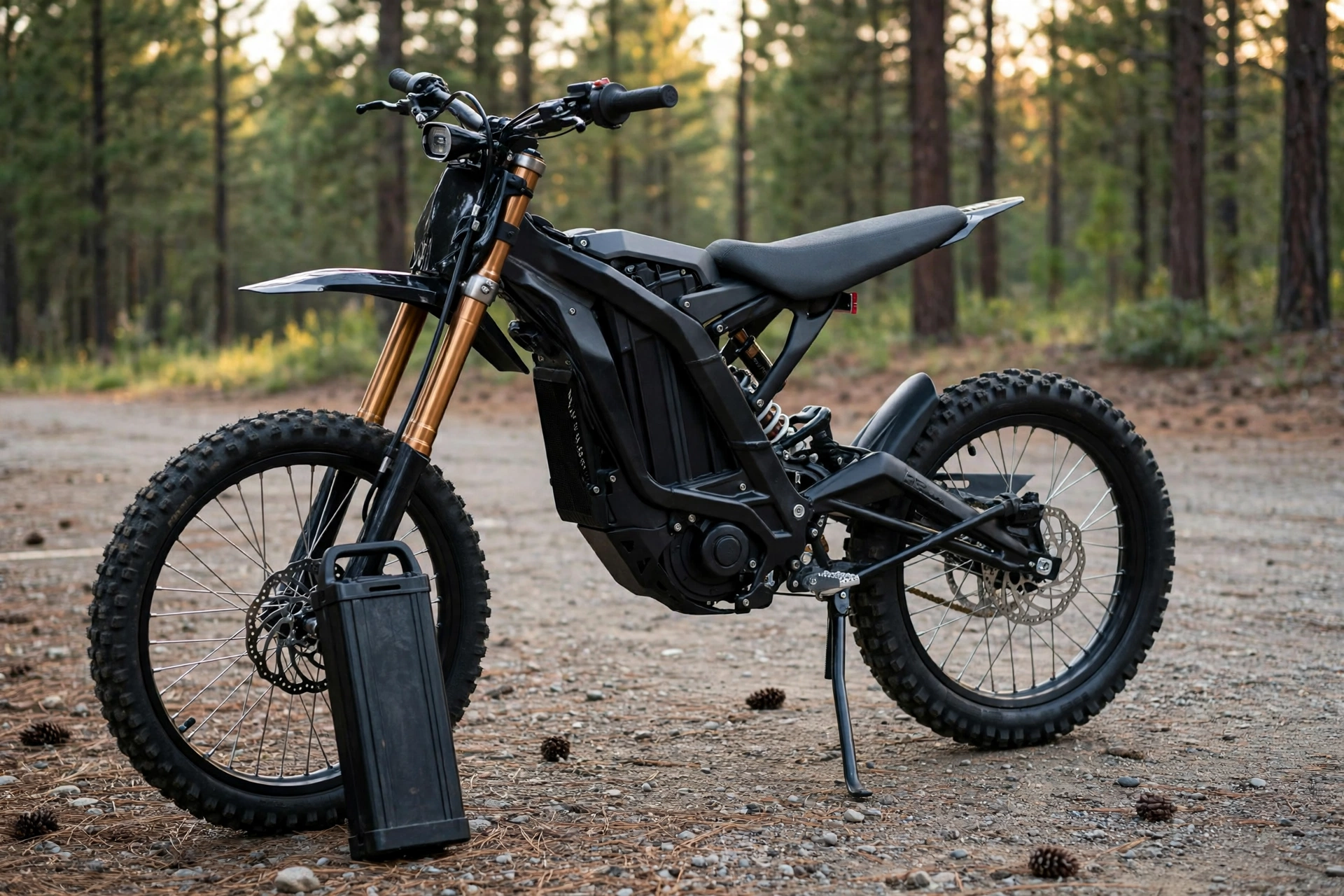
This is the bike the whole category is judged against, and for 2026 it changed more than the plastics suggest. The old 60V system is gone. In its place: a 72V 35Ah battery (2.52 kWh), a 10 kW peak motor — up from 8 kW — and 295 Nm at the rear wheel. Weight stays around 125–130 lbs, the seat at 32.7 inches, wheels at 19-inch front and 18-inch rear with proper knobby tyres. The frame is still the slim forged-aluminium triangle that makes the X look half bicycle, half motorcycle, and it still has no pedals and never did.
Torque is the story, not top speed. The X tops out around 47 mph, which sounds tame until you ride a 130 lb bike that reaches 31 mph in 2.7 seconds. On tight trail, that instant drive out of corners is worth more than another 20 mph at the top end. Riders over about 200 lbs or over 5’10” should sit on one before paying: the cockpit is compact, and the Ultra Bee exists partly because grown men kept folding themselves onto this frame.
Charging is civilised. The pack lifts out, charges from a normal wall outlet, and goes from 20% to 80% in just over 2 hours on the stock charger; a full charge takes roughly 3 hours (est., based on the previous model’s published full-charge time). Before you add a second pack or a faster charger, run your outlet and breaker setup through our charger compatibility checker — a 10-amp draw on a circuit shared with a garage freezer is how nuisance trips happen.
Our score: 8.4/10 — Range 6/10 · Charging 8/10 · Value 9/10. The range score is the tested number talking, not the brochure.
Ultra Bee HP: the grown-up surron electric dirt bike
The 2026 Ultra Bee HP is where Sur-Ron stops being a big toy. Peak output is 21.5 kW in Sport and 24.5 kW in Turbo, torque is 520 Nm at the wheel, and the battery is a 74V 60Ah pack — 4.44 kWh, nearly double the Light Bee X. It weighs 195 lbs, carries 240 mm of suspension travel at both ends, and tops out near 59 mph. Dealer listings for the current HP, such as this 2026 Ultra Bee listing with the full spec sheet, put the price at $5,799, while other US dealers ask up to $6,499 (all checked October 27, 2026).
The claimed range is 71 miles. The test behind that number is Eco mode at a constant 31 mph — a parade lap, not a trail ride. Plan on 40 to 50 miles of real mixed trail work (est., scaled from the 4.44 kWh pack and the consumption the Light Bee X shows in tested riding). Charging runs about 2.5 hours from 20% to 80% on the upgraded 1,000W charger; the 47 lb pack is removable, though at that weight “removable” is a gym exercise, not a convenience.
Our blunt verdict: the Ultra Bee HP is the best value in this entire range for an adult trail rider. The jump from the X buys real suspension, a real frame size, double the battery and more than double the power for about 30% more money. If your budget reaches it, skip the X.
Our score: 8.6/10 — Range 8/10 · Charging 7/10 · Value 8/10.
Storm Bee: full-size, fast, and hard to actually buy
The Storm Bee is a full-size motocross-format machine: 21-inch front wheel, 37-inch seat height, 280 lbs, a liquid-cooled motor rated at 10 kW continuous and 22.5 kW peak, and a 104V 55Ah pack (5.72 kWh) good for a claimed 75 miles at 31 mph and a top speed near 68 mph. On paper it answers the 250cc four-stroke class directly, and it is the only Sur-Ron that earns a mention in our fastest e-bike guide.
Then reality intervenes. US stock is sporadic, the biggest dealer listing showed out of stock when we checked on October 27, 2026, and a 4-hour charge time for the biggest battery here makes a two-moto day a planning exercise. Parts depth for the Storm Bee in North America is a fraction of what the Light Bee enjoys.
Our score: 7.4/10 — Range 7/10 · Charging 6/10 · Value 6/10. The machine is serious. The ownership proposition in the US, for now, is not.
Real range: what a surron electric dirt bike does on one charge
Range is where this category’s marketing gets dishonest, so here is the tested picture. The most useful published figure is the Voro Motors back-to-back range test, which drained a Light Bee X at 28 miles of hard mixed riding. Set that against the factory’s 46.6-mile claim, measured at a steady ~25 mph. Same bike, same battery: the difference is entirely throttle. Expect roughly 60% of any Sur-Ron claim at trail pace, about 40% in Sport or Turbo everywhere (est.).
Applied across the lineup, that planning math gives: Hyper Bee around 20–25 real miles, Light Bee X around 28 tested miles, Ultra Bee 40–50 miles (est.), Storm Bee 45–55 miles (est.). Cold weather and steep climbing cut those numbers further, and a 220 lb rider will not match a 165 lb test rider. If your loop is 30 miles of trailhead-to-trailhead riding, the Light Bee X is marginal and the Ultra Bee is the correct answer. Buy on the tested number and the brochure becomes a pleasant surprise; buy on the brochure and the walk home is yours.
What a surron electric dirt bike costs per mile: our own math
Electricity is nearly free at this scale, and the arithmetic proves it. At a typical US residential rate of $0.17 per kWh, a full charge costs: Light Bee S, 0.96 kWh × $0.17 = $0.16. Hyper Bee, 1.28 kWh × $0.17 = $0.22. Light Bee X, 2.52 kWh × $0.17 = $0.43. Ultra Bee, 4.44 kWh × $0.17 = $0.75. Storm Bee, 5.72 kWh × $0.17 = $0.97. The most expensive bike in the range costs less than a dollar to fill.
Run that against distance. The Light Bee X at its tested 28 miles costs $0.43 ÷ 28 = about 1.5 cents per mile in energy. A 250cc petrol dirt bike returning 45 mpg on $3.60 fuel costs $3.60 ÷ 45 = 8 cents per mile — more than five times as much, before oil, filters and engine hours enter the ledger. Over a 2,000-mile trail year the gap is roughly $130, and the electric bike skips every oil change in that year too.
The sharper number is purchase price per mile of range, because it exposes the brochure game. Light Bee X: $4,499 ÷ 46.6 claimed miles = $97 per mile — but $4,499 ÷ 28 tested miles = $161 per mile, the honest figure. Ultra Bee at its $5,799 listing: $5,799 ÷ 71 claimed miles = $82 per mile, or $5,799 ÷ 45 realistic miles (est.) = $129 per mile. Storm Bee: $8,499 ÷ 75 claimed miles = $113 per mile. Hyper Bee: $2,799 ÷ 35 claimed miles = $80 per mile.
By this measure the Ultra Bee is the value pick of the range and the Light Bee X’s brochure advantage evaporates the moment you use the tested number. That is exactly why we publish both.
Who should buy which surron electric dirt bike
For a kid aged roughly 9 to 14 moving up from a balance bike or a mini petrol bike: the Hyper Bee, and it is not close — the remote limiter alone justifies it. For a smaller teen or cautious adult beginner: the Light Bee X in Eco mode; the S only makes sense at a steep used discount. For an adult trail rider who will actually cover ground: the Ultra Bee HP, for the battery and the suspension, full stop. For a motocross rider with a supportive local dealer: the Storm Bee, eyes open about stock and parts.
And for the rider whose plan is “trails on Saturday, road to work on Monday” — none of these. Look at a road-legal dual-sport instead, or accept the trailer-and-trailhead life that every surron electric dirt bike demands. Compared back to back with smaller machines in our electric mini bike and motorcycle guide, the Sur-Rons are faster, stronger and far less road-friendly, in that order.
Is it legal? The part nobody puts in the ad
Plain answer: in stock form, no surron electric dirt bike is street legal in most US states, and none is an e-bike under any state’s Class 1, 2 or 3 system. Those classes cap motors at 750W and require working pedals. The gentlest Sur-Ron, the Light Bee S, has no pedals and roughly four times the class power limit; the Ultra Bee has about thirty-three times it. Calling these “e-bikes” in a listing does not change what a police officer or a judge calls them: unregistered motor vehicles when they are on a public road.
Where you can ride: private land with the owner’s permission, motocross tracks, and designated OHV trail systems. Most state OHV programs require the bike to be registered as an off-highway vehicle and to carry a trail sticker or permit — that is the registration path that genuinely exists for these machines: cheap, and it covers trail use only. California went further in 2026: its SB 586 law created an “eMoto” classification for exactly this kind of machine, which classifies them as off-road vehicles — it does not make them street legal, and it gives agencies clearer grounds to impound ones ridden on roads and bike paths.
The street conversion question comes up constantly, so here is the honest version. A small number of states allow an off-road motorcycle to be plated after adding DOT lighting, mirrors, a horn, road tyres and passing inspection, and some owners plate Sur-Rons that way.
Most states will not title a bike whose paperwork says off-road only, and no Sur-Ron model is sold in the US with federal road certification. Europe is different — homologated L1e and L3e versions of the Light Bee are sold there with type approval — but a European-approval bike does not transfer that status to a US import. If road use matters, buy a bike that was certified for the road in the first place. Riding a Light Bee down a bike path because it is quiet is the fastest way to get every trail in your county closed to everyone, and it is the one behaviour this guide condemns without qualification.
Running costs beyond the battery
Ownership is cheap, not free. Knobby tyres under this much wheel torque last 500 to 1,500 trail miles. The Light Bee’s belt-and-chain primary drive is a known wear item, and a stretched belt is the most common trailside failure on early bikes. Brake pads go fast on descents because regen is modest. Budget for a battery eventually: a replacement Light Bee X pack lists around $1,300 in the US (est., based on current dealer spare-part listings) — the largest single cost in the bike’s life, and the strongest argument for charging between 20% and 80% day to day.
FAQ
Is a surron electric dirt bike street legal in the US?
No, not in stock form in most states. Sur-Rons exceed every e-bike class (750W limit, pedals required) and are sold as off-road vehicles without federal road certification. State OHV registration and a trail sticker make one legal on designated trails, not on roads.
How far does a Light Bee X really go on one charge?
Plan on 28 miles of hard mixed riding — that is the figure a published back-to-back test recorded. Gentle riding at steady low speed can approach the factory’s 46.6-mile WMTC claim, and a heavy rider in Sport mode on steep ground will see less than 28.
How long does a Sur-Ron take to charge?
Roughly 2 hours from 20% to 80% on the Light Bee X and Hyper Bee, about 2.5 hours for the Ultra Bee’s bigger pack over the same window, around 4 to 4.5 hours for the Light Bee S, and about 4 hours for a full Storm Bee charge. Every model in the range charges from a standard wall outlet.
Which Sur-Ron should a beginner buy?
A young beginner: the Hyper Bee, because the parental remote and power modes let an adult control the bike’s pace. An adult beginner with trail access: the Light Bee X in Eco mode. Skip the Ultra Bee and Storm Bee until throttle control is automatic — 520 Nm does not forgive beginner mistakes.
Can you ride a Sur-Ron on mountain bike trails?
Only where motorised use is explicitly allowed. Most MTB trail networks ban throttle-powered vehicles regardless of how quiet they are, and a Sur-Ron counts as motorised everywhere. Check the land manager’s rules for the specific trail system before you ride; “nobody stopped me” is not permission.
Bottom line, in one breath: buy the Hyper Bee for kids, the Ultra Bee HP for adults, the Light Bee X if the budget stops at $4,499 — and buy every surron electric dirt bike with your eyes open about range and the law. The torque is real. So are the limits.
Before you decide, test-ride a surron electric dirt bike if you can, and compare it with a second surron electric dirt bike in a different size. That comparison makes the range, charging and legality trade-offs in this surron electric dirt bike guide much easier to judge.
A short test ride will tell you more about a surron electric dirt bike than any spec sheet.