Last updated: October 25, 2026
Some Saturday soon, your child will point at a screen and say the words: electric dirtbike. Maybe a friend at school has one. Maybe a video did the selling. Either way, you are now the parent standing between a kid and a machine with a throttle, and you deserve the honest version — what an electric dirtbike actually is, what it costs once you count everything, and where your family is even allowed to ride one. That is this guide. No brochure talk. Just the ladder, the budget and the rules, in the order a family actually meets them.
First, the good news, because there is plenty. An electric machine is quiet enough to ride near home without the whole street knowing. There is no hot exhaust pipe waiting to brand a small calf, no petrol smell soaking into the garage, no clutch for little hands to fight. You press a button, it wakes up, and a seven-year-old can be rolling at walking pace inside a minute. For a family, those are not small things. They are the reason this category exists in our driveways at all.
Now the part the adverts skip. This is not a bicycle with a helper motor, and it is not a toy from the ride-on aisle. It is a small motorcycle. It needs real protective gear, a legal place to ride, an adult watching, and a budget that goes well past the price tag on the box. Families who plan for all four of those have a wonderful time. Families who plan for only the first one tend to own an expensive garage ornament by Christmas.
So here is our promise for the next few pages. We will walk the ladder rung by rung, from a $799 balance bike for a three-year-old to the $4,000 machine a parent rides alongside a teenager. We will add up the whole first year — bikes, helmets, boots, stickers, a carrier, even the electricity — and show the arithmetic. And we will translate the new laws into plain English, because “the ranger said so” is a miserable way to learn them.
What an electric dirtbike is — and what it is not
An electric dirtbike is a small off-road motorcycle powered by a battery and an electric motor. It has a straddle seat you sit on like a horse, handlebars, knobby tyres for loose ground, and a twist throttle. What it does not have is pedals. That single missing part — pedals — is the line the law, the trails and common sense all draw around this category, and it is worth understanding before any money moves.
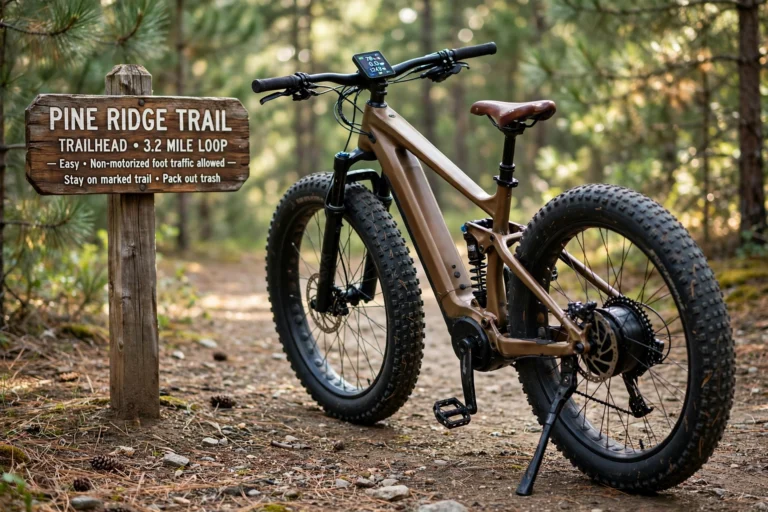
It is not an e-bike. A proper e-bike has working pedals and fits the three-class system: motors capped at 750 watts, assistance topping out at 20 or 28 mph depending on class. Our complete guide to Class 1 e-bikes explains where those machines may go, which is basically anywhere a bicycle may go. An electric dirtbike sits outside that system entirely. It is treated as an off-highway vehicle, closer in the law’s eyes to a petrol motocross bike than to the pedal-assist bike in your hallway. Families who buy one expecting bicycle freedoms are the families who get turned around at the trailhead.
It is also not a toy, even at the small end. The ride-on motorcycles in toy shops run weak motors, plastic tyres and brakes that are more suggestion than equipment. The real starter machines in the next section have proper hydraulic brakes, real suspension and frames built to survive being dropped by a falling child — because being dropped is part of learning. The price gap between a $250 toy and a $799 Stacyc is mostly the price of stopping safely, and stopping is the first skill your child needs.
What it genuinely is: the gentlest on-ramp motorcycling has ever had. Power arrives smoothly, with no clutch to stall and no gears to hunt for. Most kids’ models let a parent dial the speed down to a jog and lock that setting with a PIN or an app. And the quiet matters more than people expect. A child can practise figure-eights in a friend’s field at 9 a.m. on a Sunday and the neighbours will hear the birds, not the bike.
The family ladder: matching an electric dirtbike to age, size and nerve
Buy for the child in front of you, not the child in the advert. Seat height and weight matter more than motor size: your rider should reach the ground with both feet nearly flat, and be able to pick the bike up after a tip-over, or at least hold it upright while you jog over. Here is the ladder as we would climb it, with US prices checked October 25, 2026.
Ages 3 to 5 — balance first. The Stacyc 12eDrive ($799) is a balance bike with a secret: once your child can coast and brake confidently, a gentle twist throttle takes over, with speed modes topping out around 9 mph. A Stacyc 16eDRIVE ($1,049) stretches the idea to ages 4–8: 20 pounds, a 17-inch seat, and modes at roughly 5, 7.5 and 13 mph. Run time is 30–60 minutes and a charge takes about the same, so the $195 spare battery is the best money in this whole guide — it ends the “is it charged yet?” negotiations.
Our guide to electric mini bikes covers more of these small machines. Opinion, stated plainly: a child who cannot yet balance a pedal-free bike has no business on a throttle, and Stacyc’s start-as-a-balance-bike design is the correct first rung.
Ages 5 to 12 — real trials skills. The Kuberg Trial Hero ($2,595) is a proper little trials bike: 73 pounds, about two hours of riding per charge, and a phone app that lets a parent set top speed and even a riding perimeter. Its one household flaw is a charge time of around 6 hours (est.), so it charges overnight or it does not ride.
The new Triumph TXP-20 ($3,495, launched September 2026 and built by trials specialists OSET) answers that flaw directly — a bigger battery good for up to three hours of trials-paced riding, a PIN-protected parental speed limit, and a magnetic lanyard that kills the motor if the rider comes off. In one Australian magazine test of its bigger TXP-24 sibling, the rider gave out before the battery did. The TXP-24 itself ($3,995) carries riders from age 11 up to adults of about 199 pounds, which makes it the rare kids’ bike a parent can honestly share.
Teens — the value rung, with a warning label. The Yozma IN10 ($1,079–$1,199 at the official store) is the shock of the ladder: a real mini dirt bike, 121 pounds, removable battery, for less than a flagship phone. Independent GPS testing recorded 33–35 mph against a 40 mph claim, and 15–20 miles of real trail range against a claimed 53 miles. That gap is exactly why we test claims in print. Beside it sits a warning: the Riding’times GT73 (about $1,349) advertises up to 155 miles of range, while BikeRide’s testers measured 19 miles off-road from both its batteries. Nineteen. Our view is firm — skip any brand that quotes fantasy range to parents. A family cannot plan a Saturday around a lie.
Parents — ride alongside, on the right machine. The Sur-Ron Light Bee X ($4,000 at US dealers) is the family-fleet anchor: 126 pounds, a claimed 47 mph and 47 miles, with a realistic trail range of 25–32 miles (est.). It is quick, quiet and genuinely capable, and it will keep up with a teenager for years. It is also a motorcycle in pace and consequence. Handing one to a young teen as a first bike is the single most common mistake we see in this category, and we will not soften that: ladder first, Light Bee later.
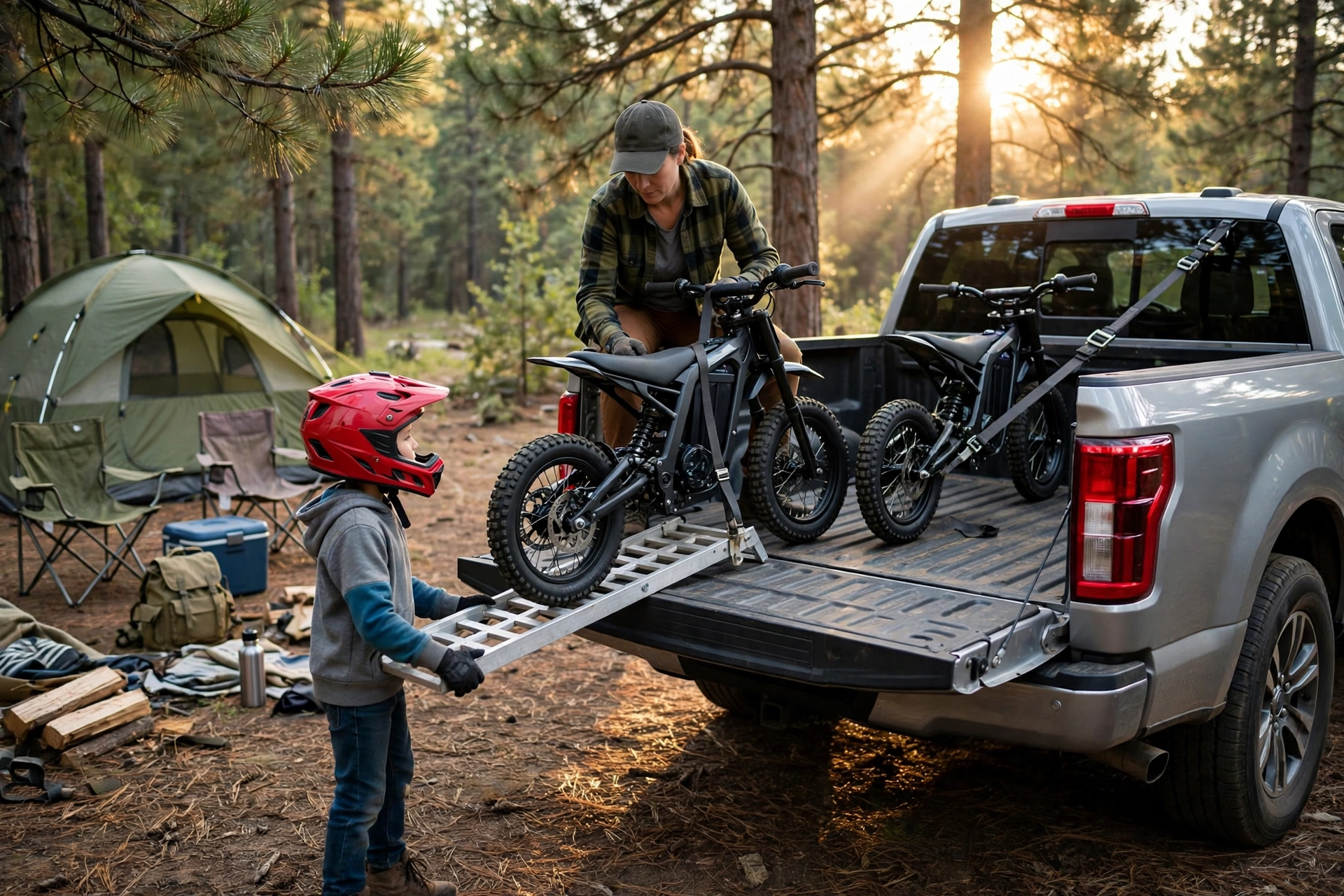
The full electric dirtbike family budget: the bike is only the first cheque
Here is the computation nobody at the dealership does for you. Take a typical two-rider family: a teenager on the IN10 and a parent on the Light Bee X, riding about 20 weekend days in year one.
| Yozma IN10 (teen) | $1,099 |
| Sur-Ron Light Bee X (parent) | $4,000 |
| Teen gear set — helmet $80, boots $90, chest protector $60, goggles $15, gloves $20 | $265 |
| Adult gear set (est.) | $310 |
| California Green Stickers, 2 bikes × $54 | $108 |
| Two-bike hitch carrier (est.) | $329 |
| A season of charging (see below) | $24 |
| Tyres and brake-pad reserve (est.) | $150 |
| First-year total | $6,285 |
The charging line surprises everyone, so here is its arithmetic. The IN10’s battery holds about 1.12 kWh; 40 full charges across a season use roughly 45 kWh. The Light Bee’s pack holds about 2.4 kWh; 40 charges use about 96 kWh. Together that is 141 kWh, and at a typical US home rate of $0.17 per kWh it costs about $24 — for the entire season. The electricity is a rounding error. The gear is not, which is why it sits in the table at full price.
Now divide. $6,285 across 20 ride days is about $314 per family day in year one. In year two the bikes are already yours, so the same season costs roughly $174 — charging, consumables and sticker renewals — which is under $9 a day.
Compare that honestly with a comparable family hobby: six ski days for three people, at day tickets of $150 each (est.) and rentals at $55 each (est.), comes to $2,700 + $990 = $3,690, and in April you own nothing but the photos. The electric dirtbikes, by contrast, get handed down to the next child or sold on; a clean Light Bee X holds its value well. Budget-honest does not mean cheap. It means knowing that $6,285 is the real number before the first Saturday, not discovering it by February.
Electric dirtbike safety and supervision: the rules that do not bend
Rule one, and our strongest opinion in this guide: buy the gear before the bike. A helmet that fits today, boots that cover the ankle, gloves, goggles and — for anything faster than a Stacyc — a chest protector. If the family budget cannot stretch to the gear, the budget cannot stretch to the bike, full stop. Kids outgrow boots in a season; buy the boots second-hand if you must, but never the helmet, because a used helmet’s history is invisible.
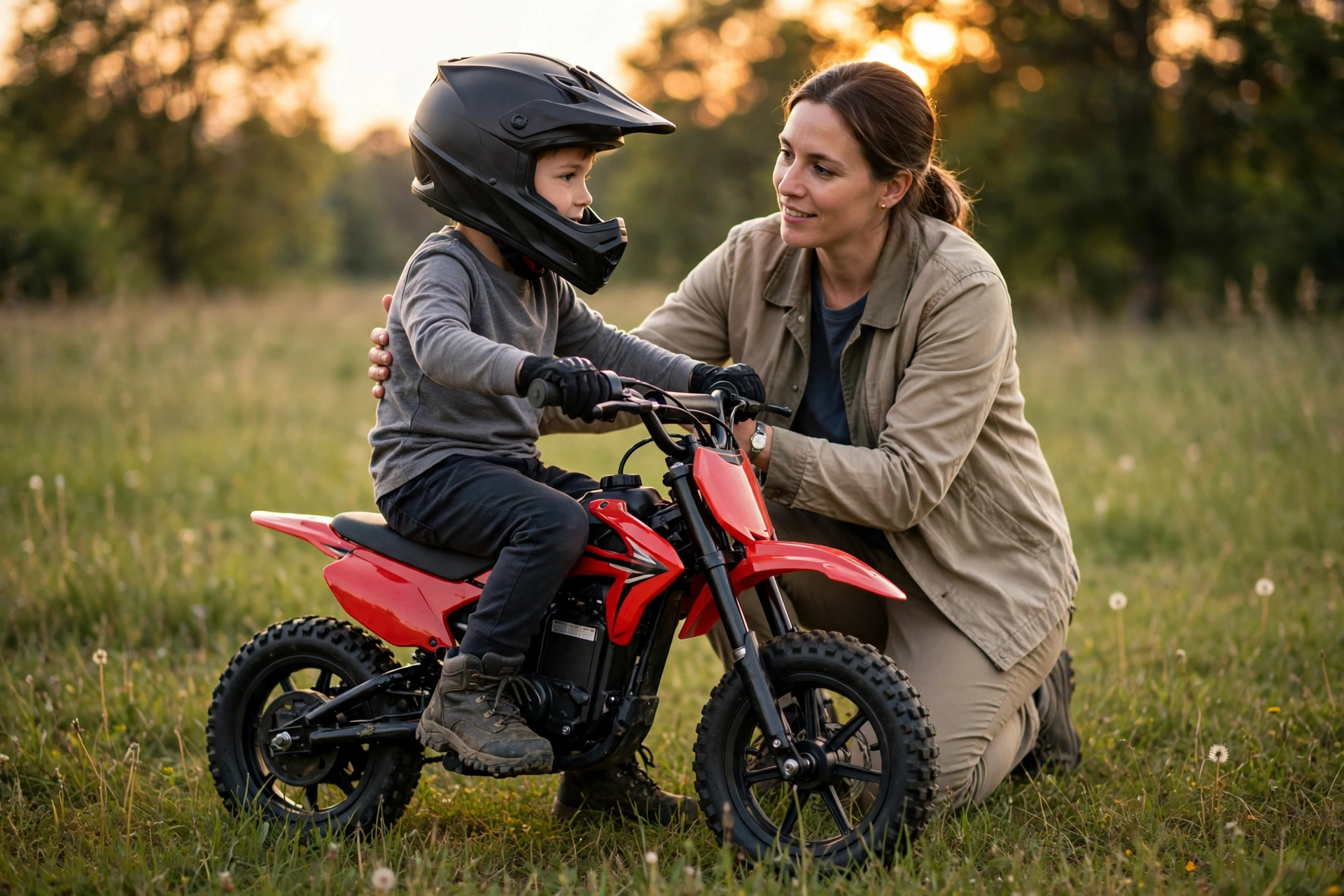
Rule two: the parent holds the speed keys. Use them. Stacyc’s modes, Kuberg’s app perimeter, the TXP range’s PIN lock and magnetic cut-off lanyard all exist because a child’s judgement arrives years after their courage. Start every new rider at the lowest setting, in an open field, with one job only: stop smoothly, ten times in a row. Throttle is the reward after braking, never before it.
Rule three: line of sight, always, until a teenager has earned otherwise over many weekends — and even then, ride times and areas are agreed before helmets go on. No passengers, either. Some bench-seat mini motos are marketed with room for two; a passenger changes the braking, the balance and the injury list, and on a child’s bike it is simply a no. Falls will happen at walking pace on grass, and that is the tuition every rider pays. Your job is to make sure the tuition stays cheap: soft ground, low speed, full gear, and an adult close enough to help lift the bike and check the tears.
Where your family can legally ride an electric dirtbike
The legal map is simpler than it looks. You may ride on private land with the owner’s permission — your own field, a friend’s ranch, a farmer who says yes. You may ride at designated off-highway vehicle areas: state OHV parks, national-forest OHV trail systems and motocross tracks with open practice days, usually for a day fee of $5–$10 (est.). Our guide to dirt e-biking digs into trail etiquette and access in more depth. And that, roughly, is the list.
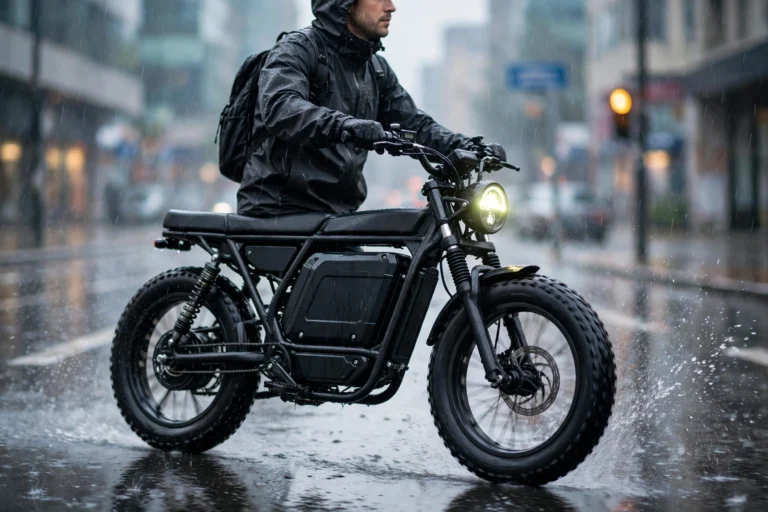
You may not ride on streets, sidewalks, pavements, ordinary bike paths or the playing field behind the school — not even slowly, not even just to the corner. Those places belong to bicycles and pedestrians, and a pedal-less dirtbike is not a bicycle in any state. This is the misunderstanding that causes most family trouble, so it is worth one more sentence: fitting pedals to a scooter-fast machine later does not reclassify it, and neither does riding gently.
California has now written this down, and other states are watching. Since January 1, 2026, a law called SB 586 gives these machines an official name — off-highway electric motorcycle, or eMoto — and files them under the same rules as petrol dirt bikes. In plain English: the bike needs a DMV Green Sticker ($54, covering two years), the rider needs a helmet, and the bike belongs on OHV land or private property, never on the road or the bike path.
The dividing line the law uses is the one from earlier in this guide: built for off-road use, straddle seat, two wheels, and no pedals fitted by the manufacturer. Families outside California should treat their own state parks’ OHV page as the final word, because registration details vary — but the shape of the rules is converging everywhere.
Charging and caring for an electric dirtbike at home
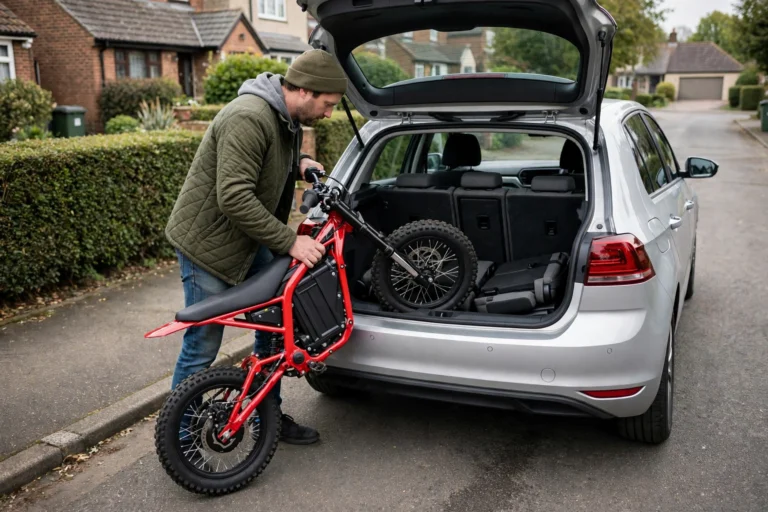
Home life with these machines is mercifully dull, and dull is good. Most family-sized packs lift out — the Stacyc battery swaps in seconds, the IN10’s pack removes for indoor charging, the Light Bee’s too — so the bike can live in a cold garage while the battery charges somewhere warm and watched. Use the charger the maker supplied, charge on a hard surface away from bedding and sofas, and never charge a pack that has been punctured, swollen or drowned in a crash. Store batteries part-charged (around half to three-quarters) if the bike will sit for a month, and bring them indoors over winter.
Charge times shape family habits more than range does. A Stacyc refills in 30–60 minutes, fast enough for a snack break to reset the afternoon. The TXP-20’s big pack takes a few hours (est.) — charge it the night before. The Kuberg’s roughly 6-hour charge (est.) makes the same point harder. Build the ritual: home from the trail, bikes washed, batteries on charge, gear hung up. Children who learn the ritual learn the sport properly.
Care, otherwise, is a short list, and it is the electric advantage families feel in their wallets. No engine oil, no air filter, no spark plug, no petrol going stale in a can. What remains: chain lube after wet rides, tyre pressures before every ride, brake pads on inspection, and a hose-down with the battery removed. Twenty minutes a month covers most of it. Do check spoke tension and axle nuts after the first few rides on cheaper mini motos — things bed in, and a two-minute spanner check is cheaper than any alternative.
Our electric dirtbike verdict: the picks we would buy with family money
Scores are our own, marked on Range / Charging / Value for each age band’s headline pick.
Ages 4–8 — Stacyc 16eDRIVE ($1,049). Our score: 8.8/10 (Range 7 / Charging 9 / Value 8). The balance-bike start and the 60-minute battery swap make it the easiest first year in the whole category.
Ages 7–11 — Triumph TXP-20 ($3,495). Our score: 8.5/10 (Range 8 / Charging 8 / Value 6). Expensive, yes. The PIN speed lock, kill lanyard and three-hour stamina make it the one we’d hand to a keen nine-year-old. Details and the full TXP range are on the official OSET page, and independent coverage of the September launch is at BraapTrax.
Teens — Yozma IN10 ($1,079–$1,199). Our score: 7.5/10 (Range 5 / Charging 7 / Value 10). Fifteen to twenty honest trail miles is a fine Saturday. Nothing at this price comes close.
Teens, with a caution — Riding’times GT73 (~$1,349). Our score: 6.2/10 (Range 4 / Charging 6 / Value 7). A fun machine wearing a dishonest range claim. Buy it only with your eyes open and a short ride home.
Parents — Sur-Ron Light Bee X ($4,000). Our score: 8.4/10 (Range 7 / Charging 8 / Value 8). The grown-up anchor of the family fleet. Buy it for yourself, lend it to a teenager later than you want to.
Family electric dirtbike questions, answered plainly
At what age can a child start on an electric dirtbike? Three years old is the realistic floor, and only on a balance-style machine like the Stacyc 12eDrive, only at its lowest speed setting, and only once the child can balance, coast and brake on a pedal-free bike. The throttle comes after the balance, not instead of it.
How much does an electric dirtbike cost once you count everything? For one small child: a Stacyc 16eDRIVE at $1,049 plus a $265 gear set is $1,314, and a $195 spare battery takes it to $1,509. For a two-rider family with a parent on a Light Bee X, our full first-year budget above totals $6,285 — gear, stickers, carrier, charging and all.
Can my teenager ride one to school or on bike paths? No. These are off-highway machines. Streets, sidewalks and bike paths are closed to them in every state, and since January 2026 California law (SB 586) says so in exactly those terms. School runs need a legal e-bike or a bicycle, not a dirtbike.
How long will the battery last on a family day out? Plan on rhythm, not records. A Stacyc gives 30–60 minutes per pack, which is why the spare battery matters. The TXP-20 runs up to about three hours at trials pace. An IN10 covers 15–20 trail miles in independent testing. A Light Bee X manages 25–32 trail miles (est.) under an adult. Pack a picnic for the charging hour and the day plans itself.
Do we need a licence or registration? No driving licence is needed off-road. Registration depends on where you ride: on public OHV land in California the bike needs a $54 Green Sticker (two years) and the rider needs a helmet. On your own private land with permission, neither applies. Other states run similar sticker schemes — check before the first trip, not at the gate.
Electric or petrol for a first family dirt bike? Electric, and not by a whisker. No clutch to stall, no hot exhaust, no noise feud with the neighbours, a charger instead of a petrol can, and a parent-set speed limiter on most kids’ models. Petrol still wins for all-day trail epics. Families are not doing all-day trail epics in year one.
For families still deciding, the simplest test is this: an electric dirtbike should fit the rider, the budget and the riding place all at once. When those three line up, an electric dirtbike is a safe, quiet way for a family to spend weekends outdoors together.