Last updated: October 25, 2026
Every e bike battery argument I have ever stood in starts the same way. Somebody reads the range number on the box, believes the box, and plans a ride the box never promised. Forty miles in, the display is flashing and the pedalling has gone very quiet. The pack didn’t fail. The arithmetic did.
Here’s the thing riders learn late: the motor gets the glory, and the suspension gets the forum threads, yet the battery decides almost everything that matters. How far you go. How the bike handles with weight low in the frame. What the bike is worth in four years. And what you’ll pay, in real money, when the pack fades — because it will. A quality pack is the single most expensive wear item on the bike, worth more than a season of tyres, chains and brake pads combined.
So this guide treats the pack like the component it is. Sizes and watt-hours first. Then honest range math, charging costs, replacement costs, and the care rules that keep a lithium pack from becoming a garage fire story. Prices are from US retailer listings and federal energy data, checked October 25, 2026. Where a figure is our estimate rather than a published spec, it’s marked (est.) with the basis shown — consumption varies too much between riders for anyone to hand you a single true number.
The short version, up front: buy the smallest certified pack that covers your longest regular ride with a fifth of the charge left over. For most trail riders that’s 625 to 750 watt-hours. Electricity is nearly free. The pack itself is the running cost, and I’ll prove that with numbers further down.
E Bike Battery Sizes: Watt-Hours Are the Only Honest Number
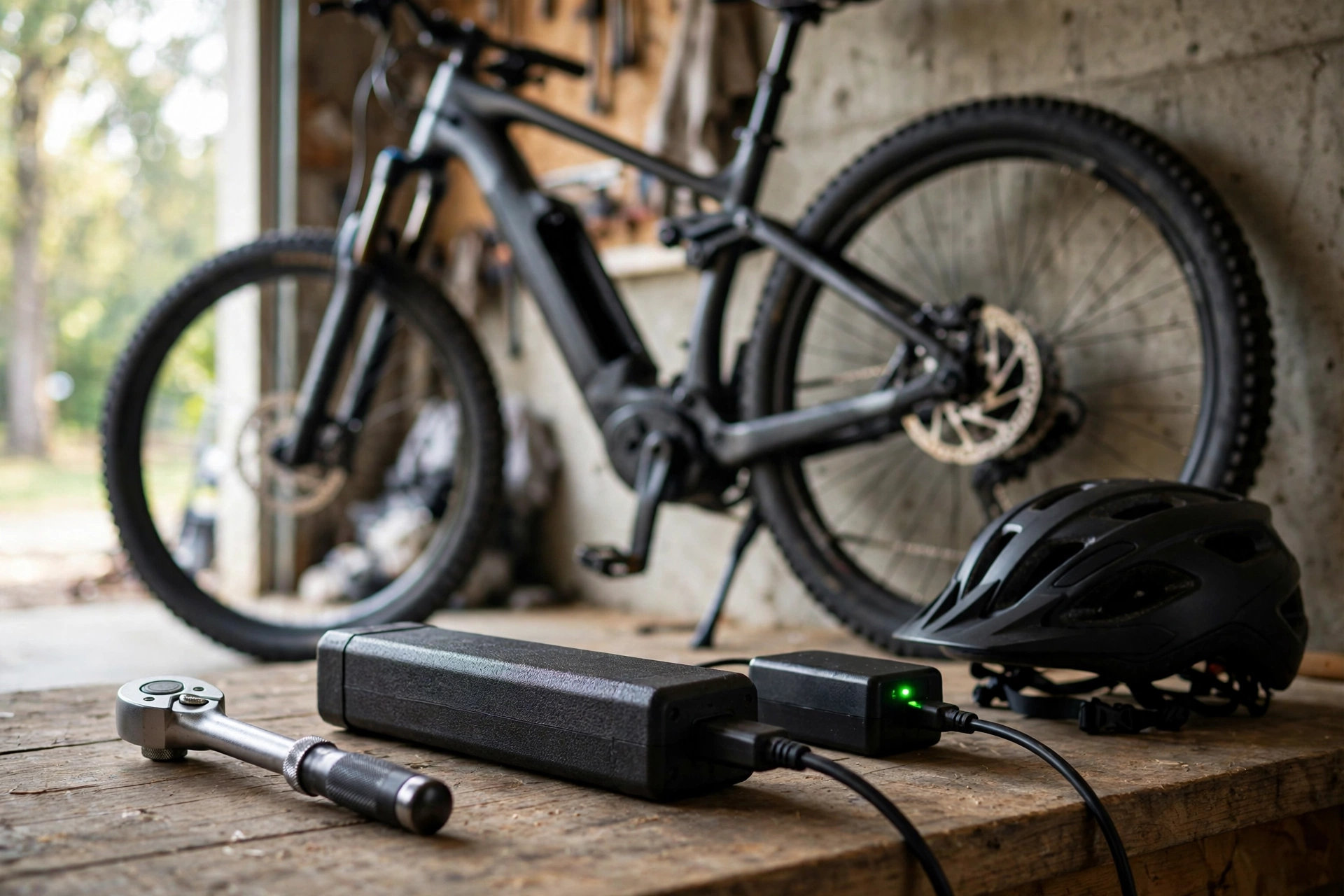
Capacity is energy, and energy is watt-hours. The formula is one line: watt-hours = volts × amp-hours. A Bosch PowerTube 500 runs 36 volts and 13.4 amp-hours — 36 × 13.4 = 500Wh, which is where the name comes from. A 48V pack rated at 10.4Ah holds the same 500Wh. Different sticker, same fuel tank.
This is why shopping by amp-hours alone will burn you. A “big” 20Ah pack on a 36V system holds 720Wh. A 20Ah pack on a 48V system holds 960Wh. Same amp-hours, a third more energy. Shop for an e bike battery by watt-hours and the games stop.
Voltage itself is a design choice, not a quality grade. Bosch and Shimano build around 36V. Many US brands run 48V, some 52V. Higher voltage lets a system deliver the same power at lower current, which means less heat in the wiring. It doesn’t make a pack better. What makes a pack better is cell quality, the battery management system watching over it, and whether the maker will still sell you a replacement in six years.
| Pack size | Where you find it | Realistic Tour range (est.) | Weight (est.) |
|---|---|---|---|
| 400Wh | Lightweight city bikes, slim trail builds | ~31 miles | ~4.8 lb |
| 500–504Wh | Bosch PowerTube 500, Shimano BT-E8035 | ~38 miles | ~6.0 lb |
| 625Wh | Bosch PowerTube 625, mid-range trail bikes | ~48 miles | ~7.4 lb |
| 720–750Wh | Bosch PowerTube 720/750, full-power eMTBs | ~58 miles | ~8.9 lb |
| 800–840Wh | Long-travel eMTBs, cargo and trekking bikes | ~65 miles | ~10.0 lb |
| 840Wh + 250Wh extender | Dual-pack setups, bottle-mount extenders | ~84 miles | ~13.3 lb total |
Range figures above assume Tour-mode consumption of about 13 Wh per mile (est., the mid-band explained in the next section). Weights are estimated from roughly 185 watt-hours per kilogram, the energy density Bosch publishes for its PowerTube 720 — an 8.6 lb pack, for reference.
Range extenders deserve a sentence of their own. A bottle-sized 250Wh extender like Bosch’s PowerMore 250 clips onto compatible frames and feeds the main system — Bosch eBike Systems designs its packs and extenders to combine inside one ecosystem, which is exactly how an extender should work. It is the smartest weight compromise in the whole category: ride light all week, clip on the bottle for the Saturday epic. Carrying a second full-size pack in a backpack works too — people do it on big alpine days — and your spine will file a formal complaint by hour three.
Real Range: What an E Bike Battery Actually Gives You per 100Wh
Range is just capacity divided by consumption. Capacity you know. Consumption — watt-hours burned per mile — is the part the ads leave out. Based on published rider testing and the consumption bands the big systems report, plan on these figures (est.):
- Eco: 7–10 Wh/mile. The motor offsets the bike’s weight; your legs do the rest. Good for 10–14 miles per 100Wh.
- Tour: 11–14 Wh/mile. Motor and legs share the work. This is the honest default: 7–9 miles per 100Wh.
- Sport: 14–18 Wh/mile. Strong help on every climb. Around 6–7 miles per 100Wh.
- Turbo: 20–25 Wh/mile. Full power, all the time. Just 4–5 miles per 100Wh.
- Throttle only: roughly 25 Wh/mile. Four miles per 100Wh, and you aren’t exercising, you’re operating an appliance.
Run a 750Wh pack through those bands and the truth shows up fast. Eco, ridden gently: about 88 miles (est.). Tour: about 58 miles (est.). Turbo on a hilly loop: about 34 miles (est.). One battery, three different bikes, depending on which button your thumb lives on.
Now look at the ads. Bosch’s retail listings claim “up to 140 km” — 87 miles — for the PowerTube 750. That is the Eco number, with a light rider, on friendly ground. It is not a lie exactly. It is a ceiling dressed as an expectation. My position is simple: a brand that prints 100-mile range on a 500Wh commuter is misleading you on purpose, and you should price the bike using the Tour number and treat anything above it as a bonus.
What moves your real number around? Rider weight is the big one — a heavier rider can lose a third or more of the range a light rider gets from the same e bike battery on the same route (est.). Climbing is next: a thousand feet of elevation gain costs roughly the energy of several flat miles. Speed is sneakier than people think, because air resistance climbs fast above 15 mph. Cold is the silent thief — lithium cells deliver less in winter, and 20–30% less near freezing is a realistic planning figure (est.). Soft knobby tyres on pavement, a headwind, a rack loaded with groceries: each one takes its cut.
On singletrack, forget miles for a second. Trail riding is slow, punchy, stop-start work, mostly in Sport with Turbo bursts for the steep pitches. A 750Wh pack is a four-to-five-hour trail day for most riders (est.) — which covers almost any loop a land manager has actually built. If your rides routinely beat that, you don’t have a battery problem. You have an extender problem, and it’s a good problem to have.
Charging Costs for an E Bike Battery: The Electricity Is the Cheap Part
Let’s kill the suspense: filling an e bike battery costs pocket change. The U.S. Energy Information Administration puts the average US residential electricity price at 17.30 cents per kWh for 2025, with the latest monthly figure — August 2026, released October 23, 2026 — at 18.16 cents. The EIA’s electricity price explainer breaks down why residential power costs what it does. Running the math at 18.16 cents, and adding roughly 10% for charger losses (est.):
- 500Wh pack, full charge: about 10 cents.
- 750Wh pack, full charge: about 15 cents.
- 840Wh pack plus a 250Wh extender: about 22 cents for the pair.
- Per 100 miles at Tour pace: about 26 cents of electricity.
Ride 3,000 miles a year at Tour consumption and your annual charging bill lands near $7.80 (est.). Not per month. Per year. Our full breakdown of what it costs to charge an electric bike, charger by charger, sits in the charging-cost guide if you want the longer version.
Charging time matters more than charging cost. A 750Wh pack on a standard 4-amp charger takes around six hours from empty, with roughly half the charge back in about two and a half hours — fine overnight, annoying at a trailhead café. Smaller packs fill faster, which is a real argument for the 500Wh class if your rides are short: less waiting, less weight, less money tied up in cells you never drain.
E Bike Battery Replacement Cost and Lifespan: The Math Nobody Prints
Every pack fades. The standard industry rating is 500 to 1,000 full charge cycles before capacity drops to about 80% of new — Bosch’s own specification for the PowerTube 500 lists 500 to 600 charging cycles, so treat the top of that range as optimism. Calendar age counts too: a pack that’s babied and barely ridden still loses capacity sitting in the garage, and five to eight years is a fair working life for a quality pack (est.). The fade is gradual. Your 58-mile pack becomes a 46-mile pack, then a 40-mile pack, and one autumn you notice the big loop isn’t on the menu anymore.
Then comes the invoice. These are US retailer listings checked October 25, 2026:
- Shimano STEPS BT-E8035, 504Wh: $748.99.
- Bosch PowerTube 625 (smart system): $1,018.99.
- Bosch PowerTube 750 (smart system): $1,142.99 — and a second retailer lists the same pack at $1,315.50, so shop around before you pay.
That’s roughly $1.49 to $1.63 per watt-hour for a name-brand pack. Now the analysis you won’t find on the product pages. Amortize the replacement price across the miles the pack will actually deliver — assuming 800 full-equivalent cycles (est., mid-range of the rated 500–1,000), Tour consumption of 13 Wh/mile (est.), and average capacity across the pack’s life of about 90% of new (est.) — and here is your true battery running cost:
| Pack | Replacement price | Lifetime miles (est.) | Wear cost per 100 miles |
|---|---|---|---|
| Shimano BT-E8035, 504Wh | $748.99 | ~27,900 | $2.68 |
| Bosch PowerTube 625 | $1,018.99 | ~34,600 | $2.94 |
| Bosch PowerTube 750 | $1,142.99 | ~41,500 | $2.75 |
Read that against the 26 cents of electricity per 100 miles. The pack wears out at roughly ten times the cost of the power that fills it. Size barely changes the per-mile wear — all three land between $2.68 and $2.94 — because bigger packs cost more and last proportionally more miles. What changes the number is cycle count: if your pack only makes 500 cycles instead of 800, wear jumps to roughly $4.30–$4.70 per 100 miles (est.). Which is why the care section below is not filler. Every shallow, cool, gentle cycle you give the pack is money.
Our Verdict: E Bike Battery Size Classes, Scored
The ~500Wh class (PowerTube 500, Shimano BT-E8035). Range: 6/10. Charging: 9/10 — light, quick to fill, easy to carry upstairs. Value: 8/10. Our score: 7.7/10. The right pack for more riders than the industry wants to admit.
The ~750Wh class (PowerTube 720/750 and rivals). Range: 9/10. Charging: 6/10 — six-hour fills test your patience and your planning. Value: 8/10. Our score: 7.7/10. A dead heat with the 500Wh class, won or lost entirely on how long your rides are.
The 840Wh-plus-extender class (1,090Wh combined). Range: 10/10. Charging: 4/10 — two packs to manage, two packs to store, a long evening on the charger. Value: 5/10, because the extender adds roughly $500 or more (est.) for capacity most riders use six weekends a year. Our score: 6.3/10. Buy it for a specific big ride, not for a spec sheet.
For most riders, choosing the right e bike battery comes down to matching pack size to real ride length, not chasing the biggest number on the box.
Care, Storage and Fire Safety for an E Bike Battery: Certification Is the Whole Point
A lithium pack holds a serious amount of energy in a small box, and it deserves to be treated like it. The daily rules are short. Charge on the charger the bike came with — not a universal brick from a marketplace listing. Charge at room temperature, indoors, on a hard surface, where you’d notice a problem. Never charge a pack that’s cold-soaked below freezing; bring it inside, let it warm up, then plug in. Don’t make a habit of draining it to absolute zero. For storage longer than a few weeks, park it at 30 to 60% charge — that’s Bosch’s own published guidance — somewhere cool and dry, and top it up every few months.
And if a pack is dropped hard, dented, cracked or swollen: stop. Don’t charge it, don’t ride it, don’t put it in the car. Move it outside, away from anything that burns, and call the manufacturer or a battery recycler. A crashed e bike battery that “still works” is a risk you carry into your house every night.
This is where certification stops being paperwork. UL 2271 is the standard for the battery pack itself. UL 2849 covers the whole electrical system — motor, controller, charger and wiring, tested together. The system standard matters because most pack failures involve the conversation between cells, management electronics and charger, not a lone bad cell. A pack can hold excellent cells and still be dangerous if that conversation is improvised.
New York City showed what happens when a city takes this seriously. Local Law 39 of 2023 banned the sale, lease or rental of e-bikes and batteries without accredited certification — bikes to UL 2849, batteries to UL 2271. Deaths from e-mobility fires fell from 18 in 2023 to one in 2025, a drop the FDNY credits to the law and its enforcement, and California brought in a similar sales requirement at the start of 2026. My position, and I won’t soften it: an uncertified pack has no business inside your home, whatever the listing promises and however many five-star reviews it bought.
Buying used? A second-hand pack can be a smart buy, and our guide to how EV batteries are built and how they age covers the underlying chemistry.
But inspect like a skeptic. Ask a dealer to read the cycle count and health report from the system diagnostics — Bosch and Shimano systems store it. Charge the pack fully before money changes hands and watch for heat, swelling or error codes. Check the case seams, the latch and the contacts for crash damage and corrosion. Confirm the charger is the correct one for that exact pack. And walk away from any pack with an unknown history priced at a third of new. That discount isn’t generosity. It’s the fire risk, being transferred to you.
Who Should Buy Which E Bike Battery Size
Short commutes and flat city riding, under about 25 miles a day: buy the 400–500Wh class and enjoy the lighter bike, the faster charge and the cheaper replacement when the day eventually comes. Spending more buys weight you’ll curse on every staircase.
Mixed road and trail days, 30 to 55 miles: the 625–750Wh class is the default answer, and it’s the class I’d hand to almost anyone asking at a trailhead. Enough for a proper mountain day in Tour with Sport on the climbs, home with charge to spare.
Big alpine days, cargo hauling, multi-day trekking: go 840Wh, or 750Wh plus an extender you can leave at home on short days. Accept the weight as the price of the map you’re riding.
One trail note, because it decides whether we keep the trails at all. The access we have exists because pedal-assist bikes behave like bicycles. Ride a Class 1 e-bike where the land manager allows it, yield to hikers and horses, and leave the overpowered throttle machines to private land — every land manager I have ever met can tell the difference, and a giant battery on a bike that doesn’t belong on singletrack closes gates for the rest of us. The pack was never the problem. The behaviour is.
Size your e bike battery to your longest honest ride. Not the fantasy ride. The one you actually do.
E Bike Battery FAQ
How long does an e bike battery last before it needs replacing?
Expect 500 to 1,000 full charge cycles before capacity falls to roughly 80% of new — for most riders that’s four to seven years of regular use (est.). The fade is gradual, so the practical answer is: replace it when the shorter range starts cancelling rides you want to do.
Can I fit a bigger battery to my bike?
Sometimes, inside the same system. Some frame mounts accept several sizes from one family — Bosch designs several PowerTube sizes to share mounts where the frame allows — and voltage, connector and mounting must match exactly. Cross-brand swaps are a hard no: the pack and motor electronics are built to talk to each other.
Should I charge to 100% every night?
Charge to full before a ride whenever you like; that’s what it’s for. For short daily rides, topping out around 80% and avoiding long storage at full charge is gentler on the cells (est.). The damaging pattern is storing a full, hot pack for weeks, not using the top of the range.
Why does my range drop so much in winter?
Cold slows the chemistry inside the cells, so the pack delivers less energy and sags under load. Planning on 20–30% less range near freezing is realistic (est.). Store and charge the pack indoors, fit it to the bike warm, and the loss shrinks.
Is a cheap no-name replacement battery a good deal?
No. An uncertified pack skips the tested pairing of cells, management system and charger that keeps lithium under control — the exact gap New York’s law was written to close. The savings are real. So is the risk, and it’s your house that hosts it.