Last updated: October 27, 2026
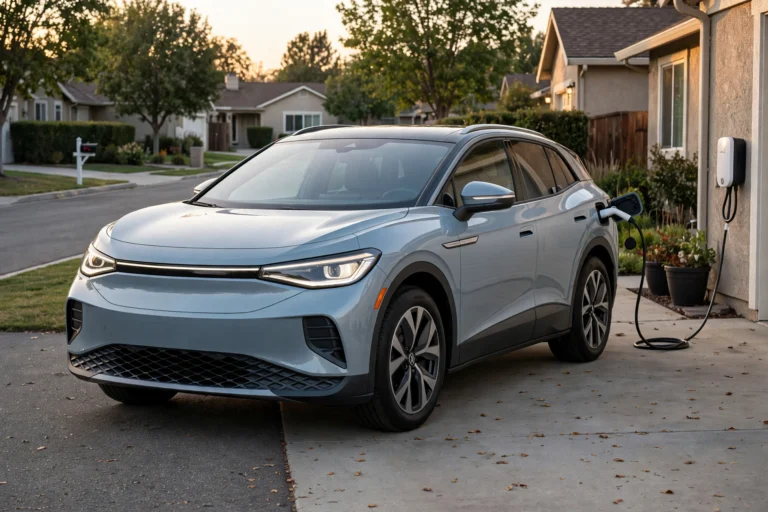
A bev electric vehicle is the car most people simply call an electric car. BEV stands for battery electric vehicle: a big rechargeable battery, one or two electric motors, and nothing else. No petrol tank. No exhaust pipe. No engine waiting to warm up on a frosty morning while you scrape the windscreen with a loyalty card. You plug it in, it charges, it drives. That is the whole idea, and it is a simpler idea than the three other powertrains it gets mixed up with.
Families do not buy spec sheets, though. Families buy answers to four questions. Will it do the school run without drama? Will the stroller fit next to the weekly shop? What does a month of driving actually cost? And what happens on the one long trip to see grandparents, when the boot is full and somebody small needs the toilet at the worst possible exit? This guide answers those four questions in plain English.
We will define the four powertrains side by side, pull out the handful of specs that genuinely matter, and price real cars on sale in October 2026. The US Department of Energy’s Alternative Fuels Data Center uses the same plain definition we do: an all-electric vehicle, also called a battery-electric vehicle, runs only on electricity stored in its battery. Then we will give you honest verdicts for the three jobs families actually hire a car to do.
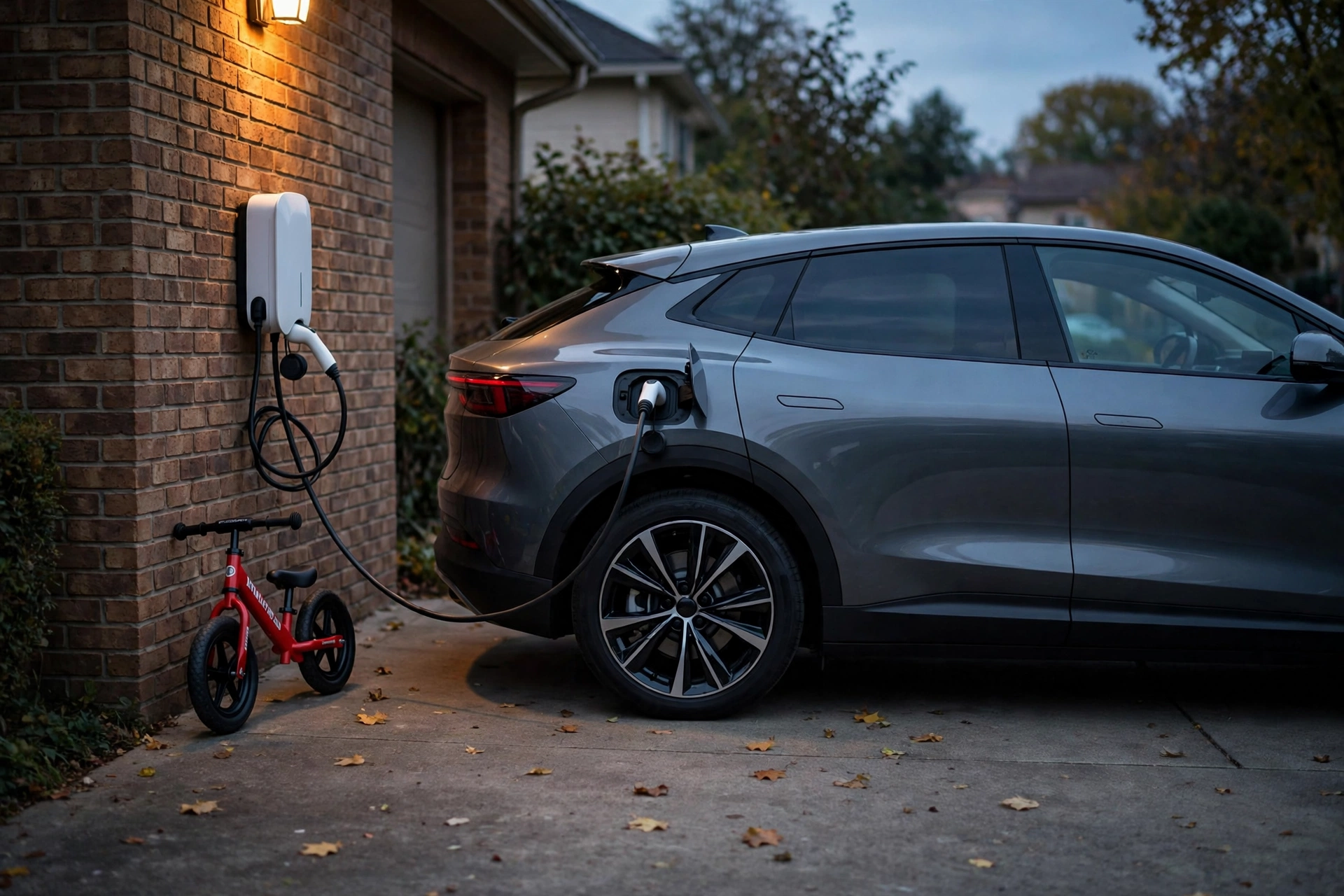
One rule before we start. A bev electric vehicle asks exactly one thing of your house: a place to charge where the car sleeps. A driveway, a garage, a kerb outside your own front door with a cable you trust. Hold on to that rule. It decides every verdict in this article.

Bev electric vehicle, hybrid, plug-in hybrid or EREV: the four powertrains in plain English
Four kinds of electrified car sit in showrooms right now, and the badges do a poor job of telling them apart. Here is the honest version.
| Powertrain | What actually moves the wheels | Do you plug it in? | Electric-only miles | A family example |
|---|---|---|---|---|
| BEV | The battery and electric motor. Nothing else. | Yes, always | The whole range: 245 to 357 miles in today’s family cars | Nissan Leaf, Tesla Model Y |
| HEV (hybrid) | A petrol engine, helped by a small electric motor | No | Effectively none; the engine is always in charge | Toyota RAV4 Hybrid |
| PHEV (plug-in hybrid) | Either the motor or the engine, taking turns | Yes, if you want the cheap miles | Roughly 30 to 52 miles, then petrol | Toyota RAV4 Plug-in Hybrid |
| EREV (extended-range EV) | The electric motor only; a petrol generator tops up the battery | Yes | A long electric stretch, then generator miles | Ram 1500 Ramcharger (not on sale yet) |
The HEV is the one your neighbour already owns. It never plugs in; it sips less petrol than a plain petrol car and asks nothing of you. Our own explainer on what a hybrid car is walks through it gently. The PHEV is a halfway house with a bigger battery: charge it nightly and most school runs and commutes happen on electricity, with a petrol engine standing by for the long haul. The EREV flips that arrangement around. FuelEconomy.gov’s plug-in hybrid guide describes these as series plug-in hybrids, often called extended-range electric vehicles, where only the motor turns the wheels and the engine merely generates electricity.
Why does the EREV row say “not on sale yet”? Because in October 2026 that is the truth. Ram’s 1500 Ramcharger is the headline act, and its production has been reported as slipping into 2027 (est. timing, based on Ram’s announcements and trade reporting). Nissan sells a cousin of the idea called e-Power in other markets, not in US showrooms. So for a family shopping today, the real choice is three-way: BEV, PHEV or plain hybrid. Pick on facts, not on badges.
The specs that matter on a bev electric vehicle
Range, honestly translated. The EPA number on the sticker is a fair-weather friend. For family planning, take 75 to 80 per cent of it as your normal working range, because you will charge to about 80 per cent most days and you will not run the battery to zero with children in the back.
Winter takes a second bite. EPA cold-weather test data on the Nissan Leaf shows losses of about 12 per cent at 20°F without cabin heat, and up to about 41 per cent with the heater running. That is the worst morning of the year, not every morning, and a heat pump softens it. Still: a 300-mile car is a 200-mile car on the coldest school run of January. Buy with that in mind and winter stops being scary.
Charging speed, in minutes you can picture. Forget kilowatts for a second. The question is how long you stand in a service-station car park with tired kids. A Hyundai Ioniq 5 on a 350 kW charger goes from 10 to 80 per cent in around 18 to 20 minutes on Hyundai’s figures: a toilet stop and a coffee.
The Leaf needs about 35 minutes for the same job on Nissan’s figures. Chevrolet quotes roughly 84 miles added in 10 minutes for the Equinox EV. At home, a typical Level 2 wallbox adds roughly 25 to 40 miles of range per hour (est., based on common 7.7 to 11.5 kW home chargers), which means a half-empty family crossover is full again before the school uniforms are ironed. Home charging is the whole game. Everything else is a top-up.
Boot space, measured in strollers. Cubic feet are abstract; a folded stroller is not. The Leaf offers 20.0 cubic feet behind the seats: one folded full-size stroller and the weekly shop will argue with each other. The Equinox EV gives you 26.4, the Ioniq 5 gives you 27.2, and the Model Y gives you about 30. Practical rule from hard family experience across the market: under 22 cubic feet, take your actual stroller to the test drive and fold it into the actual boot. Salespeople survive this. Families who skip it regret it twice a week.
Battery warranty, the quiet spec. Eight years or 100,000 miles is the floor across the industry, and Hyundai and Kia stretch it to 10 years or 100,000 miles on cars like the Ioniq 5. Real-world packs also lose a little range as they age, around a tenth over a long life (est., based on fleet and owner data). That is already priced into every used bargain we mention below. A seven-year-old BEV with 90 per cent of its original range still does the school run exactly as well as it did new.
What a bev electric vehicle costs in October 2026
All prices below were checked on October 27, 2026, against manufacturer listings and EPA figures. One piece of context first: the old $7,500 federal tax credit ended for vehicles acquired after September 30, 2025. Nobody should mourn it too loudly. Manufacturers replaced it with lower sticker prices, and Hyundai cut the Ioniq 5 by up to roughly $9,800 for 2026. The prices you see now are the real prices, with no tax-form homework attached.
The family ladder, cheapest first. The redesigned 2026 Nissan Leaf S+ starts at $29,990 before its $1,575 destination charge, with 303 miles of EPA range from a 75 kWh battery. The returning Chevrolet Bolt starts at $28,995 including destination, with 262 miles of range, as a 2027 model. The Chevrolet Equinox EV starts at $34,995 and reaches 319 miles. The Hyundai Ioniq 5 starts at $35,000 for a 245-mile Standard Range car; the one families should actually price is the $37,500 Long Range version at 318 miles. A Tesla Model Y Long Range RWD is listed by fueleconomy.gov at $44,990 with 357 miles of range.
Now our own sums, because sticker prices hide the interesting bit. Divide the price by the EPA range and you get the cost of each mile of range you are buying. Leaf S+: $29,990 ÷ 303 = about $99 per mile of range. Equinox EV: $34,995 ÷ 319 = about $110. Ioniq 5 Long Range: $37,500 ÷ 318 = about $118. Model Y Long Range: $44,990 ÷ 357 = about $126. The Leaf is not just the cheapest bev electric vehicle here; it sells you range at the lowest price per mile. Paying the Model Y premium buys space, the Supercharger network and resale strength, not cheaper miles. Know which of those you actually need.
Filling up is the other half of the story. A full Leaf battery is 75 kWh; at a home electricity price of $0.17 per kWh (est., close to the US residential average published by the EIA), a complete home charge costs 75 × $0.17 = $12.75, for up to 303 miles. That is about 4.2 cents a mile. Our electric car cost per mile guide breaks the same sums down by model if you want to check our working. Used cars deserve a sentence too: three-year-old BEVs commonly ask $20,000 to $30,000 (est., based on typical current asking prices), with years of battery warranty still running. Steep early depreciation is the first owner’s problem and the second owner’s gift.
The family maths: one school year, and five years of commuting
Two worked examples. Change our numbers to match your street and the conclusions survive, because the gap is wide.
One school year in a Leaf. Say the school run plus the after-school club run is 12 miles a day, over 180 school days. That is 12 × 180 = 2,160 miles. The Leaf’s EPA rating is 28 kWh per 100 miles, so the year needs 2,160 × 0.28 = 604.8, call it 605 kWh. At $0.17 per kWh at home, the whole school year costs 605 × $0.17 = $102.85. Call it $103.
The same year in a petrol family SUV at 25 mpg burns 2,160 ÷ 25 = 86.4 gallons; at $3.40 a gallon (est., near recent US averages) that is $293.76, call it $294. The electric year saves about $191, and it deletes roughly 40 petrol-station stops made with a sleeping toddler in the back seat. Some savings do not fit in a spreadsheet. That one nearly does.
Five years, 20,000 miles a year, three powertrains. Take a family crossover using 0.30 kWh per mile, a fair planning figure for this class. As a BEV charged at home: 20,000 × 0.30 = 6,000 kWh a year, costing 6,000 × $0.17 = $1,020 a year, or $5,100 over five years. As a RAV4 Plug-in Hybrid driven half on electricity and half on petrol: the electric half costs 3,000 × $0.17 = $510, and the petrol half covers 10,000 miles at 37 mpg (est.), which is 10,000 ÷ 37 = 270 gallons, costing 270 × $3.40 = $919. Total $1,429 a year, or $7,145 over five years, and the plug-in still needs oil changes for its engine.
A petrol-only car at 30 mpg burns 20,000 ÷ 30 = 667 gallons a year, $2,267 a year, $11,335 over five years. So the BEV saves roughly $6,235 against petrol and about $2,045 against the plug-in hybrid across five years, before you count a single service visit. Run your own household’s mileage through our total cost of ownership calculator if your numbers differ; the ranking rarely flips.
Verdict 1: a bev electric vehicle as the school-run second car
This is the easiest verdict on this page. The job is short, predictable and starts from your own driveway every single morning. The car leaves full, does 12 miles, comes home, and plugs in while you unload the lunchboxes. Range anxiety cannot survive a 12-mile day in a 303-mile car. The Leaf S+ is the pick: the cheapest range per dollar in the class, a proper hatchback boot, and a battery warranty that will outlast the car seat, the booster seat and possibly the child’s interest in being driven anywhere by you.
Our score: 9.1/10 — Family fit: 9/10 · Running costs: 10/10 · Hassle: 8/10
For the school run, a small BEV is not the brave choice. It is the obvious one, and the only reason more families have not made it is that nobody at the school gate talks about fuel bills. A used Leaf at half the price scores the same on running costs and loses only on boot space. If your second car never leaves town, stop shopping for range you will never use.
Verdict 2: the only car a family owns
One car has to do everything: the commute, the Saturday tip run, the 280-mile drive to grandparents at Christmas with the boot loaded to the glass. The candidates are the Equinox EV, the Ioniq 5 Long Range and the Model Y, all with 318 to 357 miles of EPA range and boots in the 26 to 30 cubic foot class. They can genuinely do this job. Families do it every day.
Two honest conditions apply. First, the driveway rule: you need home charging, because a weekly diet of public fast charging costs two to three times the home price (est., based on typical public DC rates) and turns refuelling into an errand instead of a non-event. Second, the Christmas trip needs one planned stop of 20 to 40 minutes instead of a five-minute splash of petrol. With children, that stop usually happens anyway. It just happens at a charger now.
Our score: 8.4/10 — Family fit: 9/10 · Running costs: 8/10 · Hassle: 7/10
Here is the opinion other guides soften, and we will not. If you cannot plug in where you park at night, do not buy a bev electric vehicle as your only car. Buy the RAV4 Plug-in Hybrid, charge it when you can, and sleep properly. A great car used against its nature becomes a resented car, and the resentment is never the car’s fault.
Verdict 3: the high-mileage commuter family
Some families do 20,000 miles a year without trying: two jobs, two schools, one elderly parent across town. For them the five-year maths above is the whole review. The BEV saves about $6,235 in fuel against a petrol car over five years, and the saving grows with every mile. The pick is the Ioniq 5 Long Range or the Model Y Long Range, and the tiebreaker is charging speed: on the two or three genuinely long days each month, the Hyundai’s 18-to-20-minute fast charge is the difference between a coffee and a saga.
Servicing helps too. No oil, no exhaust, no timing belt; brakes last longer because the motor does most of the slowing. Budget honestly for tyres, which wear a little faster under electric torque, and the ledger still lands heavily in the BEV’s favour.
Our score: 8.8/10 — Family fit: 8/10 · Running costs: 10/10 · Hassle: 8/10
High mileage is where the bev electric vehicle stops being a lifestyle statement and becomes arithmetic. The more your family drives, the worse the petrol car looks. It really is that simple.
Questions parents ask about the bev electric vehicle
Is a bev electric vehicle the same thing as an EV? Yes, in everyday language. EV is the umbrella word for anything with an electric motor doing serious work, including hybrids and plug-in hybrids. BEV is the precise term for the battery-only car with no engine at all. When a listing just says “electric”, check which of the four rows in our table it belongs to before you fall in love.
How long does the battery actually last? Longer than the family phase it serves. Every BEV battery carries at least an 8-year, 100,000-mile warranty, and Hyundai and Kia stretch that to 10 years. Expect the pack to keep roughly 90 per cent of its original range over a long life (est., based on fleet data). The car will be sold for a teenager’s first job long before the battery becomes the problem.
What happens to range in winter, honestly? Plan on 60 to 75 per cent of the EPA figure on the coldest days (est., consistent with EPA cold-weather test data), less if you make lots of short trips with full cabin heat. Preheating the car while it is still plugged in is the trick: the warmth comes from the wall, not the battery. After the first winter, nobody in the family thinks about it any more.
We rent and have no driveway. Should we still buy one? Not as your only car. A plug-in hybrid or a plain hybrid will serve you better and cost less in money and patience. Renting is exactly the situation the driveway rule was written for, and rules like that exist to be followed kindly, not to shame anybody. Revisit the question the day you have a parking space with a socket near it.
How much does a home charger cost to fit? A wallbox itself runs about $400 to $700 (est., typical retail prices), and a straightforward professional installation adds about $800 to $2,000 (est., based on typical US electrician quotes). Older fuse boards or a long cable run from the panel push it higher. Get two quotes, and ask both electricians about load management before you pay for a panel upgrade.
Are BEVs expensive to service? No, and it is one of the calmest parts of ownership. There is no oil to change and no exhaust to rust. The motor does most of the braking, so pads and discs last far longer than on a petrol car. The regular bills are tyres, a cabin filter and brake fluid every couple of years. The one real extra is tyre wear: electric cars are heavy and quick off the line, so rotate the tyres on schedule and resist the traffic-light temptation, at least sometimes.
Every figure in this guide was checked against manufacturer listings and EPA data on October 27, 2026; our research method page explains how we check prices and flag estimates. The short version of everything above fits in one sentence. If your car can sleep next to a socket, a BEV is the cheapest, calmest family motoring on sale today; if it cannot, buy the plug-in hybrid and enjoy that instead. Either way, measure the boot with your own stroller. Some things you should never take a stranger’s word for.
So, is a bev electric vehicle right for your family? If you can charge at home, a bev electric vehicle is hard to beat for daily driving, and choosing a bev electric vehicle with the right range will make every trip calmer.
A bev electric vehicle also keeps running costs simple, so a bev electric vehicle is a calm choice for busy families.