Last updated: October 25, 2026
Ask what a nissan electric car is in the United States today, and the honest answer is considerably narrower than it was three years ago: it is the Leaf. One model, three trims, a single battery size. The Ariya has been withdrawn from the American market, the planned electric sedans for Mississippi have been cancelled, and the cheaper Leaf variant that was supposed to make headlines at $25,360 will not be sold here at all.
What remains is, however, a genuinely good car. The third-generation Leaf is a crossover now, it travels up to 303 miles on an EPA cycle, it plugs directly into Tesla Superchargers, and it starts at $29,990 before destination — the lowest starting price of any new electric car in America. This guide sets out the lineup as it actually stands, examines the Leaf in detail, and explains, precisely, where European and Japanese buyers are offered the better specification.
Some context is required. The original Leaf, launched in 2010, was the first mass-market electric car of the modern era, and Nissan credits its fleet with more than 18 billion electric miles worldwide. The second-generation car, sold from 2018 to 2025, was competent and increasingly dated in equal measure: an air-cooled battery, a CHAdeMO fast-charging socket that the industry had abandoned, and a range ceiling of 212 miles. The third-generation car discards all three compromises. It is built on the CMF-EV platform shared with the Ariya, its battery is liquid-cooled, and its fast-charging socket is the North American Charging Standard. The hatchback silhouette, though, is gone. In its place stands a coupe-crossover, because that is what the American market buys.
The figures that matter are these. Every Leaf currently sold in the United States carries a 75 kWh battery and a 214 hp front motor. The S+ is rated at 303 miles of EPA range, the SV+ at 288 miles, and the Platinum+ at 259 miles — the dearest trim travels the shortest distance, a consequence of its 19-inch wheels. DC fast charging peaks at 150 kW, with a quoted 10 to 80 percent time of roughly 35 minutes. Prices, checked October 25, 2026, run from $29,990 to $38,990 before a destination charge of about $1,495, and there is no federal tax credit to subtract: the $7,500 clean vehicle credit ended for cars acquired after September 30, 2025.
Two judgements should be stated at the outset, because the rest of this guide follows from them. First: the S+ is the correct Leaf, and the Platinum+ is a trim too far. Second: Nissan’s decision to withdraw the Ariya from the United States while refreshing it for Canada and Europe is commercially rational and, for American buyers, genuinely regrettable. Both positions are argued below, with the arithmetic shown.
The nissan electric car lineup in America, as it actually stands
Strip away the marketing and the American range consists of one car. The Leaf is on sale now in S+, SV+ and Platinum+ grades. The Ariya, Nissan’s larger and more expensive crossover, was cancelled for the 2026 model year: dealers were informed in September 2025 that the Japanese-built SUV would not return, citing an import tariff of roughly 15 percent on Japanese vehicles and a need to reallocate resources to the Leaf. Nissan’s own United States site now lists the Ariya among its discontinued models, with 2025 recorded as its final year. Remaining dealer stock is the tail of the line. The $500 million plan to build electric Nissan and Infiniti models in Canton, Mississippi, has likewise been scrapped, which means every nissan electric car sold in America for the foreseeable future arrives on a ship from Japan.
This concentration has one underappreciated consequence. Nissan’s American electric strategy is now a single-product strategy, and the product is priced where the volume is. A buyer with $30,000 is served well. A buyer with $55,000 who wants a new Nissan with a battery is not served at all, and should look at a used Ariya — a point to which this guide returns.
The new Leaf in depth: this nissan electric car is a different species
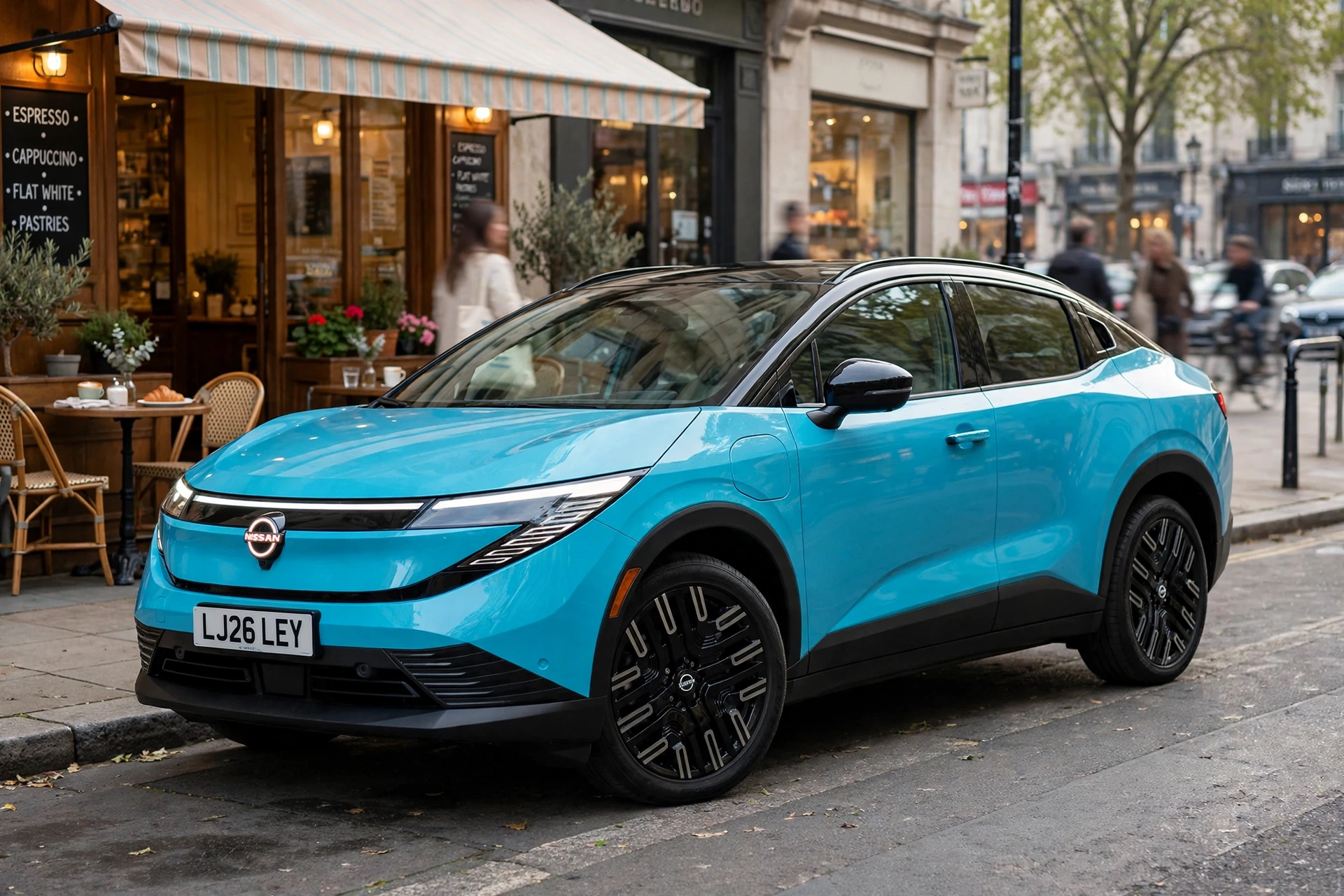
The design deserves a precise description. The third-generation Leaf is a coupe-crossover of approximately the Ariya’s visual family: a full-width light bar across a smooth black nose panel, an illuminated Nissan badge, flush motorised door handles, and a sloping roofline that ends in full-width 3D holographic tail lamps. It reads as a smaller Ariya, and deliberately so. Underneath sits a MacPherson strut front and multi-link rear suspension — the old car’s torsion beam has been retired — and the turning circle and raised seating position suit the crossover brief.
Inside, the S+ makes do with dual 12.3-inch screens, while the SV+ and Platinum+ step up to dual 14.3-inch displays with Google built in: native Maps, Assistant and the Play Store. Wireless Apple CarPlay and Android Auto are standard across the range, a point of some significance, because the Leaf’s closest rival, the returning Chevrolet Bolt, offers neither. ProPILOT Assist and the Safety Shield 360 suite are standard, as is a 360-degree camera that Nissan describes as class-exclusive. Cargo space measures 20 cubic feet behind the rear seats, ahead of the Bolt’s roughly 16.5. The Platinum+ adds a segment-first dimming panoramic roof and a Bose audio system whose speakers sit in the front headrests.
| 2026 Nissan Leaf (US) | S+ | SV+ | Platinum+ |
|---|---|---|---|
| Price (MSRP, checked October 25, 2026) | $29,990 | $34,230 | $38,990 |
| Battery | 75 kWh | 75 kWh | 75 kWh |
| Motor | 214 hp, FWD | 214 hp, FWD | 214 hp, FWD |
| EPA range | 303 miles | 288 miles | 259 miles |
| EPA efficiency | 131/111 MPGe | 122/114 MPGe | 110/103 MPGe |
| DC fast charging | 150 kW, NACS | 150 kW, NACS | 150 kW, NACS |
| Screens | Dual 12.3-inch | Dual 14.3-inch, Google built in | Dual 14.3-inch, Google built in |
Tested figures support the official ones, which is not something this site writes often. Edmunds ran a fully loaded Platinum+ — the 259-mile trim — through its real-world range test and recorded 310 miles, twenty percent beyond the EPA figure, at an observed consumption of 27.8 kWh per 100 miles against the EPA’s 33. In a separate 70 mph highway test, the car averaged 2.8 miles per kWh, only 7.6 percent below its official rating; very few electric cars get that close at a sustained 70 mph. The Drive named the Leaf its Best EV of 2026, and Kelley Blue Book gave it both Best New Model and Best EV under $35,000. The praise, for once, is proportionate.
The Ariya question, answered plainly
Can you still buy a new Ariya in the United States? No. Production for this market ended with the 2025 model year, the 2026 model year was cancelled before it began, and Nissan has offered no commitment that the car will return for 2027. What you may still find is unsold 2025 stock, after which the second nissan electric car Americans could buy becomes a used proposition only.
It is a good used proposition. The final American range started at $39,770 for the Engage, and the Evolve+ front-wheel-drive car carried an EPA rating of up to 289 miles — respectable even now. Early 2023 cars change hands from around $22,000 (est., based on typical United States listings in October 2026), which buys a quiet, well-finished crossover with a proper heat pump and, in e-4ORCE form, all-wheel drive. One caution applies: American Ariyas charge through a CCS1 socket, so Supercharger access requires a NACS adapter rather than a native port.
The contrast with Canada is instructive. The Ariya remains on sale there for 2026 at reduced prices, and a refreshed 2027 model has been announced for Canada with a native NACS port, Google built in and vehicle-to-load capability. Europe and Japan receive the facelifted car as well. The Ariya has not died. It has emigrated.
The same nissan electric car, specified differently abroad
European readers will encounter a headline figure of 386 miles for this car. American readers see 303. Both numbers describe the same 75 kWh Leaf, and the discrepancy is a matter of test cycles, not of hardware. The European WLTP cycle is gentler — lower average speeds, a larger share of urban running — and habitually returns figures roughly a quarter higher than the American EPA cycle. In this instance the gap is 27 percent. Nissan’s own engineers have been unusually candid about it, telling journalists to expect approximately 269 miles at a steady 70 mph. The EPA figure is the one to plan journeys by; the WLTP figure is the one to admire in brochures.
The specification differences are more substantive than the paperwork. Europe receives the Leaf with a choice of two batteries from launch: the 75 kWh pack and a 52 kWh pack with a 174 hp motor, good for up to 271 miles on the WLTP cycle. In the United States, that smaller-battery car was to be the Leaf S, priced at a widely reported $25,360, and in February 2026 Nissan confirmed it would not be introduced in the United States or Canada this model year, with no timeline offered for its return. What would have been the cheapest new electric car in America, full stop, remains a European exclusive by default. European cars also receive a heat pump as standard equipment; in the United States it is fitted to the SV+ and Platinum+, and the S+ buyer in a cold state should price a winter range penalty of a fifth to a third (est., based on typical heat-pump-free behaviour in comparable cars) into the decision.
Below the Leaf, Europe gets a car America will never see. The new Micra is fully electric, built on the same platform as the Renault 5 E-Tech, with 40 kWh and 52 kWh batteries, up to 416 km (259 miles) of WLTP range, and United Kingdom prices from £21,495. And in Japan, the Sakura — a kei car with a 20 kWh battery and 180 km of range — remains the country’s best-selling electric car for a fourth consecutive year, at ¥2,448,600, roughly $15,400 before subsidies (est., at October 2026 exchange rates). Nissan electric car buyers abroad are offered a ladder: Sakura, Micra, Leaf, Ariya. American buyers are offered one rung of it.
Charging: the CHAdeMO era is closed
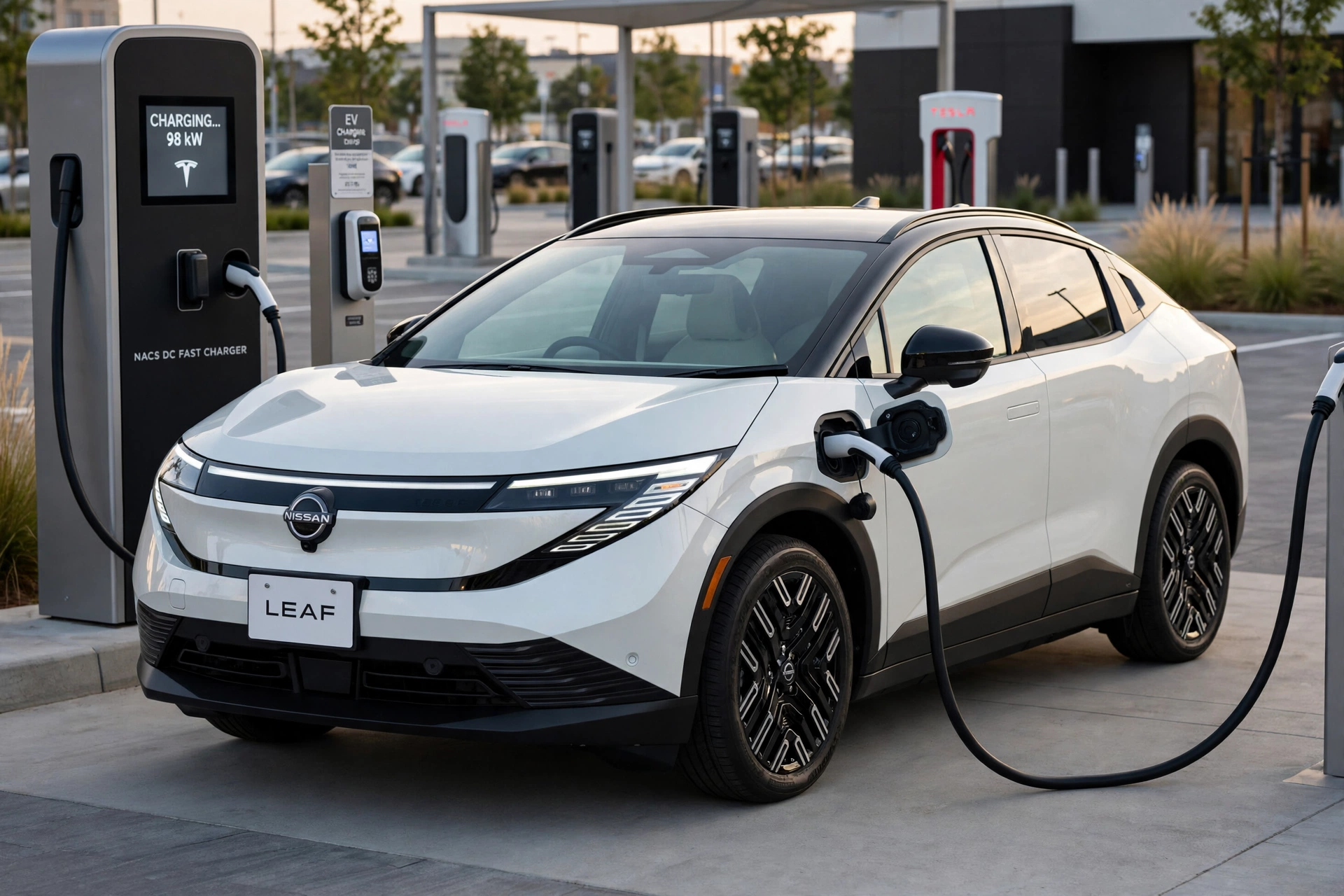
The single largest improvement in this car is invisible until you need it. The old Leaf’s CHAdeMO socket topped out near 50 kW on a shrinking network, and its air-cooled battery throttled charging on repeated stops. The new car carries two ports, one on each front fender: a J1772 socket on the left for AC charging, and a NACS socket on the right for DC. Peak DC rate is 150 kW, and Nissan quotes 10 to 80 percent in about 35 minutes, with a commendably flat charging curve — the company claims up to 273 miles of range added in 35 minutes under favourable conditions.
One quirk requires precise statement, because it will confuse owners. The NACS port is DC-only. At a Tesla Supercharger, you plug in and, with Plug & Charge activated in the MyNISSAN app, simply walk away; Nissan counts more than 27,500 compatible Superchargers. At a Tesla Destination Charger or any other AC post fitted with a NACS plug, the car cannot use it directly — AC charging must go through the J1772 port, with an adapter if the cable is NACS. It is an odd decision, plainly taken to save cost, and it deserves criticism. It is also, in practice, a minor one: home charging, which is where AC matters, happens on J1772. A full home charge on a Level 2 supply takes roughly 7 to 12 hours depending on circuit capacity (est.); the battery warranty runs to 8 years or 100,000 miles, and vehicle-to-load output of 1,500 W is available through an adapter on the J1772 port.
What a nissan electric car costs to buy and to run
Value analysis on this site begins with a computation we publish ourselves: the purchase price divided by the EPA-rated range, which yields the cost of each rated mile. Destination charges are excluded where manufacturers publish them separately, and rival prices are as checked October 25, 2026.
| Car | Price | EPA range | Price per EPA mile |
|---|---|---|---|
| Nissan Leaf S+ | $29,990 | 303 miles | $99 |
| Chevrolet Bolt (2027) | $28,995 (est.) | 262 miles | $111 (est.) |
| Nissan Leaf SV+ | $34,230 | 288 miles | $119 |
| Nissan Leaf Platinum+ | $38,990 | 259 miles | $151 |
| Hyundai Kona Electric SE | $32,975 (est.) | 200 miles | $165 (est.) |
The reading is unambiguous. The Leaf S+ sells an EPA mile for $99, the lowest figure of any electric car on the American market; the Bolt, its nearest rival, asks $111 (est.), and Hyundai’s Kona Electric — reduced for 2026 to a single SE trim with a 48.6 kWh battery and 200 miles of range — asks $165 (est.). Within the Leaf range itself, the curve turns against the buyer quickly: the Platinum+ costs $9,000 more than the S+ and travels 44 fewer miles on a charge, which is why its price per mile deteriorates to $151. You are paying for the roof, the Bose system and the larger screens. Price those items honestly before signing.
Running costs follow the same pattern. At the EPA consumption of 33 kWh per 100 miles and an assumed residential electricity price of $0.17 per kWh (est., close to the current national average), the S+ costs $5.61 per 100 miles. Over 12,000 miles a year that is 3,960 kWh and about $673. A petrol car returning 30 mpg on fuel at $3.10 a gallon (est.) costs $10.33 per 100 miles, or roughly $1,240 over the same year — the Leaf saves its owner about $567 annually before maintenance, and it has no oil to change.
Use the Edmunds-tested consumption of 27.8 kWh per 100 miles instead of the EPA figure and the electric cost falls to $4.73 per 100 miles. Fast charging narrows the advantage rather than removing it: at $0.45 per kWh (est., typical of major DC networks), the same car costs $14.85 per 100 miles, which argues for charging at home and treating the Supercharger network as infrastructure for journeys, not for weeks. For a broader five-year picture across fuel, maintenance and depreciation, our guide to what an electric car costs per mile works through the full arithmetic.
Verdict: our scores
Each nissan electric car below is scored out of ten, with sub-scores for range, charging and value. The full model-by-model background, including the previous generation and the Ariya in depth, sits in our complete guide to the 2026 Nissan Leaf, and buyers weighing the whole market rather than one brand should cross-check our overview of electric cars, their range, charging costs and who should buy one.
2026 Nissan Leaf S+ — Our score: 8.8/10 (Range 9/10 · Charging 7/10 · Value 10/10). The cheapest 300-mile electric car in America, and the trim the range table rewards. The omissions — smaller screens, no heat pump — are the correct ones to accept.
2026 Nissan Leaf SV+ — Our score: 8.4/10 (Range 9/10 · Charging 7/10 · Value 8/10). The 14.3-inch displays, heated seats and heat pump for $4,240 more. A defensible upgrade in a cold climate, and the trim most buyers will choose; the S+ remains the better arithmetic.
2026 Nissan Leaf Platinum+ — Our score: 7.6/10 (Range 7/10 · Charging 7/10 · Value 6/10). A pleasant car that pays $9,000 to go 44 miles less far. At $38,990 it also stands within $2,640 of a Tesla Model Y Standard, which is a comparison it does not win.
Nissan Ariya (used, 2023–2025) — Our score: 8.1/10 (Range 7/10 · Charging 6/10 · Value 9/10). Withdrawn, not deficient. At used prices near $22,000 (est.), it is the most car Nissan has sold with a plug, and the only route to a larger nissan electric car until the company changes its mind.
The summary is short. Nissan invented this market segment in 2010, neglected it for a decade, and has now — with a single model, priced correctly — reclaimed the entry point of it. Compare the official figures on Nissan’s own Leaf page and the EPA ratings at fueleconomy.gov before visiting a dealer, and negotiate on the SV+ if you must have the screens. The S+ is the car we would buy.
Frequently asked questions
What is the cheapest nissan electric car on sale in the US?
The Leaf S+ at $29,990 before destination (checked October 25, 2026). The smaller-battery Leaf S, reported at $25,360, was confirmed in February 2026 as not coming to the United States or Canada for the 2026 model year.
Can I still buy a new Nissan Ariya in the US?
No. The 2025 model year was the last for the United States; the 2026 model year was cancelled, and any new Ariya you find is remaining 2025 dealer stock. The car continues in Canada, Europe and Japan.
Does the 2026 Leaf work at Tesla Superchargers?
Yes. It has a native NACS port and Plug & Charge, giving access to more than 27,500 Superchargers with no adapter. Note that the NACS port accepts DC only; AC charging uses the separate J1772 port.
Why does the European Leaf claim 386 miles when the US car claims 303?
Test cycles. The European WLTP procedure is gentler than the US EPA procedure and typically returns figures about a quarter higher for the same car. Nissan’s own estimate for a steady 70 mph is approximately 269 miles.
How fast does the 2026 Leaf charge?
Up to 150 kW on DC, with a quoted 10 to 80 percent time of about 35 minutes. At home on Level 2, expect an overnight charge of roughly 7 to 12 hours (est.) depending on the circuit.
How long is the Leaf’s battery warranty?
Eight years or 100,000 miles, whichever comes first, matching the cover Nissan offers on the Ariya and broadly standard across the segment.
For shoppers weighing the Leaf against its rivals, a nissan electric car comparison should start with range per dollar, not badge alone. A nissan electric car at $99 per EPA mile sets a benchmark that makes the S+ easy to recommend on value. In short, a nissan electric car buyer who prioritises affordable range will find the Leaf S+ hard to beat.