Last updated: October 25, 2026
The Cadillac Vistiq is the three-row electric SUV that replaces the gas-powered XT6, and it starts at $79,390 including destination (all prices in this guide checked October 25, 2026). Every version — there are four — gets the same 615-horsepower dual-motor powertrain, the same 102 kWh battery and the same 305-mile EPA range rating. Read that again. The cheapest one is not a stripped fleet special. It is the full-strength car, and the trims above it mostly sell you furniture.
Here’s why that matters. Cadillac’s other electric three-row flagship, the Escalade IQ, starts at $130,300 including destination. The gap between the two is $50,910. That is real money: enough to buy a decent used SUV outright, or to pay a decade of home-charging bills.
So the honest question is what that extra $50,910 buys. Short answer: range and presence. The IQ carries a battery roughly twice the size, goes a Cadillac-estimated 465 miles, and looks like a yacht. Everything else — seven seats, huge screens, supercar pace — the smaller car matches or nearly matches.
Standard kit is where the base car embarrasses its rivals. Super Cruise hands-free highway driving: standard, with a three-year plan bundled in. A 33-inch curved display sweeping across the dash: standard. A 23-speaker AKG stereo: standard. Heated, ventilated and massaging front seats, a panoramic sunroof, adaptive dampers and heated second-row seats: all standard, on the $79,390 car. Most luxury brands charge four figures for each line of that list. Cadillac bundles the lot, then asks $14,500 extra for air suspension. Hold that thought.
Our verdict up front, because the trim walk below exists to prove it: buy the Luxury, consider the $500 Sport if you like black trim, and treat the two upper trims as a tax on impatience. What follows is the maths — price per mile of range, price per seat, price per horsepower — against the Escalade IQ and the Kia EV9, the two cars a sensible shopper should cross-check before signing anything.
What the Vistiq is, and where Cadillac parks it
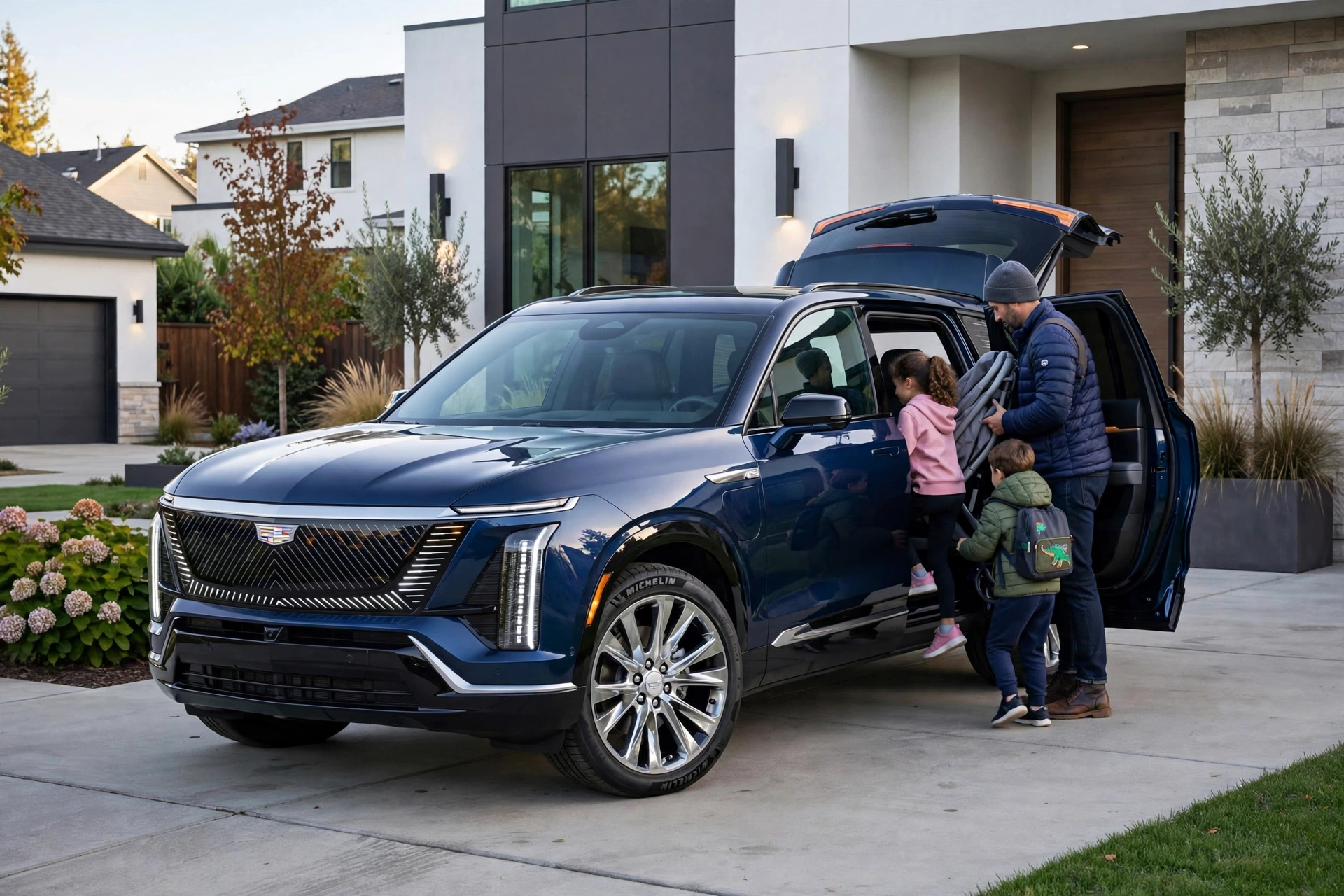
Cadillac now sells four electric SUVs. The Optiq is the small one. The Lyriq is the midsize two-row car. The Vistiq is the three-row family hauler, built in Spring Hill, Tennessee on GM’s BEV3 platform. The Escalade IQ sits on top, enormous and expensive. Our subject stretches 205.5 inches long on a 121.8-inch wheelbase and weighs about 6,326 pounds, so “midsize” is doing heavy lifting in the brochure. The honest description: it is the least expensive way to put seven people in an electric Cadillac, and it is priced like it knows that.
One packaging demerit deserves a mention before the praise resumes. There is no front trunk. The space under the hood is filled with high-voltage hardware, so every suitcase, stroller and grocery bag goes behind the seats. In a car this size, that is a real tax on airport runs, and it’s shared with the Lyriq platform underneath. If a frunk is on your must-have list, the Kia EV9 further down this page has a small one and the Escalade IQ has a huge powered one — at $50,910 more, it should.
Vistiq specs: the numbers that matter
| Item | Figure |
|---|---|
| Price range (incl. destination) | $79,390 – $98,490 |
| Powertrain | Dual-motor AWD, every trim |
| Power / torque | 615 hp / 650 lb-ft |
| 0–60 mph | 3.7 seconds (Velocity Max mode) |
| Battery | 102 kWh |
| EPA range | 305 miles (300 with the 19.2 kW charger) |
| DC fast charging | 190 kW peak; ~80 miles added in 10 minutes |
| AC charging | 11.5 kW standard (~29 miles/hour); 19.2 kW available (~47 miles/hour) |
| Seating | 7 standard; 6 with optional captain’s chairs |
| Cargo | 15.2 cu ft behind row three; 43.0 behind row two; 80.2 maximum |
| Towing | 5,000 lb |
Cadillac does not sell speed in instalments. A $79,390 Luxury and a $98,490 Platinum accelerate identically, charge identically and carry the same battery. That single fact drives this entire guide, because it means every dollar above the base trim buys comfort, trim and toys — never capability. Published test drives back up the pace claim too: reviewers consistently describe the car as properly quick and eerily quiet, with a ride that stays composed on the standard adaptive dampers. Several also note the brake pedal feels wooden underfoot, a regen-blending quirk worth sampling on your own test drive.
Range testing produced the guide’s favourite number. Edmunds ran its standardised EV range test and recorded 334 miles from a car the EPA rates at 302 miles in that specification — the rating is 305 miles on most trims — beating the official figure by roughly a tenth. Edmunds also measured consumption of 36.6 kWh per 100 miles against the EPA’s 39. Charging was less heroic: a peak of 190 kW is mid-pack now, and Edmunds needed 17 minutes 26 seconds to add 100 miles, where an EV9 does the same job several minutes sooner. Good range, average charging speed. Plan road trips accordingly.
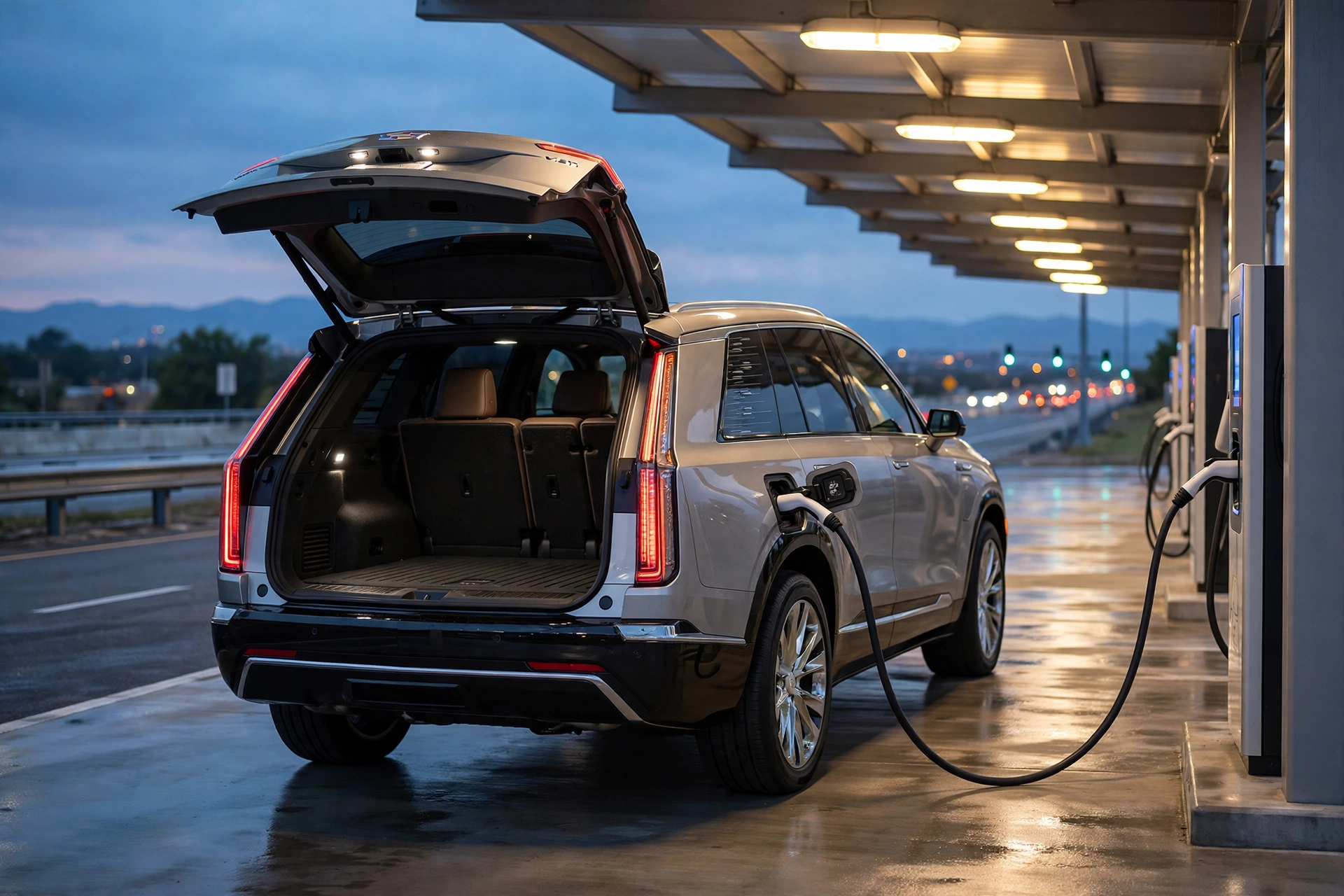
The Vistiq trim walk: what each step actually buys
Luxury — $79,390. This is the whole car. Dual motors, 615 hp, the big battery, Super Cruise, the 33-inch display, the AKG stereo, massaging front seats, the sunroof, 21-inch wheels. If Cadillac had launched with this trim alone, reviews would call it generously equipped and move on. Nothing essential is missing, because Cadillac made a rare decision: the base trim is the product, and everything above it is garnish.
Sport — $79,890. Five hundred dollars for gloss-black trim, a different grille texture and darker detailing. That is the entire list. As cosmetic packages go, it’s honestly priced — plenty of brands charge $2,000 for the same blackout treatment. Buy it if you like the look. Skip it if you don’t. Nobody will ever know either way, including you, after a week.
Premium Luxury — $93,890. Now the bill arrives: $14,500 over the Luxury. In exchange you get air suspension, rear-axle steering, Night Vision thermal imaging, an augmented-reality head-up display, second-row captain’s chairs, a 19.2 kW onboard charger and a few interior upgrades. Price the pieces honestly. Rear-axle steering genuinely helps park a 205-inch SUV and is the one item we’d miss. Air suspension rides beautifully and is also the component most likely to generate a four-figure repair bill once the warranty ends. Night Vision is a party trick that impresses passengers twice a year. This is the worst-value step in Cadillac’s electric range, and it isn’t close.
Platinum — $98,490. Another $4,600 for Brembo front brakes, a black roof, unique fascia detailing and the smugness of the top badge. Brembo brakes on a 6,326-pound family SUV that does most of its stopping with regenerative braking are jewellery. Handsome jewellery, fitted to a car that will spend its life on school runs. If you want them, fine — just know that’s what you’re buying.
Options we’d skip, and where the money goes instead
The 19.2 kW onboard charger (est. ~$1,300 on lower trims, based on GM’s pricing for the same hardware on the Lyriq). It nearly doubles home charging speed, to about 47 miles of range per hour. It also requires a 100-amp circuit that many homes cannot supply without a panel upgrade, and — the detail sales staff glide past — it drops the EPA rating to 300 miles. The standard 11.5 kW charger adds roughly 29 miles per hour, which refills this battery from empty overnight. You are paying four figures to solve a problem sleep already solves. Skip it.
The 23-inch wheels. They look superb in photographs and cost you twice: big wheels trim range on any configuration, and replacement tyres in that size run an estimated $500 or more per corner. The standard 21s are the value play and ride better on broken pavement. Skip.
Captain’s chairs, $800. Lovely thrones, easier third-row access — and they delete a seat. Your $79,390 seven-seater becomes a six-seater, and the price per seat jumps from $11,341 to $13,232. Families who regularly carry exactly two children should take them. Everyone else should keep the bench and the $800.
Premium paint, $1,225 for shades like Radiant Red. Pretty, and worth precisely nothing extra at trade-in time (est.). If a colour makes you happy every single day, buy it with your eyes open. Just file it under entertainment, not equipment.
Spend the savings where they compound instead: a proper home Level 2 installation, which is the single upgrade that changes daily life with this car. Our guide to what an electric car costs per mile shows why home charging, not public charging, is where EV running costs are won.
Range and charging: what a mile actually costs
The official numbers first. The EPA rates the car at up to 305 miles and 86 MPGe combined, using about 39 kWh per 100 miles; the full ratings are posted on fueleconomy.gov. Against that, Edmunds’ tested 334 miles suggests the official figure is honest, even slightly conservative. Budget 300 miles as your planning number and you will rarely be disappointed.
Now the money. A full home charge puts roughly 102 kWh into the pack. At an estimated $0.17 per kWh — around the current US residential average — that is about $17.34 for 305 miles, or 5.7 cents a mile. A petrol XT6 at roughly 20 mpg combined and $3.20 a gallon (est.) burns 16 cents a mile. At DC fast chargers the picture flips: at a typical estimated $0.48 per kWh, the same fill costs about $49, and the 190 kW peak speed means you’ll spend longer paying it than EV9 drivers do. The rule writes itself — charge at home, treat fast chargers as road-trip tools, and this SUV is cheap to run for its size.
Annualised, at 12,000 miles a year and the EPA’s 39 kWh-per-100-miles appetite, the car drinks 4,680 kWh: about $796 a year at home rates. The XT6 comparison at the same mileage is roughly $1,920 of petrol. That ~$1,124 yearly gap is the quiet rebate Cadillac never advertises, and over five years it closes a fair chunk of the price difference against cheaper three-row EVs.
Space for seven, priced per seat
Family buyers should know the third row’s fine print. Legroom back there is 30.6 inches and the raised floor forces a knees-up posture, though headroom is genuinely fine at 39.5 inches. Adults fit for short hops; teenagers fit for longer ones; the second row’s 40.1 inches of legroom is where grown-ups will fight to sit. Cargo space behind the third row is 15.2 cubic feet — one large suitcase, or the weekly shop if you stack with intent — opening to 43.0 with the third row folded and 80.2 with both rows down, with power folding controls in the cargo area. Competent, not class-leading.
Here is the computation that frames the whole car. Price per mile of EPA range, and price per seat, for the three seven-seat electric SUVs a buyer will actually cross-shop:
| Car | Price incl. destination | Range | $ per mile of range | $ per seat |
|---|---|---|---|---|
| Cadillac Vistiq Luxury | $79,390 | 305 mi (EPA) | $79,390 ÷ 305 = $260 | $79,390 ÷ 7 = $11,341 |
| Cadillac Escalade IQ | $130,300 | 465 mi (Cadillac est.; the EPA does not rate it) | $130,300 ÷ 465 = $280 | $130,300 ÷ 7 = $18,614 |
| Kia EV9 Light Long Range | $59,545 | 305 mi (EPA) | $59,545 ÷ 305 = $195 | |
| EV9 per seat: $59,545 ÷ 7 = $8,506 | ||||
Add one more line for fun: at 615 hp, the base Cadillac charges $129 per horsepower. The Escalade IQ, at 750 hp in Velocity Max mode, charges $174. The three-row Cadillac beats its own flagship on every value line we can draw, and loses to the Kia on all of them — the $65-per-mile gap over the EV9 is the price of the badge, the interior and 236 extra horsepower. If you’re weighing the wider field before deciding, our rundown of EV cars, their range, charging costs and who should buy them puts this segment in context.
Running costs after the sticker
Warranty cover is standard GM premium fare: four years or 50,000 miles bumper-to-bumper, and eight years or 100,000 miles on the battery. Routine maintenance is minimal — no oil, no belts, brake pads that last for years thanks to regenerative braking.
The real budget item is tyres on a 6,326-pound SUV: an estimated $350–$450 each in the standard 21-inch size, more in 23-inch, and they will not last like tyres on a crossover half the weight. Insurance on a heavy, powerful luxury EV will also run higher than on the old XT6 (est.); get a quote before you sign, not after. Finally, depreciation: big luxury EVs shed value briskly (est.), which is one more argument for the trim with the least value to shed. Run your own numbers with our total cost of ownership calculator before committing.
Verdict: Our score by trim
The pattern across this guide is monotonous, and it’s Cadillac’s own doing: one powertrain, one battery, four prices. The car is excellent. The pricing ladder is the problem. Scores below use Range / Charging / Value sub-scores, and the specs behind them are laid out on Cadillac’s official Vistiq page if you want to check our homework.
Vistiq Luxury — Our score: 8.4/10 (Range 8/10 · Charging 7/10 · Value 9/10). The cheap winner. Everything that makes this car good is included, and the Edmunds range test suggests even its official numbers undersell it. The Sport is the same car in black trim for $500 more and scores identically.
Vistiq Premium Luxury — Our score: 7.3/10 (Range 8/10 · Charging 7/10 · Value 6/10). Air suspension and rear steering are genuinely desirable. They are not $14,500 desirable, and Night Vision pads the bill for a feature most owners will demo twice.
Vistiq Platinum — Our score: 6.9/10 (Range 7/10 · Charging 7/10 · Value 5/10). Ninety-eight thousand dollars for the same speed, the same battery and a set of Brembo badges. At this money the Escalade IQ’s extra range and space start making their own case.
Buy the Luxury — or the Sport, for looks — and you get 90 percent of the flagship experience for 61 percent of the flagship price. If seven seats are more than you need, the smaller Optiq delivers the same design language for far less, as our Cadillac Optiq guide lays out. If the badge doesn’t matter at all, the EV9 is the rational buy and it isn’t close. But among Cadillacs, this base trim is the one we’d spend our own money on.
Frequently asked questions
How much does the Vistiq cost?
For 2026, $79,390 for the Luxury, $79,890 for the Sport, $93,890 for the Premium Luxury and $98,490 for the Platinum, all including the $1,995 destination charge. Prices were checked October 25, 2026, and Cadillac has already raised them twice since launch, so treat any older price you find online as history.
How far does it go on a charge?
The EPA rating is 305 miles for most trims, or 300 miles with the 19.2 kW onboard charger. In independent testing, Edmunds recorded 334 miles, beating the rating of the car it tested. Plan on roughly 300 miles in mixed use, less in deep winter or at sustained high speed.
Is the Vistiq or the Escalade IQ the better buy?
On value, the smaller car, and not by a little: $260 per mile of range against $280, $11,341 per seat against $18,614. The IQ answers with 465 miles of Cadillac-estimated range, a 205 kWh battery, 350 kW charging and limousine space. If you road-trip constantly and money is no object, buy the IQ. For everyone else, the $50,910 saving is the argument.
Does it have Apple CarPlay?
No. Cadillac removed Apple CarPlay and Android Auto from its EVs, replacing them with Google built-in navigation, maps and apps on the 33-inch display. The system works well, but if your digital life lives in CarPlay, test the replacement thoroughly before buying.
Can it tow?
Yes, up to 5,000 pounds, which covers most family trailers and small boats. Expect towing to cut range hard — budgeting around half the rated range with a heavy trailer is the usual planning rule (est.).
Which trim is the best value?
The Luxury, full stop. Same powertrain, same battery, same headline equipment list as the $98,490 Platinum, for $19,100 less. The Sport earns its $500 if you like the blacked-out look. Everything above that spends your money at a steadily worse exchange rate.
In short, shoppers who start with the base trim will find the vistiq already includes the full powertrain. Choosing that trim also leaves money for home charging, which is where the vistiq is cheapest to run. For most families, that combination is why the vistiq is the trim to buy.