Last updated: October 25, 2026
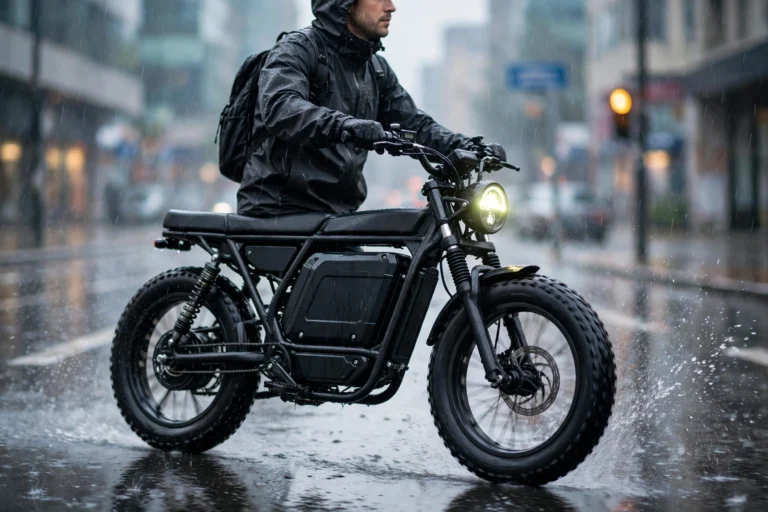
Start with the number Eahora leads with, because it’s the number that defines everything else about this bike: 1,500 watts. The Eahora P5 II 1500W electric bike pairs that rear hub motor with a seamless magnesium-alloy frame, full suspension, 24×4.0 fat tires and a 48V 20Ah battery, and sells the package for $1,399 (Eahora’s US store price, checked October 25, 2026).
On paper that’s a lot of hardware for the money. On a trail map, it’s something else entirely: in most US states this is not legally an e-bike at all, and where you can ride it is a much shorter list than where you can’t. I’m a trail rider first.
So this review starts with the motor and the suspension, and then it deals with access — because access is where this bike gets complicated.
The spec sheet, in one breath: a brushless rear hub motor Eahora rates at 1,500W with a claimed 102 Nm of torque, fed by a removable 48V 20Ah (960Wh) lithium battery with CAN-bus communication to the color LCD. Claimed top speed is 28–34 mph and claimed range is 68–80 miles in pedal-assist (Eahora’s own figures, checked October 25, 2026).
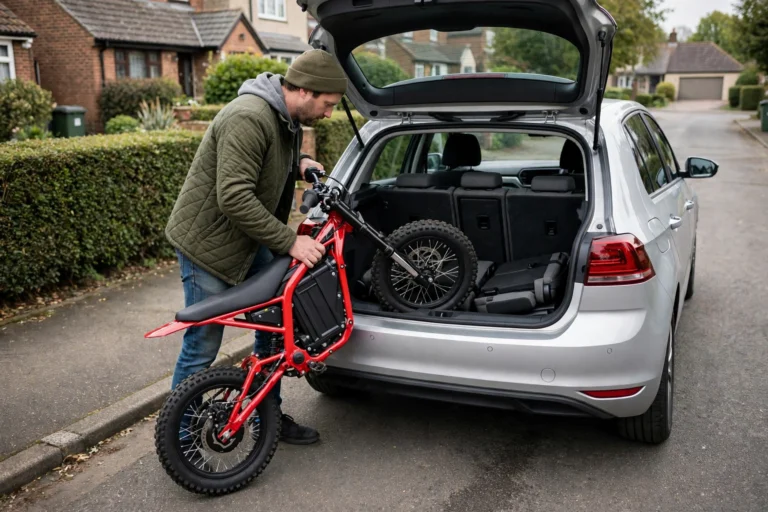
You get a Shimano 7-speed drivetrain, hydraulic disc brakes with 180mm rotors, a thumb throttle, five ride modes (Electric, Pedal-Assist, Cruise, Manual, Walk), Bluetooth app connectivity, and a 330 lb payload rating. Weight is where the paperwork already starts to wobble: one spec roundup puts the bike at 66 lbs, while retailer listings for the P5 line run to roughly 75 lbs (est.). Either figure makes this a two-handed lift onto a rack.
Now the motor truth, because “1,500W” needs unpacking. Some third-party write-ups describe the same bike as a “1,700W” model. Both numbers can be true at once: Eahora rates the motor at 1,500W, and the 48V/35A controller listed for the bike can pass 48 × 35 = 1,680W of peak electrical input — call it 1,700W peak in marketing shorthand.
What matters on a climb is that this is a hub motor. Its 102 Nm is produced at the rear axle, in one fixed ratio. A mid-drive’s torque gets multiplied by your gears; a hub’s doesn’t. Off the line and on short, steep pitches, the P5 II pulls hard. On a long, slow, technical climb, the motor spins slowly, runs hot, and has no lower gear to hide in. That’s physics, not a defect — but it’s the difference between a trail motor and a fast fat-bike motor, and this is the second kind.
The suspension layout matters more than the wattage anyway, so here’s the short version before we go deep. Up front there’s a suspension fork with lockout, and out back a coil/oil-spring shock drives the rear triangle through a linkage, with the fat tires themselves doing a real share of the work at low pressures. No Fox, no RockShox, no name-brand damper anywhere — every suspension part on this bike is unbranded, which at $1,399 is expected, and it sets the ceiling on how the bike behaves when a trail gets rough at the speeds this motor makes easy.
The magnesium frame question on the Eahora P5 II 1500W electric bike
Magnesium is not marketing fiction. AM60B — the aviation-grade magnesium alloy Eahora names in its own launch material for the P5 line — is a real die-casting alloy used for decades in car seat frames and steering wheels. At roughly 1.8 g/cm³ it’s about a third lighter than 6061 aluminum per unit of volume, it damps vibration noticeably better than aluminum, and die-casting it produces exactly what you see in the photos: a smooth, seamless, weld-free unibody with thick, sculpted sections.
The Eahora P5 II 1500W electric bike genuinely looks cast rather than welded, and that part of the claim holds up to your eyes.
Here’s what nobody can verify from the outside. No independent lab has published an alloy analysis of this frame, and there’s no home test that distinguishes AM60B from a cheaper magnesium blend or proves the wall thicknesses Eahora implies. You’re taking the alloy grade on the brand’s word. The look of the casting is consistent with die-cast magnesium. The grade, the heat treatment, the quality control — unverifiable, and any reviewer who tells you otherwise is guessing with more confidence than evidence.
And magnesium brings three ownership realities the brochure skips. First, it corrodes eagerly: the frame depends on its coating, and a deep scratch through to bare metal needs touch-up, not neglect — plus steel bolts threaded straight into magnesium invite galvanic corrosion if they weren’t isolated at assembly. Second, you cannot weld it. A cracked aluminum frame can sometimes be repaired by a specialist; a cracked die-cast magnesium frame is a replacement frame, full stop, and only Eahora sells one.
Third — and this is the point I’d underline — the weight saving never shows up where it counts. Frame material might save two or three pounds against aluminum. The hub motor, the 960Wh battery and two 24×4.0 wheelsets weigh what they weigh, which is why this “lightweight magnesium” bike lands in the same 66–75 lb (est.) bracket as its aluminum rivals. The magnesium is a legitimate engineering choice. As a reason to buy this bike over another, it’s a distraction.
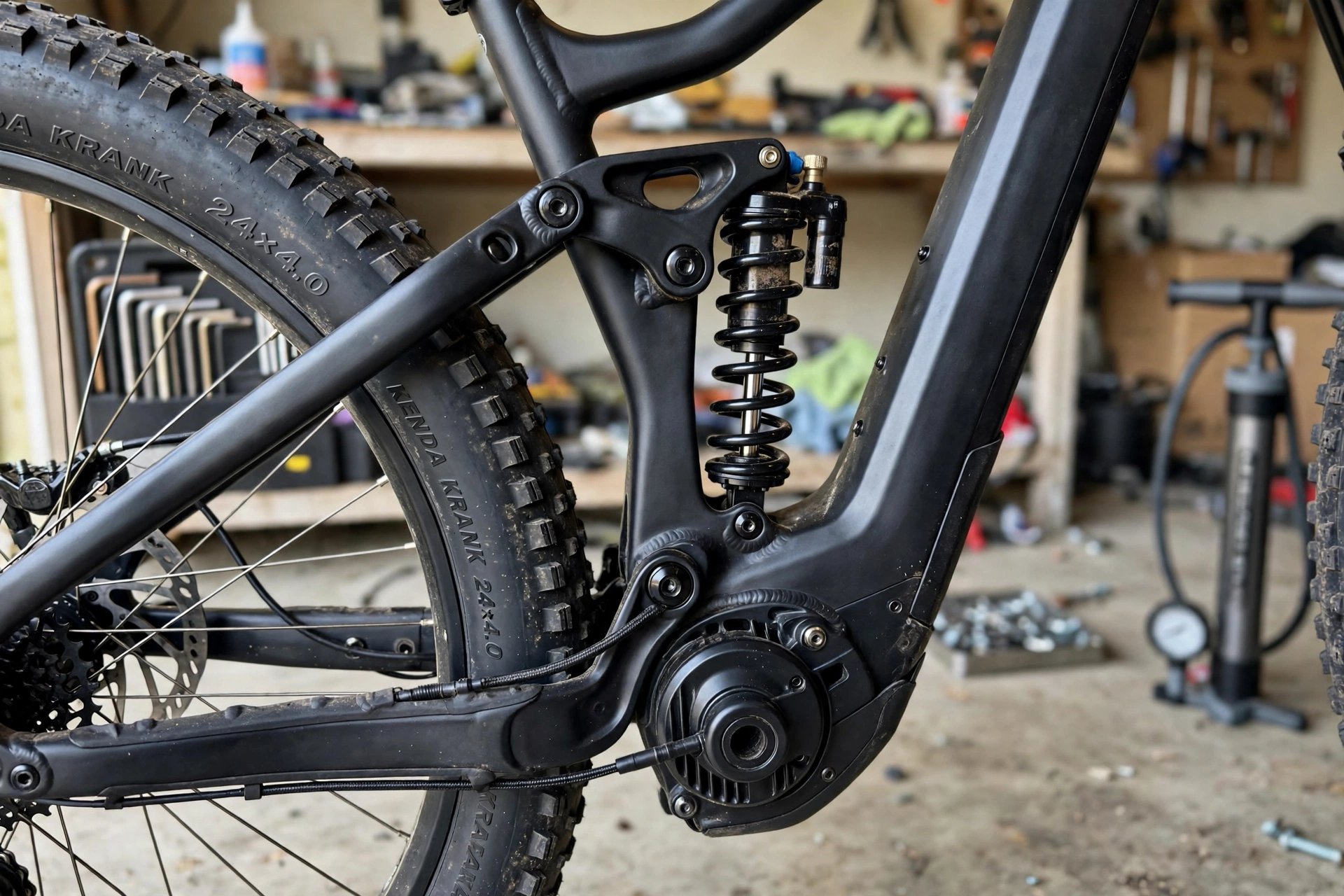
Suspension in detail: a coil shock, a linkage, and tires doing the heavy lifting
Let’s take the back end apart, because it’s the most honest part of the bike. The rear shock is a coil/oil-spring unit — listings describe it with oddly specific spring ratings (one cites a 1,200 lb spring) and modest travel at the shock itself, around 30mm (est.), which the linkage multiplies into usable wheel travel.
A coil shock is the right call here: it’s simple, it doesn’t lose air, it tolerates neglect, and its small-bump response beats a bargain air shock. Adjustment is basic — preload by collar, and that’s roughly your lot. There’s no rebound dial worth the name on units at this price, so the rear wheel will kick on repeated square-edge hits at speed. Riders coming from a proper trail bike will feel it within one descent.
The fork is where the spec sheets stop agreeing with each other. One listing claims around 100mm of travel for an adjustable aluminum fork; another claims 135mm and hydraulics. Eahora’s own pages don’t pin the number down cleanly, so treat travel as unconfirmed (est.) and judge the fork for what it visibly is: a coil-sprung fat-bike fork with lockout, sized for comfort and control on dirt roads and moderate trails, not a enduro fork.
Stanchion flex under a 200 lb rider braking hard on a 180mm rotor is part of the package. Ride it like a trail hardtail with benefits and it makes sense; ride it like a downhill bike and it will write checks the chassis can’t cash.
Then there are the tires, which quietly do half the suspension’s job. A 24×4.0 tire at 8–15 psi has a huge air volume, and that volume swallows roots, washboard and curb edges that would overwhelm this shock and fork on their own.
The trade is rolling resistance and steering weight: fat rubber at trail pressures is why the range maths below look the way they do, and it’s why the Eahora P5 II 1500W electric bike feels planted on sand, snow and loose gravel — the surfaces where it genuinely shines — and vague on pavement at speed. Reflective sidewall strips are fitted, a small detail I approve of.
Braking matches the brief better than the fork does. Hydraulic calipers on 180mm rotors are the minimum I’d accept on a bike that weighs this much and goes this fast, and the P5 II meets that minimum — one roundup even lists upgraded multi-piston calipers, though I couldn’t verify the piston count from Eahora’s own material, so file that under unconfirmed. Budget for pads: stopping ~240 lbs of bike and rider from 30 mph eats pad material, and fat-bike speeds arrive far more often than fat-bike braking distances suggest.
Motor truth and the range maths Eahora hopes you skip
Eahora claims 68–80 miles of range. Let’s do the arithmetic the product page doesn’t. The battery is 48V × 20Ah = 960Wh. Covering 80 miles on 960Wh requires 960 ÷ 80 = 12 Wh per mile. Twelve watt-hours per mile is what a light road e-bike with a pedaling rider uses on flat pavement. A 70 lb fat-tire bike on 4-inch rubber with a hub motor does not live there.
At the claim’s lower edge, 68 miles, you still need just 14.1 Wh/mile. That number is not a lie told with a straight face so much as a best-case laboratory figure — lightest rider, lowest assist, flat ground, warm day — presented as the headline.
Here are planning numbers built from consumption bands typical for this format (all est., derived from the 960Wh pack):
- Throttle-heavy riding at 25–32 mph: 35–45 Wh/mile → 960 ÷ 45 ≈ 21 miles to 960 ÷ 35 ≈ 27 miles.
- Mixed pedal-assist, moderate effort: 22–28 Wh/mile → roughly 34–44 miles.
- Gentle eco assist with real pedaling on flat ground: 16–19 Wh/mile → roughly 50–60 miles, and only if you genuinely pedal.
So plan on 30–40 miles for mixed real-world use of the Eahora P5 II 1500W electric bike, and treat anything past 45 as a good day. No instrumented independent range test of this bike exists yet — the reviews available are affiliate roundups and owner reports, and I’ve labeled them that way throughout. Owner reports do support the speed claim better than the range claim: riders consistently describe holding 28–32 mph, with the 34 mph top of the bracket needing a light rider and a full battery (est.). A few owners also note the charger flipping to green at about 97% — a small BMS quirk worth knowing, not a dealbreaker.
Charging itself is slow: listings put a full charge at 6–8 hours from the stock charger. The pack is removable and talks to the display over CAN-bus, so the percentage readout is more trustworthy than the voltage-guess gauges on cheaper bikes. A full charge pulls roughly 1.1 kWh from the wall (est.) — about 19 cents at average US residential rates, which is why the running-cost side of e-bikes is never the problem; our breakdown of what it costs to charge an electric bike shows the same maths across the category.
Now price it per honest mile. At the $1,399 list price and a realistic 35-mile planning range, the Eahora P5 II 1500W electric bike costs $1,399 ÷ 35 ≈ $40 per mile of real range, or $1,399 ÷ 960Wh ≈ $1.46 per watt-hour of battery. Compare the legal-class benchmark, Aventon’s Aventure.2: $1,999, a 720Wh battery, claimed 60 miles, realistic ~40 miles (est.) — that’s $1,999 ÷ 40 ≈ $50 per real mile and $2.78 per watt-hour.
The Eahora is cheaper per mile and far cheaper per watt-hour. What the extra Aventon money buys is not range. It’s legality, a dealer network, and a frame you can get parts for in five years. Keep that trade in mind; it’s the whole story of this bike.
Where you may legally ride an Eahora P5 II 1500W electric bike
This is the section that decides whether you should buy one, so I’ll be exact. US federal law defines a low-speed electric bicycle as having a motor under 750W and a top motor-powered speed under 20 mph. The three-class system used by more than 40 states builds on that: Class 1 and 2 cap assist at 20 mph, Class 3 caps pedal-assist at 28 mph, and every class caps the motor at 750W. The Eahora P5 II 1500W electric bike has double the legal motor wattage, a throttle, and a claimed 34 mph top speed. It fits no class.
Our Class 1 e-bike guide lays out what does qualify — this doesn’t.
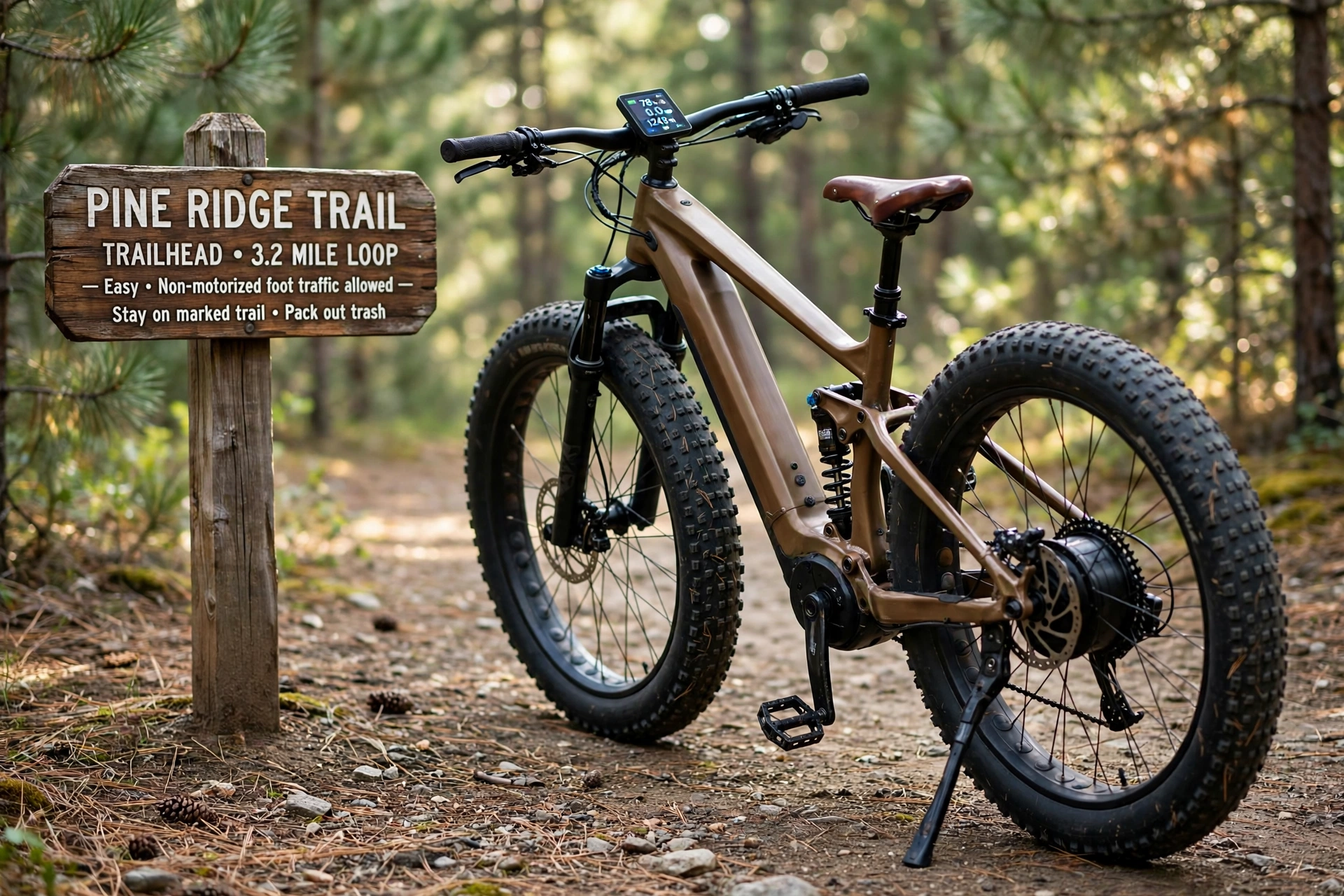
Consequences, venue by venue. On multi-use paths and rail trails: no — those are class-bike territory in most jurisdictions, and an out-of-class bike is treated as a motor vehicle. On mountain bike singletrack: no, with emphasis. The US Forest Service and BLM allow classed e-bikes only where they’ve designated them; anything beyond the classes is a motor vehicle, legal only on roads and trails open to motorized use. Most trail systems, state parks and land trusts write the same rule.
On public roads: in many states a 1,500W throttle bike at 34 mph falls into moped or motor-driven-cycle law, which can mean registration, a plate, a license and insurance — it varies by state, and “the listing said e-bike” is not a defense.
Where it is unambiguously legal: private land, OHV parks, motorized forest roads, and anywhere motorcycles are welcome. If that’s your riding, the access problem disappears. If it isn’t, understand that riding this on a non-motorized trail risks a citation, and — the part I actually care about — every out-of-class bike on a hiking-biking trail becomes an argument for closing that trail to the classed e-bikes that are allowed there. I have no tolerance for that trade. Don’t be the reason.
Two more checks before money changes hands. Battery certification: I could not find a UL 2849 listing for this bike in Eahora’s materials (checked October 25, 2026), and some cities, landlords and transit systems require exactly that certification. And if you want the dirt-riding picture in full — what each format can and can’t do off-road — our guide to e-bike dirt riding covers the terrain side of the same access rules.
Build quality, brakes and the support reality of the eahora p5 ii 1500w electric bike
Strip the headline specs away and the bones are reasonable for $1,399: a Shimano 7-speed drivetrain (adequate, cheap to service, and it will wear faster under hub-motor torque — budget a chain a season), hydraulic brakes on 180mm rotors, a color display with Bluetooth app pairing for ride data and settings, cruise control, a walk mode, and an automatic battery disconnect feature that an independent review of the P5 II noted approvingly.
Assembly out of the box is the usual fat-bike hour with hex keys, and budget time for a brake bedding-in ride and a bolt check after the first 50 miles — cast frames and linkage hardware settle.
Support is the thin ice. Per an independent review of the brand’s terms, Eahora covers the frame for two years and the fork, motor and battery for one — read the current terms before ordering, because they change.
Help runs through email and the storefront, not a dealer network; there is no shop across town with a P5 II swingarm on the shelf. Proprietary parts are the risk that matters: the display, the controller, and above all that one-piece cast frame exist only in Eahora’s supply chain. The magnesium point returns here with teeth — a crash that cracks the frame cannot be welded back, and if the frame is out of stock or the model is discontinued, the bike is done. Owners in review roundups report generally quick responses from the brand, and the bike’s Amazon presence gives you the platform’s return window as a backstop.
That’s the support structure. Price it in.
Verdict: fast, cheap, and fenced in
Score the Eahora P5 II 1500W electric bike as two products sharing one frame. As an off-road toy for private land, farm tracks and OHV areas, it’s strong value: real suspension at both ends, a big battery, hydraulic brakes, and speed that would cost far more from a mainstream brand. As an “e-bike” in the legal sense — the sense that gets you onto paths, trails and bike lanes — it fails on day one, and no amount of spec-sheet value fixes that.
Our score: 6.3/10 — Range: 6/10 (a genuine 30–40 real miles, sold as 68–80) · Charging: 5/10 (removable pack and honest CAN-bus gauging, dragged down by a 6–8 hour charge) · Value: 8/10 ($1.46 per watt-hour undercuts every legal-class rival we compared).
Buy it if your riding lives on private land or motorized trails and you want maximum hardware per dollar. Skip it if your plan involves a single mile of shared path — a 750W classed bike like the Aventure.2 costs more per watt-hour and is worth every cent of the difference the first time a ranger asks what you’re riding.
In short, the eahora p5 ii 1500w electric bike offers strong hardware value where motorized access is allowed. Before buying the eahora p5 ii 1500w electric bike, confirm where you will actually ride it. The eahora p5 ii 1500w electric bike is therefore best judged on access first and hardware second.
FAQ
Is the Eahora P5 II 1500W electric bike legal on bike paths?
No, in most US jurisdictions. Bike paths and multi-use trails are generally limited to the three e-bike classes, all capped at 750W. At 1,500W with a throttle and a claimed 34 mph top speed, the P5 II sits outside every class and is treated as a motor vehicle in most state codes. Rules vary by state and land manager, so check yours — but plan on motorized-only access.
What range will I actually get?
Plan on 30–40 miles of mixed riding (est.), 21–27 miles if you live on the throttle at speed, and 50-plus only with gentle assist and honest pedaling on flat ground. The claimed 68–80 miles implies 12–14 Wh/mile, a figure this format of bike doesn’t achieve in the real world.
Is the frame really magnesium?
The seamless, weld-free casting is consistent with die-cast magnesium, and Eahora names the alloy as AM60B in its launch material. What can’t be verified independently is the alloy grade and casting quality — no third-party lab test exists. Treat the material as plausible and the weight benefit as mostly theoretical, since the finished bike weighs about the same as aluminum rivals.
How does it climb steep trails?
Strongly, in bursts. The hub motor’s 102 Nm hits hard from a standstill, and short steep pitches are its party trick. Long, slow, technical climbs are the weakness: a hub motor has no gears to multiply torque, so it works at low rpm where it builds heat. Keep climbs short or keep your speed up.
What should I budget for maintenance?
Brake pads and chains wear fast on a heavy, fast hub bike — budget a chain per season and pads roughly twice as often as on a regular e-bike (est.). Tires are standard 24×4.0 fitments and easy to source. The expensive risks are proprietary: the display, controller and the cast frame itself, which cannot be welded if cracked and is only available from Eahora.