Last updated: October 27, 2026
Start with the only three numbers that matter. The emporia classic level 2 ev charger delivers 48 amps hardwired — 11.5 kW at 240 volts. It costs $449 with a J1772 connector and $479 with NACS, prices checked October 27, 2026 on Emporia’s own store. It carries a UL listing, an ENERGY STAR certification and a three-year warranty. Everything else in this guide is detail. Useful detail, some of it — but if those three numbers work for your car and your panel, the Classic is the charger to beat at this price.
Here is the output, stated properly. Hardwired on a 60-amp breaker, the Classic runs the full 48 amps: 240 V × 48 A = 11.52 kW, which Emporia rounds to 11.5 kW. Plugged into a NEMA 14-50 outlet, it is capped at 40 amps — 9.6 kW. That cap is not Emporia being cautious. A 14-50 sits on a 50-amp circuit, and a continuous load may only draw 80% of the circuit rating, so 40 amps is all the code allows through a plug.
The unit ships preconfigured with the 14-50 plug on a short whip; an electrician removes the plug and hardwires it to unlock the 48-amp setting. Amperage is then adjustable in the app, in steps down to 16 amps.
Two derating facts the brochures print in small type. First, voltage. Those kilowatt figures assume 240 V service. On 208 V service — common in apartment buildings and some condos — the same 48 amps gives you 10 kW, and the 40-amp plug-in setting gives 8.3 kW. Same charger, same amps, 13% less power, because watts are volts times amps and your volts are lower.
Second, the car decides. A charger offers current; the car’s onboard charger accepts what it can. Cars with a 7.7 kW onboard charger will charge at 7.7 kW from this unit, from the Autel, from anything. The Classic’s 11.5 kW only lands in full if your car can drink 11.5 kW.
Now the number nobody prints on the box: what reaches the battery. AC charging loses energy in the car’s onboard converter — heat, mostly. A fair planning figure is 90% efficiency (est., based on the 85–92% range measured across Level 2 equipment by independent testers). So 11.5 kW at the wall becomes about 10.35 kW into the pack, and 9.6 kW becomes about 8.64 kW. Every miles-per-hour claim in every charger advert quietly assumes 100% efficiency. Discount them all by a tenth and you are close to the truth.
The emporia classic level 2 ev charger in miles per hour: the honest maths
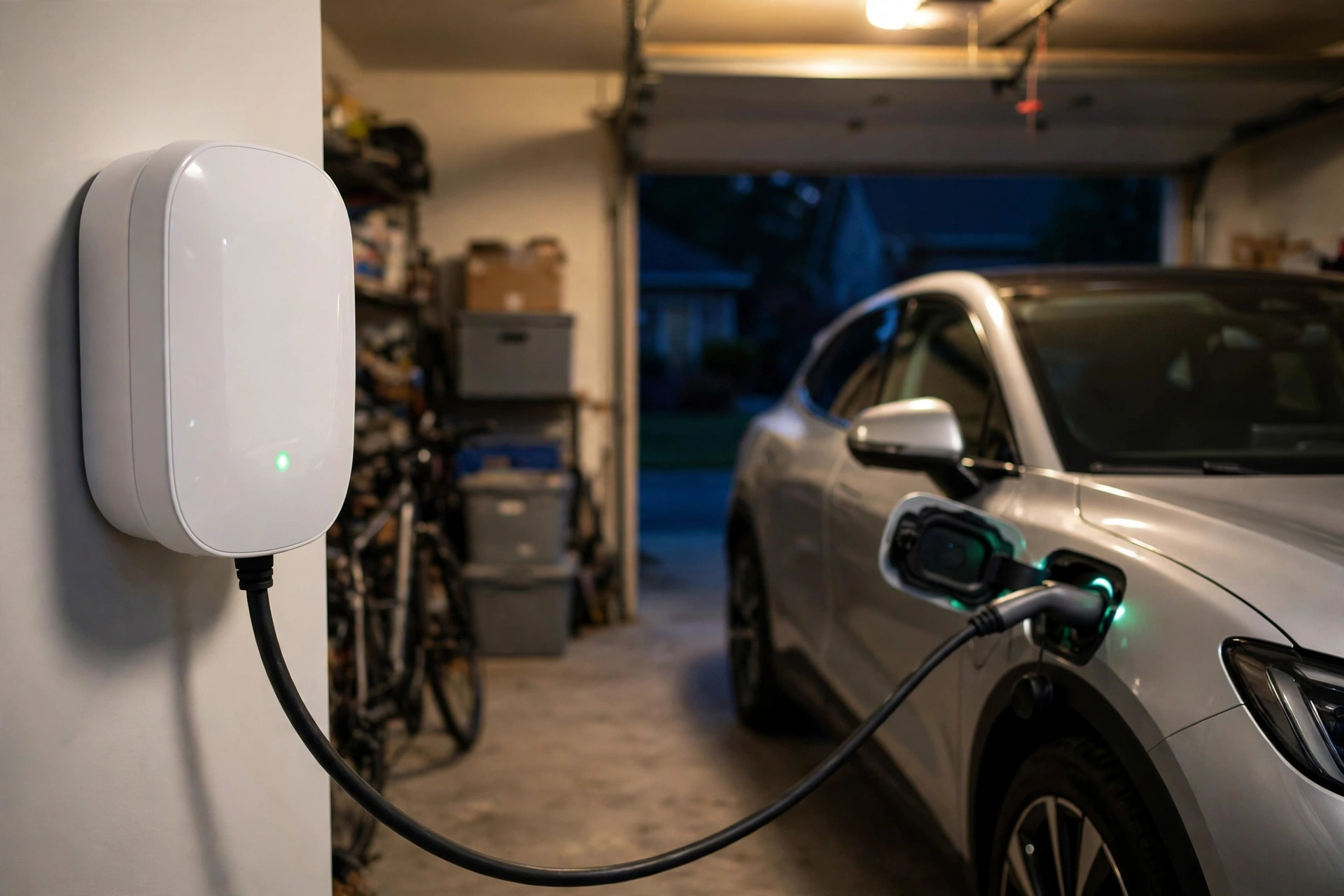
Take a Tesla Model Y, which uses roughly 250 Wh per mile in mixed driving (0.25 kWh/mi, est. from its EPA consumption figures). At the full 48-amp setting: 10.35 kW ÷ 0.25 kWh/mi = 41.4 miles of range per hour. At the 40-amp plug-in setting: 8.64 ÷ 0.25 = 34.6 miles per hour. The gap is 6.8 miles per hour. Over an eight-hour overnight session that gap grows to roughly 54 miles — the difference between waking up full and waking up at 85% after a long day’s driving. On a full eight hours, the 48-amp setting delivers about 82.8 kWh to the battery; the 40-amp setting delivers about 69.1 kWh.
Run the same maths on a thirsty vehicle. A Ford F-150 Lightning uses roughly 450 Wh per mile (0.45 kWh/mi, est.). At 48 amps: 10.35 ÷ 0.45 = 23.0 miles per hour. At 40 amps: 8.64 ÷ 0.45 = 19.2 miles per hour.
Filling the Lightning’s 131 kWh extended-range pack from 20% to 80% means adding 78.6 kWh, which takes 78.6 ÷ 10.35 = 7.6 hours at 48 amps and 78.6 ÷ 8.64 = 9.1 hours at 40 amps. Plug in at 10 p.m. and the hardwired car is done before 6 a.m.; the plugged-in car is still sipping at breakfast. If you drive an electric truck, the hardwire decision is not a detail. It is the whole decision.
Blunt version: the difference between 48 and 40 amps is 20% more power, every session, for the life of the charger. The difference between 11.5 kW and the 12 kW a rival advertises is 4%. People obsess over the second gap and shrug at the first. That is backwards.
Installation: hardwire it, and mind the GFCI trap
The 48-amp setting needs a dedicated 60-amp dual-pole breaker. The 40-amp plug-in setting needs a dedicated 50-amp breaker and — this is Emporia’s own instruction, not fine print — an industrial-grade, continuous-duty 14-50 receptacle from a maker like Hubbell, Leviton or Bryant. A $12 residential-grade outlet from a bargain bin is not rated for a car pulling 40 amps through it for eight hours a night. That is how outlets melt.
Second trap, also flagged by Emporia itself: current NEC rules require a GFCI breaker on circuits feeding a 14-50 outlet, and the Classic already has GFCI protection built in. Two GFCI devices on one circuit can nuisance-trip each other, leaving you with a dead charger and a half-charged car at 6 a.m. Emporia’s recommended escape is the hardwired installation, which does not carry the same outlet-GFCI requirement. My position is simple: hardwire this charger. You gain the full 48 amps, you delete the plug as a failure point, and you dodge the double-GFCI problem in one move. Renters and people who move every two years are the only exception.
Before the electrician quotes, work out what your panel can actually give. A 200-amp panel with a free 60-amp slot is the easy case. A loaded 100-amp panel is the interesting one, and it is where the Classic’s app-settable amperage earns its keep: you can run the unit at 32, 24 or 16 amps on a smaller breaker today and raise it later.
Our EV charger sizing calculator walks through the breaker and circuit maths for each setting. And if you are still deciding whether Level 2 is worth installing at all, read what a regular outlet can and cannot do — a wall socket gives you roughly 1.4 kW, which is 12% of what this unit delivers hardwired.
Scheduling, the app and time-of-use rates
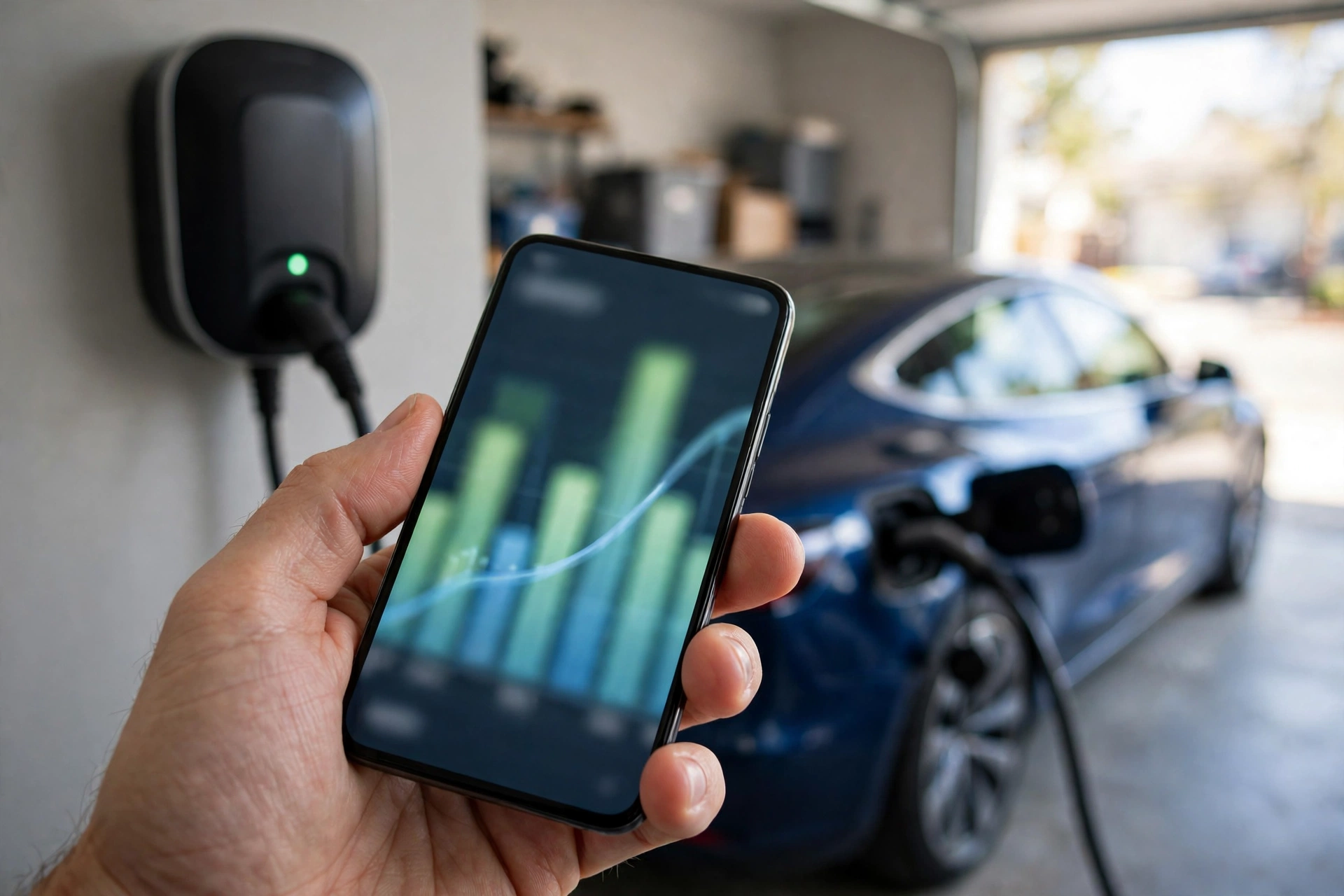
The emporia classic level 2 ev charger connects over 2.4 GHz Wi-Fi. No 5 GHz support — a real annoyance if your garage router is set to 5 GHz only, so check before install day. Through the Emporia app you get remote start/stop, charge scheduling, and a session history with energy and cost per charge. The app can sync with your utility’s time-of-use rate plan and shift charging into the cheap window automatically, or you set the window yourself. There is no subscription. Emporia charges nothing monthly for any of this, which should embarrass the brands that do.
What is that scheduling worth? Run it on stated assumptions. Drive 12,000 miles a year in the Model Y above: 12,000 × 0.25 kWh/mi = 3,000 kWh into the battery, which at 90% efficiency means 3,000 ÷ 0.90 = 3,333 kWh pulled from the wall (est.). On a time-of-use plan with a $0.30/kWh peak rate and a $0.12/kWh off-peak rate (est. figures, typical of published US TOU plans — yours will differ), charging whenever you get home costs 3,333 × $0.30 = $1,000 a year. Charging on the Classic’s off-peak schedule costs 3,333 × $0.12 = $400.
The saving is roughly $600 a year, every year, from a feature that costs nothing extra. It also moves your personal electric car cost per mile from 8.3 cents of electricity to 3.3 cents. Scheduling is not a smart-home toy. It is the highest-paid setting in the app.
Classic vs Pro: what the Classic does alone, and what needs a Vue
Be precise about the line-up, because Emporia’s own store blurs it. The Classic ($449) and the Pro ($599) charge at exactly the same speed — same 48 amps, same 25-foot cable, same three-year warranty. The $150 buys monitoring hardware and software bundled with the Pro: whole-home energy monitoring, solar charging integration, and PowerSmart load management. On the Classic, those three boxes are ticked “No” in Emporia’s own comparison table.
What the Classic does alone: it meters its own output. Every session’s kWh and cost show up in the app, tracked by day, week and month. What it cannot do alone is see the rest of your house. Whole-home monitoring needs Emporia’s Vue monitor in your panel (the Vue 3 sells for $199.99 on its own). PowerSmart — the feature that watches total household load and throttles the charger so a full panel never overloads — is sold for Classic owners as a $200 upgrade bundle (a whole-home Vue unit plus the software).
Do that maths before you buy: Classic at $449 plus the $200 PowerSmart upgrade is $649, which is $50 more than the $599 Pro that includes the whole package. If you already know your panel is tight, buy the Pro first and skip the penalty. If your panel has room, the Classic alone is the correct purchase and the Pro is $150 of features you will never switch on.
One ecosystem feature the Classic does get: Intelligent Load Sharing. Put two Emporia chargers — Classic, Pro, or one of each — on the same circuit or sub-panel, and they split the available power between two cars, giving a lone car the full rate and sharing when both are plugged in. For a two-EV household facing a panel upgrade quote in the thousands, that feature alone can pay for both chargers. Solar owners, note the limit: automatic charge-on-excess-solar is a Pro-and-Vue trick. The Classic can follow a schedule that approximates your solar hours, but it cannot chase live solar output by itself.
The emporia classic level 2 ev charger vs the Autel AC Elite and ChargePoint Home Flex
Numbers, not adjectives. The Autel MaxiCharger AC Elite Home 50A delivers a genuine 50 amps — 12 kW — for $498, and it is J1772 only; there is no factory NACS version. The ChargePoint Home Flex also reaches 50 amps and 12 kW, hardwired, at $549, with a 23-foot cable against the Emporia’s 25 feet. The Emporia counters with the lowest price and the longest cable of the three, and gives up 2 amps to both.
Reduce it to price per kilowatt, the only fair fight: Emporia J1772, $449 ÷ 11.5 kW = $39.04 per kW. Emporia NACS, $479 ÷ 11.5 = $41.65 per kW. Autel AC Elite, $498 ÷ 12 kW = $41.50 per kW. ChargePoint Home Flex, $549 ÷ 12 kW = $45.75 per kW. The Emporia J1772 is the cheapest power in this class, full stop.
And the Autel’s headline advantage — 12 kW against 11.5 — works out, after the same 90% efficiency discount, to about 1.7 extra miles per hour in a Model Y. Half a kilowatt is a rounding error wearing a bigger number.
The ChargePoint premium buys you the ChargePoint app and public-network account, not charging speed worth measuring; its own ChargerRater score from Tom Moloughney’s testing is 86 out of 100, against the Emporia’s 99 — a score that ties the highest his rig has given any home charger. Full specifications for both Emporia models sit on Emporia’s official EV charger page, and EnergySage’s independent Emporia charger review walks through the measured test results behind that 99.
Build, certifications and the small print
The enclosure is NEMA Type 4 — watertight, rated for indoor or outdoor mounting, which matters if your charger lives on an exterior wall in real weather. The certification stack is the correct one: UL 2594 for the EVSE itself, plus UL 2231, UL 2251, UL 991 and UL 817, compliance with NEC Article 625 and the SAE J1772 standard, and ENERGY STAR certification for standby efficiency.
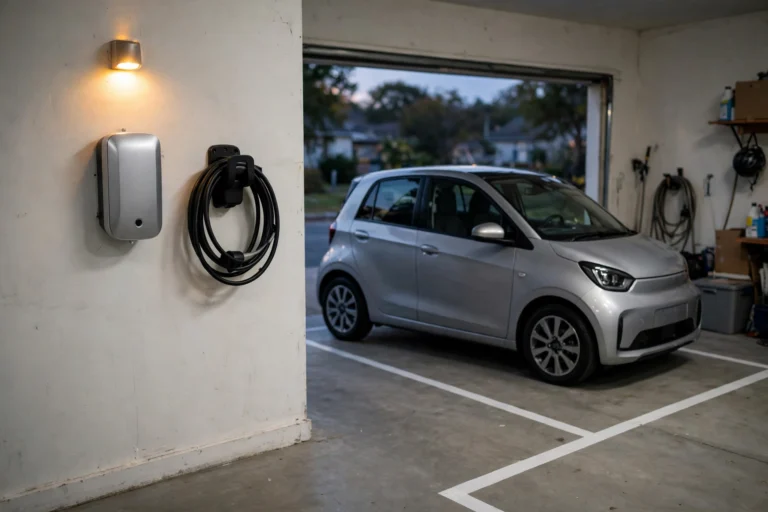
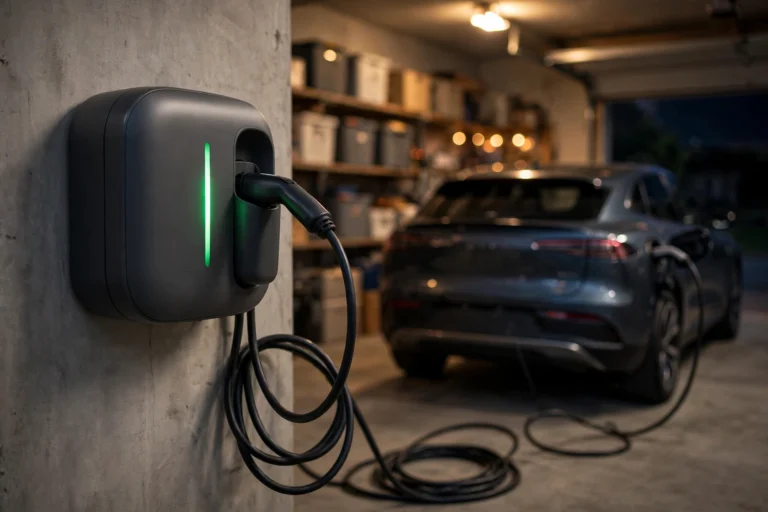
The 25-foot cable ends in a separate wall-mounted holder included in the box — the cable does not wrap around the unit, which keeps the garage wall tidy and the connector off the floor. The unit comes in white (model EMEVSE1) or black (EMEVSE1-B). Warranty is three years, returns are 60 days, shipping is free from Emporia’s store. Emporia also sells refurbished Classics at $409.99 with the same three-year warranty when stock exists — the smartest $40 saving in home charging, when you can catch one.
Two pricing traps to close on. Utility-program versions of this charger exist — a PG&E-channel unit lists at $495 for the identical white hardwired J1772 hardware that costs $449 direct. Same box, $46 for the privilege of buying it through a program page; check whether a rebate actually requires that channel before paying it. And remember that the $449 is the charger, not the installed cost: a 60-amp circuit run by an electrician is the real budget item, typically several times the price of the unit itself. Judge the emporia classic level 2 ev charger on its numbers, then judge the install quote separately and just as hard.
Our score: 8.8/10 — Output honesty: 9/10 · Monitoring & app: 8/10 · Value: 9.5/10. The output is exactly as rated, the app data is free and genuinely useful, and $39.04 per kilowatt is the number every rival in this guide fails to match. It loses marks for the monitoring upsell structure — whole-home data and load management should not cost a Classic owner $50 more than Pro buyers effectively pay — and for 2.4 GHz-only Wi-Fi in 2026.
Frequently asked questions
How fast does the emporia classic level 2 ev charger actually charge?
Hardwired, 11.5 kW at the wall and roughly 10.35 kW into the battery after conversion losses (est.) — about 41 miles of range per hour for a Model Y, 23 miles per hour for an F-150 Lightning. On a NEMA 14-50 plug it drops to 9.6 kW, roughly 35 and 19 miles per hour in the same cars. Your car’s onboard charger can lower these figures; it cannot raise them.
Should I buy the Classic or the Pro?
Buy the Classic if your panel can spare a 60-amp or 50-amp circuit — the charging hardware is identical. Buy the Pro at $599 if your panel is near capacity and you need PowerSmart load management or whole-home monitoring from day one, because adding PowerSmart to the Classic later costs $200, making the total $649. Solar owners who want automatic charging on excess solar also need the Pro with a Vue monitor.
Does the Classic work with a Tesla?
Yes, two ways. The $479 NACS version plugs straight in. The $449 J1772 version works with the J1772-to-NACS adapter Tesla includes with its cars. Given the adapter is already in your glovebox, the J1772 version is the rational buy for most Tesla households — and it keeps the charger compatible with every non-Tesla EV a guest or a future second car might bring.
Can I plug it into a dryer outlet or a standard socket?
No. The plug-in version needs a NEMA 14-50 outlet on a dedicated 50-amp circuit, with an industrial-grade receptacle. A dryer outlet is a 14-30 — different plug, smaller circuit — and Emporia does not offer it. A standard household socket is Level 1 territory at roughly 1.4 kW; this unit cannot run from one.
What breaker does the 48-amp setting need?
A dedicated 60-amp dual-pole breaker, hardwired. EV charging is a continuous load, so the circuit must be rated at 125% of the draw: 48 amps × 1.25 = 60 amps. The 40-amp plug-in setting needs a 50-amp breaker by the same rule. If your panel cannot offer either, the charger can be set lower in the app — 32, 24 or 16 amps — on a breaker sized to match.
Does the Emporia app charge a subscription?
No. Scheduling, session history, energy and cost tracking and time-of-use rate sync are all free in the app, with no paid tier. Whole-home monitoring is a hardware purchase, not a subscription — a Vue monitor in the panel — and it stays subscription-free as well.
Bottom line: the emporia classic level 2 ev charger is the value pick for most homes, provided you hardwire it. If your panel and car can use its full output, the emporia classic level 2 ev charger delivers fast, scheduled overnight charging at a fair price — and that is why the emporia classic level 2 ev charger earns our recommendation.
For most homes, the emporia classic level 2 ev charger is the straightforward choice: hardwire it, set an off-peak schedule, and let it charge overnight. If your panel and car can use the full 48 amps, the emporia classic level 2 ev charger gives you fast, low-cost home charging without a subscription — and that is why the emporia classic level 2 ev charger is the pick we recommend here.