Last updated: October 27, 2026
City commuting is a logistics problem wearing a bike costume. Where does it sleep? How do you lock it? What happens on the stairs? The velotric discover 2 is a step-through commuter that takes those questions seriously: a 750W motor, a big 705.6Wh battery, turn signals, Apple Find My tracking, and a rack rated for a proper grocery run. Velotric’s own store has it at $1,499 right now, down from a $1,999 list price (prices checked October 27, 2026). That sale price changes the whole conversation, and this review keeps coming back to it.
First, the number nobody puts in the headline. Velotric’s spec sheet claims 63 lbs. BikeRide put the bike on a scale and weighed 69 lbs. Six pounds of spec-sheet optimism. Sixty-nine pounds is fine on the flat, fine in an elevator, and a genuine workout up three flights of narrow stairs. One flight? Most adults can manage it, grumbling. Three flights, twice a day, in winter gloves? That is a lifestyle choice, and not a fun one. The battery pops out for indoor charging, which takes roughly 9 lbs (est., typical for a 48V 14.7Ah pack) off the lift and leaves the expensive bit safe inside with you.
The shape of the thing is pure city. Step-through frame only, with a low 15.35-inch standover height, an upright riding position, swept-back bars and 27.5-inch wheels wearing 2.4-inch puncture-resistant Kenda tires. Two sizes: Regular for riders 4’11” to 5’9″, Large for 5’6″ to 6’4″. Total length is 70 inches, so measure your hallway before you order. This bike does not fold, does not shrink, and does not apologize.
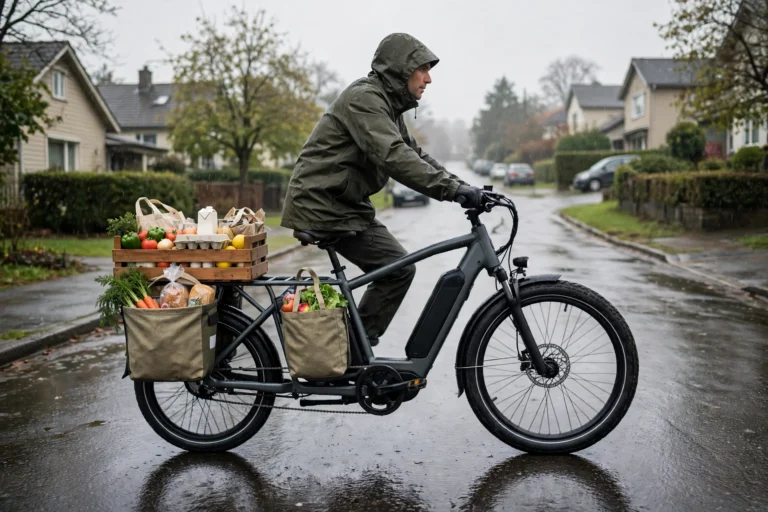
What it does instead is carry things and shrug off weather. The payload rating is 440 lbs, the rear rack alone is rated for 66 lbs and uses the MIK HD click system, so baskets and panniers snap on and off in seconds. The frame is rated IPX6 and the battery IPX7, which in plain terms means rain is a non-event. Full fenders, integrated lights and a kickstand are in the box. It arrives dressed for the job.
Velotric Discover 2 range: 75 claimed miles, about 40 tested
Velotric advertises up to 75 miles per charge. Treat that number as a weather forecast for a day that never comes. BikeRide’s instrumented range tests tell the real story: 30.34 miles at maximum assist (all 15 assist levels wound up, averaging 17.5 mph over 1,152 feet of climbing), and 40.62 miles at a mid assist setting (8 of 15, averaging 14.4 mph). Those are honest, useful numbers for a 705.6Wh battery pushing a 750W motor.
Do the energy maths and the tests line up neatly. At mid assist: 705.6Wh ÷ 40.62 miles = 17.4Wh per mile. At full assist: 705.6Wh ÷ 30.34 miles = 23.3Wh per mile. Now translate that into a commute. An 8-mile round trip at sensible assist gives you 40.62 ÷ 8 = just over 5 days between charges. A full working week on one plug-in. Ride everywhere in Boost because you can, and it drops to 30.34 ÷ 8 = about 3.8 days. Still fine. Just know which rider you are.
The range honesty score in our verdict reflects the gap between 75 and 40.6, not the battery itself. The battery is good. The percentage gauge is accurate, power stays consistent as the charge drops, and BikeRide found the motor kept assisting for half a mile after the display read empty. Plan around 40 miles, enjoy the surprise when gentle riding gives you more, and ignore the 75.
A small detail that earns trust on every ride: the display shows the remaining charge as a true percentage, and BikeRide found it fell in a steady, predictable line rather than dropping in sudden chunks the way cheap gauges do. That sounds trivial until you are deciding whether you can skip tonight’s charge. On the velotric discover 2, the number on the screen behaves like a fuel gauge you can plan a week around, and the motor delivers the same strength at 20% as it does at 90%. No sagging, no surprises at the far end of the week.
Charging the Velotric Discover 2: five hours, and the battery comes indoors
Charging is apartment-friendly, which cannot be said for every commuter bike. The pack unclips from the downtube, so the bike can live in a bike room or locked in a hallway while the battery charges under your desk or next to the kettle. The supplied charger is a 54.6V 3A unit, and a full charge takes about 5 hours. Plug in when you get home, full by bedtime. Plug in overnight, full by morning. Simple.
The cost is almost a rounding error. A full charge is 0.7056 kWh, so at an average US residential rate of about $0.17 per kWh (est.), one fill costs roughly 12 cents. Our guide to how much it costs to charge an electric bike breaks down the same sums for other battery sizes if you want to check your own tariff. The certifications matter more than the pennies: the battery is UL 2271 certified and the whole bike is UL 2849 certified. For a lithium battery that will live in your home, that paperwork is the feature. No certification, no indoor charging. That rule has no exceptions here.
One habit worth building: you do not need to charge to 100% after every ride. For a week of short commutes, running the pack between roughly 20% and 80% is kinder to the cells, and with 40 tested miles on tap you will not miss the top slice. Save the full charge for the long weekend ride.
The three-year maths: what a Velotric Discover 2 really costs per mile
Purchase price is the loud number. Cost per mile is the honest one. Here is the full sum for a typical city rider covering 2,000 miles a year — an 8-mile round-trip commute, five days a week, about 50 weeks a year — over three years, so 6,000 miles in total.
Electricity first. At the tested mid-assist consumption of 17.4Wh per mile: 6,000 miles × 17.4Wh = 104.4 kWh drawn from the battery. Add about 12% for charger losses (est.) and you buy roughly 117 kWh from the wall. At $0.17 per kWh (est.), that is $19.89. Call it $20 for three years of fuel.
Then the wearing parts, all (est.) at typical shop prices: two sets of brake pads at $30, one chain at $20, one set of tires at $110, and two tune-ups at $160. Total consumables: $320 (est.). Add it up: $1,499 purchase + $20 electricity + $320 consumables = $1,839. Divide by 6,000 miles and you get $0.31 per mile. Thirty-one cents a mile, all-in, for a bike that also does your grocery run. If you want to test your own mileage and prices, our total cost of ownership calculator runs the same kind of sum for EVs of every size.
Now the comparison that matters at the checkout. Rivals should be judged per tested mile, not per claimed mile. The Discover 2 at its $1,499 sale price: $1,499 ÷ 40.62 tested miles = $36.90 per tested mile of range. The Aventon Level 3, a close rival at $1,899, managed 53.26 miles in BikeRide’s mid-setting test: $1,899 ÷ 53.26 = $35.66 per tested mile. Nearly a tie. The Level 3 goes further per charge and carries a cleverer security system; the Discover 2 costs $400 less today and carries 140 lbs more payload. Pick your priority. At the Discover 2’s full $1,999 list price, though, the maths flips and the Aventon wins. Sale price is doing heavy lifting in this review.
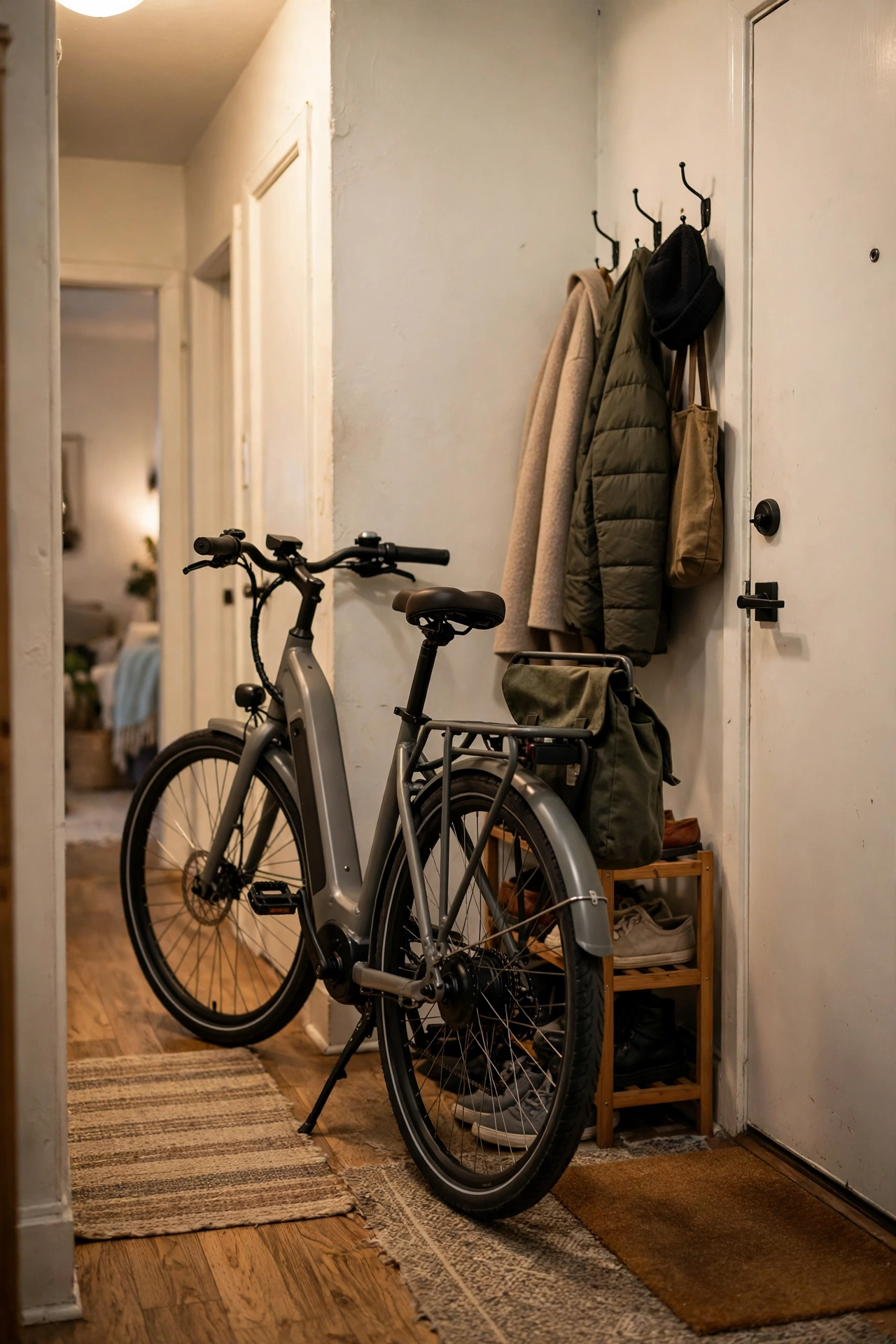
Locking it, tracking it, and the theft stuff nobody mentions
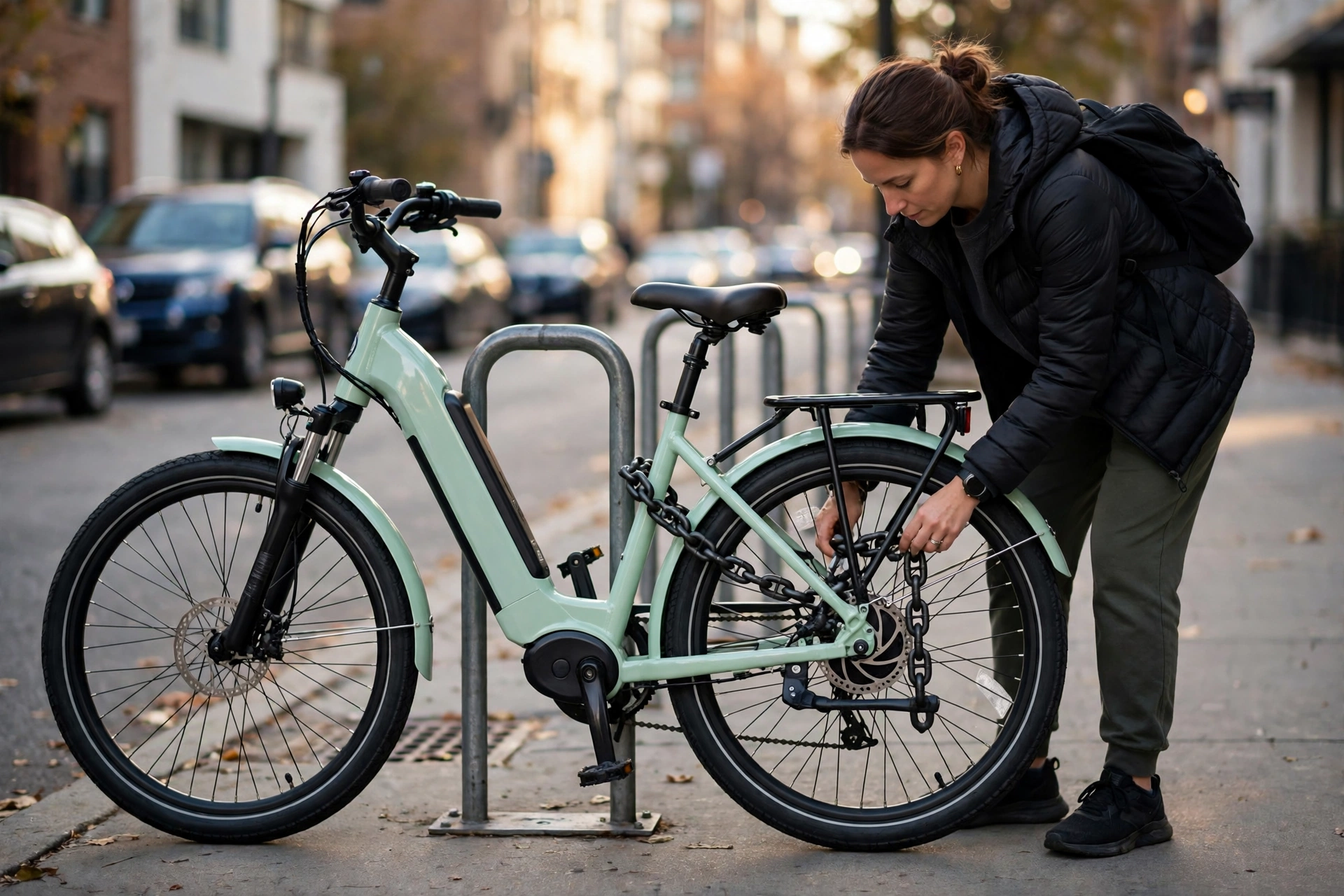
The velotric discover 2 has Apple Find My built into the frame. If the bike vanishes, your phone can point at a map. That is a recovery tool, and a genuinely good one. It is not a lock, it is not an alarm, and it does not stop anyone. Budget for a serious chain or a heavy U-lock on day one, lock to fixed racks rather than railings a thief can lift the bike over, and take the battery indoors overnight. A missing battery makes a stolen bike much harder to sell.
Here is the detail testers flagged and most listings skip: there is no electronic power lock. Anyone can walk up to your chained bike, switch it on, and scroll through the settings. They cannot ride away through a good chain, yet the omission is odd on a bike this connected. Velotric could fix it in firmware. Until then, the chain is the security system and Find My is the insurance policy.
Weight cuts both ways in the theft maths. At 69 lbs, nobody is casually carrying this bike up a street and into a van without a struggle and a second person. Determined thieves use vehicles, so do not rely on bulk alone. The winning routine is boring: fixed rack, heavy chain through the frame, battery inside, Find My switched on. Boring keeps bikes.
SensorSwap and the class switch: two ride feels in one menu
SensorSwap is Velotric’s headline trick, and it earns the name. The bike carries both a torque sensor and a cadence sensor, and you choose which one runs the show. Torque mode measures how hard you push and answers in proportion: natural, lively, the choice for riders who still want a workout. Cadence mode simply notices the pedals turning and delivers steady help: relaxed, predictable, the choice for tired legs and headwind Fridays. Fifteen assist levels sit on top, split across Eco, Trail and Boost modes with five levels each.
One annoyance, noted by BikeRide and worth repeating: sensor switching lives only in the phone app. Nearly everything else adjusts on the big 3.5-inch color display, so the app-only detour for the bike’s signature feature feels unfinished. Minor. Slightly irritating. Not a dealbreaker.
The class settings are handled better than most. The bike ships as a Class 2 at 20 mph with a thumb throttle. In the settings you can set the top speed anywhere from 12 to 28 mph, and the throttle unbolts if you want true Class 1 or Class 3 compliance where throttles are banned. Our Class 1 e-bike guide explains what each class allows and where, since the rules genuinely change between trail networks and states. Set the bike to match where you actually ride, not where you wish you rode.
The daily ride: brakes, bumps and grocery duty
Stopping a 69 lb bike carrying a rider and a week of shopping takes real brakes, and the Tektro two-piston hydraulic discs with 180mm rotors front and rear are real brakes. Strong, calm, one-finger braking. The 80mm suspension fork takes the sting out of cracked pavement, the wide tires add their own cushion, and the upright position keeps traffic visible. Turn signals, a brake-activated rear light and a 130-lux headlight are built in, not bolted on. Cruise control exists too, for long flat stretches of bike path.
Fit needs one warning. Velotric says the Large suits riders up to 6’4″. BikeRide’s 6’0″ tester had the seatpost at maximum height for proper leg extension, and riders with an inseam over 32 inches will likely find it small. Under six feet? Both sizes are comfortable and the low step-through makes stops easy. Over six feet? Sit on one at a dealer first — Velotric lists more than 1,600 partner shops in the US, which makes that test easy to arrange.
Weekend duty is paved paths and packed gravel, where it is happy and stable. It is also a reasonable starting point if your rides are getting longer, as our e-bike trekking guide describes for riders building up distance. Leave the rock gardens to mountain bikes. The Discover 2 knows its job and does it without drama.
Hills, since every city has one street that tests your choices. The 750W motor peaks at 1,100W and makes 75Nm of torque, which is plenty for loaded city grades: it will haul a rider plus a rack of shopping up the sort of hill that has cyclists standing on their pedals, with the throttle there as a bailout at junctions. BikeRide’s measured hill climbs put the velotric discover 2 around the average for its class rather than at the top of it, and the honest translation is this: it climbs like a strong commuter, not like a lightweight sport bike dragging 30 fewer pounds. Keep pedaling, keep your momentum, and it never feels strained. Stop halfway up a steep ramp and ask the throttle to restart the whole load alone, and you will find the edge of what 75Nm can do.
Our verdict: who should buy the Velotric Discover 2
Our score: 8.4/10 — City practicality: 8/10 · Range honesty: 7/10 · Value: 9/10
Every figure in this review comes from Velotric’s own listings, BikeRide’s instrumented testing, or arithmetic shown on the page; our research method page explains how we check specs before printing them. On Velotric’s official product page you can confirm the current price and spec for yourself, which is exactly what you should do before ordering any e-bike.
Buy it if your commute is 3 to 12 miles, your building has an elevator or a ground-floor bike room, and you want one bike that handles work, shopping and weekend paths without a fuss. At $1,499 it is the commuter deal of the moment. Skip it if your home is up three flights of stairs, if you are over six feet tall with long legs, or if the price jumps back to $1,999 — at list money, rivals with longer tested range take the lead. Know your stairs, know your inseam, and the decision makes itself.
One last city test worth doing before you pay: take the velotric discover 2 off the shop floor and wheel it through a doorway, turn it in a tight space, and lift the front wheel over a curb. Specs cannot tell you how a 70-inch, 69 lb bike will live in your building. Ten awkward seconds in the shop will.
Frequently asked questions
How far does the velotric discover 2 really go on one charge?
Plan on about 40 miles. BikeRide measured 40.62 miles at a mid assist setting and 30.34 miles at maximum assist. The advertised 75 miles assumes the gentlest assist, a light rider and kind terrain. A week of 8-mile round-trip commutes on one charge is realistic at sensible assist levels.
How long does the battery take to charge?
About 5 hours from empty with the supplied 3A charger. The battery unclips from the frame, so you can charge it indoors at home or at your desk while the bike stays locked downstairs. A partial top-up for the ride home takes proportionally less — roughly an hour buys you back about 8 tested miles (est.).
Is it too heavy for apartment stairs?
It depends on your stairs and your arms. Velotric claims 63 lbs; testers weighed 69 lbs. Removing the battery cuts roughly 9 lbs (est.). One flight is doable for most adults. Three flights, twice daily, will wear down your enthusiasm fast — in that building, a lighter or folding bike is the smarter buy.
Can it really do 28 mph, and is that legal?
Yes and it depends. The velotric discover 2 ships limited to 20 mph as a Class 2 bike with a throttle. The settings let you raise the limit to 28 mph, which makes it Class 3, and the throttle can be removed for places that ban throttles on Class 3 bikes. Check your local rules before unlocking the speed; some trails and cities restrict Class 3 bikes.
Does Apple Find My mean I can skip buying a lock?
No. Find My helps you recover a stolen bike; it does not stop the theft, sound an alarm, or even lock the power — anyone can switch the bike on while it is parked. Buy a heavy chain or U-lock, use fixed racks, and bring the battery indoors. Find My is your second line of defense, never the first.
Which size should I choose if I am around 6 feet tall?
The Large, with a caveat. Velotric rates it to 6’4″, yet a 6’0″ tester needed the seatpost at its maximum, and inseams over 32 inches may not get full leg extension. If that sounds like you, test-ride at a dealer before buying rather than ordering blind.