Last updated: October 27, 2026
Somewhere near your front door there is probably a black brick with a cable at each end, and one day it will stop working, or get left at a relative’s house, or vanish the way chargers do. When that happens you will search for a replacement electric scooter charger and find a wall of lookalike bricks, all cheap, all promising to fit everything. Take a breath. This is a solvable problem, and it does not require you to become an electrician.
Here is the good news first. A scooter charger is not mysterious. It is a small power supply that takes the strong electricity from your wall socket and serves it to the battery at the exact strength the battery was built to drink. Every charger carries a label stating that strength, and every scooter battery has one correct answer. Your whole job — the whole of this guide, really — is reading two labels and making them agree.
This guide is written for people who bought a scooter to get to work, to the shops, to a friend’s house — not to study electronics. Nothing here needs tools beyond a phone camera and, if you have one, a cheap ruler. Where something is genuinely a job for the manufacturer or a repair shop, I say so plainly.
And the safety promise, up front: the single most protective habit with any charger costs nothing. Use the charger that matches your scooter, stay in the home while it runs, and unplug when the light turns green. Everything else in this guide is detail underneath that one rule. One comfort note: if bending to a floor-level socket is hard for you, choose a charger with a longer cable, so the brick can rest on a shelf at waist height. Cable length is a real feature.
The three things that must match on any electric scooter charger
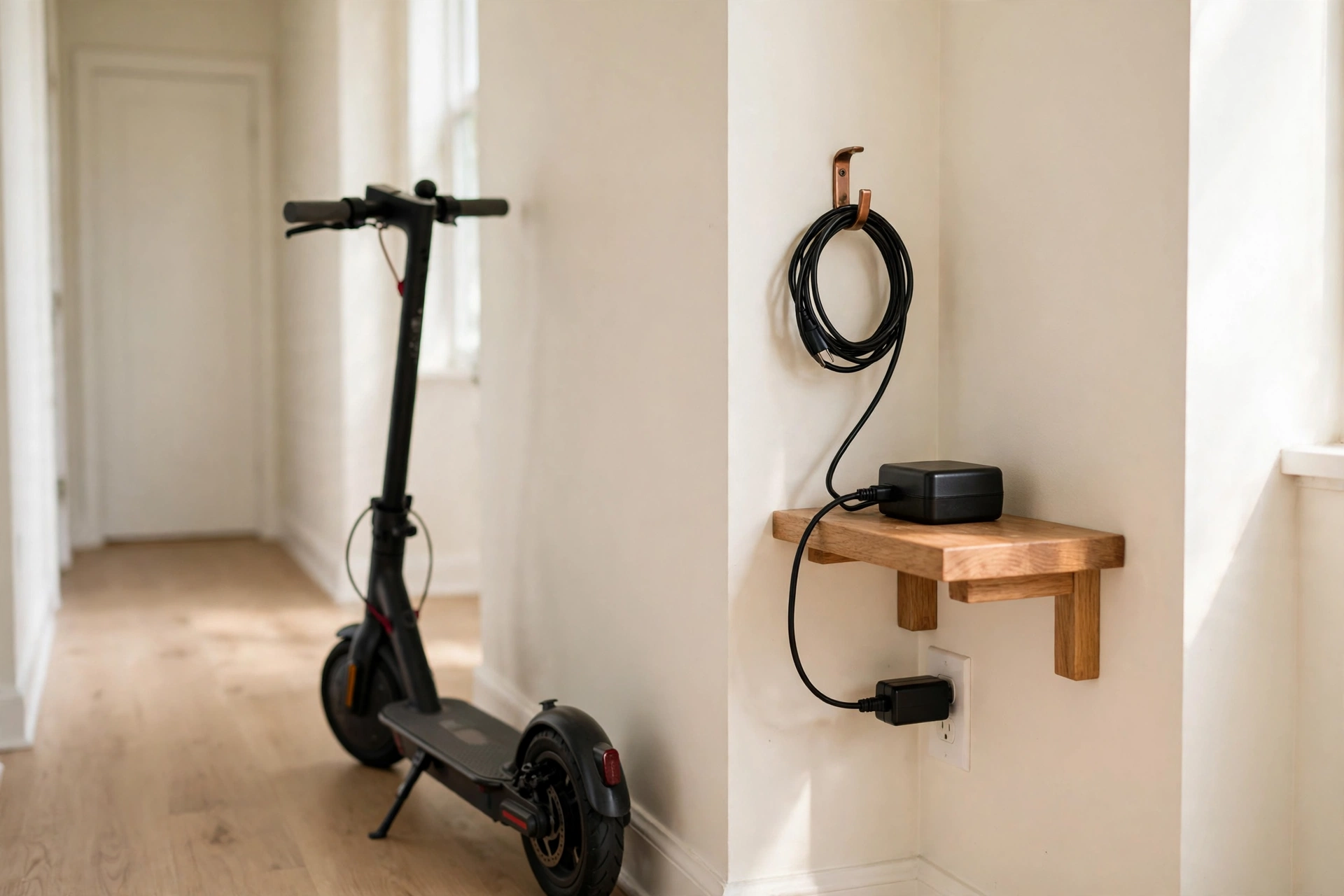
Think of it as a three-key lock. The first key is voltage — the strength the charger delivers, printed on its label as “Output” and measured in volts (V). The second key is the connector — the plug at the end of the cable. The third key is polarity — which way round the electricity flows through that plug. Get all three right and the charger is correct. Get any one wrong and the best outcome is that nothing happens; the worst are a damaged battery or, rarely but really, a fire.
The fourth number, amps (A), works differently: it does not have to match exactly, because amps describe how fast the charger pours, and the scooter’s battery management system — its built-in supervisor, called the BMS — only accepts what the battery can take. A similar or slightly higher amp rating than the original is usually acceptable. Voltage is the strict one. Voltage must match. We will take each key in turn.
Where do you find your scooter’s answers? Three places, in this order. First, the label on your original charger, if you still have it — photograph it before you lose it entirely. Second, the scooter’s manual or the maker’s support page, which lists the charger’s output voltage and current. If both are missing, email the manufacturer with your model name and serial number and ask for the charger specification in writing.
Why your electric scooter charger says 42 volts on a “36-volt” scooter
This is the point that confuses almost everyone, so let us go gently. A battery’s headline voltage — 36V, 48V and so on — is its nominal voltage, a sort of average for the name tag. A lithium battery is a row of small cells, and each cell is genuinely full at 4.2 volts. A “36-volt” pack is ten cells in a row: it rests around 36 volts in use, and to fill it completely the charger must gently push at 42 volts — ten times 4.2. So a charger for a 36V scooter correctly says 42V output on its label. That is not a mismatch. That is the match.
The same arithmetic runs through every size of scooter battery:
- 24V system (small kids’ and light scooters, like the Gotrax GKS) → charger output 29.4V
- 36V system (most commuter scooters, like the Segway Ninebot Max range and the Gotrax GXL V2 and G4) → 42V
- 48V system (stronger commuters and mid-range performance scooters) → 54.6V
- 52V system (enthusiast scooters and e-bikes) → 58.8V
- 60V system (high-performance scooters) → 67.2V
- 72V system (flagship machines like the Kaabo Wolf King GTR) → 84V
Two lessons hide in that table. First, the pattern never changes — the charger number is about 17 percent higher than the battery’s name. Second, notice how close some of these sit. A 42V charger on a 48V scooter will simply never fill it. A 54.6V charger on a 36V scooter is a genuine hazard: it will try to push a smaller battery well past full. So the voltage check comes first, before price, before plug shape, before everything. Read the output line on the label out loud. If it does not match your scooter’s charging voltage, stop there, however good the bargain looks.
One variation worth knowing: some scooters, including Segway’s Max G2, hide the charger inside the scooter itself. On those, what you carry is just a power cord — the Max G2’s manual lists a built-in charger delivering 42 volts at 2.9 amps — and a “replacement charger” is really a replacement cord. If your old setup had no brick at all, your scooter is one of these, and shopping becomes much simpler.
Connectors: the plug that fits can still be the wrong plug
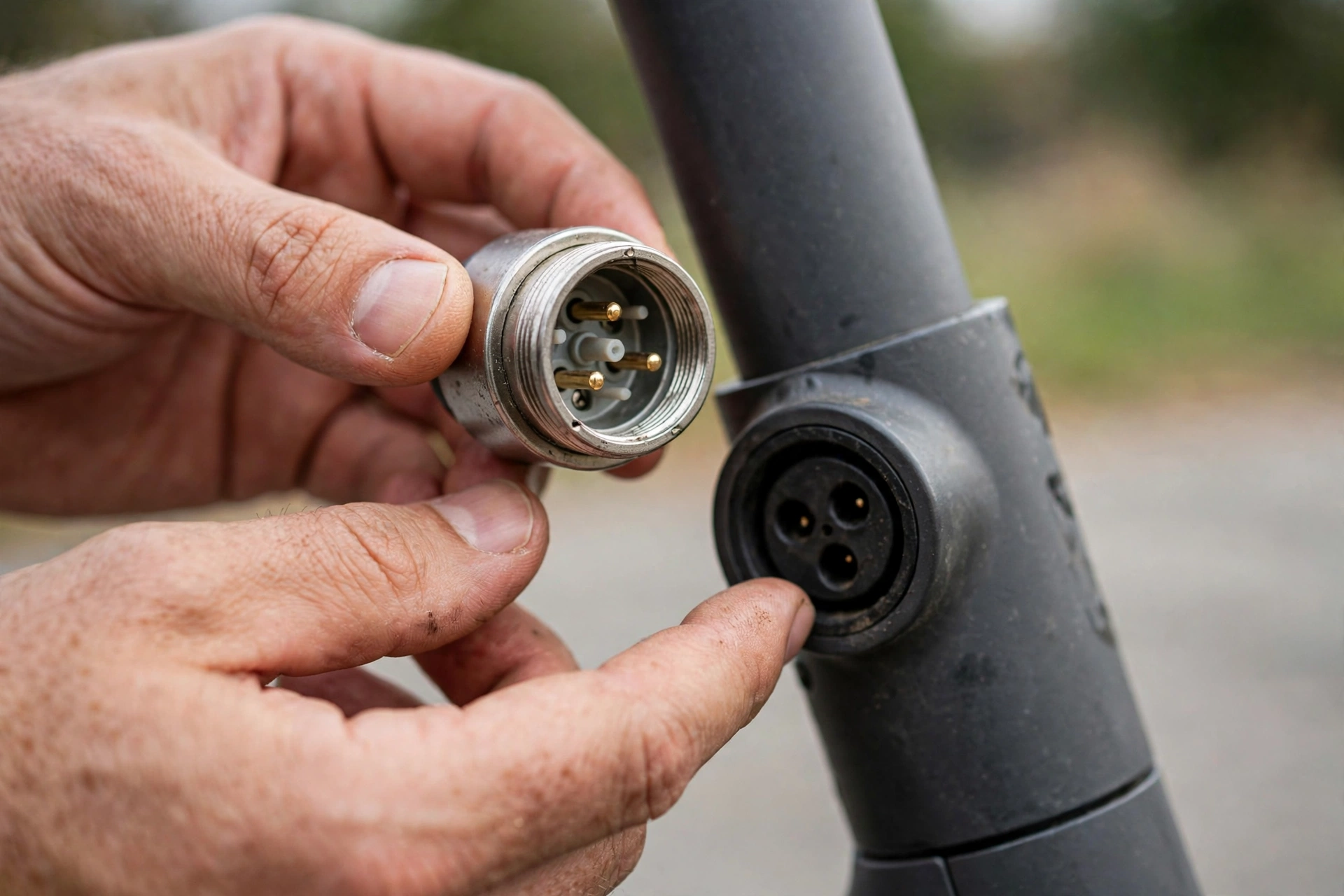
Sadly, the industry never agreed on one plug. The barrel plug is the round pin found on most commuter scooters; it comes in sizes measured in millimetres, most often 5.5mm across the outside with a 2.1mm or 2.5mm hole in the middle — and those two look identical until one wobbles. The XLR plug is a chunkier three-pin round connector, borrowed from microphone cables, common on mobility scooters and older models. The GX16 “aviation” plug is a metal-ringed connector that screws snug, used on performance scooters; Kaabo’s manuals even print the pin layout (“1+ 2−”) because which pin is positive matters. And some brands use proprietary plugs shaped to fit nothing else on Earth — annoying, right up until you realise it also makes the dangerous mistakes impossible.
The calm way to identify yours takes two minutes. Photograph the charge port and the plug on your old charger, close up, with a ruler or a coin beside them for scale. Count the pins. Then, when a listing claims to fit your model, compare all three: the photograph, the pin count, and the printed output voltage and amps. A listing that only says “fits most scooters” without printing those numbers is asking you to gamble, and it is fine to walk away from it.
Polarity is the invisible third key. On nearly every electric scooter charger the centre pin is positive, and a correctly made charger follows that. But a wrongly wired bargain charger can reverse it, and reversed polarity can damage the charge port and the battery’s supervisor board in seconds. Remember: a plug sliding in smoothly proves only that the hole is the right size. It says nothing about the electricity behind it.
Amps: how fast is fast enough, and when fast turns unkind
Amps are the pouring speed, and the sums are simple enough to do on a napkin. Take Segway’s Ninebot Max G2 as our worked example, because Segway publishes everything: its battery holds 15.3 amp-hours (551 watt-hours), and its built-in charger pours at 2.9 amps.
Divide the battery size by the pouring speed and you get the rough charging time:
- 15.3 Ah ÷ 1.5A (a small budget brick) = about 10.2 hours of pure pouring — realistically 11 to 12 hours (est.), because every lithium charge slows down for the final stretch as the battery tops off
- 15.3 Ah ÷ 2.9A (the G2’s own charger) = about 5.3 hours — and indeed Segway’s manual says roughly 5 hours, with independent tests landing near 6
- 15.3 Ah ÷ 5A (a fast charger, sold for the Max series at around $59 by the specialist retailer Levy Electric) = about 3.1 hours — realistically 3.5 to 4 hours (est.) once that slow final stretch is included
So a faster electric scooter charger is real, and for a delivery rider or a two-trip day it can be worth having. But speed has a cost measured in warmth. Pouring fast makes the battery warmer, and warmth, repeated daily, is what ages lithium cells. The gentle rule of thumb used by battery engineers is to keep everyday charging at or below about 0.5C — in plain terms, an amp number no bigger than half the battery’s amp-hour number. The G2’s own 2.9A on a 15.3Ah battery is a relaxed 0.19C, part of why those scooters last. A 5A charger on the same scooter is 0.33C — fine as an occasional hurry-up. The same 5A brick on a small scooter with a 7.8Ah battery would be 0.64C, and that is a charger working a little battery hard, every day.
At the far end of the scale, the big machines solve this by splitting the job. The Kaabo Wolf King GTR carries a 72-volt, 35Ah battery — about 2,520 watt-hours — and Kaabo supplies two 84V 2A chargers that plug in at once for a roughly 8.5-hour charge, with optional 5A chargers bringing that near 3.5 hours. It is not a reason to improvise with two random bricks, though: use the pair the maker specifies.
What does a charge cost? Delightfully little: the G2’s battery, allowing roughly 15 percent lost as heat (est.), draws about 0.65 kilowatt-hours from the wall — about 11 cents at a typical US home rate of 17 cents per kWh. Even the giant Kaabo pack works out near 50 cents. Our guide to what it costs to charge an electric bike runs the same sums for two-wheelers of every size.
The safety section: why “universal” chargers keep appearing in fire reports
Please read this section even if you skim the rest, because this is the one that protects your home. The US Consumer Product Safety Commission — the federal safety agency — publishes a short, clear page on micromobility battery charging safety, and its advice is plain: only use the charger supplied with your device or an approved replacement, always be present when charging, never charge while sleeping, and follow the manufacturer’s instructions. That guidance exists because mismatched charging is one of the known routes to the sudden, fast lithium battery fires that fire services now train for.
The sharpest example is the so-called “universal” charger — one brick advertised as suitable for many brands and voltages at once. The CPSC has linked two specific universal chargers sold online to 47 reported fires and over $100,000 in property damage, and Consumer Reports has publicly urged retailers to stop selling universal chargers for exactly this reason. As one CPSC commissioner put it, even good batteries can cause fires when used with incompatible chargers. The battery’s supervisor board is a last line of defence, not a permission slip; a mismatched electric scooter charger can lean on that defence until it fails.
So here is my position, without hedging: never buy a charger whose selling point is that it fits everything. It matches one voltage, one connector, one polarity — yours. A charger that boasts about fitting forty models was built to nobody’s exact specification, and your battery pays for the difference.
The practical shopping translation is short. Look for a genuine UL or ETL mark on the label — tested by a recognised laboratory — and treat a lone “CE” or “FCC” logo on a no-name brick as decoration, since those can be self-declared. Buy from the scooter’s maker or a named specialist retailer rather than an anonymous marketplace seller. Charge on a hard, clear surface away from bedding and exits, stay home while it runs, and unplug at the green light. If a charger ever becomes too hot to hold comfortably, smells of chemicals, or starts buzzing loudly, stop using it. That is not a quirk. That is a warning.
Before you buy a new electric scooter charger, check these five things
An electric scooter charger is blamed for many deaths it did not commit. Before spending anything, walk this short list in order — it takes five minutes and it starts at the wall, not the shop.
- The outlet. Plug a lamp or phone charger into the same socket. If it is dead too, you have a tripped breaker or a tripped GFCI (the little test/reset socket found in bathrooms and garages), not a broken charger.
- The charger’s light and sounds. Most bricks show a light when they receive power, and many have a small fan. A brick with no light, no warmth and no fan on a live outlet is likely the failed part. A light that turns green the instant it meets the scooter usually means the connection is not being made at all — which points to the next step.
- The scooter’s charge port. Look inside it with your phone’s torch. Bent pins, green corrosion, a melted edge or a missing rubber cap all interrupt charging, and a damaged port will defeat every new charger you buy. Port damage is a repair-shop job, not a shopping job.
- Temperature. Many scooters refuse to charge when the battery is very cold or has just been ridden hard, and quietly accept a charge an hour later indoors. If the scooter came in from freezing weather, patience is the diagnostic tool.
- A borrowed charger. If a friend has the same model, one careful test with their charger separates “charger died” from “scooter needs help” better than any guess.
One firm boundary: if your charger model has a replaceable fuse listed in its manual, changing it is fine. Beyond that, do not open a charger brick — capacitors inside can hold a charge after unplugging, and nothing inside is user-serviceable. A dead brick is replaced, not repaired at the kitchen table.
A spare charger, a second home for it, and the 80 percent habit
Once your scooter is charging again, consider the purchase that makes the whole problem smaller next time: a second electric scooter charger. Commuters keep one at home and one at work, which removes the daily carrying, the forgotten-brick mornings, and most of the temptation to borrow a colleague’s almost-right charger. Buy the spare the same way you bought the replacement: maker’s own or a listed, specialist-sold equivalent, matched on all three keys.
Prices, checked October 27, 2026, so you can budget honestly: unbranded marketplace bricks for common voltages start around $15 to $35; a specialist retailer’s standard charger for the Segway Max series starts at about $24, with their 42V 5A fast option at about $59; a genuine Segway Ninebot 42V charger from the brand’s own storefront listings sits around $40. Those are sane prices for a part your home’s safety leans on.
Then there is the kind upgrade: a smart charger. Grin Technologies’ Cycle Satiator is the best-known example — Grin’s own product page describes a programmable unit, certified (CSA, UL and CE listed) and currently $295, that saves charging profiles, including one that stops at about 80 percent. Why stop early? Lithium batteries age fastest at the very top of charge, and partial charging can substantially extend a pack’s cycle life. The habit that follows is gentle: 80 percent for ordinary days, 100 percent only the night before a long ride. Cross-checking a different two-wheeler as well? Our charger compatibility checker walks through the same matching logic.
Our verdict on buying a replacement charger
Our score: 8/10 — Safety of the typical buying route: 6/10 · Clarity of maker specs: 7/10 · Value of OEM vs third-party: 9/10.
The safety score is the sober one: the typical route — a search, a marketplace, a cheap brick — is genuinely risky, and it only becomes safe when you slow down and do the three-key check. Clarity scores middling because makers print the numbers but bury them in manual tables. Value scores highest, and here is the second firm position of this guide: the manufacturer’s own electric scooter charger is the bargain. Around $40 buys the exact specification, a real listing mark and a returns desk. Against the price of a battery — let alone a fire — the saving from a $17 no-name brick is the worst trade in all of scooter ownership. If you ride something like the Ninebot Max G30P we covered in full, or a flagship like the Kaabo King GTR, the charger is part of that machine’s design. Treat it that way. Our research method page shows how every figure in this guide was checked.
Frequently asked questions
Can I use a different electric scooter charger if the plug fits?
No — not on the strength of the plug alone. A barrel plug sliding in only proves the hole is the right diameter. The replacement must also match your charging voltage exactly (42V for a 36V scooter, 54.6V for a 48V one), carry the same polarity, and deliver a sensible amp rating. If all four agree, a good third-party charger is fine. If any one disagrees, the fact that it fits is the most dangerous thing about it.
Why does my charger say 42V when my scooter is 36V?
Because 36 volts is the battery’s average, name-tag number, while a full lithium cell sits at 4.2 volts. Ten cells in a row need 42 volts to fill completely, so the charger is labelled with the filling voltage, not the name-tag one.
Will a faster charger damage my battery?
Used occasionally, a moderately faster charger within the maker’s limits is fine — the battery’s management system controls what it accepts. Used daily at a high rate, the extra warmth slowly ages the cells. A kind everyday ceiling is roughly half the battery’s amp-hour number in amps (0.5C): about 7A for a 15Ah pack, 4A for an 8Ah pack. When in doubt, the amp rating of the charger your scooter came with is the maker’s own answer.
My charger light turns green instantly. Is the charger broken?
Usually not. Instant green most often means the circuit is not being completed: a damaged or dirty charge port, a plug not fully seated, or a battery that has a fault and is refusing charge. Work through the five checks above — outlet, light and fan, port, temperature, a borrowed charger — before buying anything.
Can one charger serve two different scooters?
Only if both scooters share the same charging voltage, connector and polarity — two commuters from the same family, for instance. The moment the models differ, check all three keys for each scooter separately; if even one differs, each scooter keeps its own charger. Programmable smart chargers with saved profiles are the one legitimate exception, and they are a deliberate, checked setup, not a hopeful one.