Last updated: October 27, 2026
Verdict first. The chevy electric vehicle range story has one king, one honest bargain, one styling tax and one trap. The king is the Silverado EV Work Truck with the Max Range battery: 493 miles EPA-estimated, and testers have beaten that number. The honest bargain is the Equinox EV, the rare car that went farther in an independent test than on its window sticker. The styling tax is the Blazer EV. The trap is a set of 22-inch wheels that deletes 29 miles from a Blazer EV before you leave the dealership. Rank chevy electric vehicle range claims by the sticker alone and you will get two of those four wrong.
So here is the method. Every car below gets three numbers, not one. The EPA rating, because it is the only figure measured the same way across the range. The best credible tested figure beside it, from instrumented tests by Edmunds, Car and Driver, Consumer Reports or MotorTrend. And a planning number: what you should actually count on in deep winter, using a 35 percent cold-weather cut (est.) as the midpoint of the 30 to 40 percent loss band that cold-climate testing keeps producing. Sticker numbers sell cars. Planning numbers get you home.
The chevy electric vehicle range leaderboard
Four models, four very different range stories. Prices below were checked October 27, 2026, and the range ratings are the EPA-estimated figures Chevrolet publishes, which you can cross-check any time against the fueleconomy.gov listings for each car.
| Model | EPA range | Best tested figure | Winter planning figure (est.) | Price |
|---|---|---|---|---|
| Silverado EV Work Truck, Max Range | 493 miles | 539 miles (Edmunds) | 320 miles | Lineup from $54,895; Max Range around $74,200 (est.) |
| Equinox EV, front-wheel drive | 319 miles | 356 miles (Edmunds) | 207 miles | $36,490 (LT 1, incl. destination) |
| Blazer EV, front-wheel drive | 312 miles | No clean FWD test; AWD tested at 200 miles at 75 mph (Car and Driver) | 203 miles | $46,095 (LT, incl. destination) |
| Bolt, 2027 | 262 miles | 217 miles at 70 mph (MotorTrend) | 170 miles | $28,995 (LT, incl. destination) |
Read the tested column twice. Two of these cars beat their stickers in independent hands. One matched the pattern every EV owner learns eventually: fine at 70 mph, punished at 75. One has not been on sale long enough to earn a full instrumented verdict, and it is the cheapest car here by nearly eight thousand dollars.
Silverado EV: 493 miles, and the testers found more
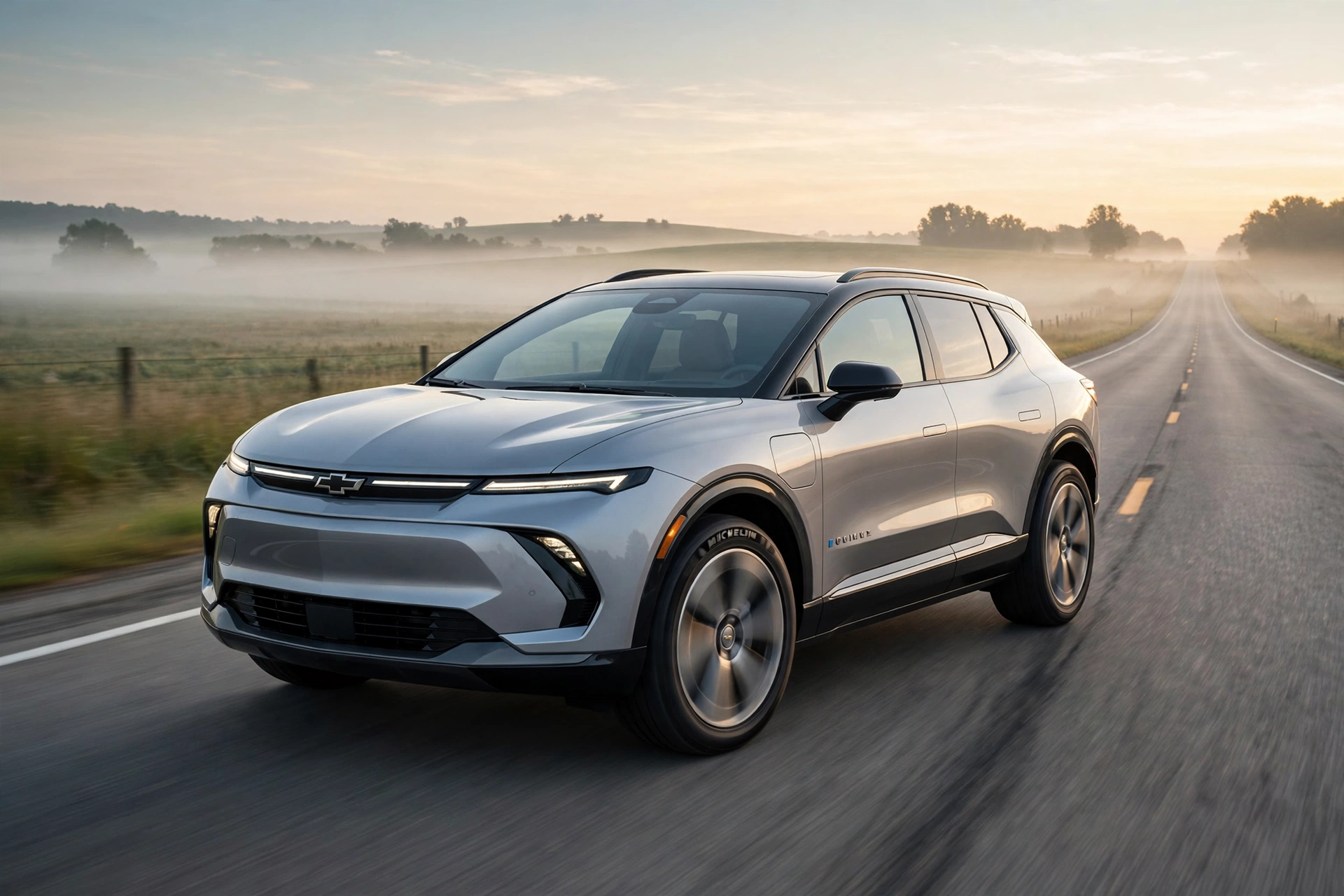
Start at the top. The Silverado EV is the only Chevrolet where the battery choice matters more than the trim choice. Chevrolet’s own 2026 specification release lays it out plainly. In Work Truck form you get three packs: Standard Range at 286 miles, Extended Range at 424 miles, Max Range at 493 miles, all EPA-estimated. Step up to the LT and the same three packs read 283, 410 and 478 miles, the Max figure there being a GM estimate. The Trail Boss off-road trim offers Extended at 410 and Max at 478. The pattern is not subtle. At every battery size, the plain work truck goes farthest.
Then the testing. Edmunds drove a Work Truck with the Max Range pack 539 miles on a single charge, a record for their test loop, beating the 492-mile EPA rating of the truck they tested by 47 miles. Our own full breakdown of the truck’s specs and towing numbers is in our Silverado EV guide. GM also sent engineers out in a 2026 Work Truck and covered 1,059.2 miles on one charge. Impressive. Useless. That run crawled at 20 to 25 mph for seven days, in summer, with the climate control off. It proves the battery is big. You already knew the battery was big. Ignore it.
Wheels and toys cost miles here too, just quieter than on the Blazer EV. In 2025, the luxury RST with the same Max Range pack was rated 460 miles against the Work Truck’s 492, and its 24-inch wheels were the main reason. For 2026 the RST is gone, replaced by the LT and Trail Boss, and both still surrender 15 miles at Max Range size to equipment and rubber. Fifteen miles is not a scandal. It is a reminder that range is bought with plainness. The Max pack itself is a roughly 205 kWh unit, charges at up to 350 kW in Max Range form and 300 kW in Extended form, and even towing will not scare it the way it scares smaller trucks; halve the range with a heavy trailer, the standard planning rule, and you still hold about 245 miles.
Plan on this: 490 miles in mixed driving, fast-charge legs of about 377 miles between 10 and 80 percent stops (the maths is below), and roughly 320 miles in deep cold (est.). No other Chevrolet is close. No other electric truck is either.
Our score: 8/10 — Range vs rating honesty: 9/10 · Winter planning: 8/10 · Value: 6/10
Equinox EV: the chevy electric vehicle range that beats its own sticker
The Equinox EV is the best range story Chevrolet sells, and it is not the expensive one. The front-wheel-drive car carries an EPA estimate of 319 miles from an 85 kWh pack. Edmunds then tested it and recorded 356 miles, beating the sticker by 37 miles. Car makers are not supposed to lose that bet. Almost all of them do, in the other direction. The chevy electric vehicle range figure most buyers will cross-shop against a Tesla Model Y is, for once, conservative.
Two honest debits. First, all-wheel drive costs 12 miles: the AWD car is rated 307. That is a small penalty as AWD penalties go, and it buys real winter traction, so pay it if your roads demand it. Just know the price is printed in miles before it is printed in dollars. Second, the Equinox EV charges at a peak of 150 kW and takes around 42 minutes to go from 10 to 80 percent. That is a slow stop by 2026 standards. On a road trip you will feel those minutes. You will feel them less often than in most rivals, because the legs between stops are long, and the section below does that arithmetic properly.
The cold-weather kit is right. A heat pump is standard on the Equinox EV, which matters more than any single number in this article once the temperature drops below freezing. Plan on 319 in mild weather, about 250 to 280 at a steady 70 mph on the highway (est., based on the Edmunds test’s highway share), and 207 in deep cold (est.). At $36,490 for the LT 1 including destination, checked October 27, 2026, this is the range-per-dollar benchmark of the whole Chevrolet line.
Our score: 9/10 — Range vs rating honesty: 9/10 · Winter planning: 7/10 · Value: 9/10
Blazer EV: where chevy electric vehicle range goes to die at 75 mph
Now the trap. The Blazer EV LT, front-wheel drive, 85 kWh pack: 312 miles EPA-estimated, $46,095 including destination. Reasonable start. Then the order sheet starts taking miles back. Fit the 22-inch wheels and the rating falls to 283. Order all-wheel drive instead and the rating is also 283. The SS gets a bigger 102 kWh pack and lands at 302 miles, which tells you everything about what the extra performance costs. Twenty-nine miles, gone, for wheels. Never tick that box. There is no road in America where 22-inch wheels are worth 29 miles of range.
The highway evidence is worse. Consumer Reports ran an RS all-wheel drive Blazer EV at a steady 70 mph and measured 275 miles against a 279-mile rating. Respectable. Car and Driver ran the same formula at a steady 75 mph and got 200 miles. Same car, same battery, five miles per hour faster, 75 miles gone. That is the steepest speed penalty in this entire line-up, and it lands exactly where American road trips live. If your driving is interstates at 75, the Blazer EV’s real planning number is about 200 miles on a full charge, not 312.
Credit where earned: Chevrolet fits the Blazer EV with a heat pump, and the cabin is a genuinely pleasant place to watch the miles fall. But the value case collapses next to its sibling. The Blazer EV LT costs $9,605 more than the Equinox EV LT 1 and offers seven fewer EPA miles. You are paying for the shape. Say that out loud in the showroom and the purchase either makes sense or it does not. Winter planning: 203 miles for the front-drive car (est.), about 184 for the all-wheel drive (est.), and roughly 129-mile fast-charge legs in deep cold for the AWD (est.). Plan on those, and the car will never strand you. Plan on 312, and it might.
Our score: 5.5/10 — Range vs rating honesty: 5/10 · Winter planning: 6/10 · Value: 5/10
Bolt: the cheapest chevy electric vehicle range you can buy
The Bolt is back for 2027, and the honest summary is short: 262 miles EPA-estimated, $28,995 for the LT including destination, checked October 27, 2026. The battery is a 65 kWh lithium iron phosphate pack, and that chemistry is the story. Chevrolet says charge it to 100 percent, routinely. No 80 percent daily habit, no nursing. Run the numbers against its own sibling: an Equinox EV charged to the customary 80 percent leaves home showing about 255 miles. A Bolt charged to its recommended 100 percent shows 262. On a Tuesday morning, the cheapest Chevrolet EV in the showroom starts the day with more usable miles than the bigger car.
MotorTrend has already run the new Bolt at a steady 70 mph and measured 217 miles, 83 percent of the EPA figure. That is a normal highway haircut, neither a scandal nor a surprise. The charging curve is the real upgrade over the old car: 150 kW peak instead of 55, a 10 to 80 percent stop in about 26 minutes by Chevrolet’s figures, and a native NACS port, the first on a Chevrolet, so Tesla Superchargers need no adapter. Car and Driver measured a peak of 148 kW in testing and watched it add 100 miles in 17 minutes. The legs are short. The stops are shorter. For road-trip rhythm, that trade works.
Winter is where the 2027 car fixes the old Bolt’s worst habit. The original car heated its cabin with a resistive element and paid for it heavily in the cold. The new one gets GM’s energy recovery heat pump system as standard. Deep cold will still take its cut: plan on about 170 miles (est.) when the temperature sits near zero. That is a workable number for a car at this price, and it is a better number than the old Bolt managed with a similar sticker rating.
Our score: 8.5/10 — Range vs rating honesty: 8/10 · Winter planning: 7/10 · Value: 10/10
The road-trip maths Chevrolet does not print
Road trips are not driven from 100 percent to zero. They are driven between fast chargers, inside the 10 to 80 percent window where DC charging stays quick. That window holds 70 percent of the pack. Multiply it out, using tested figures where they exist:
Silverado EV Work Truck Max Range: 539 tested miles × 0.70 = 377 miles per leg. Equinox EV: 356 tested miles × 0.70 = 249 miles per leg. Bolt: 217 highway-tested miles × 0.70 = 152 miles per leg. Blazer EV AWD at 75 mph: 200 tested miles × 0.70 = 140 miles per leg. Same roads, same chargers. The Silverado EV covers two and a half Bolt legs without stopping, and its stops pull at up to 350 kW. The Blazer EV, the second most expensive car here, has the shortest legs of the four at real interstate speeds.
Now price the miles. Bolt: $28,995 ÷ 262 EPA miles = $111 per mile of range; against MotorTrend’s highway figure, $28,995 ÷ 217 = $134. Equinox EV: $36,490 ÷ 319 = $114 per EPA mile, and $36,490 ÷ 356 Edmunds miles = $103 per tested mile, the best honest figure in the line. Blazer EV LT: $46,095 ÷ 312 = $148 per EPA mile. Silverado EV Work Truck Max Range: about $74,200 (est., from fleet list pricing) ÷ 493 = roughly $151 per EPA mile, and you also get a truck. Our cost per mile guide runs the same logic across running costs, and it reaches the same conclusion this table does: the Equinox EV and Bolt are where Chevrolet’s range is cheap, and the Blazer EV is where it is not.
Winter: every one of them has a heat pump now
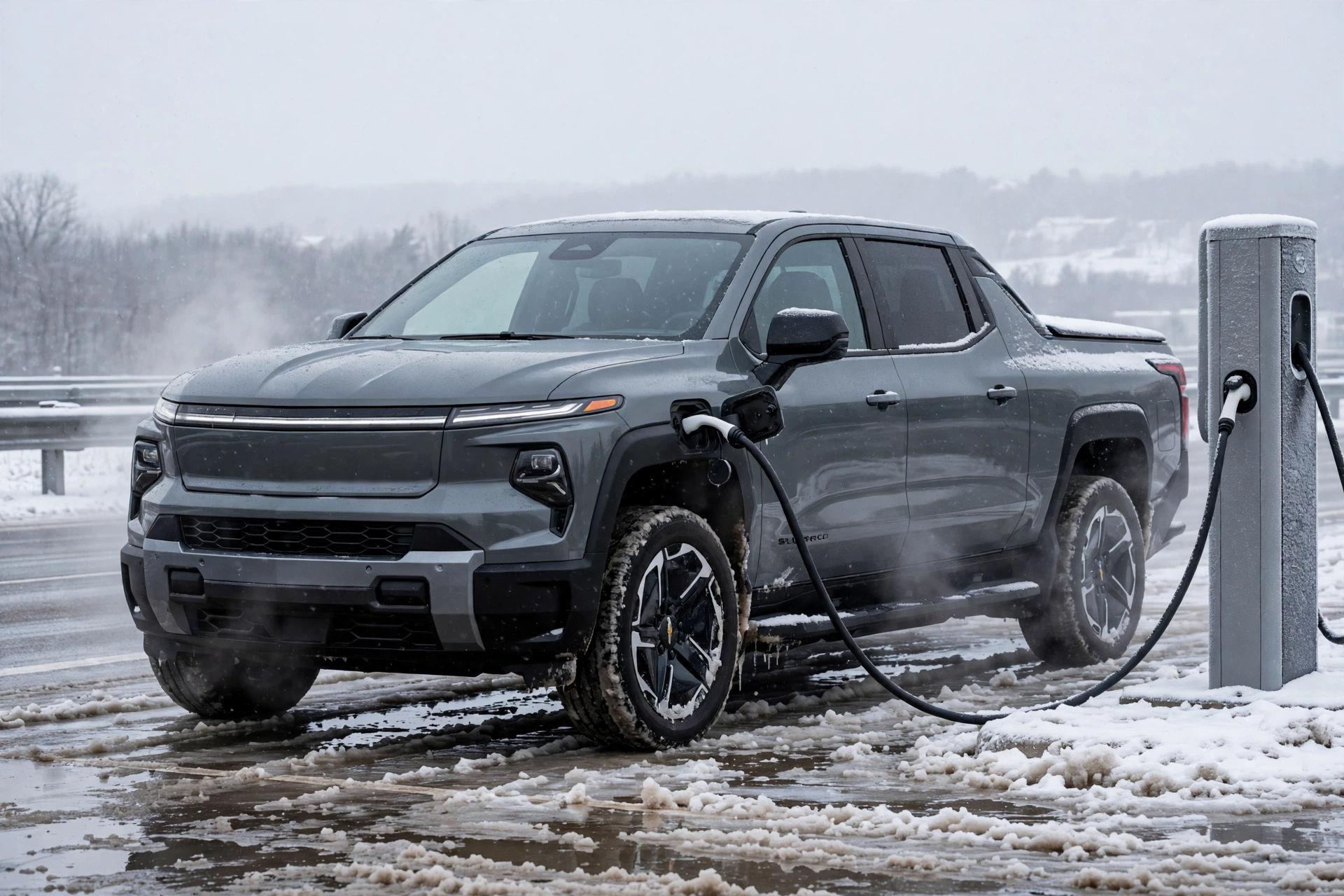
The single biggest chevy electric vehicle range improvement of the last two years is not a battery. It is a heat pump, fitted across the line. The Equinox EV has one as standard. The Blazer EV has one. The Silverado EV runs GM’s energy recovery system, and the 2027 Bolt gains a heat pump the old car never had. Heat pumps move heat instead of making it, and in mild cold, roughly 20 to 40 degrees Fahrenheit, they cut the winter penalty hard.
They do not repeal physics. In deep cold, on short trips with a frozen cabin and a cold-soaked battery, plan on losing 30 to 40 percent of the EPA figure (est.). That band is what cold-climate fleet data and every serious winter test keep landing in, and our winter range loss guide shows the test results behind it. Applied at the 35 percent midpoint: Silverado EV 320 miles, Equinox EV 207, Blazer EV 203 in front-drive form, Bolt 170. Winter fast-charge legs shrink with them: about 224 miles for the Silverado EV, 145 for the Equinox EV, 119 for the Bolt. Precondition the cabin and battery while the car is still plugged in, every time. It is the cheapest range you will ever buy, because it comes off the wall instead of the pack. If you want the full ownership picture across seasons, our total cost of ownership calculator folds winter efficiency into the five-year numbers.
The verdict
Buy the Equinox EV front-wheel drive if you want the most honest range per dollar in American showrooms right now. Buy the Bolt if the budget rules and the driving is local; its 262 miles are all usable, every day, by design. Buy the Silverado EV Work Truck Max Range if you tow or cross states, and buy it plain. Buy the Blazer EV only if the shape matters more to you than the numbers, and if you do, keep the standard wheels on it. Chevrolet’s range line-up is genuinely strong at the top and the bottom. It is the expensive middle that needs a harder look.
Frequently asked questions
Which model has the longest chevy electric vehicle range?
The Silverado EV Work Truck with the Max Range battery, at 493 miles EPA-estimated. Edmunds tested that specification at 539 miles, the longest result they have recorded for any EV. The full Chevrolet-published ratings, including the LT and Trail Boss figures, are in the Chevrolet Silverado EV specifications.
How much range does the Blazer EV lose with the 22-inch wheels?
Twenty-nine miles. The front-wheel drive Blazer EV is rated 312 miles on standard wheels and 283 miles on the 22-inch option. All-wheel drive also rates 283 miles. It is the most expensive checkbox on the Blazer EV order form, and it is paid for in range.
Can I charge the 2027 Bolt to 100 percent every night?
Yes. The Bolt’s lithium iron phosphate battery is built for it, and Chevrolet recommends routine full charges. That makes the Bolt’s 262 EPA miles genuinely usable daily range, where most nickel-based packs are happiest living between 20 and 80 percent.
How far will an Equinox EV actually go between fast chargers?
Plan on about 249 miles. Edmunds tested the front-wheel drive car at 356 miles on a full charge, and the usable 10 to 80 percent fast-charging window holds 70 percent of that: 356 × 0.70 = 249. The stop itself takes around 42 minutes from 10 to 80 percent, the Equinox EV’s one real weakness.
How much range do these cars lose in deep winter?
Plan on 30 to 40 percent below the EPA figure (est.) in deep cold with short trips and full cabin heat. At the 35 percent midpoint: Silverado EV about 320 miles, Equinox EV about 207, Blazer EV about 203, Bolt about 170. All four models now run heat pumps, which softens the loss in milder cold, and preconditioning while plugged in recovers more of it.
Is the Silverado EV’s 493-mile rating real?
Yes, and unusually, independent testing says it is understated. Edmunds recorded 539 miles from the Max Range Work Truck. The 1,059-mile figure GM publicised from its own engineer-run test is also real and also meaningless for buyers: it was set at 20 to 25 mph, in summer, with the climate control off, over seven days.