Last updated: October 27, 2026
Begin with the fact that shapes everything else on this page: you cannot buy a new Canoo. The company filed for Chapter 7 bankruptcy on January 17, 2025, closed its doors the same day, and has not built, sold or supported a vehicle since. So an honest guide to canoo lifestyle vehicle key features is really two guides folded into one. The first is a look back at a genuinely original piece of design — a one-box electric van with a lounge for a rear seat and glass in places no other maker dared to put glass.
The second is a cold-eyed account of what it means, in October 2026, to own a vehicle whose maker no longer exists: no warranty desk, no parts counter, no software team, nothing.
Both stories deserve telling, and they deserve telling in that order, because the beauty of this vehicle is precisely what tempts people to skip the second story.
Canoo’s end was quick at the finish and slow in the making. Founded in 2017 as Evelozcity, the company went public through a merger in 2020 and raised roughly $600 million. It spent that money developing a single skateboard platform and a family of rounded vehicles to sit on it, while production slipped year after year.
By December 2024 it had furloughed or dismissed nearly everyone left, including its last 82 employees, and idled its Oklahoma plants. When the filing came, the bankruptcy papers listed about $126 million in assets against $164 million in debts, and the statement said plainly what had gone wrong: a hoped-for loan from the U.S. Department of Energy’s Loan Programs Office never arrived, and foreign investors never closed either.
What happened next matters for anyone eyeing a surviving example. Chapter 7 means liquidation, not reorganisation — there was never a version of this story where Canoo paused, restructured and resumed building vans. A court-appointed trustee took control, and chief executive Anthony Aquila, who had also been one of the company’s lenders, formed a new entity that bought substantially all of Canoo’s assets for $4 million in cash, alongside cancelling more than $11 million the company owed his own finance firm.
TechCrunch’s reporting on the asset sale lays out the terms, and the judge approved them in April 2025 despite objections — including a rival $20 million offer from a London investor who later asked the court to undo the deal.
The sale closed on April 11, 2025. No production restart followed, no parts operation opened, and no service network appeared.
The tail end of the estate was still being picked over this year: in June 2026 an eight-day auction in Oklahoma City disposed of the former factory’s equipment — robotics, tooling, test rigs — all sold as-is. That is what remains of Canoo as an industrial concern.
The vehicles themselves, all few of them, sit in government fleets and private hands, and we explain on our research method page why every figure in the rest of this article is labelled as a launch-era figure rather than a current one: there is no current one.
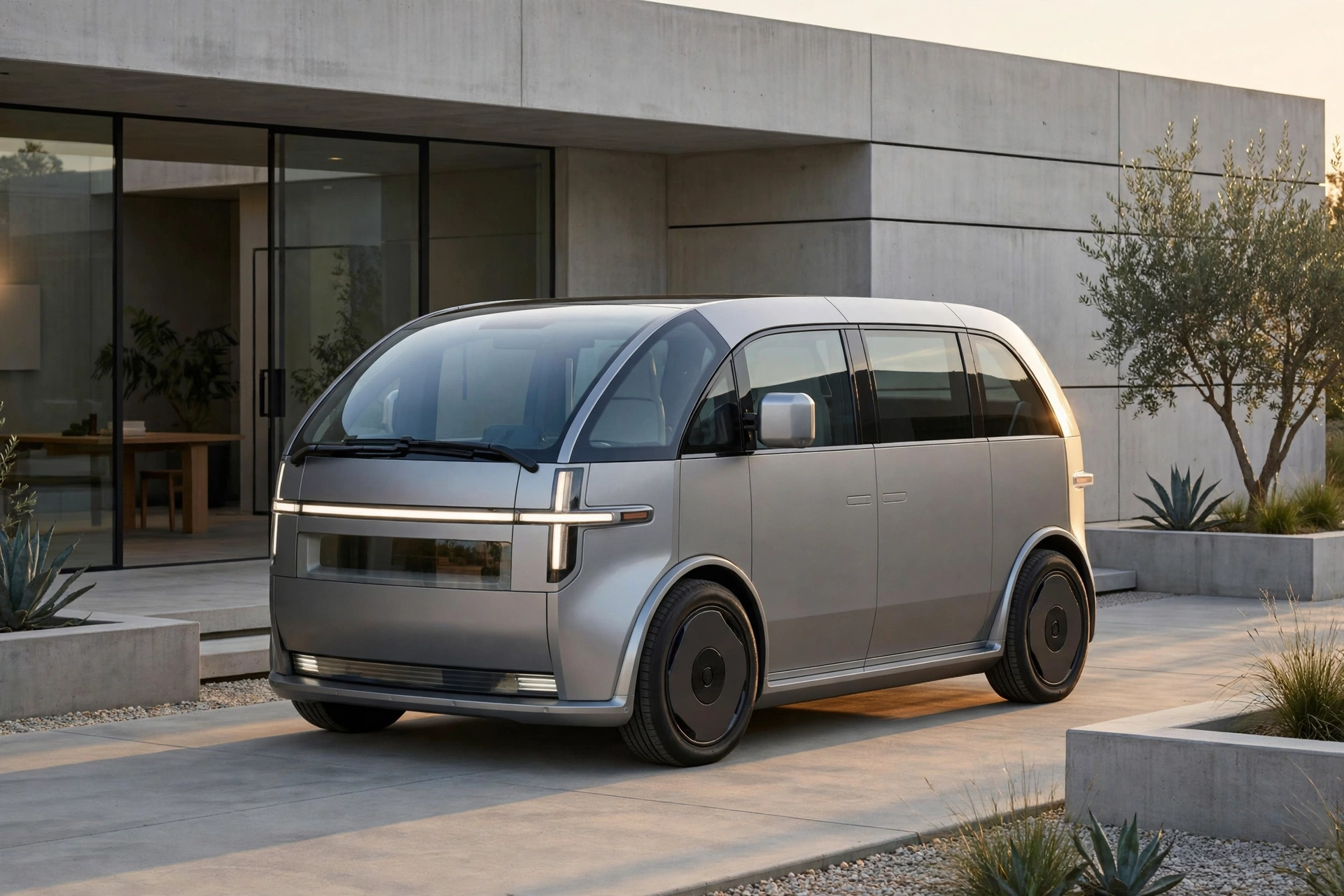
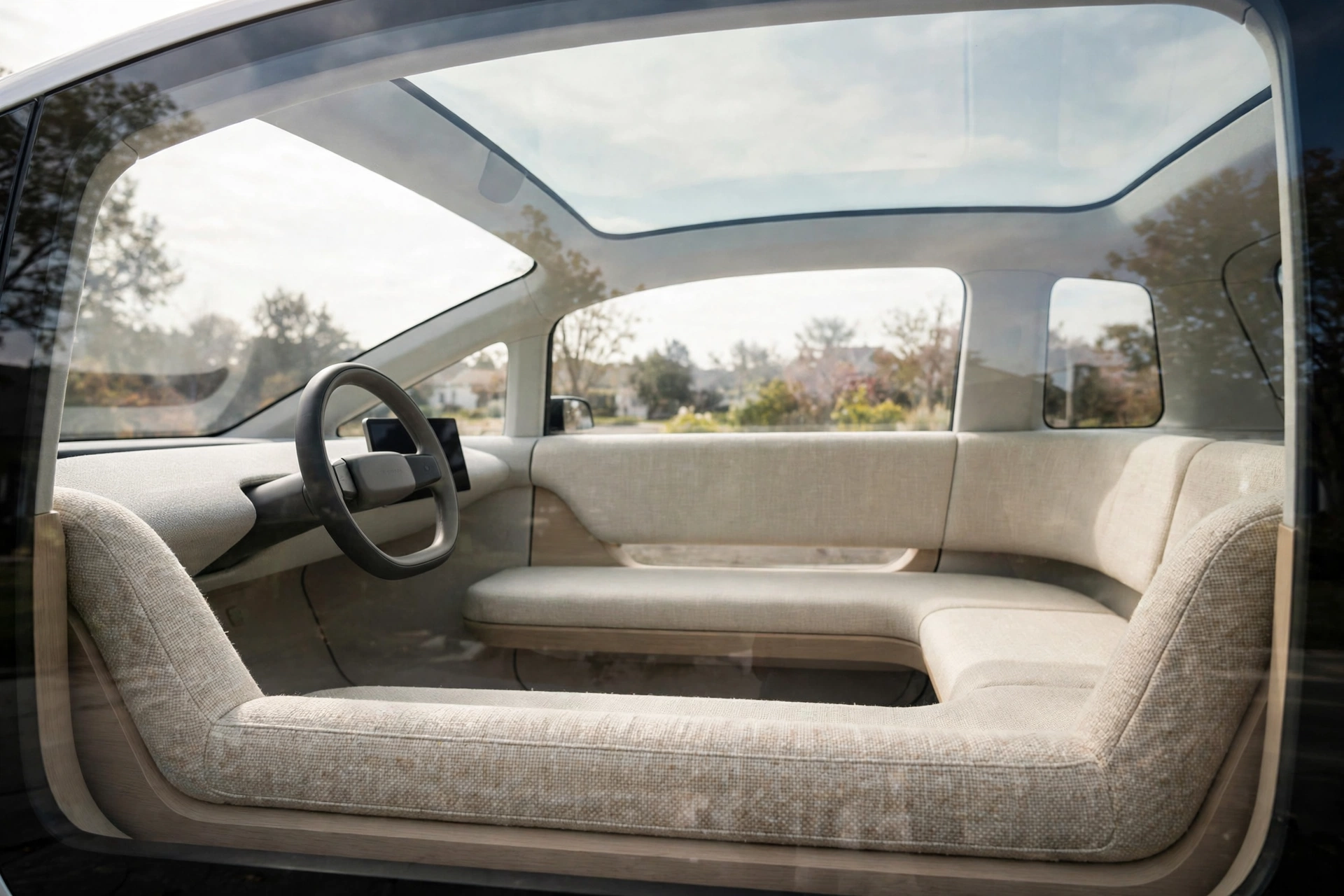
So, the vehicle. Of all the canoo lifestyle vehicle key features, the cabin is the one people remember first. Sit in one — and a handful of journalists and fleet drivers did, briefly — and the first impression is of air. The Lifestyle Vehicle was drawn by Richard Kim, the designer behind BMW’s i3 and i8, and it has the same willingness to rearrange furniture.
There is no bonnet to speak of, no engine bay at all. The windscreen sweeps down and around, the roof is a broad sheet of glass, and the cabin reads as one calm, continuous volume rather than a collection of compartments.
It remains, years after its debut, the most quietly radical interior the electric era produced.
The canoo lifestyle vehicle key features that made it famous
Start with the shape, because everything about this vehicle follows from it. The Lifestyle Vehicle is 174.1 inches long — shorter than a Toyota RAV4 — yet it seats seven and encloses about 188 cubic feet of interior volume, figures normally attached to a full-size SUV. The trick is subtraction. With the motor at the rear, the battery flat in the floor and no transmission tunnel to package around, the designers pushed the windscreen forward over the front wheels and gave the cabin the entire middle of the car.
The result is a pod: tall, rounded, almost symmetrical front to back, and deliberately faceless — Canoo used slim LED light bars at both ends as the brand signature instead of a badge.
Then there is the glass. Two panes of it define the vehicle. The first is the panoramic roof, which floods the rear compartment and turns the back seat into something closer to a conservatory. The second is smaller and cleverer: the “street view window,” a low panel of glass set into the nose below the main windscreen, roughly 955 by 310 millimetres, which lets the driver see the kerb, the bollard and the toddler’s scooter directly ahead of the bumper — the exact patch of road a high bonnet normally hides.
It is a tiny luxury and a genuine safety feature in one, and no production rival copied it.
The rear seat completes the idea. Instead of a conventional bench, the Lifestyle Vehicle wrapped its passengers in a continuous, sofa-like lounge that curves around the back corners of the cabin, upholstered in recycled fabrics in muted tones. The front chairs are separated by open floor. Materials throughout were chosen with a light touch — woven textiles, pale trim, very little chrome — and there is a restraint to the surfaces that most modern SUVs, with their gloss black and their acreage of screen, never attempt.
Doors and storage were kept simple. Cupholders are small. The ambience is not.
Canoo lifestyle vehicle key features under the skin: the skateboard and steer-by-wire
Beneath that calm cabin sat the industry’s most committed piece of platform engineering. Canoo’s skateboard carried everything — battery, motor, steering, brakes, suspension — in a flat chassis onto which different bodies could be lowered: this passenger pod, a cargo van, a pickup. The battery was not merely in the structure; it was part of it, its modules bolted directly into the skateboard so the pack itself added torsional stiffness, an idea rival engineers admired and quietly noted.
Suspension was double wishbones front and rear with transverse composite leaf springs, a layout borrowed from the Corvette, chosen to keep the floor low and flat.
The steering was the headline act. Canoo claimed the first true steer-by-wire system offered for a production vehicle: no mechanical column connecting wheel to road wheels, only signals, with full redundancy built in. That is why the wheel itself could be a rounded rectangle — a yoke in spirit, kinder in shape — and why the driving position could sit so far forward.
Brake-by-wire came with it. The arrangement freed space, simplified the right-hand-drive conversions that the U.S. Postal Service later ordered, and gave the vehicle its eerily light, precise low-speed manners.
It also means the steering of every surviving Canoo depends entirely on electronics and software written by a company that no longer employs a single engineer.
The passenger version’s hardware, as launched, was modest beside its ideas: a single rear motor with up to 300 hp and 332 lb-ft of torque, a top speed claim of 125 mph and a 0–60 mph estimate around 6.3 seconds. The delivery variant that actually reached customers offered 200 hp as standard, with a 350 hp option. None of it was ever the point. This was a vehicle selling space, light and calm, not numbers.
Range, charging and running costs, as launched
The Lifestyle Vehicle carried an 80 kWh battery of cylindrical 2170 cells. Canoo’s figure, repeated from debut to the end, was 250 miles of range on the EPA cycle. Treat that number with care: it was a target the company published, never a rating earned in retail certification. The passenger LV never went on general sale, and it does not appear on fueleconomy.gov — we checked the EPA’s own listings, and no Canoo of any year is there.
The delivery versions that did ship carried Canoo’s own EPA-based estimates of around 200 to 217 miles, depending on variant.
For a wider sense of how launch claims compare across the market, our overview of EV range, charging and costs shows what certified figures look like for vehicles you can still buy.
Among the canoo lifestyle vehicle key features on paper, charging was respectable for its moment. DC fast charging was quoted at 20 to 80 percent in about 28 minutes, and the onboard AC charger ran at 7.2 kW — slow by 2026 standards — needing roughly six and a half hours for the same 20-to-80 span.
What does a full battery cost at home? The arithmetic is simple, and it is one of the few Canoo numbers that has not changed: 80 kWh × $0.17 per kWh (est., close to the current U.S. average residential electricity price) = $13.60 for a full charge. Spread over the claimed 250 miles that is 5.4 cents a mile; over a soberer 200 miles (est., for a heavy van shape at highway pace) it is 6.8 cents a mile. The same fill on a DC fast charger at $0.45 per kWh (est.) would cost about $36.
Running the totals for any used EV you are weighing is easier with our total cost of ownership calculator — though, as the next section explains, electricity is the smallest line in a Canoo budget.
Prices need the same care. The Lifestyle Vehicle was announced at $34,750 in 2021, with Base, Premium, Adventure and Delivery trims targeted between $34,750 and $49,950; by late 2022 the announced starting price had risen to $39,950. Not one retail customer ever paid any of those figures, because not one retail delivery ever happened.
Canoo’s entire output across its life amounted to fewer than two dozen production vehicles in its best year (reported figures cluster around 19 to 22), plus small fleet batches: three crew transport vehicles for NASA, six right-hand-drive delivery vans for the Postal Service, an evaluation pickup for the U.S. Army, and a scattering of vans for the State of Oklahoma and rental fleets.
Walmart’s agreement to buy 4,500 vans — the deal that once defined the company — produced a pilot, not a fleet, and Walmart eventually took its van business to GM’s BrightDrop instead.
That scarcity cuts both ways in the final computation of this sad story: in April 2025, substantially everything Canoo owned — patents, platform, tooling, brand — sold for $4,000,000. Divide that by the last announced starting price: $4,000,000 ÷ $39,950 ≈ 100. The whole company changed hands for the sticker price of roughly one hundred of its own vans.
Against the roughly $600 million raised, $4 million is 0.67 percent — about two-thirds of one cent back for every dollar investors put in.
The ownership reality: parts, software and service in 2026
Here is the section that decides whether a Canoo should ever darken your driveway. A Chapter 7 liquidation does not transfer obligations; it ends them. Whatever warranty paperwork accompanied a vehicle — and fleet buyers had negotiated their own terms — there is no company left to honour it.
InsideEVs’ report on the filing records the moment the doors closed, and nothing since has reopened them: the entity that bought the assets acquired property, not a going concern, and through October 2026 it has announced no vehicles, no parts programme and no service operation of any kind.
Work through the canoo lifestyle vehicle key features one by one and each lands on the same problem. Consider what that means in practice, item by small item. The steer-by-wire system has no mechanical fallback to inspect and no independent specialist who stocks its actuators. The battery is structural, so a pack fault is not a module swap at a dealer — there is no dealer.
Body panels were thermoformed plastic, dent-resistant in life and simply unobtainable in death. Software updates stopped when the servers’ owners stopped paying for them; connected features, diagnostics and the fleet tools the delivery vans were built around should be assumed dead or dying.
Even the mundane becomes research: which tyres (ordinary), which brake components (some shared, some not), which independent EV workshop within towing distance is willing to learn a one-off vehicle at your hourly rate. Government fleets that kept their vehicles — NASA’s crew transporters, the Postal Service’s six vans — maintain them as best they can with no factory behind them, which tells you exactly how a private owner will fare.
One more quiet annoyance, because small annoyances are where orphaned cars truly punish you: insuring and registering a Canoo invites questions for which insurers have no script, and valuing one invites an argument with no data to settle it.
There is no price guide entry, no meaningful sales history, no established used market — only the occasional fleet disposal or private sale, at numbers the sellers invent. Anyone quoting you a confident “market price” for a Canoo in 2026 is guessing, and the guess is theirs, not yours, only until you pay it.
Who should buy one: canoo lifestyle vehicle key features for collectors, not commuters
Two audiences remain, and only two. The first is the collector. Fewer Canoos exist than almost any other documented EV of the modern era, the design is historically important, and the surviving passenger vehicles were largely prototypes and show cars — which makes a documented, running example a genuine artefact, closer in spirit to a Tucker than to a used minivan. If that is your interest, buy the best-documented vehicle you can find, buy it as sculpture and scholarship, and store it kindly.
On the arithmetic, be clear-eyed: put an asking price of, say, $15,000 (est. — an illustrative figure, since no published market price exists) against the last announced $39,950 list price and you get (39,950 − 15,000) ÷ 39,950 = a 62.5 percent fall. For a collector that discount is the entry ticket, and future value will be set by rarity and nostalgia, not by any guide.
The second audience is the technically fearless tinkerer: a home mechanic with EV experience, a workshop, a trailer and a temperament that enjoys diagnosing a steer-by-wire fault with no manual, no hotline and no parts pipeline. For that person, a cheap fleet LDV could be a fascinating project. Note the conditions stacked inside that sentence.
Everyone else — every family, every commuter, every small business tempted by the space and the price — should walk away, and we say that without hedging: as transport, a Canoo in 2026 is a beautiful liability. A business that needs this shape of vehicle with a warranty behind it will find supported options in our guide to electric vans for business, and will sleep better for choosing one.
Our score: 3.5/10 — Design & features: 9/10 · Parts, service and software support: 1/10 · Value as a collectible: 6/10. The middle score is the honest heart of this review. Score the drawing alone and it still embarrasses most of what the industry sells; score the ownership proposition and it collapses to the floor, because ownership is a relationship with a maker, and this maker is gone.
Frequently asked questions
Can you still buy a Canoo Lifestyle Vehicle new?
No. Canoo ceased operations on January 17, 2025, the passenger version was never delivered to a retail customer even while the company lived, and no successor sells the vehicle today. Any “new” listing you encounter is a leftover fleet unit or a mistake.
Which canoo lifestyle vehicle key features still work now that the company is gone?
The mechanical ones — the glass, the lounge seating, the space, the basic driving hardware — work until something fails. The electronic ones are the fragile half of the list: over-the-air updates have ended, connected services should be assumed finished, and the steer-by-wire and brake-by-wire systems have no service channel behind them at all.
What happens if a Canoo breaks down?
You find an independent EV specialist willing to take it on, you pay diagnostic time at their rate, and for any Canoo-specific component — a steering actuator, a body panel, a structural battery element — you are sourcing from salvage, fabrication or nowhere. There is no warranty route and no factory parts desk; that is the whole difficulty.
How many Canoos were actually built?
Very few. Reported production figures for its best year cluster around 19 to 22 vehicles, with small fleet deliveries on top: three crew transporters for NASA, six delivery vans for the U.S. Postal Service, an Army evaluation vehicle, and limited numbers for Oklahoma state fleets and rental operators. The pickup and the passenger van never reached general sale.
Could Canoo return under its former chief executive?
Nothing in the record through October 2026 suggests it. Anthony Aquila’s entity bought the assets out of liquidation in April 2025, which preserved the intellectual property and equipment under one roof — but no vehicle programme, parts operation or hiring has been announced since, and the factory equipment itself was auctioned in June 2026. Treat any revival talk as speculation until a vehicle with a warranty appears.
Is a Canoo a sensible buy as a cheap used EV?
Only if the word “cheap” survives contact with a single repair bill. The purchase price is the easy part; the first failure of a proprietary system is where the bargain ends. For daily driving, the same money buys a warranted, supported used EV with a parts counter attached, and that is the correct choice for everyone who needs the vehicle to simply work.
The Lifestyle Vehicle deserved a longer life. Its cabin — that pale, glassy, seven-seat room on wheels — understood earlier than any rival that electric packaging was an invitation to rethink the interior, not just the drivetrain. Honour it properly: admire it, document it, preserve the few that remain. Whatever the canoo lifestyle vehicle key features promised in 2019, they were promises about a product — and the product’s maker is the part that failed. Just do not mistake a museum piece for a family car.
For anyone weighing this story today, the canoo lifestyle vehicle key features remain a lesson in bold design, and the canoo lifestyle vehicle key features also remain a warning about orphaned vehicles. That is why the canoo lifestyle vehicle key features belong in a collection, not on a daily commute.
That verdict is the thread running through every section above, and the canoo lifestyle vehicle key features still explain why the van fascinated so many people. Remember the canoo lifestyle vehicle key features as design history first, and let the canoo lifestyle vehicle key features guide a careful, collector-only decision.
In short, judge the canoo lifestyle vehicle key features on their own terms, and keep the canoo lifestyle vehicle key features in their proper place: admired, preserved, and never mistaken for a supported daily driver.
Finally, keep the canoo lifestyle vehicle key features in perspective: admire the canoo lifestyle vehicle key features for what they pioneered, and judge the canoo lifestyle vehicle key features by the support that is no longer there.