Last updated: October 27, 2026
Start with the seat, not the spec sheet. An electric dirt bike for kids lives or dies on one measurement: can your child put both feet down, squeeze the front brake lever with small fingers, and pick the thing up after a tip-over? Watts come second. Top speed comes third. If the seat is wrong, nothing else on the page matters, because a scared kid on a tall bike learns one skill only — how to stop riding.
The market splits into four camps, and parents keep shopping across them as if they were one product. There are powered balance bikes for toddlers. There are cheap chain-drive minis from Razor and its rivals. There are proper miniature motocross machines from KTM, Husqvarna and GASGAS that share parts with 50cc race bikes. And there are trials bikes from OSET and Kuberg that teach balance at walking pace. Shop for an electric dirt bike for kids by camp, not by headline price: each camp has its own sizing logic, its own charger, and its own idea of what a five-year-old should be doing.
Age labels are the weakest information on the box. Two six-year-olds can stand 15 cm apart in inseam. One sits flat-footed on a bike, the other is on tiptoes with the bars at chest height. Manufacturers know this, which is why the good ones publish seat heights and inseam ranges in millimetres. Trust those numbers. Measure your child’s inseam in riding boots, against a wall, book between the legs — then match it to the seat.
Safety hardware matters more than power hardware. Look for three things: a parent-set speed limit that a child cannot override from the saddle, a cut-off that kills the motor when the bike falls over or the rider parts company with it, and brakes a small hand can actually reach. A bike with 5 kW and no parental lock is not a toy. It is a liability with knobby tyres.
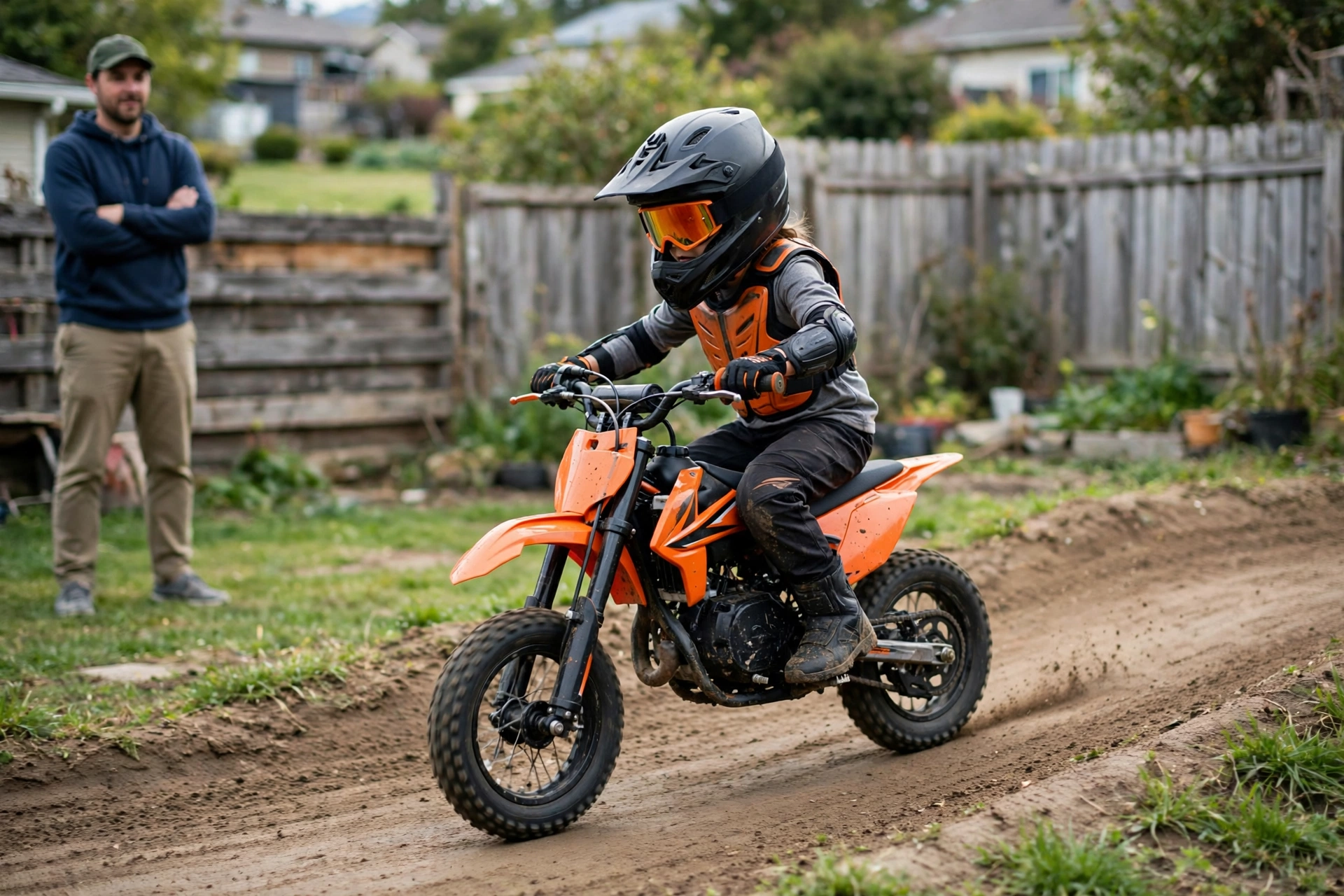
Electric dirt bike for kids sizing: seat height beats age every time
Here is the ladder, rung by rung, with prices checked October 27, 2026 against manufacturer releases and US dealer listings. The STACYC 12eDrive sits at 13 inches of seat height — 330 mm, lower than most pedal bikes a three-year-old straddles. The OSET 12.5 trials bike is next at 390 mm (15.0 in). Then comes the KTM SX-E 2 at 470 mm, adjustable up to 500 mm. After that the ladder jumps hard: the KTM SX-E 3 adjusts between 634 and 682 mm, and the SX-E 5 sits at 682 mm at full height with a lower bodywork position around 634 mm. That jump from 500 mm to 634 mm is where families get caught. KTM’s taller SX-E 2.12 for 2027 (£2,549 in the UK) exists precisely to bridge it.
Weight is the second gate. The STACYC weighs 17 lb with its battery. A fallen STACYC is a shrug. The SX-E 2 weighs 29 kg (63.9 lb) — a five-year-old will not deadlift that off a leg, so the rollover sensor and your own proximity do the work. The SX-E 5 is around 40 kg (est., based on KTM’s published dry figures for the class). Teach the falling-off part on grass, at walking pace, before anyone touches a track.
Method note: figures come from manufacturer spec sheets and dealer listings; anything unconfirmed is marked (est.) with its basis — the standard described on our research method page.
First wheels: STACYC and OSET teach balance before speed
The STACYC 12eDrive is a balance bike with a throttle, and that is a compliment. No pedals, no pegs to catch a shin, a 13-inch seat, and three power modes that top out at roughly 5, 7 and 9 mph. Run time is 30–60 minutes from the little 20V (max) 2Ah pack, and a recharge takes 45–60 minutes, so a second battery turns a session into a morning. At $799 it is not cheap for something with 12-inch wheels. It is still the right first powered bike for a 3–5-year-old under 75 lb, because the failure mode is a slow wobble onto grass, not a throttle whisky moment into a fence.
Our score: 8.6/10 — Size fit: 10/10 · Safety controls: 9/10 · Value: 7/10. The modes are parent-selected, the weight is toddler-manageable, and resale stays strong.
OSET plays a different game. The 12.5 Racing is a trials bike: 600W 24V motor, separate dials on the controller for speed, power and throttle response, a 390 mm seat and a 60 lb rider limit, aimed at ages 3–5. The dials are the point. You set walking pace and a soft throttle map, hand the bike over, and turn one dial at a time as balance improves. UK list price is £1,299; US pricing varies by dealer (est., based on UK list and past US listings around $1,350–$1,500). Dirt Rider’s early test of the 12.5 called it the best learning bike its testers had sampled, and the reasoning still holds: trials geometry forces slow-speed balance, the skill that transfers to every motorcycle afterwards. As a first electric dirt bike for kids in the trials mould, nothing else teaches throttle discipline this gently. The catch is the battery — two sealed lead-acid blocks, old tech, heavier than lithium and slower to charge. Kuberg’s young-rider and Trial E models from the Czech Republic chase the same idea with lithium packs and app control, though US dealer coverage is thin (est., based on current dealer listings), so ask about parts support before money moves.
Electric dirt bike for kids that can race: the KTM, Husqvarna and GASGAS minis
The KTM SX-E 2 is the smallest real motorcycle here, and the details show it. Hub motor, 1.8 kW peak, no chain to lube or catch a boot lace. Two seat heights, 470 and 500 mm. Hydraulic disc brakes front and rear — 140 mm rotors, bicycle-pattern pads you can buy anywhere. Three modes: walking speed, a medium setting capped at 12.4 mph, and full power at 20.5 mph. KTM claims up to 100 minutes of riding from the swappable lithium pack, with 80% charge in 35 minutes and a full charge in about 60. A rollover sensor cuts power in a fall, and a wrist lanyard kills the motor if the rider comes off. KTM’s own launch release for the SX-E 2 lists the US MSRP at $2,199, and the Husqvarna EE 2 is the same machine in white at the same money. For a 4–6-year-old who has outgrown a STACYC, this is the correct next step. Full stop.
Our score: 9.1/10 — Size fit: 9/10 · Safety controls: 10/10 · Value: 8/10. The lanyard, the rollover cut-off and the locked-in low modes are the best parental-control package in this guide at any price.
Step up and the hardware turns serious. The SX-E 3 runs a 48V motor with 3.8 kW peak output, a 648 Wh battery, WP suspension with 144 mm of front travel, and a seat that adjusts between 634 and 682 mm; US pricing sits at $4,599 in current listings, and KTM’s spec sheet gives a full charge at 160 minutes on the 350W charger. The SX-E 5 is the full 50cc-class race weapon: 5 kW peak, a 907 Wh battery, six ride modes that can be locked with a dongle under the seat so the rider cannot bump the power up mid-session, and WP air forks you tune with a pump for rider weight. KTM quotes more than two hours of riding for a beginner and roughly 30 minutes at full race pace — both numbers are honest, and the gap between them is the whole lesson about electric range. US MSRP is $5,799 before freight. The Husqvarna EE 5 ($5,849 in 2027 dealer listings, now water-cooled, which Husqvarna says extends running time by 30%) and the red GASGAS MC-E 5 ($5,449 in 2027 listings, seat adjustable 634–682 mm) are the same platform wearing different plastic. Buy whichever your local dealer will service.
Our score: 8.8/10 (SX-E 5) — Size fit: 8/10 · Safety controls: 9/10 · Value: 7/10. Nothing else at this size charges in 70 minutes, swaps suspension settings this easily, or holds value like the Austrian trio. The price is the price.
One warning, delivered plainly: the full-power mode of an SX-E 5 will carry a 30 kg child at speeds a geared 50cc petrol bike reaches. Unlock it because the rider has earned it on track, in gear, under coaching — never because a birthday happened.
The cheap seats: Razor’s MX350 and MX650
Razor sells more kids’ dirt bikes than everyone else combined, and the MX350 is why. Current US retail is $299.99 at big-box stores (checked October 27, 2026), for a 350W chain-drive mini with 12-inch knobby tyres, a two-speed switch (about 10 mph low, 14 mph high), a 140 lb rider limit and up to 30 minutes of continuous use. Independent roundups agree on the weak points: in Ezvid’s 2026 electric dirt bike roundup, the cited road test found the MX350’s throttle stiff and a little jerky, with braking from the rear wheel only. Razor’s age guidance has also shifted between model years — some packaging says 13+, current retail listings position it for 8+ — so treat the 140 lb limit and the low-speed switch as the real gates, not the birthday on the box. For a cheap electric dirt bike for kids, that honesty matters more than the headline wattage.
The battery is the compromise you pay for twice. It is sealed lead-acid, it wants roughly 12 hours on the charger for those 30 minutes of riding, and it loses capacity every season whether the bike moves or not. The MX650 at $719.99 adds dual suspension, disc brakes at both ends, 17 mph and a 220 lb limit — and Razor rates that one 16+, which should end the common habit of buying it for tall ten-year-olds. Seat time per dollar on a Razor is fine. Seat time per weekend is not: one flat battery at 10 a.m. ends the day, because the pack is bolted in and the recharge is overnight.
Our score: 6.9/10 (MX350) — Size fit: 7/10 · Safety controls: 6/10 · Value: 8/10. Buy it as a first taste of throttle on private land, with a helmet on the same receipt. Do not buy it as a track bike, and do not let the low price talk you out of the gear budget.
Electric dirt bike for kids charging costs: the maths nobody runs
Electricity is nearly free at this scale. Take a US residential rate of $0.17 per kWh (est., close to the 2026 national average). A full charge for the SX-E 5’s 907 Wh battery costs 0.907 × $0.17 = $0.15. The STACYC’s little pack (18V nominal × 2Ah = 36 Wh) costs 0.036 × $0.17 = $0.006 — six-tenths of a cent. The Razor’s lead-acid block, at roughly 0.17 kWh drawn per charge (est., based on its 24V pack size and charger losses), comes to about $0.03. None of these bikes uses a car-style connector, so our EV charger compatibility checker is one tool you can skip here — every charger in this guide plugs into a plain wall outlet.
The real cost per riding hour is purchase price wearing a thin disguise. Run the same 100 hours of riding through three bikes:
Razor MX350: $299.99 to buy. At 30 minutes a charge, 100 hours needs 200 charges: 200 × $0.03 = $6.00 of electricity. Lead-acid packs fade fast under deep cycling, so budget one replacement pack at $70 (est., typical aftermarket price) inside those 200 cycles. Total: $299.99 + $6.00 + $70 = $375.99, which is $3.76 per riding hour.
KTM SX-E 2: $2,199 to buy. KTM claims up to 100 minutes a charge; plan on 75 minutes of real mixed riding (est., derating the claim for stops, hills and a heavier thumb). That is 80 charges for 100 hours. The pack holds about 0.34 kWh (est., from its 9.4Ah power-tool-format battery), so 80 × 0.34 × $0.17 = $4.62 of electricity. Total: $2,203.62, which is $22.04 per riding hour.
KTM SX-E 5: $5,799 to buy. At beginner pace, two hours a charge means 50 charges for 100 hours: 50 × $0.15 = $7.71. Total: $5,806.71, or $58.07 per riding hour. Electricity is $7.71 of that. Even at race pace — 30 minutes a charge, 200 charges — the electricity bill for 100 hours is $30.85. The lesson travels well: on any electric dirt bike for kids, you are paying for chassis, suspension and battery quality, not for fuel. A petrol 50 costs less to buy and then charges you rent forever in oil, filters and top-end rebuilds.
Charge times, collected in one place: STACYC 45–60 minutes; SX-E 2 about 60 minutes (80% in 35); SX-E 3 160 minutes on its 350W charger; SX-E 5 70 minutes for 100% and 45 for 80%; OSET 12.5 several hours for its lead-acid pair (est., charger is a small 2A unit); Razor MX350 and MX650 around 12 hours each. The Austrian bikes win Saturday morning. It is not close.
Where you may ride one: land, trails and access rules
None of the bikes in this guide is street legal. No lights homologated for the road, no plates, no mirrors — and in most US states and Canadian provinces, an electric dirt bike for kids does not fit the legal e-bike classes either, whatever the seller’s listing implies. The class framework that governs pedal e-bikes on shared paths is a different rulebook entirely, and our Class 1 e-bike guide shows how narrow that definition is. Riding an SX-E 5 on a public bike path will end the conversation with a ranger quickly, and not in your favour.
Legal ground looks like this: your own land, private land with the owner’s permission, commercial motocross tracks that run electric mini classes, and designated OHV areas whose rules accept unregistered off-highway minis for riders under supervision. The electric advantage is real but narrow — near-silent running keeps a backyard track tolerable to neighbours in a way a two-stroke never will, and several tracks now run e-mini sessions precisely because the noise complaint file stays empty. It does not create a right to ride anywhere. Check the land manager’s page before the trailer comes out, every time; our longer explainer on e-bike dirt riding and where these machines fit walks through the access patchwork in more depth, and families graduating to full-size machines should also read the electric mini bike and motorcycle guide before the next purchase.
Two access rules from the trail side, because this is where I have no patience left. First: an overpowered bike in small hands damages trails and access for everyone — a 5 kW mini ridden badly on a shared hiking path is how whole areas get closed to all riders. Second: if a venue says helmets, boots and a supervising adult, that is the price of admission, not a suggestion to negotiate at the gate.
Gear and setup: spend on the rider before the bike
Budget the kit with the bike, in the same cart. Full-face helmet that fits snugly now — not one to grow into. Goggles, gloves, and boots that cover the ankle; a chest protector is cheap insurance on anything faster than the STACYC’s 9 mph top mode. A wobbly $300 bike in full gear teaches a child more than a $5,799 bike in trainers, because the first setup keeps the lesson going after the first fall. Gear is not an accessory line on the receipt for an electric dirt bike for kids; it is part of the machine.
Setup rituals that pay off: start every new rider in the lowest mode on flat grass, cones for a braking box, and a parent close enough to reach the lanyard. Check chain tension and tyre pressure weekly on the chain-drive bikes — the hub-motor SX-E 2 and EE 2 skip that chore entirely, one more reason they suit busy families. Run WP fork pressure and rear preload to the rider’s weight on the SX-E 3 and 5; soft suspension set for a heavier sibling is how small riders get bounced off line. Store lithium packs around half charge if the bike will sit for a month, and never charge any of these packs unattended overnight in a hallway — garage, on a non-flammable surface, charger where you can see it.
Frequently asked questions
How fast does an electric dirt bike for kids actually go?
From 5 mph in a STACYC’s training mode to about 20.5 mph for a fully unlocked SX-E 2, with the SX-E 5’s top modes running with 50cc petrol race bikes. The number that matters is the slowest mode, not the fastest: if the lowest setting is still too quick for your space, the bike is too much bike.
What age should a child start on one?
Three is a sane floor, and only on a balance-format bike like the STACYC 12eDrive or the OSET 12.5 with the speed dial at walking pace, in full gear, on grass, with an adult at arm’s length. Pegs, a seat over 500 mm and real suspension belong to the 4–6 band and up, sized by inseam as set out in the sizing section above.
Can my child ride it to school or on the road?
No. Nothing in this guide is street legal or classed as a road e-bike in US or Canadian rules. Private land, permissioned land, tracks and designated OHV ground are the map. Sidewalks and bike paths are not on it.
How long does the battery last before it needs replacing?
Lithium packs in the KTM-group bikes are rated for long service — the SX-E 2’s battery chemistry is quoted at 1,500 charge cycles by the maker — and in family use the bike is usually outgrown first. Lead-acid packs in the Razor and OSET 12.5 fade noticeably within a couple of seasons of regular deep cycling (est., based on typical SLA cycle life), which our cost maths above already prices in for the Razor.
Is a spare battery worth buying?
On the swappable-pack bikes — STACYC and the SX-E 2 class — yes, if your sessions run past an hour; it converts the 35–60 minute recharge into a ten-second swap. On the SX-E 3 and 5 the pack is effectively fixed for the session, so the fast 70-minute charge on the 5 is the better answer than a second mortgage on a spare.
What is the single best buy here?
For most families reading this, the best electric dirt bike for kids is the KTM SX-E 2 at $2,199, bought the week the STACYC gets outgrown. Real brakes, real parental controls, a battery that swaps and charges inside an hour, and a seat the average five-year-old can flat-foot. Racing families skip straight to the SX-E 5 and accept the bill. Everyone else — measure the inseam, check the land you actually have to ride on, and let those two facts spend the money.