Last updated: October 27, 2026
Most road tests measure how a car stops the way a stopwatch measures a dinner party. Feet, metres, a number in a table. But tesla model y comfort braking is not really about the number. It is about the last ten feet before the white line, the ones your passengers feel in their necks. A car can post a fine braking distance and still be an ungraceful thing to ride in, dipping and nodding at every junction like a horse that has spotted something in the hedge. The Model Y, in both its generations, is a study in that difference: seriously strong brakes wrapped, on the older car, in occasionally thoughtless manners.
Slow down in a Model Y and almost everything happens at the accelerator pedal. Lift, and the motors lean against the car’s momentum, feeding energy back to the battery and drawing you down to walking pace, then to a stop, then holding you there. Done well, it is the single most luxurious thing about the car — one continuous, unbroken gesture of slowing, like a good waiter removing a plate you had not noticed was empty. Done badly, with a clumsy right foot, it is a small repeated lurch that makes the rear seats quietly miserable. The hardware sets the ceiling. Your right foot decides how close to it you live.
On any Model Y you are likely to buy, the choreography is one-pedal by default. Tesla calls the final act Hold: regenerative braking continues down to very low speeds, and when the car stops, the brakes apply themselves so it stays stopped, on a slope or on the flat, without your foot on anything. There is no creeping forward at idle, no rolling back theatrics at a hill start. The car simply waits, poised, until you press the pedal again.
That simplicity is recent, and it was arrived at by subtraction. Owners of early cars could choose a gentler Low regenerative braking setting, and a Stopping Mode menu — Creep, Roll or Hold — for the final few feet. Tesla’s own manual notes that Stopping Modes may be unavailable on vehicles built from around January 2024, and the Low regen choice went the same way on mainstream cars: gone, in the name of one consistent calibration. Whether that trade pleases you depends entirely on whether you were the sort of driver who used those menus, or the sort who never knew they existed.
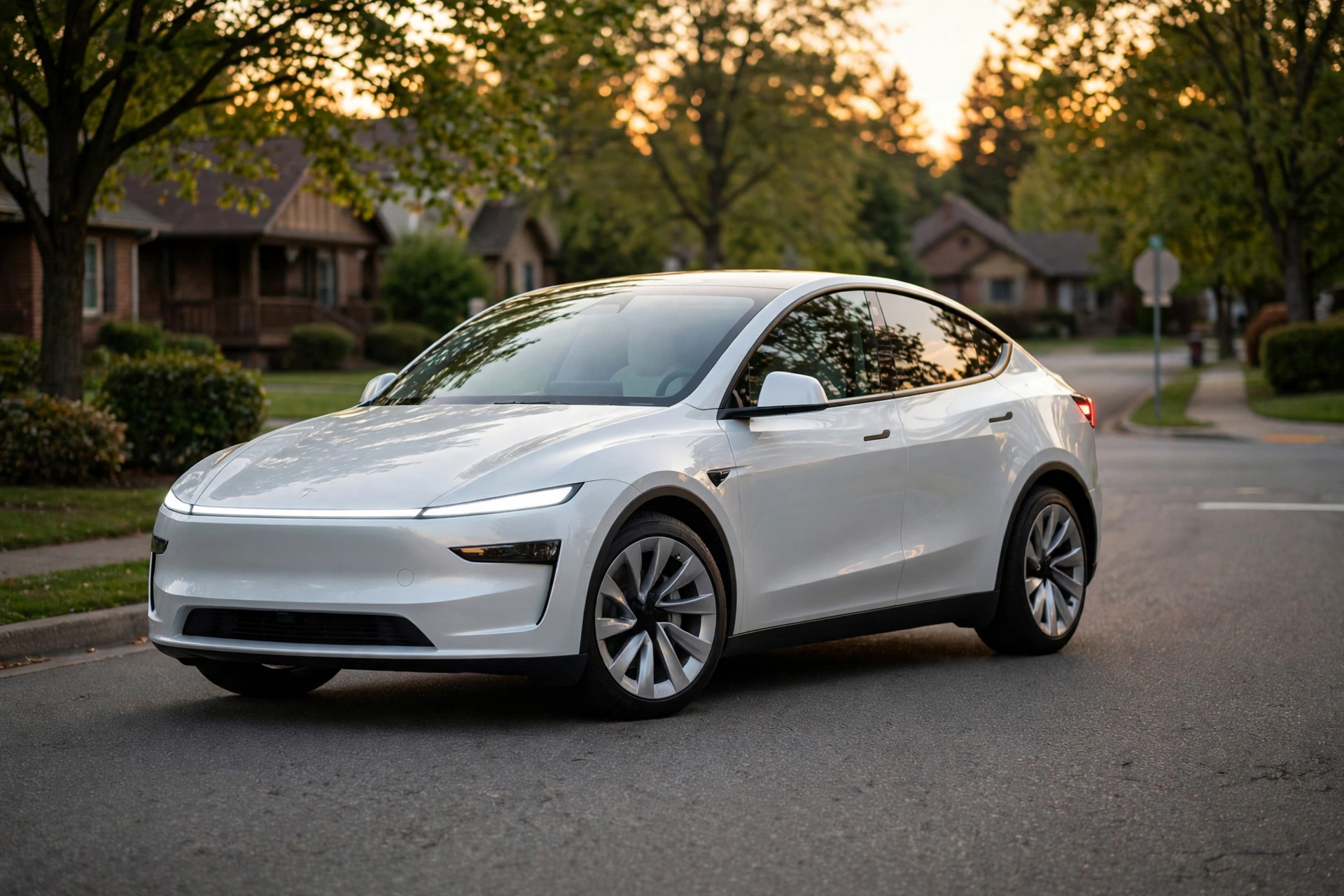
Tesla Model Y comfort braking begins at the accelerator pedal
The first thing to understand is that lift-off deceleration in this car is strong — stronger than in most electric rivals, and far stronger than the engine braking of any petrol car. ThinkEV’s Canadian review of the refreshed car puts it plainly: the Model Y’s regenerative braking is among the strongest fitted to any EV, and one-pedal driving becomes second nature within a day. Strength, though, is not the same as abruptness. What tosses a passenger’s head is not how hard the car can slow, but how suddenly the slowing arrives, and that suddenness lives in the first centimetre of pedal release.
The technique is unglamorous and total: never snap off the accelerator. Ease out of it the way you would set down a full cup of tea you are carrying for someone else. Begin the lift early — earlier than feels natural for the first week — and let the deceleration build like a sentence rather than a shout. Experienced owners describe the pedal less as a switch and more as a dimmer, and that is precisely the mental model that works. Modulate, and the Model Y slows with an almost liquid continuity. Dump the pedal, and the car dives on its nose, the rear-seat occupants sway, and someone in the back asks, in the careful voice people use, whether you might be feeling quite well.
There is a small honesty point worth making here, because brochure language tends to sand it away. One-pedal driving does not make the friction brakes redundant, and it does not shorten emergency stops. It rearranges the ordinary ones. Perhaps ninety percent of your slowing — the junction, the roundabout, the traffic easing on the motorway — can live entirely on the motors. The pedal on the left remains for the moments that matter most, and its character is a separate question, one the refreshed car answers quite differently from its predecessor.
What the Juniper refresh changed beneath your right foot
The Juniper car, sold from 2025, did not merely retune the old system. It replaced its foundations. Reporting on Tesla’s engineering briefings describes a new brake system with reduced-drag calipers and two independent hydraulic master cylinders — one worked by your foot, one by the car itself, which is why the pedal now stays still when the car brakes on its own under Autopilot or FSD. A pedal that no longer shudders or sinks beneath you while the electronics work is a tiny detail, and it is exactly the sort of tiny detail that makes a cabin feel composed rather than haunted.
More significant for everyday comfort is what happens when you do brake. In the older car, pressing the brake pedal meant friction brakes, full stop; regen lived only on lift-off. In the Juniper, pedal braking begins with regeneration and folds in the friction brakes only as your pressure asks for more, according to Tesla’s engineers, with the handover between the two deliberately seamless so the pedal feel does not change as the blend shifts. Drive’s Australian first-drive review noticed the result from the driver’s seat, describing the transition from power to regenerative braking as exceptionally smooth, on a car whose reworked suspension also stops delivering every speed bump into the cabin as a personal message. Slowing and riding, in other words, were polished together, and each flatters the other.
The Juniper also quietly returned a choice the range figures had taken away. Alongside the now-universal Hold behaviour sits a Deceleration setting — Standard or Reduced — which, in Tesla’s words, adjusts how quickly the vehicle slows when the accelerator pedal is released. Reduced is the setting the old Low regen loyalists were mourning: gentler lift-off, a longer, lazier coast down to the stop, and — thanks to the blended pedal — no real efficiency penalty, because the brake pedal can still call on full regeneration when you ask it to stop properly. It is the correct answer for households with a carsick child, and Tesla deserves credit for engineering its way back to offering it.
Tesla Model Y comfort braking on a frozen morning
Every Model Y owner meets the dotted line. On a cold morning, or after charging to one hundred percent, the power meter on the screen shows a dotted section on its left side: regenerative braking is limited, because a cold or full battery cannot accept energy at the usual rate. Lift off the accelerator in that state, in a car without help, and the car coasts on far further than yesterday — the same gesture producing a completely different result, which is the enemy of calm driving and, at the first frosty junction of the day, a mild hazard to your composure.
Tesla’s remedy is a setting with a name like a legal clause: Apply Brakes When Regenerative Braking Is Limited. The owner’s manual describes it with unusual clarity — the regular braking system automatically engages whenever regenerative braking is limited, so that you experience the same amount of deceleration whenever you release the accelerator, regardless of the state of the battery. In the elegant sense of the word, it is an invisible servant. The car quietly spends a little brake-pad life to buy you consistency, and consistency is what comfort actually is. My position is simple: turn it on the day you collect the car and never think about it again.
Two footnotes from the manual deserve air. First, when the system is applying the brakes for you, the brake pedal may move under your hovering foot and feel stiffer when pressed; Tesla calls this expected, and once you know it is not a fault, it stops being alarming. Second, the feature may not operate if the brakes are extremely hot — a mountain-descent edge case, but the reason a long downhill on a full battery still rewards an attentive driver. Cold has other braking side effects, too; Tesla notes that fitting aggressive winter tyres can temporarily reduce regenerative braking power while the car recalibrates, and our guide to electric car winter range loss explains the cold-battery behaviour that sits behind all of this. How you charge matters here as well — a car routinely charged to full will spend its first miles every day in the limited-regen zone — and checking your setup against our EV charger compatibility checker is a sensible ten minutes before winter arrives.
The numbers: how far it takes to stop, and what a stop gives back
Comfort aside, the brakes themselves are strong. Car and Driver’s instrumented test of the 2020 Model Y Long Range recorded a 70–0 mph stop in 161 feet. Put that in furniture terms: the Model Y is about fifteen and a half feet long, so 161 ÷ 15.6 ≈ 10.3 — a touch over ten of its own lengths to erase motorway speed entirely. MotorTrend’s more recent test of the lighter 2026 Model Y Standard stopped from 60 mph in 119 feet, a reminder that the base car, carrying less weight, is no poor relation when the pedal is truly needed. These are respectable figures for a two-tonne family crossover wearing all-season tyres, and no version of this car has an emergency-braking problem. Its problems, such as they are, live at five miles per hour, not seventy.
The other number worth understanding is what an ordinary stop returns. Take a Model Y at roughly 2,000 kg with driver and family aboard, slowing from 40 mph (17.9 metres per second). Its kinetic energy is ½ × 2,000 × 17.9² ≈ 320,000 joules, which is 320,000 ÷ 3,600,000 ≈ 0.089 kWh. If the motors recover about seventy percent of that (est. — real recovery varies with speed and battery temperature), each stop banks roughly 0.06 kWh. A commute with twelve proper stops each way, five days a week, is 120 stops: 120 × 0.06 ≈ 7.4 kWh a week, or around twenty-five miles of range quietly refunded. Pleasant, but hardly the point. The real dividend of regen is not the energy; it is that the slowing costs no brake wear and arrives, when driven well, as one smooth exhalation instead of a series of jabs.
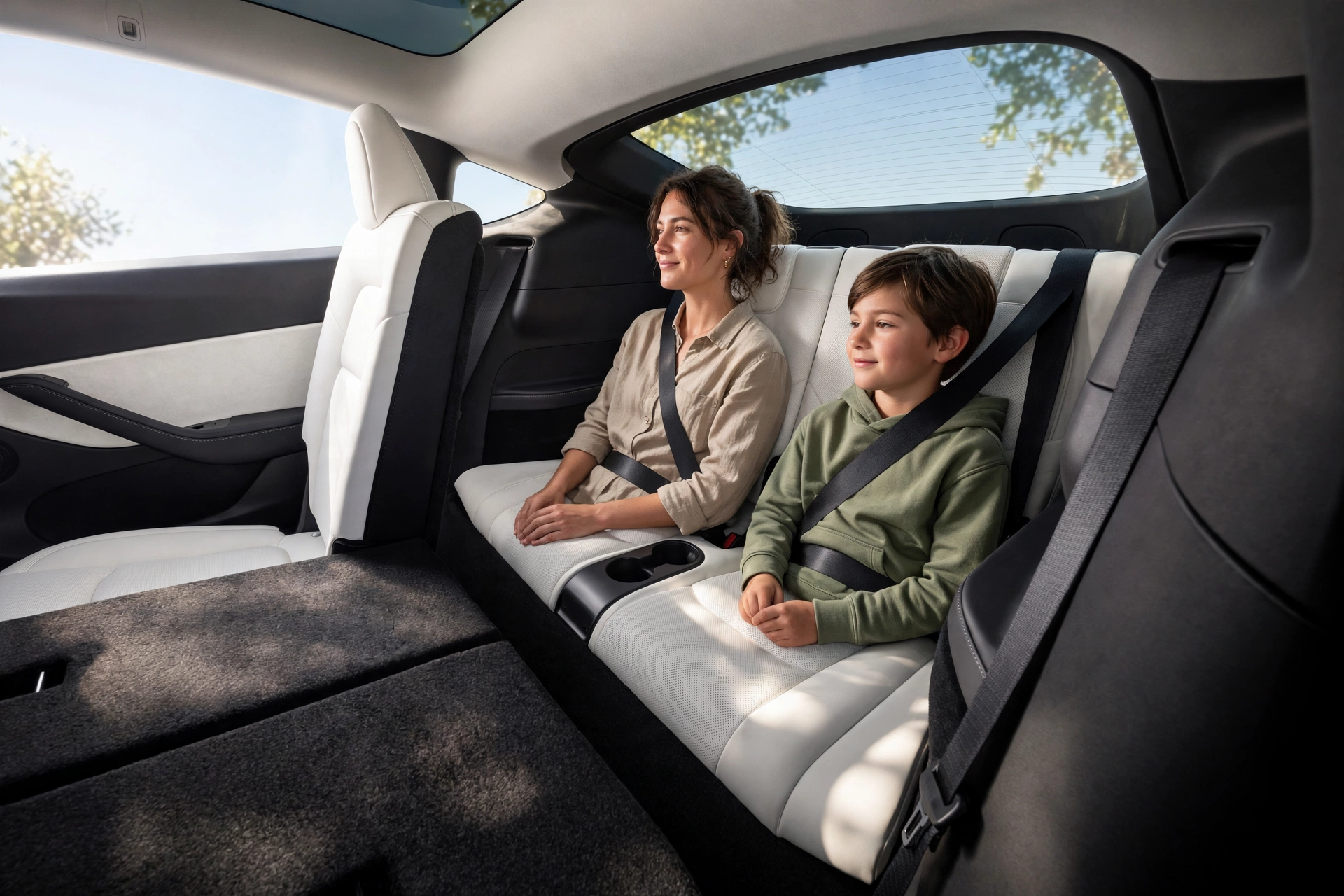
Tesla Model Y comfort braking, judged from the back seat
The back seat is where braking quality is truly graded, because rear passengers get no wheel to hold, no pedals to anticipate with, and — thanks to the physics of sitting behind the car’s centre — a slightly exaggerated helping of every pitch and nod. Owner forums carry a steady, recognisable pattern: passengers, especially children and anyone prone to travel sickness, reporting queasiness in the first weeks of family Model Y ownership, and drivers discovering that the sensation fades almost entirely as their right foot learns the car. The reports cluster on the same causes — the initial snap of lift-off, and enthusiastic acceleration followed by strong regen, a seesaw that no stomach enjoys. Our running log of Tesla Model Y problems covers the ownership niggles more broadly, but this particular one is usually cured by technique rather than by Tesla.
The cures, in order of usefulness. First, feather — the unhurried, early lift described above solves most of it. Second, on the Juniper, select Reduced deceleration and leave it there if your passengers are delicate; on an older car without that menu, accept that your foot is the setting. Third, consider Chill mode, but for the right reason. Chill does not soften regenerative braking — it governs acceleration only, and Tesla’s manual describes it as limiting acceleration for a slightly smoother and gentler ride. Its comfort value is indirect but real: a gentler accelerator map makes your pedal work calmer in both directions, and many owners report their passengers settle once the car’s whole tempo drops. Treat it as a metronome, not a brake control.
One more small luxury deserves mention: silence. Because ordinary slowing is done by the motors, there is no pad squeal, no groan from cold discs at the first stop of the day, none of the small mechanical sighs that date a petrol car. The Juniper’s cabin, with its wraparound ambient light and ventilated seats, finally has slowing to match its upholstery. The older car is nearly as quiet — it is the abruptness, not the noise, that gives it away.
Our verdict on tesla model y comfort braking
Our score: 7.5/10. Smoothness: 8/10 — in Juniper form, with the blended pedal and Reduced deceleration available, this is among the most graceful slowing in the class; the older car, feathered well, is a half-mark behind. Consistency in cold weather: 7/10 — the blended-braking setting restores an even feel on frosty mornings, though a full battery still announces itself and the system steps aside when the brakes run very hot. Pedal feel: 7/10 — the Juniper’s seamless blend is genuinely well judged, while the older car’s friction-only pedal is honest but wooden, and the self-moving pedal under blended braking takes a day to stop noticing.
The plain summary: buy the Juniper if braking manners matter to your family, set Reduced deceleration and the blended-braking option, and spend a week teaching your right foot some manners. The Model Y’s brakes were never weak. At last, in the current car, they are also polite — and on the school run, polite is the whole game.
Frequently asked questions
Does tesla model y comfort braking feel different when the battery is cold?
Yes, briefly. A cold or fully charged battery limits regenerative braking, shown by the dotted line on the power meter, and without help the car coasts further when you lift off. Enabling Apply Brakes When Regenerative Braking Is Limited — the setting Tesla’s Model Y owner’s manual explains on its regenerative braking page — has the friction brakes quietly make up the difference, so the car slows the same way every time.
Can I turn one-pedal driving off altogether?
No. Current cars are one-pedal by design, with Hold behaviour standard. The Juniper offers a Reduced deceleration setting that softens lift-off considerably, and Drive’s testers found both settings well tuned — read Drive’s first-drive review of the refreshed Model Y for how the two calibrations feel back to back. Older cars built before roughly January 2024 may still offer Creep and Roll stopping modes, and some earlier cars had a Low regen setting.
Why does the brake pedal sometimes move or feel stiff on its own?
That is the blended-braking system at work. When the car applies the friction brakes for you — because regen is limited, or because the Juniper is blending the two systems — the pedal can move slightly and feel stiffer. Tesla’s manual states this is expected and does not change your ability to slow the car. It is disconcerting for exactly one day.
Does Chill mode make the braking gentler for passengers?
Not directly. Chill limits acceleration; regenerative braking strength is unchanged. It helps some families anyway, because the softer accelerator response calms the driver’s pedal movements in both directions and lowers the car’s general tempo. For genuinely gentler slowing, the correct lever is the Juniper’s Reduced deceleration setting — and, on any Model Y, an earlier, slower lift of the right foot.
Is the Model Y’s braking strong enough in a real emergency?
Yes. Car and Driver measured a 2020 Model Y Long Range stopping from 70 mph in 161 feet — about ten car lengths — and MotorTrend stopped the lighter 2026 Model Y Standard from 60 mph in 119 feet. The friction brakes are full-sized and full-powered; everything this article discusses concerns grace at low speed, not capability at high speed. If you want the wider performance picture, our Tesla Model Y speed and range test explainer covers how the car goes as well as how it stops.