Last updated: October 27, 2026
Every performance trim is a receipt. The mustang mach e gt asks you to pay $5,050 more than a Premium AWD with the same extended-range battery, and in return it promises to make you 0.4 of a second faster to 60 mph. That is the whole deal. Everything else, the seats, the brakes, the red calipers, is decoration around one transaction: your money, converted into tenths of a second and paid for with miles of range.
So let’s count it properly. Prices here were checked on October 27, 2026, and they include Ford’s $2,045 destination charge, because a fee you cannot refuse is part of the price. The Premium AWD Extended Range sits at $50,390. The GT sits at $55,440. The Rally sits at $59,735. Ford’s own breakdown lives on Ford’s Mustang Mach-E page, and the efficiency figures below come from the EPA listings on fueleconomy.gov, not from a brochure.
What worries me is not the GT itself. It’s the options list underneath it. Ford has spent the 2026 model year quietly moving things that used to be included into boxes with prices on them. A suspension that was standard on the GT last year now sits inside a $3,495 package. The front trunk, free for five model years, is a $495 option. A blue paint-and-stickers package costs $2,495. The GT is a good car surrounded by small ambushes.
This guide audits all of it: what the GT premium buys, what it costs you in range, where the genuinely good value hides (it is not where Ford points), and which version a budget hawk would actually sign for. Our scoring method is the same one we describe on our research page — manufacturer figures first, independent tests beside them, and every estimate labelled.
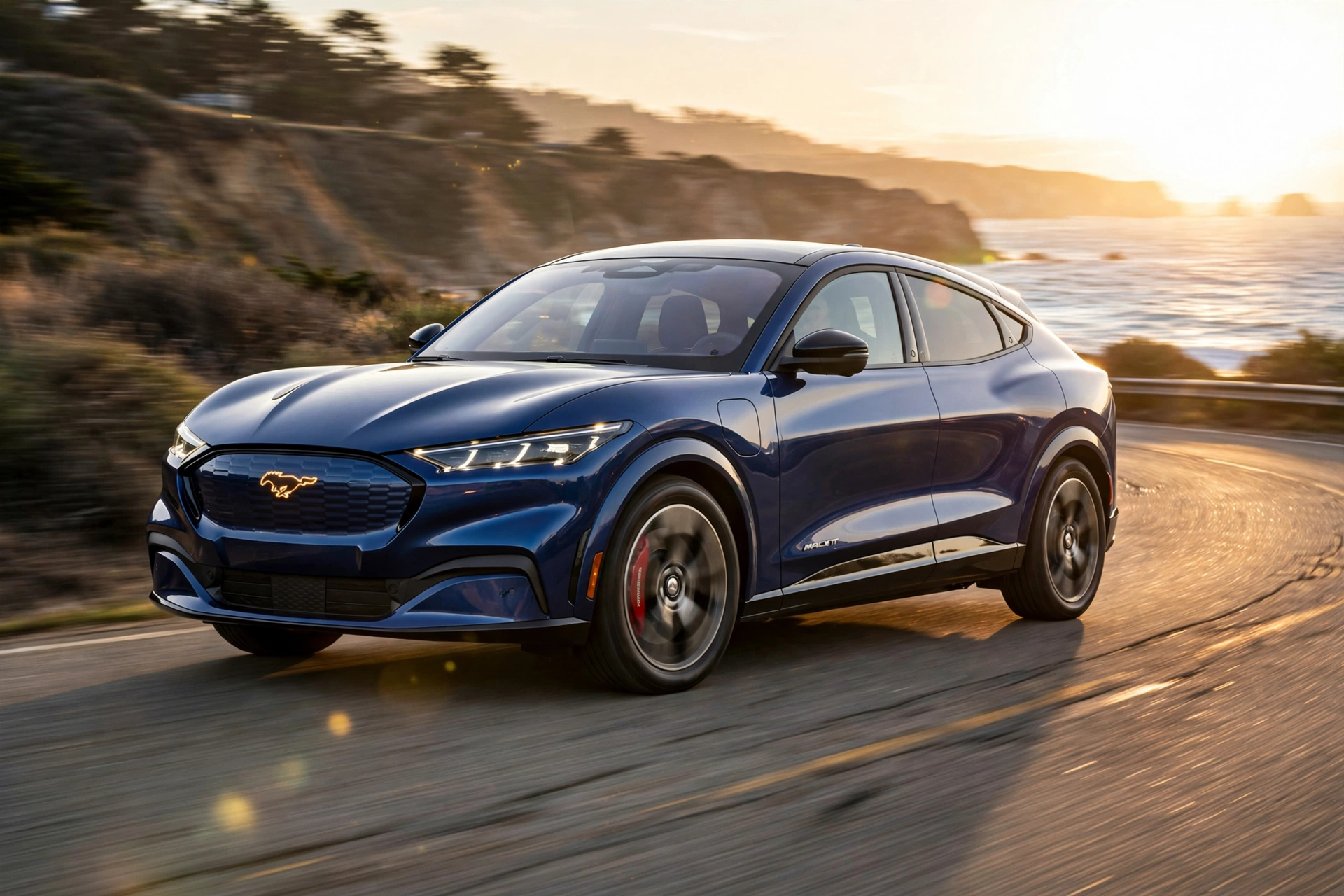
Mustang Mach E GT specs: what the extra $5,050 actually buys
Start with the hardware, because the hardware is real. The GT runs two motors, one per axle, making 480 hp and 600 lb-ft of torque. The Premium AWD Extended Range makes do with the same 91 kWh (usable) extended-range battery and a milder tune. Ford quotes 3.8 seconds to 60 mph for the GT and 4.2 seconds for the Premium AWD. MotorTrend tested the Premium AWD at 4.1 seconds, so Ford’s ladder is honest, if a little flattering to everyone.
The mustang mach e gt also brings bigger Brembo front brakes, Ford Performance seats, 20-inch wheels, a more aggressive front end with the illuminated pony in the closed grille, and the Technology Package included rather than optional. It weighs 4,995 lb in tested form. That is not a light car pretending to be a heavy one. It is a heavy car, full stop, and the brakes earn their keep.
| Version | Price (incl. destination) | Power / torque | 0–60 mph | EPA range |
|---|---|---|---|---|
| Premium AWD Extended Range | $50,390 | 365 hp (est.) / 428 lb-ft | 4.2 s (Ford); 4.1 s (MotorTrend tested) | 300 miles |
| Mustang Mach E GT | $55,440 | 480 hp / 600 lb-ft | 3.8 s (Ford) | 280 miles |
| GT with Performance Upgrade | $58,935 | 480 hp / 700 lb-ft | 3.3 s (MotorTrend tested) | 280 miles |
| Rally | $59,735 | 480 hp / 700 lb-ft | 3.4 s (Ford) | 255 miles |
Notice the shape of that table. Power goes up once, at the GT step, then never again. Every dollar after $55,440 buys torque, software, suspension or costume. Horsepower stays at 480 all the way to the top of the range. Ford is selling the same engine three times, and the differences are in the tuning and the trim. That is not a criticism by itself. It is a warning to read each step on its own merits, because the badge keeps glowing while the hardware stops changing.
One opinion, stated plainly: the base GT is the most awkward buy in the line-up. It pays the full range penalty, 280 miles instead of 300, and pays $5,050 for the privilege, yet it leaves the best part of the GT experience, the 700 lb-ft tune and the adaptive dampers, sitting in an options package. Either save the money with the Premium or finish the job. The middle car is a compromise nobody’s wallet asked for.
The $3,495 package: 100 lb-ft of software and dampers that used to be free
Here is the premise correction every 2026 shopper needs. On the 2025 car, MagneRide adaptive dampers were standard on the GT. On the 2026 car, they are not. They now live inside the new GT Performance & Handling Package, a $3,495 bundle that also includes the GT Performance Upgrade and a set of machined-face 20-inch wheels. If you are cross-shopping a discounted 2025 against a 2026, that one line explains a chunk of the price gap, and not in the direction you’d hope.
The Performance Upgrade itself is software. Ford’s own description of the upgrade for earlier cars is blunt about it: revised powertrain and thermal management, no mechanical changes, torque up from 600 to 700 lb-ft. On 2024 and 2025 GTs, owners could buy it as a one-time purchase through the FordPass app after taking the car home. For 2026, it is folded into the package.
The good news: it works. MotorTrend tested a 2026 mustang mach e gt fitted with the package at 3.3 seconds to 60 mph, 11.8 seconds in the quarter mile at 115 mph, and 105 feet from 60 mph to a stop. Those are serious numbers for a five-seat family SUV, and they beat Ford’s own V8 Dark Horse coupe to 60 in the same test.
MagneRide is the other half of the package on the mustang mach e gt, and it is the half you feel every day. The dampers stiffen for hard cornering and soften for broken pavement, which matters in a car this heavy. A GT without them rides on conventional passive suspension and still costs $55,440. A GT with them costs $58,935. My verdict: if you buy a GT at all, the package is the one option that earns its price, because it is the only one that changes what the car is rather than what it looks like. We will do the per-tenth maths on it shortly, and it beats the trim step comfortably.
What does not earn its price: the California Special package at $2,495. Rave Blue accents, hood graphics, blue stitching, logos on the wheels. It is a lovely tribute if you collect special editions. As transport, it is $2,495 for stickers. Skip it without a second thought.
Mustang Mach E GT range and charging: the tax you pay on every trip
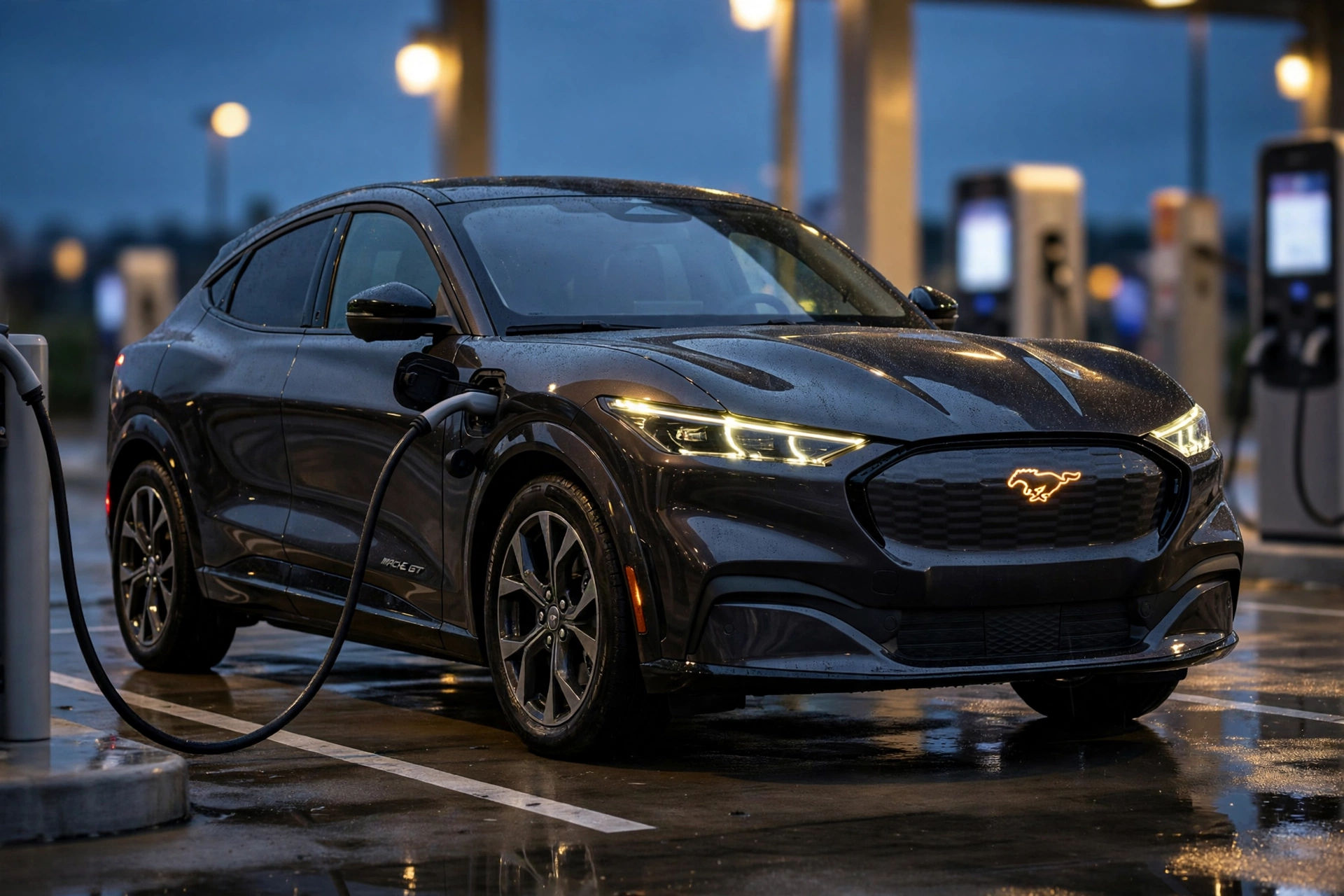
Speed is a one-line cost. Range is a subscription. The mustang mach e gt is EPA-rated at 280 miles on its 91 kWh pack, 20 miles less than the Premium AWD with the same battery, because the bigger motors, wider tyres and extra weight drink more from the same tank. The Rally drops to 255 miles and 84 MPGe combined on fueleconomy.gov, the thirstiest Mach-E you can buy. The GT itself is rated at 90 MPGe combined, 95 in the city and 85 on the highway.
Tested figures are less kind. MotorTrend ran the GT Performance through its 70 mph road-trip range test, full charge down to 5 percent, and got 208 miles. The Premium managed 250 miles in the same test. Read that again: on a real highway at a steady 70, the performance version of this car surrenders 42 miles to its own sibling. A Tesla Model Y Performance did 279 miles in the same test series and a Hyundai Ioniq 5 N did 224. The Ford is the slowest traveller in its own comparison.
Charging does not rescue the mustang mach e gt. The DC peak is 150 kW, respectable in 2021 and merely adequate now. Ford quotes roughly 36 minutes for 10 to 80 percent on the extended-range pack. MotorTrend’s fast-charge test added 77 miles in 15 minutes and 127 miles in 30 minutes, against 126 miles in 15 minutes for the Tesla. The pattern is consistent: on a road trip, you stop more often and stay longer. At home, none of this matters much, because the car charges overnight like every other EV, and our cost per mile guide shows how cheap those home miles are next to petrol.
Running costs, then, in plain numbers. At 90 MPGe, the GT uses 33.7 ÷ 90 = 0.374 kWh per mile. At $0.17 per kWh (est., a typical US residential rate), that is about 6.4 cents per mile in electricity. The Rally, at 40 kWh per 100 miles from its EPA listing, costs about 6.8 cents per mile. Small numbers, honestly earned. The real running-cost traps sit elsewhere: the performance tyres are summer-compound Pirelli P Zeros on the tested GT, which wear faster and cost more than touring rubber, and 20-inch replacements are never the cheap line on the invoice. Budget for tyres like you mean it.
Insurance gets one paragraph and no fake precision. A 480 hp performance trim will usually be quoted in a higher group than a 365 hp family trim from the same range, and the gap varies too much by driver and state for any guide to print a trustworthy number. Get a quote on the exact trim before you sign. People skip this step and then act surprised.
The audit: dollars per tenth, dollars per mile
Now the part I actually enjoy. Two computations, both simple, both brutal.
Cost per tenth of a second. The step up to the mustang mach e gt: $55,440 − $50,390 = $5,050, and it buys 0.4 seconds (4.2 down to 3.8 on Ford’s own figures). That is $5,050 ÷ 4 tenths = $1,262.50 per tenth. The package step: $3,495 buys 0.5 seconds (3.8 down to 3.3, the second figure MotorTrend-tested). That is $3,495 ÷ 5 tenths = $699 per tenth. The software-and-dampers package delivers its speed at 55 percent of the trim step’s rate. Performance gets cheaper as you climb this ladder, which is exactly backwards from how Ford presents it.
Cost per mile of EPA range. Take the full price, destination included, and divide by the rated range. Premium AWD Extended Range: $50,390 ÷ 300 = $168 per mile of range. GT: $55,440 ÷ 280 = $198 per mile. GT with the package: $58,935 ÷ 280 = $210 per mile. Rally: $59,735 ÷ 255 = $234 per mile.
The Rally buyer pays 39 percent more for each mile of range than the Premium buyer, and receives 45 fewer miles for the trouble. If range is what your life needs, the maths screams at you to stop climbing at the Premium. If speed is what your life needs, the package is the efficient way to buy it. Run your own household numbers through our total cost of ownership calculator before the test drive, not after.
One more line for the history books. The original 2021 Mach-E GT started at $59,900 before destination. The 2026 mustang mach e gt starts at $53,395 before destination. Five years, $6,505 cheaper, and a better car. Ford’s price cuts on this model have been real, and the current October 2026 offers add a further choice between $3,500 cash back and low-rate finance on remaining 2026 stock, running to November 2, 2026. Prices checked October 27, 2026.
Rally: brilliant on gravel, a $234-per-mile costume on asphalt
The Rally is the mustang mach e gt with the Performance Upgrade’s 700 lb-ft as standard, MagneRide dampers retuned with a RallySport mode, about an inch of extra ride height, underbody shielding, a front tow hook, fog lamps and Michelin CrossClimate 2 all-weather tyres on retro white wheels. Ford quotes 3.4 seconds to 60 mph. It is the most characterful Mach-E, and owners who genuinely drive forest roads will love it.
Most buyers do not drive forest roads. They drive to work on asphalt, in the rain, and for them the Rally is $4,295 more than the GT ($59,735 against $55,440) and $800 more than a GT with the Performance & Handling Package ($58,935), while being a tenth slower than that car and carrying 25 fewer miles of EPA range. Its skid plates protect a battery that commutes over speed bumps. Note, too, that for 2026 the Rally’s rear spoiler moved from standard equipment to the options list. The costume is now rented, not owned.
If your weekends are genuinely gravel, buy the mustang mach e gt Rally and enjoy it; it is the only factory Mach-E built for that life. If your weekends are garden centres, you are paying $234 per mile of range for a photograph. Be honest about which buyer you are. Our wider guide to EV range, charging costs and who should buy what makes the same point across the whole market: the cheapest range is the range fitted to the driving you actually do.
2026 changes and the 2027 shadow
The 2026 model year is mostly a reshuffle. The California Special arrives on the GT. The GT Performance & Handling Package is new. The Technology Package, which used to bundle features that were once standard on lower trims, is at least included on the GT and Rally. A heat pump is now standard across the range, which helps winter efficiency. Rear doors gain proper grab handles. The frunk, once a bragging point, becomes a $495 option on every trim, which is the single pettiest line in the 2026 order book.
And there is no federal tax credit to soften any of it: the Mach-E does not qualify for the purchase credit, and the old leasing workaround ended on September 30, 2025.
Then there is the timing problem. Ford has already announced 2027 pricing, and the 2027 GT drops $2,400 to a $50,995 MSRP, or $53,040 with destination, with the extended-range battery standard across the whole line-up. Hold that against a 2026 GT at $55,440, less the current $3,500 cash back, which lands at $51,940 if you take the cash instead of the finance rate.
A discounted 2026 undercuts the cheaper 2027 sticker by about $1,100, and you can drive it home this week. A patient buyer who does not need a car today might still prefer the 2027’s simplified range. Either way, walking into a dealership without knowing both numbers is how people overpay. Broader background on the Mustang-badged EVs sits in our electric Mustang guide.
Mustang Mach E GT verdict: our scores
Mustang Mach E GT (base): Our score: 7.2/10. Performance 8/10 · Range 6/10 · Value 7/10. Quick, handsome, well-braked, and undermined by having its best hardware held back for a package.
GT with Performance Upgrade (Performance & Handling Package): Our score: 7.6/10. Performance 9.5/10 · Range 6/10 · Value 7.5/10. The fastest way to spend GT money, because $699 per tenth beats $1,262 per tenth every day of the week. The road-trip range is still the weak leg.
Rally: Our score: 6.4/10. Performance 9/10 · Range 5/10 · Value 5.5/10. A delight for the small minority who will use it as intended, and the most expensive miles in the range for everyone else.
FAQ
How much does the Mustang Mach E GT cost right now?
$53,395 before destination, $55,440 with the $2,045 destination charge included, checked on October 27, 2026. Add $3,495 for the Performance & Handling Package. October 2026 offers on remaining stock include $3,500 cash back or subsidised finance, running to November 2, 2026, and transaction prices often land below sticker.
Is MagneRide standard on the 2026 GT?
No. It was standard on the 2025 GT and is not on the 2026 car. For 2026 you get MagneRide only inside the $3,495 GT Performance & Handling Package, which also adds the 700 lb-ft Performance Upgrade and unique wheels.
How far does the GT really travel on a charge?
The EPA says 280 miles for the mustang mach e gt. MotorTrend’s 70 mph road-trip test, run from full to 5 percent, returned 208 miles. Mixed everyday driving will land between those numbers, closer to the EPA figure in town and closer to the test figure on a fast highway. The Premium AWD reached 250 miles in the same road-trip test.
Is the Performance Upgrade just software?
Yes. It raises torque from 600 to 700 lb-ft through revised powertrain and thermal management, with no mechanical changes, and cuts the 0–60 mph time from 3.8 to 3.3 seconds. On the 2026 car it is sold as part of the Performance & Handling Package rather than as a standalone app purchase.
GT or Rally?
For road use, the GT with the package: it is $800 cheaper than the Rally, a tenth quicker, and rated for 25 more miles. The Rally only wins if unpaved roads are a regular part of your life, in which case its raised suspension, shielding and all-weather tyres stop being decoration.
Does the Mach-E GT get a federal tax credit?
No. The Mach-E does not qualify for the federal purchase credit, and the leasing route that once worked around the rules ended on September 30, 2025. State and local incentives may still apply, so check your own state before assuming the sticker is the final word.
In short, the mustang mach e gt makes most sense with the Performance & Handling Package, and the mustang mach e gt remains a fast, well-braked family SUV despite its shorter real-world range. Choose the mustang mach e gt only after a quote and a test drive on your usual roads.