Last updated: October 27, 2026
Here is the question I get asked about the Mercedes EQS 580 more than any other: is it still the one to beat? Short answer from this referee: no. Longer answer: it depends entirely on which round you care about, and that is exactly how we are going to settle it. The Mercedes EQS 580 4MATIC still tops the EQS sedan range for 2026, still carries the biggest screen in the business, and still rides like a magic carpet that went to finishing school. It also charges slower than a Lucid, runs fewer miles than a Lucid, and loses value faster than anything else on this card. Four rivals, five scored rounds, one winner per round. Pick your round before you pick your car.
First, the state of the lineup, because Mercedes has been shuffling it. The AMG EQS 53 is gone. For 2026 the sedan comes in three trims that all share the same enlarged 118 kWh battery: the rear-drive EQS 450+ at $99,900, the EQS 450 4MATIC at $102,900, and the 580 4MATIC at $123,900 before destination. Add the $1,350 destination charge and the 580 stickers at $125,250 (prices checked October 27, 2026). Our full walk through the range sits in our complete Mercedes electric car guide, so this page can stay in the ring.
The rules of this card are simple. Every rival gets named, every round gets scored out of ten, and nobody gets a sympathy point. The challengers: the Lucid Air Touring, the efficiency bully; the BMW i7 xDrive60, the traditionalist; and the Tesla Model S, the outgoing champion that Tesla stopped building in May 2026. If a score looks harsh, the numbers under it will tell you why.
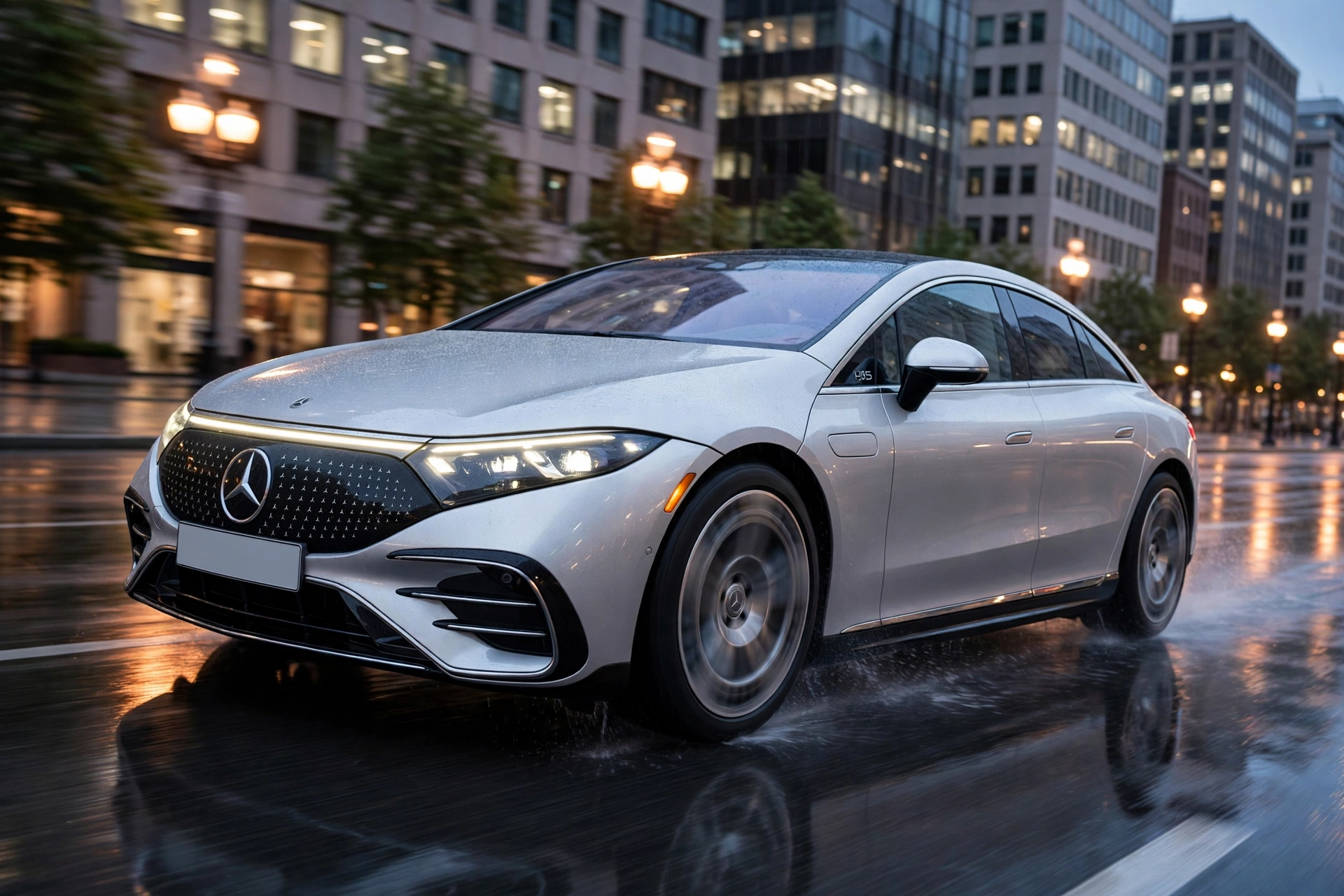
The tale of the tape for the home fighter. Dual permanently excited synchronous motors, 536 hp and 633 lb-ft of torque, fully variable 4MATIC all-wheel drive, and a curb weight of 5,864 lb. Mercedes quotes 0–60 mph in 4.2 seconds; MotorTrend’s testers stopped the clock at 3.7 seconds, so the factory number is sandbagged by half a second. The MBUX Hyperscreen is standard on the 580, all 56 inches of curved glass with a 17.7-inch central OLED, and so is 10-degree rear-axle steering, which folds this 207.7-inch limousine down to a turning circle of about 35.8 feet. On paper, this is a heavyweight. Let the rounds decide.
Round 1: Mercedes EQS 580 range vs Lucid Air and Tesla Model S
Range first, because range is where this fight gets uncomfortable for Stuttgart. FuelEconomy.gov rates the 2026 car at 371 miles and 93 MPGe combined, using 36 kWh per 100 miles. The cheaper EQS 450+ goes farther, 390 miles, which tells you what the second motor and the big wheels cost. Credit where due: the EQS beats its own label in independent hands. Edmunds drove a 2022 EQS 580 to 381 miles against a 340-mile EPA rating from that era, and Car and Driver recorded 350 miles in its 75-mph highway test. This car does not lie about range. It just does not lead.
Because the Lucid Air Touring is a range bully and this round is not close. The Touring posts 431 miles of EPA range on its 19-inch wheels at 134 MPGe, from a smaller 92 kWh battery. Read that again. Lucid extracts 60 more miles from 26 fewer kWh. The Tesla Model S, in its final 2026 form, is rated at 410 miles. The BMW i7 xDrive60 trails the group at 311 miles, and it is the only car here the EQS 580 clearly out-ranges. Efficiency is physics, and physics has scored this round.
Round 1 scores: Lucid Air Touring 10 · Tesla Model S 9 · EQS 580 7 · BMW i7 xDrive60 5. Winner: Lucid, by a wide margin.
Round 2: Charging — the round the EQS 580 cannot win
The Mercedes EQS 580 peaks at 200 kW on a DC fast charger, and Mercedes quotes 10–80% in 31 minutes. Do the referee’s arithmetic with me: 70% of 371 miles is about 260 miles added in 31 minutes, roughly 8.4 miles per minute plugged in. Respectable in 2022. In late 2026, at $125,250, it is a generation behind. The 400-volt architecture is the ceiling and no software update will raise it.
Lucid quotes up to 300 kW for the Air line, and even allowing for the Touring’s lower-voltage pack trimming the peak (est. ~250 kW), it refills markedly faster per mile thanks to that efficiency edge. The Model S peaks at 250 kW and brings the Supercharger network with it, which is worth real points on any American road trip. The i7 is the one rival charging at EQS pace, peaking just under 200 kW (est.). At home, the 580’s 9.6 kW AC charger needs the thick end of an overnight session for a full 118 kWh, so a proper wallbox is not optional equipment in any practical sense. Plan your install with our EV total cost of ownership calculator before the car arrives, not after.
Home charging has its own maths, so let us do it out loud. A completely empty 118 kWh pack on the 9.6 kW onboard charger is a 12-hour-plus session (118 ÷ 9.6 ≈ 12.3 hours). Nobody sane arrives home empty, though. An eight-hour overnight window at 9.6 kW delivers about 77 kWh, which at the EPA’s 36 kWh per 100 miles is roughly 210 miles of range restored while you sleep. For a car that lives on a wallbox, the 200 kW peak argument mostly evaporates. It only bites on road trips, which is exactly where the Lucid and the Tesla take their points.
Round 2 scores: Tesla Model S 9 · Lucid Air Touring 9 · EQS 580 6 · BMW i7 xDrive60 6. Winner: Tesla on network, Lucid on speed; the EQS 580 finishes tied for last.
Round 3: Performance — 536 hp meets the stopwatch
Straight-line speed is where the Mercedes EQS 580 defends its honor. Mercedes claims 4.2 seconds to 60 mph; MotorTrend measured 3.7. That is genuinely rapid for a car weighing within a good lunch of three tons, and the delivery is the point: 633 lb-ft arrives as one smooth, silent shove, with AIRMATIC air suspension keeping the body flat and the drama at zero. If your passengers spill coffee in this car, you were trying.
The scorecard still has to be honest. The Lucid Air Touring makes 620 hp and hits 60 mph in 3.4 seconds. The Model S makes 670 hp and does it in 3.1. The BMW i7 xDrive60 matches the Mercedes on power at 536 hp and concedes the sprint, at a claimed 4.5 seconds. So the EQS 580 beats the rival it most resembles and loses to both American cars. One-sided opinion, referee’s privilege: at this price, 536 hp is the floor of acceptable, not a headline. Mercedes knows it too, which matters when we get to the 2027 section below.
Round 3 scores: Tesla Model S 10 · Lucid Air Touring 9 · EQS 580 8 · BMW i7 xDrive60 7. Winner: Model S, in its farewell season.
One driving note the spec sheet hides. The 580 lets you dial regenerative braking up or down with steering-wheel paddles, including a strong one-pedal setting in town, and the brake pedal blending is the one place testers keep marking it down: the pedal feel goes soft and synthetic at low speed. It stops fine. It just never feels like a mechanical connection, because there barely is one. File it under first-world problems, and score the Lucid a half-step ahead on brake feel if your right foot is picky.
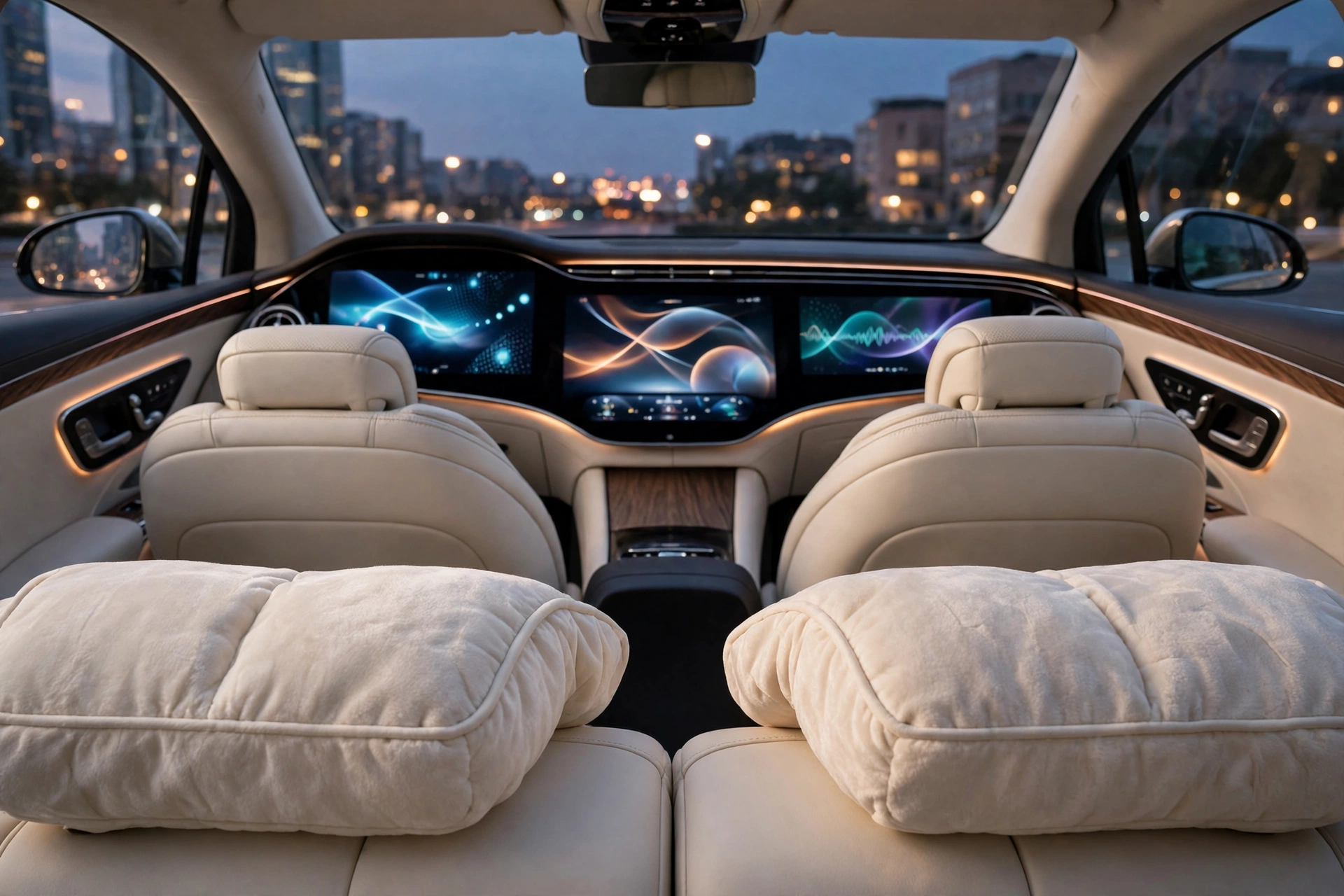
Round 4: Cabin and comfort — the home crowd erupts
Now we reach the round this car was built to win, and it wins it walking away. The Hyperscreen is standard on the Mercedes EQS 580, and rivals still have no answer to a dashboard that is one curved sheet of glass housing three displays, the passenger’s included. The Burmester 3D system is standard. The seats heat, cool, and massage. The rear headrests get pillows. The cabin is wrapped, stitched, and hushed in a way a Tesla cabin simply is not, and the Lucid, for all its engineering brilliance, feels like a very clever studio apartment next to this hotel suite.
The BMW i7 fights hardest here, with its own theatre screen and a more conventional luxury playbook, and some buyers will prefer physical buttons to Mercedes’ touch surfaces. Fair point, partial credit. What settles it is the whole package: air suspension, acoustic glazing, that 10-degree rear-axle steering making parking garages painless, and a rear seat shaped for actual adults. Rear legroom is 40.4 inches and the hatchback swallows 22 cubic feet behind the seats. This is the finest electric luxury cabin under a Rolls-Royce badge. Round to Mercedes, unambiguously.
Round 4 scores: Mercedes EQS 580 10 · BMW i7 xDrive60 9 · Lucid Air Touring 7 · Tesla Model S 5. Winner: Mercedes EQS 580, the only perfect score on this card.
Round 5: The money round — where this fight gets decided
Time for the arithmetic nobody at the dealership will do for you. Price per mile of EPA range, using delivered or base prices checked October 27, 2026:
- Mercedes EQS 580: $125,250 ÷ 371 miles = $337.60 per mile of range
- Lucid Air Touring: $81,400 delivered ÷ 431 miles = $188.86 per mile of range
- BMW i7 xDrive60: $124,200 ÷ 311 miles = $399.36 per mile of range
- Tesla Model S: $94,990 final MSRP ÷ 410 miles = $231.68 per mile of range
The i7 is worse value still, and the Lucid humiliates both Germans. Running costs narrow the gap only slightly: the EPA pegs the EQS 580 at $800 a year in electricity, about $1.34 per 25 miles, and a full home charge of that 118 kWh pack costs roughly $20 at 17 cents per kWh (est., US average residential rate). Our breakdown of electric car cost per mile shows the pattern across the market; big German flagships never win it.
Then there is depreciation, the EQS family’s open wound. ISeeCars data puts the EQS line’s first-year value loss at 48.7%, roughly $65,143 gone in twelve months. Recharged’s 2025–2026 depreciation guide found normal-mileage 2023 EQS 580 sedans that stickered between $120,000 and $135,000 retailing at $55,000 to $65,000. Take the midpoints and do the subtraction on the record: $127,500 new, about $60,000 three years later, a loss of roughly $67,500 — about $1,875 evaporating every single month. Meanwhile Edmunds reports October 2026 buyers are already paying around $10,400 under MSRP for new 580s, because the market has read the same scorecard you are reading.
So here is the referee’s ruling on money, and it is not balanced: do not buy a new Mercedes EQS 580 at sticker. Either negotiate like the discount data says you can, or buy the three-year-old car at $60,000 and let the first owner keep the depreciation trophy. The used car even keeps the best warranty card in the deck, a 10-year/155,000-mile electrical components warranty from new, so a 2023 car carries battery coverage most rivals cannot match at any age.
If you shop used, shop precisely. Cars from 2025 onward carry the bigger 118 kWh battery; earlier 580s run a 107.8 kWh pack and lower EPA ratings, so a cheap 2022 is not the same animal as a cheap 2025. Ask for a battery health report, confirm the over-the-air updates are current, and budget for tyres: nearly three tons on 21-inch rubber eats a set faster than any S-Class ever did. None of that scares this referee. It just goes on the checklist next to the price.
Round 5 scores (new): Lucid Air Touring 9 · Tesla Model S 7 · EQS 580 4 · BMW i7 xDrive60 3. Round 5 scores (used, ~2023): EQS 580 10. Split decision, and the split is the whole story of this car.
The 2027 problem: Mercedes has already built a better EQS 580
One more complication before the verdict, and it is a genuine one. Mercedes-Benz USA already lists a 2027 EQS 580 4MATIC with a spec sheet that reads like a response to this entire article: 576 hp, 0–60 mph in 3.9 seconds, an 800-volt architecture with DC charging up to 350 kW, 10–80% in 27 minutes, a native NACS port, a two-speed transmission, and optional steer-by-wire steering arriving as an option during the year. US pricing for the 2027 car had not been published when we checked on October 27, 2026.
Does that kill the 2026 car? No, and here is the challenge I will put to you directly: the 2027 car’s charging and power gains are real, and its price will be full. The 2026 car is the one being discounted five figures today, and the used ones are half price. The 2027 EQS 580 is the better machine. The 2026 EQS 580, bought right, is the better deal. Referees score what is in front of them.
Our verdict on the Mercedes EQS 580
Our score: 7.6/10 — Range: 8/10 · Charging: 6/10 · Value: 5/10 (9/10 used). The EQS 580 is the comfort champion of electric flagships and an efficiency runner-up, a car that wins the round owners sit in every day and loses the rounds measured in kilowatts and dollars. Bought new at a negotiated price, it is a fine, quiet, deeply luxurious sedan. Bought used at three years old, it is one of the great luxury bargains of the EV era. Bought new at sticker in the shadow of an 800-volt replacement, it is a donation to the first-owner depreciation fund. Choose which of those three buyers you are, and you have your answer.
The rivals’ final cards: Lucid Air Touring — Our score: 8.8/10 (efficiency and value champion; thinner service network). Tesla Model S — Our score: 8.4/10 (performance and network champion; production ended May 2026, so remaining stock is marked up, not down). BMW i7 xDrive60 — Our score: 7.2/10 (superb cabin, shortest range, worst price per mile here).
Mercedes EQS 580: frequently asked questions
Is the Mercedes EQS 580 still on sale for 2026? Yes. The EQS 580 4MATIC is the top trim of the 2026 EQS sedan range, priced from $123,900 plus $1,350 destination. The AMG EQS 53 was dropped, leaving the 450+, 450 4MATIC, and 580 4MATIC, all sharing a 118 kWh battery.
How much range does the EQS 580 have in the real world? The EPA rates the 2026 car at 371 miles. Independent testing flatters it: Edmunds recorded 381 miles from a 2022 model rated at 340 miles in its day, and Car and Driver managed 350 miles at a steady 75 mph. Expect 300–350 miles in mixed real-world use, less in deep winter.
How fast does the EQS 580 charge? Peak DC rate is 200 kW, with a quoted 10–80% time of 31 minutes. That trails Lucid and Tesla rivals. The heavily updated 2027 model raises this to 350 kW and 27 minutes with a native NACS port.
Is the Hyperscreen standard on the 580? Yes. The 56-inch MBUX Hyperscreen, with its 17.7-inch central OLED display and a dedicated passenger screen, is standard equipment on the 580. Lesser EQS trims make do with a 12.8-inch portrait screen unless optioned up.
New or used: which EQS 580 should I buy? Used, unless the new-car discount is deep. Three-year-old 580s retail around $55,000–$65,000 against $120,000–$135,000 original stickers, and the 10-year/155,000-mile electrical warranty means a 2023 car still carries long battery coverage. If you buy new, Edmunds’ October 2026 data shows around $10,400 off MSRP is achievable.
What is the difference between the 2026 and 2027 EQS 580? The 2027 car is a major technical update: 576 hp instead of 536, an 800-volt system with 350 kW charging instead of 200 kW, a two-speed transmission, a NACS charging port, and optional steer-by-wire. The 2026 car fights back on price, because it is the one dealers are discounting now.
Does the EQS 580 have a frunk? No. The front compartment is sealed for owners, the hood is a service item, and even the windscreen washer fluid goes in through a little flap in the front fender. Your 22 cubic feet of cargo space lives behind the rear seats, under a proper hatch. Odd for an EV, normal for a Mercedes, and worth knowing before your first airport run.