Last updated: October 25, 2026
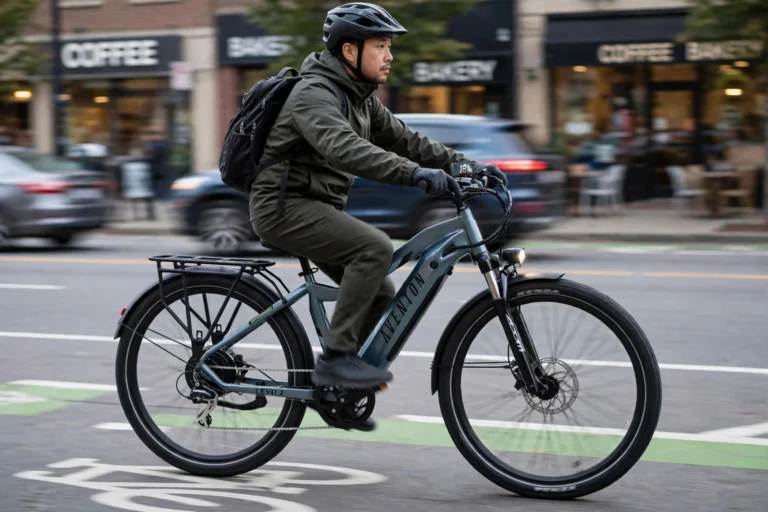
Start with the school run, because that is where this decision actually lives. Ours is 1.9 miles each way, one hill that feels personal, and a car that drinks a gallon of fuel doing short cold trips it was never built for. A hiboy electric bike costs about a cent and a half to cover that same round trip. That gap — roughly $77 of petrol a school year against about $2.30 of electricity, and the maths is shown further down — is the whole reason Hiboy sells as many bikes as it does.
Hiboy is a budget brand. Say that plainly before anything else. These are not the polished machines you get from the big European names, and the finish, the displays and the suspension forks all show where the money was saved. What you get instead is a lot of motor, a lot of battery and a price that undercuts the big names by hundreds of dollars. For a family trying to retire the second car, that trade is often the right one.
The range has settled into a clear shape for 2026. The P6 fat-tire bike is the headline act. The EX6 step-through is the one most households should actually buy. Above them sit the EX9 commuter and the EX11 full-suspension machine, and below them the little P7 commuter, the C1 mini folder and the DK1 — which is not a bicycle at all, whatever the search results imply. Prices below were checked October 25, 2026 on Hiboy’s own store.
One warning before the tour. Hiboy’s spec pages are a moving target. The P6 now ships with a smaller battery than the one in most of its reviews, the payload figure has dropped, and the charge time has grown. None of that makes it a bad bike. It does mean you should buy the bike on today’s spec sheet, not on a glowing review written about last year’s version.
The hiboy electric bike lineup at a glance
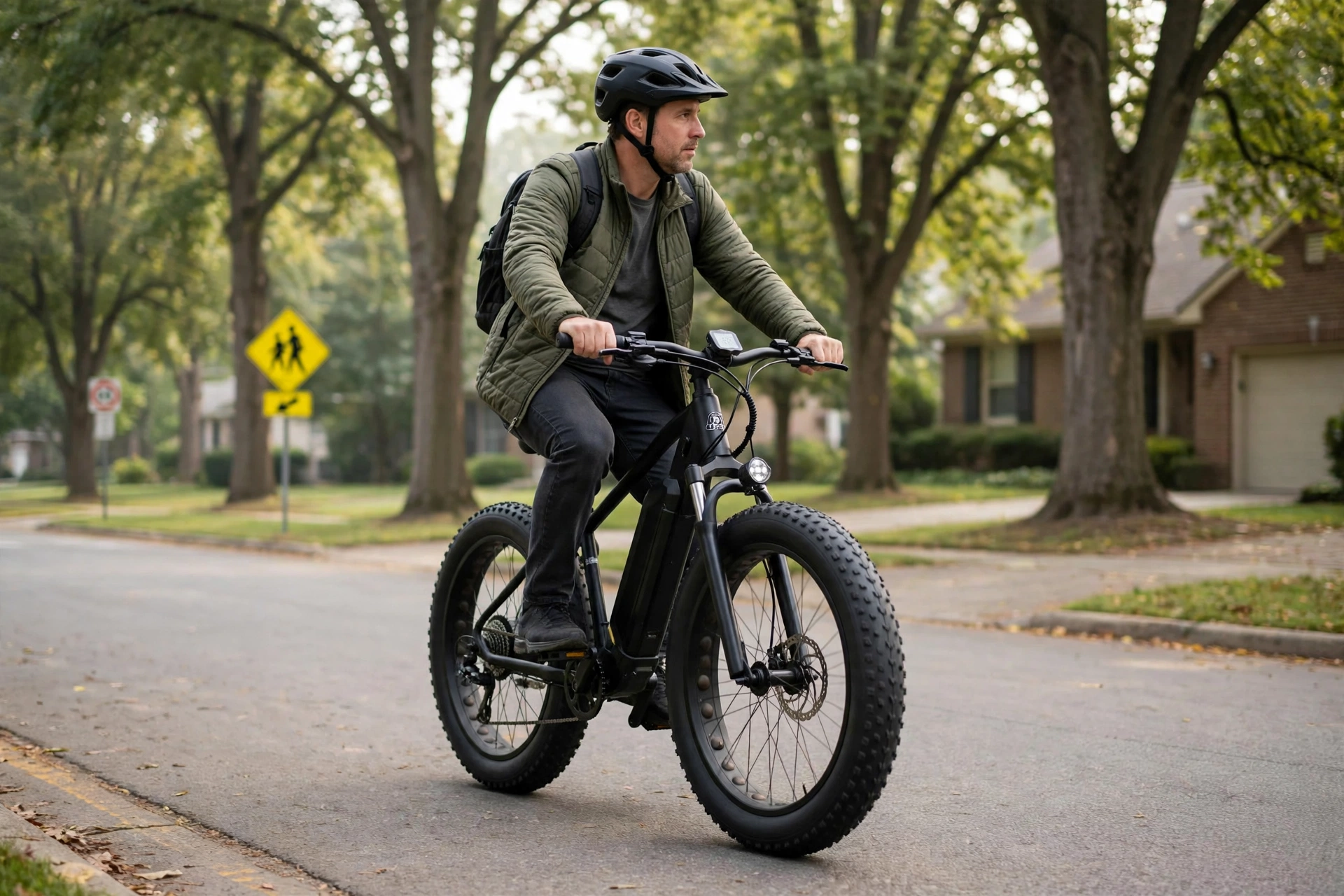
Seven models wear the badge, and they split into three honest groups. The fat-tire bikes — P6, EX6, EX6F and EX11 — are the heart of the range, built around 4-inch tires, removable batteries and prices between $849.99 and $1,299.99. The commuters, P7 and EX9, trade the fat rubber for narrower tires and easier pedalling geometry. Then come the small machines: the C1 folder at $629.90 and the DK1 kids’ dirt bike at the bottom of the store.
Here is the short version of every hiboy electric bike that matters, with the fuller tour below:
- Hiboy P6 — $1,099.99 (list $1,479.99). 750W motor, 48V 11.6Ah battery, 26×4″ tires, Class 3, 65 lb.
- Hiboy EX6 — $899.99 (list $1,579.99). 500W motor, 48V 14.5Ah battery, 20×4″ tires, step-through frame, 66 lb.
- Hiboy EX9 — $1,199.99 (list $1,999.99). 1,000W peak motor, torque sensor, 26×2.5″ tires, 330 lb payload.
- Hiboy EX11 — $1,299.99 (list $1,999.99). Full suspension, 48V 18Ah battery, 26×4″ tires, 90 Nm torque.
- Hiboy P7 — around $870 (est., catalogue pricing varies by region). 500W motor, 720Wh battery (est.), 27.5″ wheels.
- Hiboy C1 — $629.90 (list $899.99). 350W motor, 36V 7.8Ah battery, 14″ wheels, folding frame.
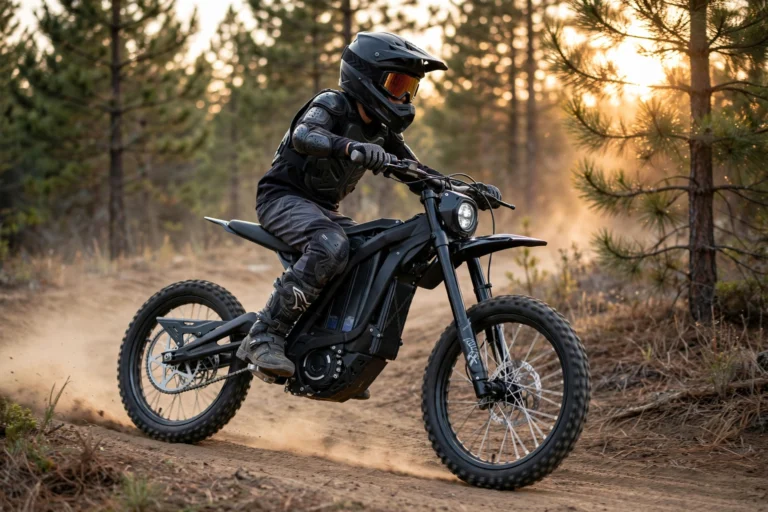
- Hiboy DK1 — a 300W electric dirt bike for children aged roughly 3–10. No pedals. Not an e-bike.
The P6: the fat-tire flagship, with fine print
The P6 is the best-known hiboy electric bike of the lot, and the spec explains why. A Bafang 750W rear hub motor peaks at 1,000W with around 80 Nm of torque, enough to haul a loaded bike up the hill at the end of our street without the rider arriving as a puddle. It is a Class 3 machine: 20 mph on the throttle, 28 mph with pedal assist. The 26×4″ puncture-resistant tires roll over cracked pavement, gravel cut-throughs and the occasional dropped kerb like they are not there, and an 80mm hydraulic suspension fork takes the sting out of the rest.
Now the fine print, because there is some. Hiboy’s current P6 listing quotes a 48V 11.6Ah removable battery — 557 watt-hours. Most reviews on the internet, including several glowing ones, describe a 48V 13Ah battery. That bigger pack is what earlier buyers received; today’s bike carries the smaller one, and the official charge time has stretched to 6–7 hours to match the newer spec sheet’s honesty. The maximum load has also settled at 265 lb, not the 330 lb older reviews celebrate. Check the live listing before you buy, and hold the bike to the numbers printed there.
What has not changed is the riding character. Testers consistently call the P6 fun — genuinely, grin-on-a-fire-road fun — with a bright display, a loud horn and a frame that feels screwed together properly. The complaints are just as consistent. There are no fenders, no rear rack and no taillight in the box, which is a strange omission on a bike marketed for commuting. The stock brakes on many units are mechanical discs, and a 28 mph bike deserves better. The throttle is live the moment the bike powers on, so a knocked twist-grip at a crossing can surge the bike forward. And it comes in one size with a tall standover, so shorter riders should sit on one before ordering.
Our take for families is blunt. The P6 is a brilliant weekend toy and a strong solo commuter. As a family load-hauler it fights you — no rack, no fenders, a 65 lb lift onto a car rack, and a payload ceiling that a parent plus a child seat plus a week of lunches can genuinely approach. Buy it for the rider. Look one rung down the range for the household.
Hiboy electric bike range: the claim vs the test
Hiboy quotes the P6 at 50–62 miles with pedal assist and 25–31 miles on throttle alone. Read the footnote and the claim shrinks: those numbers come from a 143 lb rider. A 143 lb rider is a teenager, not a parent with a pannier of library books and a growth-spurt ten-year-old’s lunchbox. Independent testers tell the truer story. BikeRide’s summary of expert P6 tests puts throttle-only range at around 30 miles — the bottom of Hiboy’s claimed band, achieved without the cargo most family bikes carry daily.
Plan on two-thirds of any headline figure and you will rarely be stranded. That rule holds across the range. The EX6 claims 41 miles on throttle and 75 miles with pedalling from its bigger 696Wh battery, figures Hiboy bases on a 165 lb rider. Owners back the shape of it, if not the ceiling: one Best Buy reviewer with 1,700 miles on an EX6 reports 30–40 miles on pure throttle, which for a 4-mile school run means charging roughly once a week and never thinking about it in between. A hiboy electric bike that asks for a plug once a week is a family appliance. One that needs it nightly becomes a chore with wheels.
The EX11 sits at the far end of this honesty scale. Its “up to 100 miles” headline comes with Hiboy’s own test conditions attached: assist level 1, flat concrete, no wind, an average speed of 9.3 mph. At 9.3 mph, 100 miles takes nearly eleven hours. Nobody commutes like that. The battery underneath the claim — a proper 48V 18Ah, 864Wh pack — is genuinely large, and 45–55 real miles (est., based on the pack size and the EX6’s tested efficiency) is still excellent. Just buy the watt-hours, not the headline.
The EX6: the one most families should buy
If the P6 is the poster bike, the EX6 is the purchase. The step-through frame is the reason. Hopping on and off at school gates, in a skirt, with a child seat fitted behind you, forty times a week — the low 18-inch step-over stops being a spec and becomes the whole product. Around it Hiboy has built the most family-complete bike in its range: 20×4″ fat tires, a 500W motor peaking at 960W, fenders fitted as standard, a rear rack rated at 33 lb, lights front and rear with a brake-activated taillight, and a bell loud enough to clear a pavement of earbud-wearing teenagers.
The battery is the other half of the argument. At 48V 14.5Ah — 696Wh — it is bigger than the P6’s current pack despite the EX6 costing $200 less, and it slides out for charging at a kitchen counter, which matters in a house where the garage is a rumour. Range claims are 41 miles throttle-only and 75 miles assisted; the owner feedback above suggests 30–40 honest throttle miles. Top speed is 25 mph with pedalling and 20 mph on the throttle. Riders up to 300 lb are covered by the payload rating, the highest of the fat-tire pair, and there is a folding sibling, the EX6F, if storage space is your binding constraint.
It is not perfect, and we will not pretend otherwise. BikeRide’s expert panel scored the EX6 81/100, praising the comfort and accessories while calling out a basic fork that bottoms out, a small display with awkward buttons, ghost pedalling at higher speeds and a saddle that goes from fine to furniture at about mile five. Riders near six feet tall found it cramped despite Hiboy’s height range suggesting otherwise. Treat it as a bike for riders roughly 5′0″ to 5′10″ and it fits its brief beautifully. This is the hiboy electric bike we would hand to a neighbour replacing a second car, and it is not close.
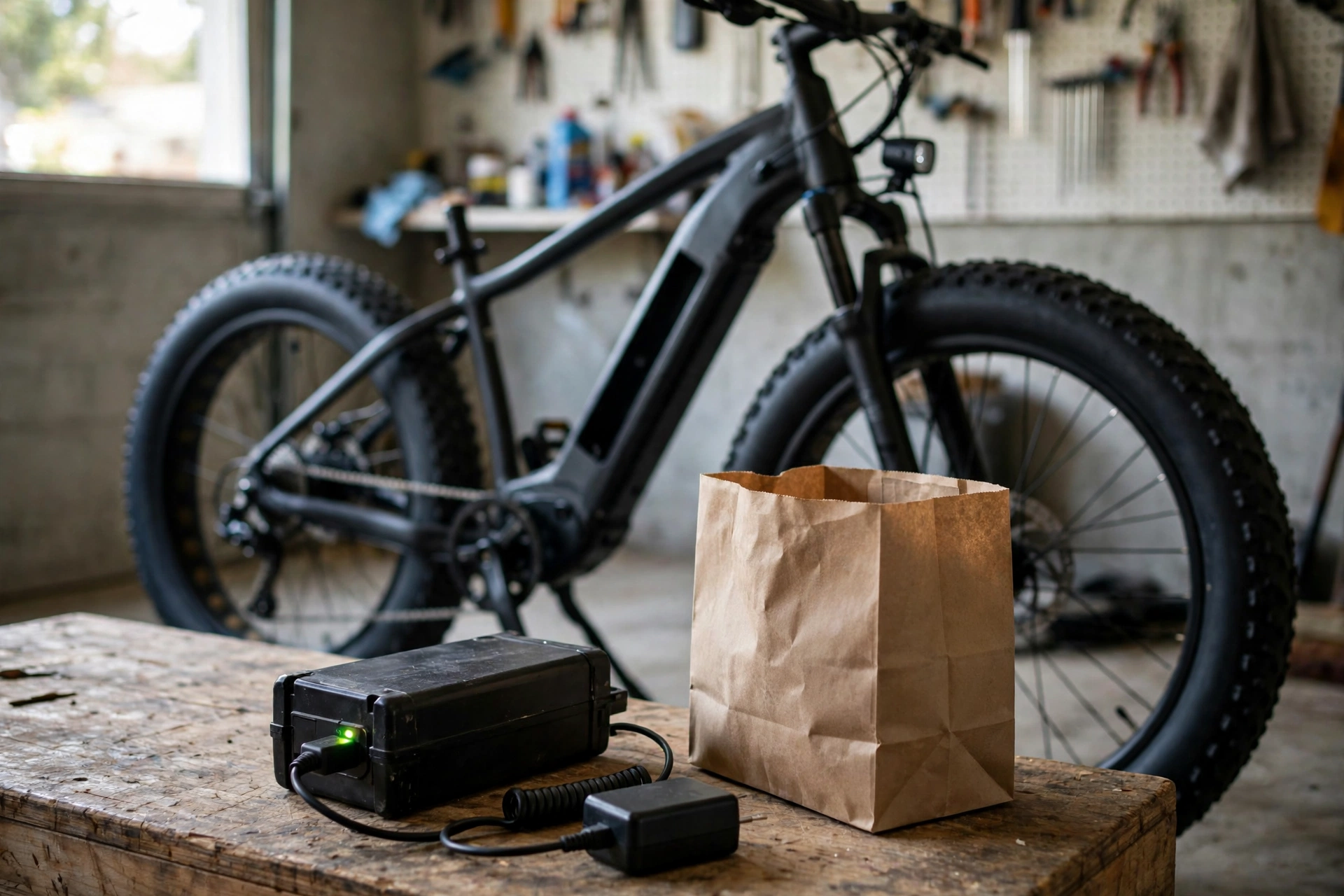
What a hiboy electric bike costs to charge
Here is the arithmetic that sells these bikes, done slowly so you can check it. The EX6 battery holds 48 volts × 14.5 amp-hours = 696 watt-hours, or 0.696 kWh. At an average US home electricity price of $0.17 per kWh (est.), a full charge costs 0.696 × $0.17 = $0.118 — call it 12 cents. The P6’s smaller 557Wh pack costs about 9 cents to fill. Even Hiboy’s biggest battery, the EX11’s 864Wh unit, comes to roughly 15 cents a charge.
Now run the school year through it. Our 3.8-mile round trip, 180 school days, is 684 miles a year. At the owner-reported 35 miles per EX6 charge, that is about 20 charges — $2.36 of electricity, annually, for the entire school run. The same miles in a petrol car at 30 mpg and $3.20 a gallon (est.) burn 22.8 gallons and cost $72.96, before parking, before the cold-engine wear those short hops cause. Per 100 miles, the EX6 runs at roughly 34 cents of electricity against about $10.67 of petrol. If you want to test the numbers against your own tariff, our guide to how much it costs to charge an electric bike walks through the same maths for any battery size.
Charging times are the honest downside. The EX6 needs 7–8 hours for a full charge, the P6 6–7 hours, the EX11 a patience-testing 9–10 hours. These are overnight chargers, not top-up-over-lunch chargers, and there is no fast-charge option anywhere in the range. The removable batteries soften the blow: bring the pack indoors, plug it in by the kettle, ride out in the morning. When a pack eventually tires, budget for a replacement rather than a new bike — our e-bike battery replacement cost estimator will price that up before you commit.
Stepping up: EX9 and EX11
The EX9 is Hiboy growing up in public. It is a step-through urban commuter on 26×2.5″ tires with something no other bike here has: a dual-sided torque sensor, which meters your pedalling effort and feeds in power to match, instead of the on-off shove of a basic cadence sensor. The motor peaks at 1,000W, hydraulic brakes come standard, the payload ceiling rises to 330 lb, full fenders and a rear rack are fitted, and Hiboy claims up to 62 miles of range. At $1,199.99 it is priced against real competition from established commuter brands, and the torque sensor is the first Hiboy feature that competes on feel rather than on numbers.
The EX11, at $1,299.99, is the range’s heavy artillery: a full-suspension fat-tire bike with a four-link rear end, an 80mm dual-crown fork, dual-piston hydraulic brakes on 180mm rotors and that 864Wh battery. The 110 lb rear cargo rating is a genuinely useful number for camping and fishing trips. It is also a very heavy, very long-charging machine built for weekend distance, not for the gate run. Families should admire it and buy the EX6.
The small print: P7, C1 and the DK1
The P7 is the quiet commuter of the range: a 500W motor, a 720Wh battery on catalogue figures (est., as Hiboy’s regional listings differ), 27.5″ wheels and a claimed 68 assisted miles at a catalogue price around $870 (est.). On paper it undercuts the EX9 while keeping a proper commuter shape. In practice the spec sheets vary enough between regions that you should confirm the battery size on the exact listing before paying.
The C1 is a different species: a folding mini-bike on 14-inch wheels, with a 350W motor, a small 36V 7.8Ah battery and claimed ranges of 21.7 miles electric and 26.2 miles assisted from Hiboy’s own spec table. At $629.90 it suits a flat campus, a boat, a last mile from a station. It does not suit school-run duty — 14-inch wheels find every pothole the council has been ignoring, and a 230 lb load ceiling disappears fast under an adult plus a child plus bags. Buy it as a spare vehicle, not a family one.
And the DK1 needs a sentence of honesty all to itself: it is a 300W electric dirt bike for small children, with no pedals, a 15.5 mph top speed and a 140 lb rider limit. A fine toy. It is not an e-bike, it cannot take part in family rides on equal terms, and it does not belong on this page’s shopping list for transport. If your children are asking for one, that is a birthday conversation, not a commuting one. Parents weighing classes and legality for younger riders should read our complete guide to Class 1 e-bikes before spending anything.
Verdicts: our scores for every model
Scores are ours, weighted the way a household actually uses a bike: honest range first, charging pain second, value always. Every hiboy electric bike below was marked against the same yardstick, and the spread is wider than the marketing suggests.
- Hiboy P6 — Our score: 7.4/10 (Range 7/10 · Charging 6/10 · Value 8/10). The fun flagship, docked for the missing rack and fenders, mechanical brakes at 28 mph and a battery that quietly shrank.
- Hiboy EX6 — Our score: 8.1/10 (Range 8/10 · Charging 6/10 · Value 9/10). The family pick. Biggest battery per dollar in the range, the right frame shape, accessories actually included.
- Hiboy EX9 — Our score: 7.8/10 (Range 8/10 · Charging 6/10 · Value 7/10). The grown-up commuter; the torque sensor earns real points, the price invites real competition.
- Hiboy EX11 — Our score: 7.6/10 (Range 9/10 · Charging 5/10 · Value 7/10). A distance machine with a 9–10 hour charging habit. Superb at its job, miscast as a daily.
- Hiboy P7 — Our score: 7.0/10 (Range 7/10 · Charging 6/10 · Value 7/10). Sensible commuter value, held back by regional spec confusion.
- Hiboy C1 — Our score: 6.2/10 (Range 4/10 · Charging 7/10 · Value 7/10). A charming spare, not a workhorse. Small wheels, small battery, small claims — at least the claims are honest.
- Hiboy DK1 — Our score: 6.8/10 (Range 5/10 · Charging 7/10 · Value 7/10). Scored as the children’s dirt bike it is: good toy, wrong page if you came for transport.
Frequently asked questions
Which hiboy electric bike is best for the school run?
The EX6, and it is not a close call. The step-through frame, fitted rack and fenders, brake light and the biggest battery per dollar make it the hiboy electric bike that behaves like family transport from day one. The P6 only wins if the same bike must also do weekend trails for a solo rider.
How far does a Hiboy P6 really go on one charge?
Hiboy claims 50–62 miles with pedal assist and 25–31 miles on throttle, tested with a 143 lb rider. Independent testers report around 30 miles throttle-only. A parent carrying cargo should budget 22–27 throttle miles, or 35–45 assisted miles on a mixed route (est., based on the 557Wh pack and tester results).
How long do Hiboy batteries take to charge?
Longer than the brochures of a few years ago suggested. Current figures: P6 6–7 hours, EX6 7–8 hours, EX11 9–10 hours, C1 5–6 hours. All batteries are removable, so overnight charging indoors is the routine Hiboy ownership settles into.
Are Hiboy e-bikes legal to ride on the road?
The P6 is a Class 3 e-bike — pedal assist to 28 mph with a 20 mph throttle — which some trails and shared paths restrict. The EX6 tops out at 25 mph assisted. Rules vary by state and city, so check your local class rules before assuming a Class 3 bike is welcome everywhere your family rides.
Can a Hiboy carry a child seat and a week of groceries?
On the EX6, yes: the 300 lb payload and 33 lb rack rating cover a child seat or a serious grocery load, though not both at maximum at once. On the P6 you would be adding the rack yourself and working under a 265 lb ceiling — one more reason the EX6 is the family answer.
Is a Hiboy worth it next to a bigger brand?
For the money, the EX6 and P6 deliver motor and battery specs that cost $400–700 more elsewhere, and that is the whole proposition. You pay for it in fork quality, displays, brake specification on some P6 units and a one-year warranty. Families who ride daily and locally usually come out ahead. Riders who need dealer support on every street corner should pay the extra and sleep better.
So, the short version. A hiboy electric bike is the budget route onto two electric wheels, and for once the budget route mostly works — provided you buy the current spec sheet, plan on two-thirds of the claimed range, and pick the EX6 for family duty. The second car can stay retired.
For a household weighing this choice, a hiboy electric bike makes most sense when daily miles are short, charging can happen overnight, and the bike will be ridden often enough to replace car trips. A hiboy electric bike bought on current specs, rather than old reviews, is the safer purchase. And a hiboy electric bike chosen for the school run should be judged on the step-through frame, the rack and fenders, and the real range on a loaded ride, not the headline figure alone.