Last updated: October 25, 2026
Pick the wrong ebike motor and the rest of the bike stops mattering. Not the suspension. Not the brakes. Not the dropper post you are so proud of. The motor decides how the bike climbs, how it sounds at 7 a.m. on an empty trail, how fast it eats chains, and — the part buyers skip — whether you are welcome on that trail at all.
Every motor sold today lives in one of two places: at the bottom bracket, driving the cranks, or inside a wheel hub, driving the tire directly. That single choice cascades into everything else. Torque delivery, heat, weight balance, sensor feel, failure modes, even which trails you may legally ride. Spec sheets will try to sell you watts. Placement is the honest number, and it is not a number at all.
Access is the reason I care. Most US singletrack that allows e-bikes allows Class 1 only: pedal assist, no throttle, assist that quits at 20 mph. Land managers are watching, and every overpowered throttle bike poached on non-motorized trail becomes an argument at the next access meeting. Our Class 1 e-bike guide covers the rulebook in detail; this guide covers the hardware that keeps you inside it — or throws you out of it.
So here is the order I think in when I am grinding up a climb and the motor starts to fade: placement first. Then torque, the watts label game, sensors, the big brand systems with their real numbers, noise and heat, and finally how each design dies and what it costs you. Figures are manufacturer numbers unless I flag them (est.).
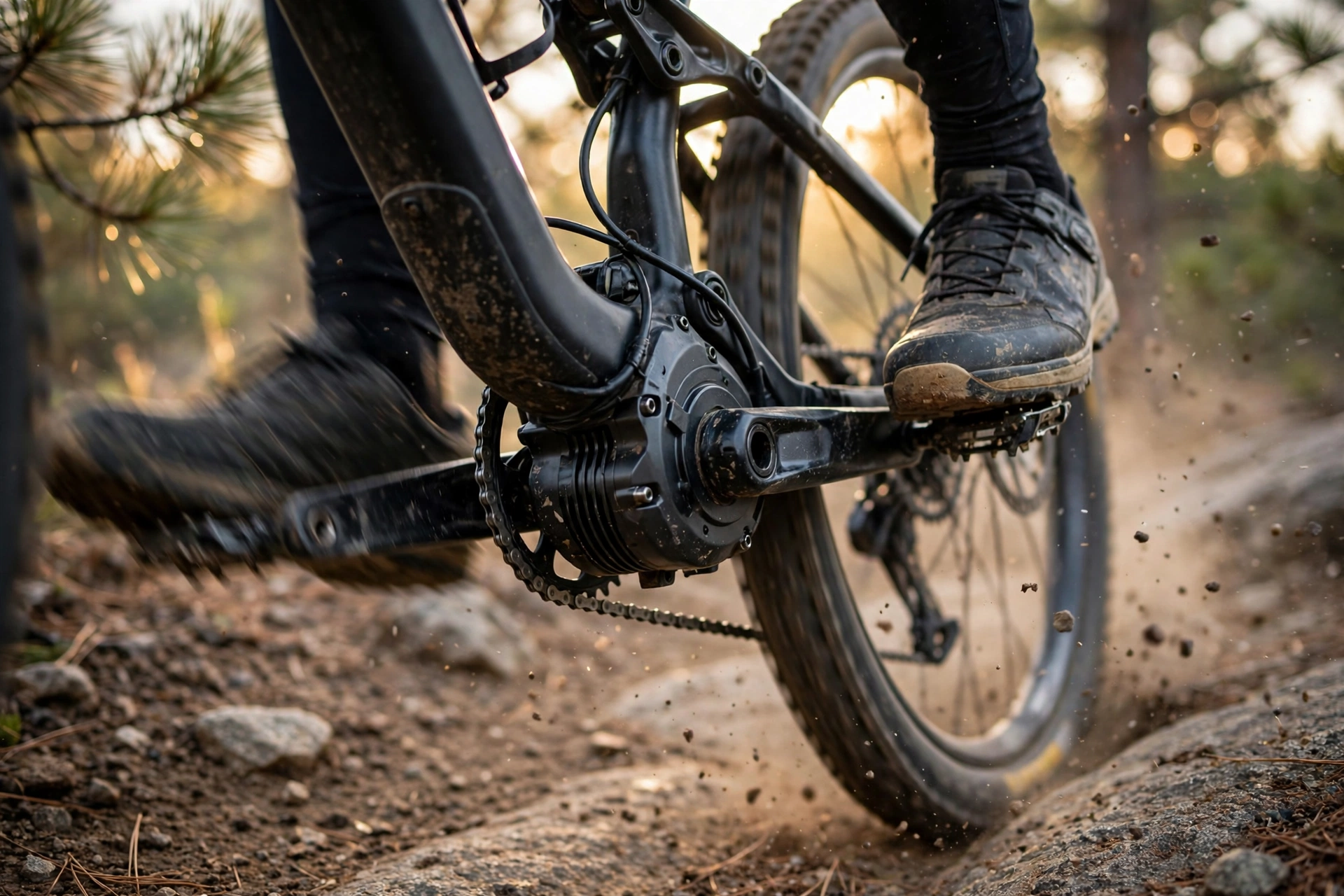
Two homes for an ebike motor: the bottom bracket and the hub
Mid-drive: the motor works the gears
A mid-drive sits at the bottom bracket and pushes on the chain, exactly where your legs do. That sounds like a small detail. It is the whole game. Because the motor drives through your cassette, it gets to use your gears. Drop into the 51-tooth cog and the motor spins fast while the wheel turns slowly — which is precisely what an electric motor wants. Electric motors make their best power and their best efficiency at high rpm. A mid-drive on a climb is a motor in its happy place, with the weight slung low and central, where it helps handling instead of fighting it.
The costs are real. The chain, cassette and chainring now carry your watts plus the motor’s, and they wear like it. The frame must be built around the motor, so there is no cheap path in. And when the motor dies, it is a dealer-level, system-level conversation, not a wheel swap. It remains the ebike motor layout I would buy with my own money. Still: for trail riding, this is the only architecture I take seriously, and our e-bike dirt riding guide assumes a mid-drive for the same reason.
Geared hub: small motor, planetary trick
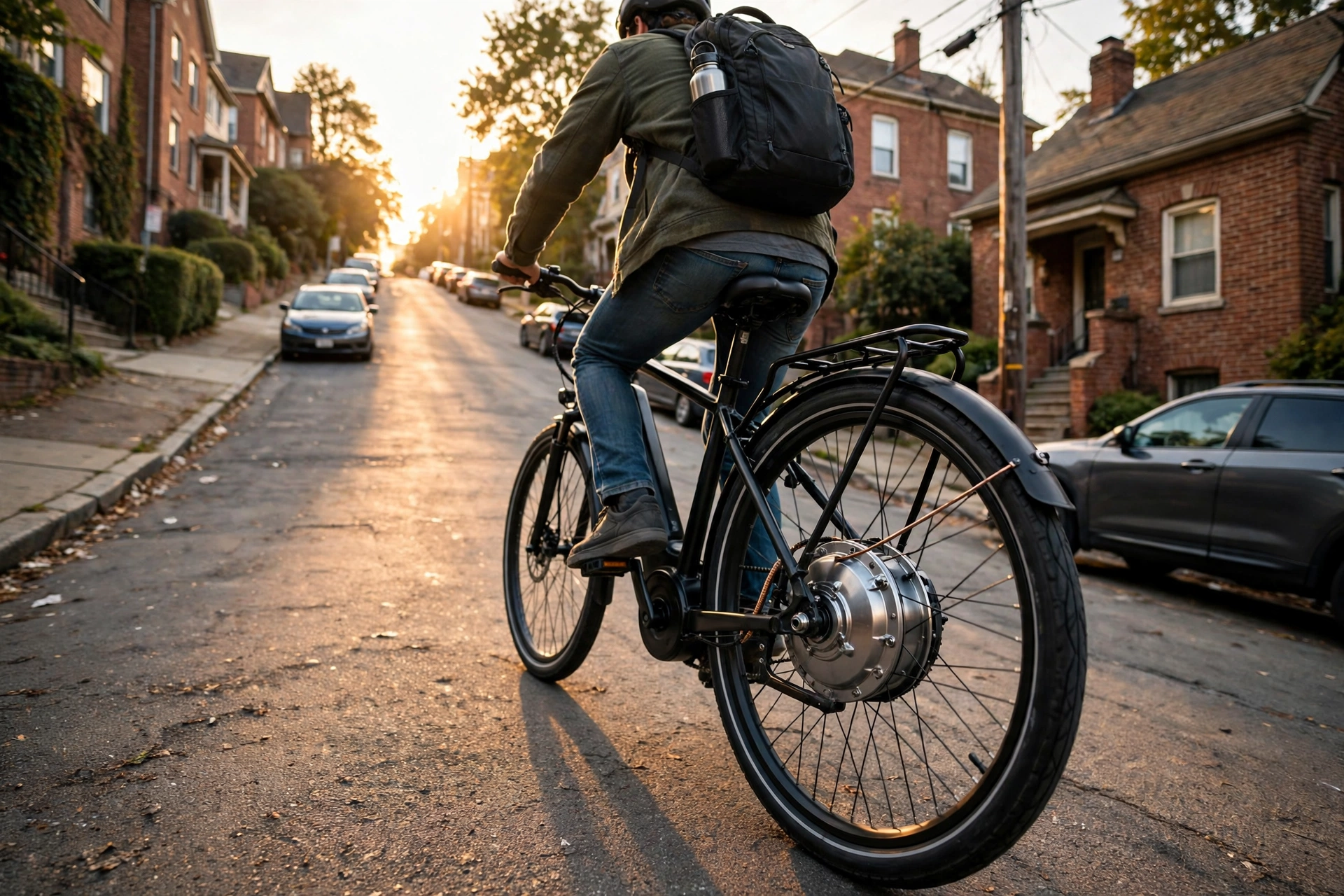
A geared hub hides a small motor inside the rear (rarely front) wheel, spinning a set of nylon planetary gears that reduce its speed and multiply its shove. The gears let a little motor punch above its weight, and the whole unit freewheels when you stop pedaling, so there is no drag. Weight runs roughly 3 to 4.5 kg (est.) for common 500–750 W units, all of it in the wheel, all of it unsprung mass your suspension cannot control. On a rigid commuter that hardly matters. On a trail bike it matters on every root. As a commuter ebike motor: excellent. As a trail tool: no.
Direct-drive hub: the silent brick
A direct-drive hub deletes the gears. The axle is the motor shaft; the shell of the hub is the rotor. No planetary gears to strip, almost nothing to wear, and it can feed a little energy back under braking. It is also heavy — 6 to 9 kg (est.) in the sizes people actually buy — produces a faint magnetic drag when unpowered, and makes its torque in a narrow, wheel-speed-locked band. Dead reliable. Dead boring. On flat city streets, boring is a compliment.
Torque: the ebike motor number that actually climbs
Torque, measured in newton-metres (Nm), is twisting force. It is the number that decides whether a climb feels like a tailwind or a wall. Watts describe how fast work gets done once you are moving; torque is what gets a loaded bike moving up a 15% pitch from a standstill, in the wet, with a gate to open halfway up. Ignore any advert that leads with watts and whispers the torque. Read the torque figure first — it is the ebike motor number that predicts your worst climb, not your best one.
Here is the arithmetic the brochures leave out. Take an 85 Nm mid-drive, standard trail-motor territory. In a modern granny gear — 32-tooth chainring, 51-tooth cog — the cassette multiplies crank torque by 51 ÷ 32 = 1.59. So 85 Nm becomes roughly 135 Nm at the rear axle; discount about 5% for chain losses (est.) and the wheel still sees about 128 Nm. Push that through a 0.35 m wheel radius and the tire shoves the ground with about 366 newtons of force.
Now the strong geared hub, rated at 60 Nm. Sixty is all it ever makes, because its internal gearing is fixed. 60 ÷ 0.35 m gives roughly 171 newtons at the contact patch. Less than half the push, and it arrives whether you are in the right gear or not, because for a hub there is no right gear. Gravity alone on a 95 kg rider-and-bike total demands about 93 newtons just to hold station on a 10% grade. The hub clears that bar and has little left for the steeper pitch around the corner. The mid-drive has nearly four times the requirement in reserve.
Watts are a label game: nominal, peak, and the law
Two motors can both wear a “750 W” sticker and share almost nothing. The rating that matters legally is nominal — continuous power, the output a motor can hold without cooking itself. Peak power is what it can borrow for a few minutes. Brands quote whichever is bigger, and the ebike motor on a European bike makes the game obvious: it is rated at 250 W nominal, because EU rules (Regulation 168/2013, standard EN 15194) cap continuous rated power at 250 W with assistance to 25 km/h. The same class of motor peaks at 600 W. Bosch’s Performance Line CX is the cleanest example — 250 W nominal, 600 W maximum, and nobody who has ridden one calls it a 250 W experience.
The US framework is looser. The federal definition of a low-speed electric bicycle caps the motor at 750 W — one horsepower — and the three-class system layers speed rules on top: 20 mph for Class 1 and 2, 28 mph for Class 3. States and land managers then decide where each class may ride. Note what the law regulates: the label and the speed, not the peak output or the torque. That loophole is how you get “750 W” bikes that peak far higher, and it is exactly the loophole that gets trails closed.
Now the physics, because physics does not read brochures. Put a 95 kg rider-and-bike total on a 10% grade at 15 km/h (4.17 m/s). Gravity asks for 95 × 9.81 × 0.10 × 4.17, about 389 W. Rolling resistance on knobby tires at a Crr of 0.008 (est.) adds roughly 31 W. Air drag adds about 20 W. Total: near 440 W at the wheel, sustained for as long as the climb lasts.
A fit rider holds perhaps 150 W of that. The motor owes the remaining 290 W at the wheel — around 360 W drawn from the battery after system losses (est.). So our “250 W” motor is legally compliant, thermally busy, and living well above its nameplate.
Hold peak output for twenty slow minutes and the controller starts taking power back to protect the windings. That rollback, not the battery gauge, ends most hub-motor climbs — the energy math is separate, and we break it down in what it costs to charge an electric bike. The U.S. Department of Energy’s Alternative Fuels Data Center credits e-bikes with efficiency up to 3,800 mpg equivalent, which is the real story here: these motors are frugal everywhere except a steep hill at walking pace, where physics collects its tax.
Sensors: why two bikes with the same ebike motor feel nothing alike
A cadence sensor counts pedal rotations with a magnet ring. Pedals turning? Full assist, after a delay. Pedals stopped? Assist lingers a beat, then quits. It is cheap, it is durable, and it feels like a light switch — because it is one. On a flat commute nobody cares. On a technical climb, a light switch is how you loop out on a wet root.
A torque sensor measures how hard you are pushing, usually at the crank or bottom bracket, and scales the assist to match: push at 340% support and a 60 Nm leg effort becomes a serious shove; soft-pedal and the motor soft-pedals with you. Bosch says its current systems sample pedal input more than 1,000 times per second, and you can feel every one of those samples in how cleanly power arrives mid-corner. This is why two bikes with identical motors ride like different species. My position is simple: a cadence sensor on anything marketed as a mountain bike is a corner cut too far. Torque sensing is not a luxury feature. It is the feature.
The big systems, with their real numbers
Bosch is the default for a reason. The current Performance Line CX is rated at 250 W nominal with 85 Nm of torque, up to 340% support and a 600 W maximum, in a magnesium case weighing 2.8 kg — figures Bosch publishes across its own eBike pages, and software updates since 2025 have let owners raise newer CX units to 100 Nm, then 120 Nm on the latest generation. The ecosystem is the catch and the benefit: batteries, displays and diagnostics are Bosch-only, and dealers love the reliability data. The lightweight Performance Line SX trims the formula to 55 Nm and 2.0 kg for riders who still want legs.
Shimano’s EP801 matches the CX on paper — 85 Nm, 600 W peak (est. for US tune), 250 W nominal — and undercuts it on weight at about 2.6 kg. The ride feel is the Shimano signature: less punch off the line, a smoother blend, power that feels like your own legs on a very good day. Early EP8 units had a freewheel rattle on descents that drove owners mad; the EP801 mostly fixed it. Mostly.
Yamaha’s PW-X3 also posts 85 Nm at roughly 2.75 kg, with a reputation for instant response from a standstill and a compact case that frame designers like. Yamaha is also now the owner of Brose’s e-bike drive business, sold in 2025 — an odd sentence to write, but the Brose units live on. Brose built its name on quiet: an internal belt drive instead of straight-cut gears, torque near the top of the class (the Drive 3 Peak is rated at 95 Nm), and the most natural decoupling when you stop pedaling. If silence is your religion, Brose was your church.
Bafang plays a different sport. The M620 (Ultra) and the BBSHD conversion motor are rated at 1,000 W nominal with a claimed 160 Nm, and the M620 alone weighs 5.3 kg — nearly double a Bosch CX, before you add the battery to feed it. As engineering, it is honest, tunable, and parts are everywhere. For hauling cargo or dragging a loaded trailer up a fire road, it is a legitimate ebike motor with no rival at the price. As trail policy, it is a disaster wearing a number plate.
Motors like this belong on cargo bikes, private land and roads where the law treats them as what they are. Bolt one to a hardtail, twist the throttle up a non-motorized climb, and you are not an ambassador. You are the reason the rest of us lose access. Two quick footnotes: DJI’s Avinox system now claims up to 120 Nm in boost on the M1 and 150 Nm on the M2S, at weights near 2.6 kg — the torque war is real — while TQ’s HPR50 (50 Nm, 1.85 kg) and Fazua’s Ride 60 (60 Nm) prove the lightweights can be nearly invisible until the hill arrives.
Noise, weight and heat: what the brochure hides
Noise is a quality you cannot unhear. Brose’s internal belt is the benchmark — close to silent. Bosch’s current CX is respectably hushed after its redesign, though the gearbox whine rises under full load. Shimano’s EP801 still mutters on rough descents (est. — it varies by frame). Straight-cut gears in cheap mid-drives and worn geared hubs whine like a dentist’s drill by year two. Direct-drive hubs are the quietest of all: nothing inside to make noise, which is the one spec-sheet win I will grant them.
Weight placement beats weight total. A 2.8 kg motor at the bottom bracket disappears into the bike’s balance. A 3.5 kg geared hub lives at the axle, where it degrades suspension response, punishes spokes, and makes a rear flat a wrestling match involving connectors and torque arms. And heat is the silent spec: any motor forced to work slowly under heavy load — a hub on a long 12% grade is the textbook case — converts your battery into warmth instead of altitude, then derates. Mid-drives dodge this by spinning fast in a low gear. It is the same trick your legs use, which is rather the point.
How each design dies, and what maintenance actually looks like
Mid-drives die slowly and expensively through the drivetrain first. Chains on strong mid-drives commonly last 800–1,200 km before hitting the wear limit (est., shop rule of thumb); hub bikes routinely double that, because the chain only ever sees leg power. Cassettes and chainrings follow the same schedule, and a worn chain ignored too long takes the whole set with it. The ebike motor itself usually fails at the edges: water past the axle seals, bearing play, a creak that turns out to be loosening mount bolts, or electronics that need a dealer’s diagnostic key.
Geared hubs die at the planetary gears — nylon teeth that strip under heat and shock loads — at hall sensors drowned by wheel-spray, and at spokes fatigued by torque they were never laced for. Direct-drive hubs barely die at all; kill one and you have usually killed the controller, the wiring at the axle exit, or the bearings with rust. Every hub shares one chore: a puncture means tools, connectors and patience, not a quick-release and ninety seconds. Budget for it.
Our scores, by motor type
Full-power mid-drive (Bosch CX, Shimano EP801, Yamaha PW-X3)
Our score: 9/10 — Climbing: 10/10 · Reliability: 8/10 · Trail Manners: 9/10
The complete package. Gears multiply torque, sensors meter it, and Class 1 legality keeps you on the trail network. Drivetrain wear is the tax.
Lightweight mid-drive (TQ HPR50, Fazua Ride 60, Bosch SX)
Our score: 8/10 — Climbing: 7/10 · Reliability: 8/10 · Trail Manners: 10/10
For riders who want a bike first and a boost second. You will work on steep pitches. That is the deal, and it is a good one.
Geared hub
Our score: 7/10 — Climbing: 5/10 · Reliability: 8/10 · Trail Manners: 7/10
The commuter’s friend: cheap, sealed, honest. Keep it off steep singletrack and it will outlive the frame it is bolted into.
Direct-drive hub
Our score: 5/10 — Climbing: 4/10 · Reliability: 9/10 · Trail Manners: 5/10
Nearly immortal, mostly joyless. Flat cities, big wheels, no hills worth naming — that is its whole habitat.
Oversized conversion mid-drive (Bafang M620 / BBSHD class)
Our score: 4/10 — Climbing: 10/10 · Reliability: 6/10 · Trail Manners: 2/10
Immense, tunable, and completely out of place on shared trails. Cargo rigs and private land, yes. Singletrack, never.
Frequently asked questions
How long does an ebike motor last?
There is no odometer-based expiry. A sealed hub motor can pass 20,000 km with nothing but bearings (est.). A mid-drive’s motor unit often outlasts two or three drivetrains — chains, cassettes and chainrings are the consumables, not the motor. Water is the real killer: pressure washers and deep crossings end more motors than mileage ever will.
Hub or mid-drive for steep hills?
Mid-drive, and it is not close. The gear multiplication shown above means more force at the tire and a motor spinning in its efficient band instead of baking at low rpm. A hub can be geared and torquey on paper; a long, slow, steep climb exposes it every time.
What does 85 Nm feel like in real riding?
Like a strong friend pushing at exactly the moments you ask. Eighty-five Nm at the crank, multiplied by a low gear, restarts a loaded bike on pitches where you would otherwise be walking. What it should not feel like is a launch — if the bike surges, the tune or the sensor is wrong, not the number.
Can I ride a 750 W bike on mountain bike trails?
Wattage alone does not decide it. Trail access turns on class: pedal-assist only, 20 mph assist limit, no throttle — Class 1 — is what most e-bike-legal singletrack requires. A 750 W Class 1 bike is fine where e-bikes are allowed. A 750 W bike with a throttle, or one derestricted past its class, is a motor vehicle on a non-motorized trail, whatever the sticker says.
Why does my hub motor feel weak halfway up a long climb?
Heat. At low wheel speed the motor turns battery power into heat faster than the hub shell can shed it, and the controller cuts output to protect the windings — thermal rollback. It recovers after a rest, which fools people into blaming the battery. The fix is gearing you do not have, or a mid-drive.
Is a torque sensor worth paying extra for?
Yes — it is the single upgrade that changes how the bike rides, more than an extra 10 Nm ever will. Proportional assist means traction on loose climbs, no surging in switchbacks, and power that stops when you stop. On a pure flat-path commuter, save the money. Everywhere else, pay it.
Choosing the right ebike motor comes down to matching the ebike motor to the riding you actually do, not to the biggest number on the box. The best ebike motor for trail riding is the one that keeps you legal, keeps its cool on long climbs, and feels like an extension of your legs.
In short, an ebike motor should be judged on torque, sensor feel, and trail legality, and a well-chosen ebike motor will make every climb easier without drawing unwanted attention on shared trails.