Last updated: October 25, 2026
Every heavyweight bout needs a referee, and the hummer 2026 lineup walks into the ring the same way it always has: bigger, louder and heavier than everything else in the division. GMC’s electric supertruck still comes as a pickup and an SUV, still starts within a whisker of six figures, and still treats efficiency like a rule written for other trucks. My job here is simple. I score every round — specs, range, charging, the head-to-head fights against the Tesla Cybertruck and Rivian R1T, and the money — and I call each one. No split decisions. If you think I’ve scored a round wrong, the numbers are on the table for you to check.
The headlines first. Prices start at $99,095 including destination for the 2X and $107,195 for the 3X, and pickup and SUV carry identical starting stickers (prices checked October 25, 2026). The dual-motor 2X makes 570 hp. The tri-motor 3X makes 830 hp as standard and a frankly absurd 1,160 hp when you add the big 24-module battery. A limited Carbon Fiber Edition tops the range with a GMC-claimed 0–60 mph launch of 2.8 seconds. Two new paint colours, Coastal Dune and Auburn Matte, join the order book, along with new Granite Drift and Stealth Eclipse cabin themes.
Now the catch, because there is always a catch with this truck. The Hummer EV pickup weighs roughly 9,000 lb (est., based on GMC’s published figures for recent model years) — more than a Cybertruck and R1T combined would be an exaggeration, yet only just. That mass buys presence and off-road hardware. It also burns electricity at a rate no rival matches, and not in the good way. Hold that thought; the range round is where it costs the Hummer points.
Scoring rules, so you can argue with them properly. Range is judged on tested results where they exist, not brochure claims. Charging is judged on peak rate and how much range lands in 10 minutes. Value is judged against what the same money buys elsewhere. Ready? Round one.
That scoring frame is what makes this hummer 2026 guide useful for buyers comparing supertrucks on facts rather than hype.
The hummer 2026 Lineup: Two Bodies, Three Ways to Spend Six Figures
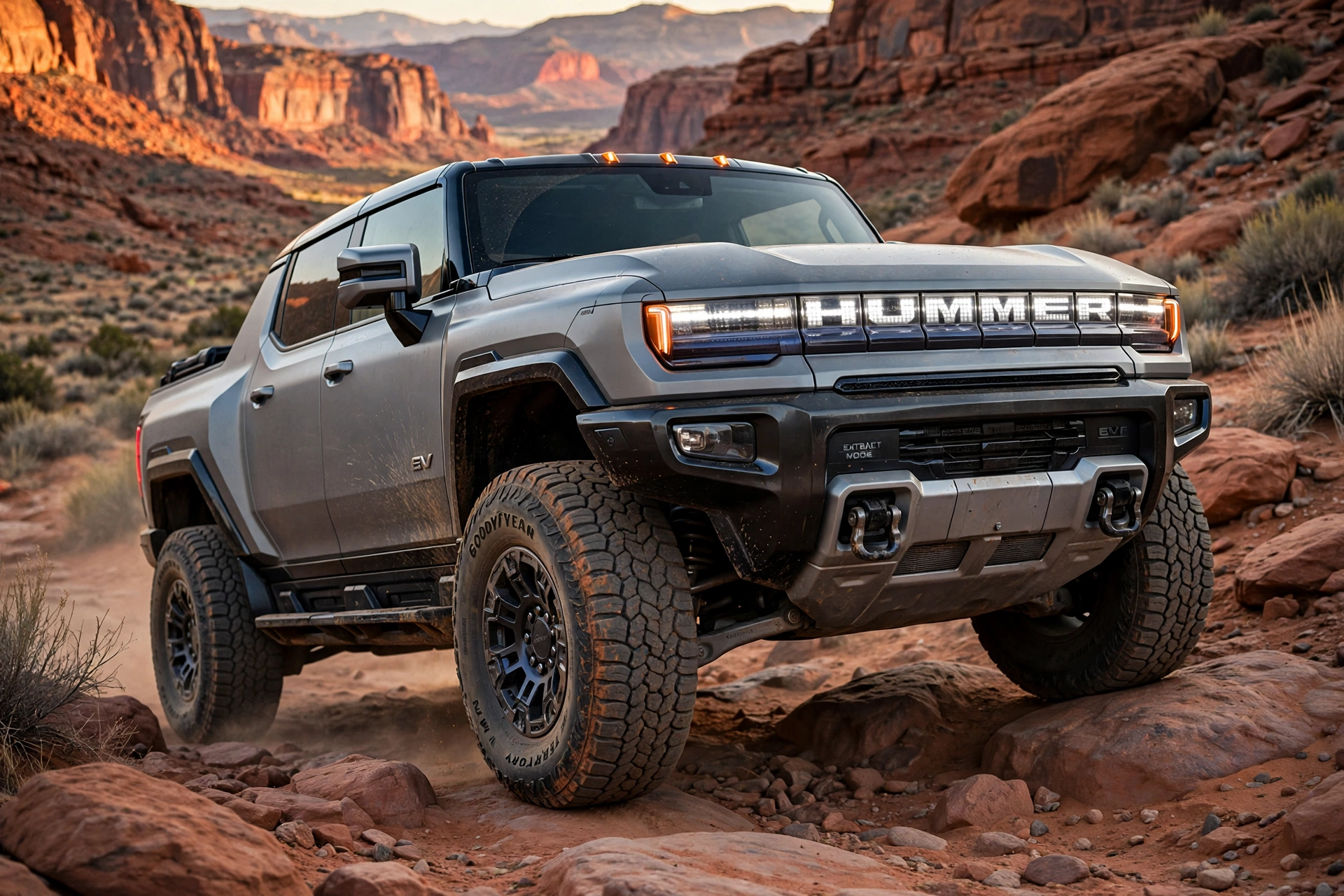
Strip away the marketing and the range is refreshingly simple. Every hummer 2026 model is all-wheel drive with four-wheel steering and Super Cruise as standard. The 2X runs two motors and the 20-module battery. The 3X runs three motors, adds torque vectoring and the Watts to Freedom launch mode, and unlocks the optional 24-module battery. Body choice is a coin flip on price: the pickup gets a short bed and GMC’s MultiPro tailgate, the SUV gets a proper enclosed cargo hold and a rear-mounted spare.
The genuinely new trick for 2026 is King Crab. CrabWalk — the diagonal shuffle that made this truck famous — is still here, and King Crab builds on it by turning the rear wheels significantly faster than the fronts, so the back end swings around obstacles instead of dragging. GMC says no other 4×4 offers that kind of rear-wheel agility. Referee’s call: it’s real, it’s useful on tight rock trails, and GMC deserves credit for also pushing it out as a free over-the-air update to 2022–2025 owners. Rivian’s Kick Turn is clever. King Crab is better theatre and, on a switchback, arguably more useful. Round to GMC.
Bidirectional charging arrives for 2026, too. Pair the truck with GM’s PowerShift home kit and the hummer 2026 can power your house in an outage or charge another EV — the giant battery finally does a useful second job. Extract Mode still lifts the suspension roughly 6 inches for about 15.7 inches of ground clearance, the air suspension gets retuned dampers, and Super Cruise gains polish. Then GMC spoils the mood: Apple CarPlay and Android Auto are gone, replaced by Google built-in. At $99,095, deleting the phone mirroring your buyers already use is a decision I will boo every time I see it. That’s a point deducted from the ownership round before we even get there.
One more trim note before the specs. The Extreme Off-Road package on the 2X swaps the standard tyres for mud-terrains, adds underbody armour and locking differentials, and pushes power to 635 hp — while cutting range to roughly 300 miles (est.). Buyers cross-shopping the package against a base 3X should know the 3X keeps the longer-range tyre setup and adds the third motor for torque vectoring. My whistle says the package is for owners who genuinely crawl rocks monthly. Everyone else is paying range for armour they’ll use twice.
hummer 2026 Specs on the Referee’s Card
Here is the tale of the tape for the pickup, with the SUV close behind on every line. EPA figures shift a little with wheel and tyre fitment, so treat the table as the headline configurations, not every permutation.
| Spec | 2X | 3X | 3X + 24-module / Carbon Fiber Edition |
|---|---|---|---|
| Motors / power | 2 motors, 570 hp | 3 motors, 830 hp | 3 motors, up to 1,160 hp |
| Battery | 20-module (about 177 kWh usable, est.) | 20-module | 24-module, 212.7 kWh usable |
| EPA range (pickup) | 316 miles | 312 miles | 363 miles |
| EPA range (SUV) | 319 miles | 310 miles | — |
| 0–60 mph | about 4.5 sec (est.) | about 3.5 sec (est.) | 2.8 sec (GMC claim) |
| DC fast charging | Up to 350 kW; GMC estimates about 100 miles in 10 minutes | ||
| Towing | Pickup 8,500 lb; SUV 7,500 lb; payload about 1,300 lb (pickup) | ||
| Starting price | $99,095 | $107,195 | Carbon Fiber Edition about $122,300 (est., dealer-listed) |
Two numbers deserve a referee’s raised eyebrow. The first is GMC’s torque marketing: you will see figures like 13,000 lb-ft quoted for the Carbon Fiber Edition, and that is wheel torque after gear multiplication, not the motor figure rivals quote. It’s not a lie, but it isn’t the same sport. The second is the battery swing. The jump from 312 to 363 EPA miles on the 3X pickup comes entirely from the 24-module pack, which is exactly the option that also unlocks 1,160 hp. If you’re buying a 3X, the big battery isn’t an option box. It’s the whole point of the truck.
For the full-frame picture of what trucks like this cost to run, our guide to EV range, charging costs and who should buy one is worth a read before you sign anything.
Real-World Range: Where the hummer 2026 Meets Physics
Time to call the round GMC least wants scored. The hummer 2026 carries the biggest battery in the business and posts respectable EPA numbers — 363 miles at best. Then physics clocks in. Independent testing of the 24-module pickup by Edmunds returned 390 miles on their gentler real-world loop, beating the older 329-mile EPA rating, which shows the range is genuinely there at moderate speeds.
But the same test measured consumption of 57.8 kWh per 100 miles. The SUV was worse in Edmunds’ hands: 62.6 kWh per 100 miles. Car and Driver’s 75-mph highway testing of the SUV returned roughly 245–250 miles — a fifth of the rated range, gone, because a nine-thousand-pound brick has to shove air aside at speed.
Here is my call, and I won’t soften it: the Hummer’s inefficiency is a design choice, not an engineering limit. A Rivian R1T covers 420 EPA miles from a smaller battery because Rivian sweated the aerodynamics and the weight. GMC chose presence. Every mile you drive a Hummer, you pay roughly double the electricity of a Model Y doing the same trip, and on a DC fast charger you pay it at the most expensive per-kWh rates in the ecosystem. Range round: the Hummer survives on battery size alone. On efficiency, it’s not a split decision — it’s a shutout loss.
Charging a hummer 2026 Battery the Size of a Hot Tub
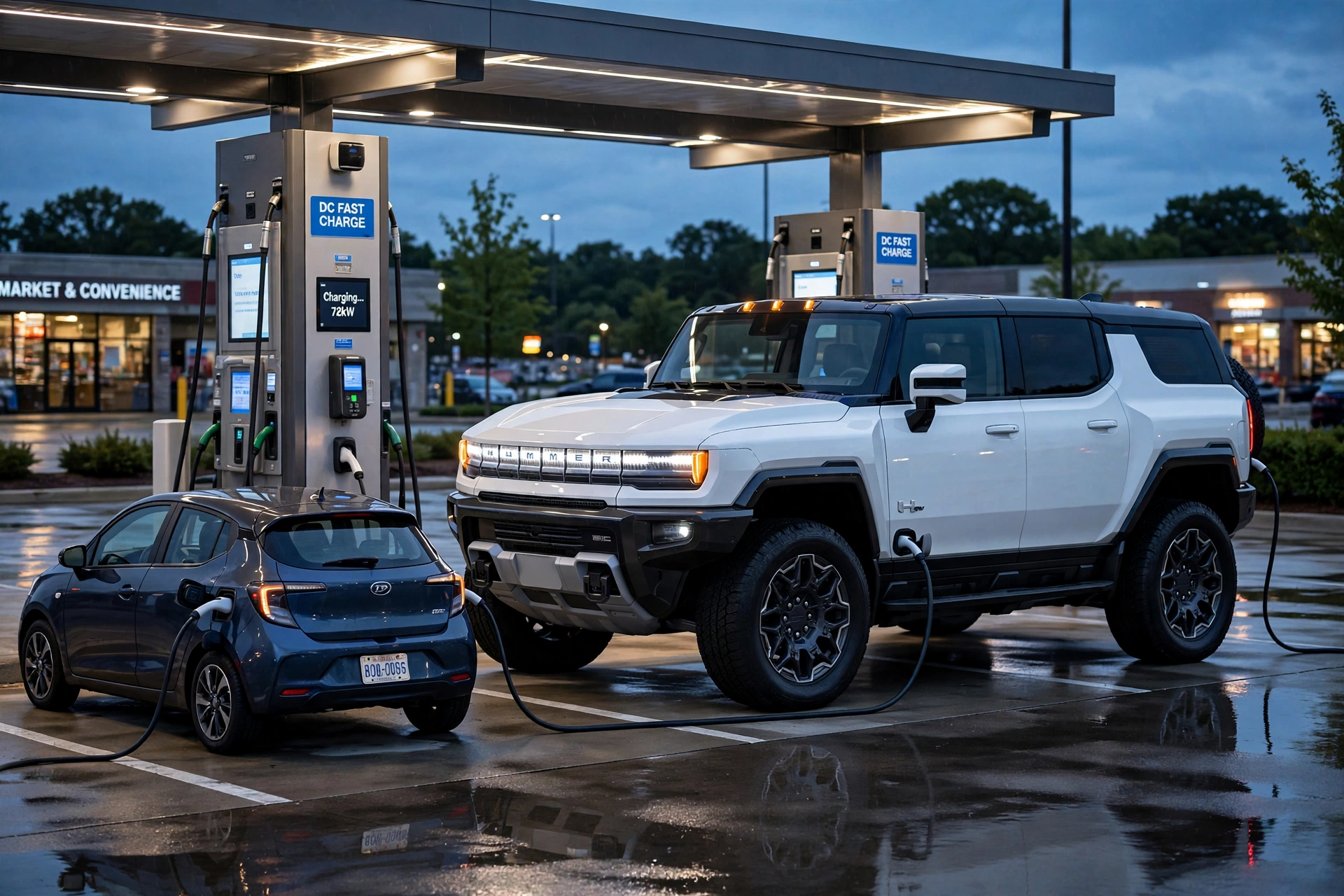
Credit where it’s due: GMC knew a 212.7 kWh battery would be a charging nightmare, so the Hummer gets 800-volt-class DC fast charging at up to 350 kW, with a GMC estimate of about 100 miles added in 10 minutes in ideal conditions. That’s a strong peak number. The caveat is the curve. Testers have repeatedly found that the Hummer’s charge rate tapers hard, and a 10–80% session takes around half an hour or more even on a healthy 350 kW post; on a weak charger, filling this pack is an exercise in patience. Peak speed wins the sprint round. Session time is a different fight.
For road trips, planning around the hummer 2026 charging curve matters more than its peak rate alone.
At home, the maths friendlier. An 11.5 kW wallbox refills roughly 16 miles of range per hour by GMC’s own figures, which covers a normal day’s driving overnight without drama, and the available GM PowerShift bidirectional setup turns the truck into a home battery. If you charge mostly at home, the big pack is a non-issue. If you road-trip on public chargers, budget your stops in hours per thousand miles, not minutes — and keep our electric car cost per mile breakdown handy before you assume the fuel savings will rescue the deal.
Head-to-Head: hummer 2026 vs Cybertruck vs Rivian R1T
Enough warm-up. Three trucks, five rounds, one winner. The Cybertruck AWD starts around $82,235 with destination (checked October 25, 2026), tops out at 325 EPA miles, and the tri-motor Cyberbeast has been independently clocked at 2.6 seconds to 60 mph. The Rivian R1T starts from $72,885, reaches 420 EPA miles in Dual Max form, and its Quad flagship makes 1,025 hp. Both weigh in near or below 7,200 lb. The hummer 2026 is the heaviest, priciest fighter on the card, so it has to win rounds outright to justify itself.
Round 1 — range. R1T, clearly. 420 EPA miles beats the Hummer’s 363, and the Rivian does it on a battery roughly 70 kWh smaller. Cybertruck third at 325. Round 2 — straight-line speed. A photo finish: Cyberbeast’s tested 2.6 seconds edges the Carbon Fiber Edition’s claimed 2.8, and a claim loses to a timeslip in my book. Cybertruck takes it. Round 3 — charging. The Hummer and Cybertruck both peak around 350 kW, but Tesla’s Supercharger network is the most reliable fast-charging ecosystem on the continent, so the Cybertruck takes the round on venue, not just speed. Round 4 — off-road tricks. Hummer, and it isn’t close. CrabWalk, King Crab, Extract Mode, underbody cameras, 35-inch tyres: this is the round the Hummer was built for, and neither rival can match the repertoire. Round 5 — truck work. Cybertruck and R1T both tow up to 11,000 lb against the Hummer pickup’s 8,500 lb, and both offer more payload. The supertruck loses the truck round — let that sink in.
Tally the card: R1T one round, Cybertruck two, Hummer one, with one round (charging hardware versus network) argued into Tesla’s column. The Hummer doesn’t lose because it’s bad. It loses because its two best tricks — size and theatre — aren’t scored categories, while the things that are scored favour the lighter trucks.
Running Costs: The Analysis Nobody Else Ran
Now the computation I ran for this guide, because the per-mile numbers tell the story faster than any verdict. Assumptions, stated plainly: home electricity at $0.17 per kWh (est., close to the US residential average), usable battery capacities, and each truck in its longest-range configuration. The arithmetic is simple division, and you can redo it on a napkin.
| Truck | Price | EPA range | Price per mile of range | Cost to fill (home) |
|---|---|---|---|---|
| GMC Hummer EV 3X, 24-module | $119,900 (est.) | 363 miles | $119,900 ÷ 363 = $330 per mile | 212.7 kWh × $0.17 = $36.16 |
| Tesla Cybertruck AWD | $82,235 | 325 miles | $82,235 ÷ 325 = $253 per mile | 123 kWh × $0.17 = $20.91 |
| Rivian R1T Dual Max | $89,885 (est.) | 420 miles | $89,885 ÷ 420 = $214 per mile | 141 kWh × $0.17 = $23.97 |
Read that middle column again. Every mile of range in the Hummer costs you $330 of purchase price, 54% more than the same mile in the Rivian. Run the efficiency side and it gets worse: the Hummer’s EPA figures imply 212.7 ÷ 363 ≈ 58.6 kWh per 100 miles, or about $9.96 per 100 miles at home rates — eerily close to the 57.8 kWh Edmunds actually measured.
The R1T implies 33.6 kWh per 100 miles, about $5.71. Over 100,000 miles, the Hummer burns roughly $4,250 more in home electricity alone than the Rivian (est., at the rates above), and double that gap opens up if your miles are mostly DC fast charging. Even the Hummer’s own stablemate makes the point: the closely related Chevy Silverado EV posts up to 478 EPA miles from a similar Ultium parts bin, because Chevrolet tuned for range instead of spectacle.
The Verdict: A Points Decision
GMC Hummer EV 3X (24-module) — Our score: 7.4/10 (Range 8/10 · Charging 8/10 · Value 4/10). The best party trick in the business, a genuine 363-mile rating, and a charging peak that matches anything on sale. It’s docked heavily on value and efficiency, because physics doesn’t care about your light bar.
Tesla Cybertruck — Our score: 7.5/10 (Range 7/10 · Charging 9/10 · Value 6/10). Faster in tested trim, cheaper to buy and to fill, plugged into the best network. The styling verdict I leave to you — I’ve recused myself.
Rivian R1T — Our score: 8.3/10 (Range 10/10 · Charging 6/10 · Value 7/10). The winner on points. The 420-mile Dual Max is the range king of electric trucks, full stop, and its 220 kW charging ceiling is the only category where it gives ground back.
So who should buy the hummer 2026? The buyer who wants the trail theatre, the silhouette and the 1,160 hp brag, and who charges at home. That buyer exists, and for them no rival substitutes. Everyone else is paying $330 a mile for range the Rivian sells at $214. GMC’s own 2026 Hummer EV announcement leads with capability, not efficiency — GMC knows exactly which rounds it wins. Cross-check the official consumption figures at fueleconomy.gov before you sign, then make your own call. That’s the referee’s final word. Yours counts more.
On balance, the hummer 2026 remains a distinctive choice even where it loses on value.
FAQ
How much does the hummer 2026 cost?
The 2X starts at $99,095 including destination and the 3X at $107,195, with identical starting prices for the pickup and SUV (checked October 25, 2026). The limited Carbon Fiber Edition sits well above that — dealer listings put it around $122,300 (est.).
What is King Crab mode?
King Crab is a new off-road rear-steer mode for 2026. It turns the rear wheels significantly faster than the fronts, swinging the rear of the truck around obstacles and tightening low-speed manoeuvres beyond what CrabWalk offers. It’s standard on all 2026 trims and is being sent to 2022–2025 owners as a free over-the-air update.
How long does the Hummer EV take to charge?
On a 350 kW DC fast charger, GMC estimates about 100 miles of range added in roughly 10 minutes under ideal conditions, though real sessions taper and a 10–80% charge typically takes around half an hour or more. At home on an 11.5 kW wallbox, expect about 16 miles of range per hour — enough for overnight fills.
How much can the 2026 Hummer EV tow?
The pickup is rated at 8,500 lb and the SUV at 7,500 lb, with pickup payload around 1,300 lb. That’s honest working-truck territory, but both the Cybertruck and R1T are rated up to 11,000 lb, which is why the Hummer lost our truck-work round.
Does the 2026 Hummer EV have Apple CarPlay?
No. For 2026 GMC removed Apple CarPlay and Android Auto from the Hummer EV, replacing them with a Google built-in infotainment system on a 13.4-inch display. If phone mirroring matters to you, factor that in before the test drive, not after.
Why is the Hummer EV so inefficient?
Weight and shape. At roughly 9,000 lb (est.) with the aerodynamics of a garden shed, it needs around 58 kWh to cover 100 miles — roughly double a typical electric crossover. The huge battery hides that thirst on the range chart, but your electricity bill will find it.