Last updated: October 25, 2026
Verdict first, because that is what you came for. The tesla warranty is two warranties wearing one name. The battery and drive unit cover is genuinely strong: eight years, up to 150,000 miles, and a written promise that the pack keeps at least 70% of its capacity. The basic cover wrapped around the rest of the car is ordinary: four years or 50,000 miles, the same term Hyundai beat years ago. Treat them separately. They age separately, they expire separately, and they are worth very different amounts of money.
Nothing here requires faith. Every term below comes from Tesla’s own warranty documents, checked October 25, 2026. The mileage caps differ by model and trim, so the car you own decides the cover you get. A base Model 3 and a Model S sit 50,000 miles apart on battery protection. That gap matters at resale time, and most sellers never mention it.
Two things changed recently and both are easy to miss. From the 2026 model year, Tesla added a separate seven-year, 70,000-mile warranty for a list of expensive propulsion parts that used to fall off cover when the basic warranty ended. And Tesla now sells two different extended service agreements: a monthly subscription for general repairs, and a one-off $2,000 battery extension for Model 3 and Model Y. One of those products is poor value. The other is defensible. The maths is further down. The stack comes first, then the exclusions, the used-buyer position and the claim process.
Our score for the warranty as a whole: 7.6/10 (Coverage 8 / Clarity 6 / Value 9). It costs you nothing at purchase, which is why Value scores high. Clarity scores low because Tesla splits the terms across a support page, a warranty guide per model, and a ZEV section most owners never open.
The tesla warranty stack, model by model
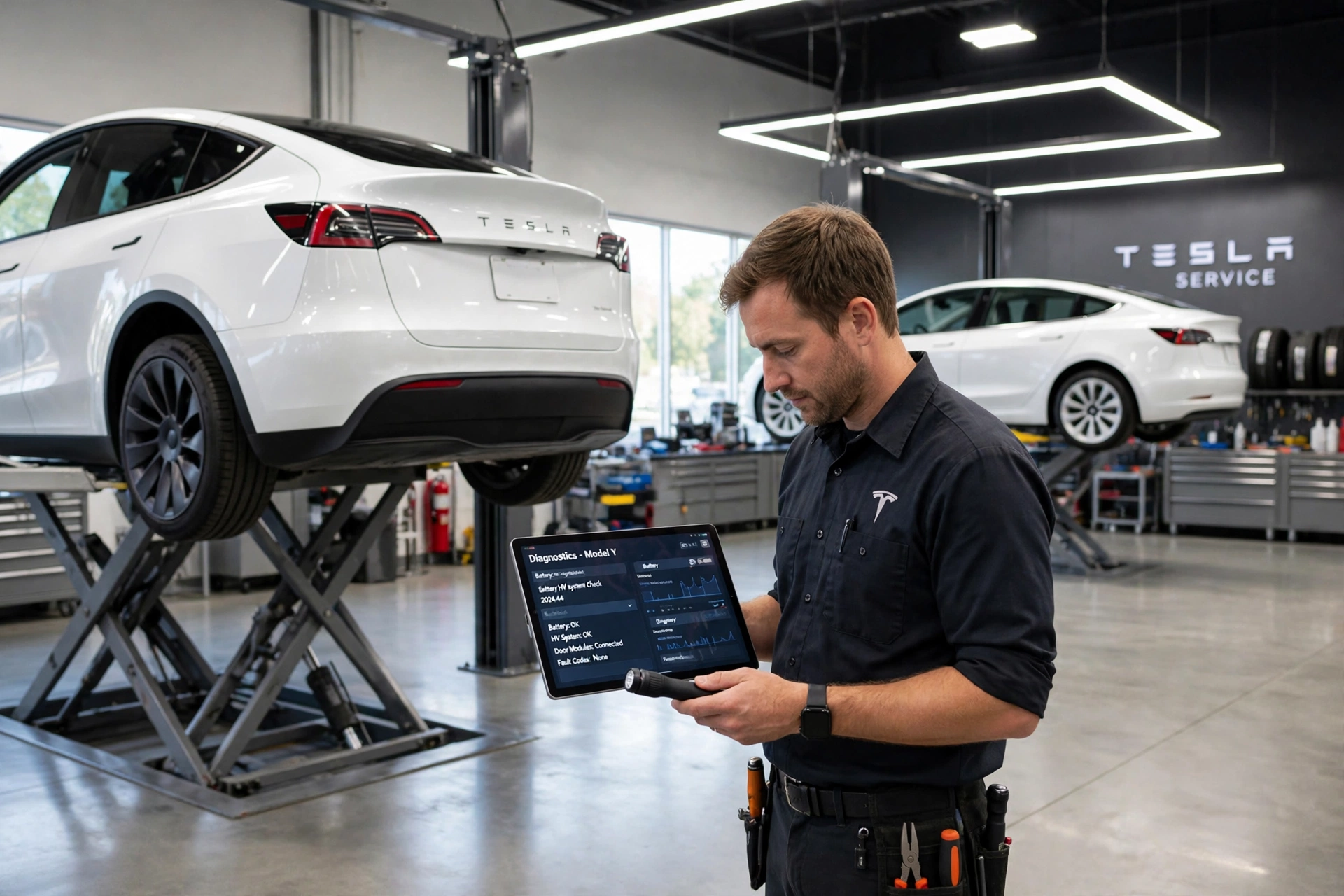
A new Tesla carries five layers of cover, each with its own clock. Miss one clock and that layer is gone, even while the others still run.
| Layer | Term | What it covers |
|---|---|---|
| Basic Vehicle Limited Warranty | 4 years / 50,000 miles | Defects in materials and workmanship across the whole car |
| Supplemental Restraint System | 5 years / 60,000 miles | Seatbelts and airbag system |
| Battery and Drive Unit — Model S, Model X, Cybertruck | 8 years / 150,000 miles | Pack and drive units, minimum 70% capacity retention |
| Battery and Drive Unit — Model 3 / Model Y Premium (Long Range) and Performance | 8 years / 120,000 miles | Pack and drive units, minimum 70% capacity retention |
| Battery and Drive Unit — Model 3 RWD, Model Y RWD and standard Model Y AWD | 8 years / 100,000 miles | Pack and drive units, minimum 70% capacity retention |
| High-Priced Propulsion-Related Parts (ZEV) | 7 years / 70,000 miles | Listed propulsion parts, 2026 model year Model S, 3, X and Y |
| Body Rust Limited Warranty | 12 years / unlimited miles | Rust perforation only — a hole through the panel, from the inside out |
Trim names decide the battery row, not the badge on the tailgate. Tesla’s current warranty page puts the standard Model Y AWD on the 100,000-mile row and the Premium and Performance cars on the 120,000-mile row. Two neighbours can own the same model in the same colour and hold battery cover that differs by 20,000 miles. Check your own paperwork, not a forum post.
Older cars keep the edition in force on the day they were bought. Tesla says so in the warranty itself. A 2023 car does not gain the 2026 propulsion-parts layer, and a car bought before February 1, 2019 has no body rust warranty at all.
One more layer is already scheduled. For model year 2027 Model 3 and Model Y, an Emissions Performance Warranty adds eight years or 80,000 miles on the components that charge the battery, store energy and move the car. It largely overlaps cover you already have. Note it, then forget it.
The 70% promise, decoded into miles
Every battery row carries the same floor: minimum 70% retention of battery capacity across the warranty period. Fall below 70% inside the term and Tesla repairs or replaces the pack. Stay at 71% and you get nothing. Percentages are abstract, so here is the floor in range, using the EPA ratings published at fueleconomy.gov.
- Model 3 Rear-Wheel Drive, 272 miles EPA: the guarantee runs out at roughly 190 miles of range.
- Model Y Premium Long Range, about 330 miles EPA (est.): the floor is roughly 231 miles.
- Model S, 402 miles EPA: the floor is roughly 281 miles.
- Cybertruck, 340 miles EPA: the floor is roughly 238 miles.
Now the uncomfortable part. Tesla’s own published fleet data puts average capacity loss at roughly 12–15% after 200,000 miles on Model S, Model X and Long Range Model 3 and Model Y packs. Read that again. The average pack is still near 85–88% at a distance no warranty reaches. The 70% line is set far below how these batteries actually age, which is exactly why Tesla can afford to print it in large type.
Our position is blunt: the 70% promise is a catastrophe guarantee, not a degradation guarantee. It pays when a pack fails or collapses. It will almost never pay because your range drifted down over eight gentle years. Plan accordingly.
Two more details decide real claims. Tesla measures capacity with its own service test, not with the number on your screen. And a warranty replacement pack is a remanufactured unit matched to the age and mileage of your car, not a new pack off the production line. Our guide to Tesla battery replacement costs shows what that same job costs once the cover ends, which is the number that should frame every decision in this article.
New for 2026: the propulsion parts layer
The most useful change in years is buried in a ZEV section. For 2026 model year Model S, Model 3, Model X and Model Y, Tesla now covers a defined list of high-priced propulsion-related parts for seven years or 70,000 miles. The list names the power conversion system assembly, the high-voltage fast-charge contactors, the high-voltage system controller, the front and rear halfshaft assemblies, the supermanifold assembly, the cooling fan and radiator, and the ancillary harnesses.
These are not trivia parts. A failed power conversion system can stop the car charging at all, and one 2026 Model Y owner was quoted $1,750 in parts alone for a PCS swap (est.). Before this layer existed, that bill landed on the owner the day the basic warranty expired at 50,000 miles. Now the cover runs to 70,000. Cybertruck is excluded from this layer at launch, per Tesla’s current documents. Early Cybertruck owners should read that sentence twice.
What the tesla warranty leaves out
The full exclusion list sits in Tesla’s warranty guide, and it is longer than the covered list is generous. The headline items:
- Wear and consumables: tyres, brake pads, wiper blades, filters, wheel alignment and balancing.
- Glass damage, stone chips, scratches and cosmetic paint defects.
- Accident damage, misuse, racing, and faults caused by unauthorised modifications or non-Tesla parts.
- Damage from fire, flood, theft and other events your insurer, not Tesla, exists for.
- Gradual capacity loss that stays above the 70% floor.
The 12-volt battery deserves its own line because it confuses everyone. It sits inside the basic warranty while that runs. Under the monthly Extended Service Agreement it is specifically excluded, so a dead 12-volt battery in year six is your bill — roughly $200 to $300 fitted (est.). Small money. Still annoying, and worth knowing before you pay for a plan that sounds comprehensive.
Paint gets the same treatment. There is no standalone paint warranty worth the name. Body cover means rust perforation for 12 years, and parts Tesla itself fits carry the Parts, Body and Paint Repair Limited Warranty: 12 months or 12,500 miles. Sheet metal is the exception, covered for a limited lifetime. A replacement high-voltage battery or drive unit fitted by Tesla carries four years or 50,000 miles of parts cover. A replacement touchscreen carries two years or 25,000 miles. Those numbers matter when you compare a Tesla quote with an independent one.
Roadside assistance rides along for four years or 50,000 miles. It covers towing for warrantable failures, with the first 50 miles of transport free to the nearest service centre. Run the pack to zero or break something the warranty does not cover and the callout is yours — Tesla’s warranty guide sets a minimum charge of $300 for non-covered roadside service. Roadside cover is a service, not part of the warranty itself, and it transfers to a new owner once Tesla is notified of the sale.
Buying used: what is actually left
The warranty follows the car, not the first owner. Battery and basic cover transfer automatically, and the remaining term is whatever the first delivery date and the odometer allow. Your job as a buyer is arithmetic: delivery date plus eight years, or the mileage cap, whichever lands first.
Buy certified pre-owned from Tesla and the deal improves by exactly one layer. You get the balance of the original four-year basic warranty, then a further one year or 10,000 miles of Pre-Owned Vehicle Limited Warranty after it. If the basic warranty has already expired, that one year or 10,000 miles starts on your delivery date. The battery balance carries over unchanged. Private sellers and third-party dealers cannot add the extra year. Only Tesla can.
Check the expiry dates in the car’s own Tesla account before money moves, not after. The app shows the tesla warranty status for that specific car. A three-year-old Model Y with 61,000 miles has no basic warranty left at all, whatever the advert says. Our rundown of common Tesla Model Y problems lists the faults to price into a car in exactly that position.
Our advice to used buyers is simple. Buy the car for its battery cover. Ignore the basic warranty in your valuation once a car passes four years, because it is already gone.

The extended service agreements, priced honestly
Tesla sells two different products here, and they are constantly confused with each other. Prices checked October 25, 2026.
The Vehicle ESA is a monthly subscription that starts when your basic warranty expires. Model 3 costs $50 a month, Model Y $60, Model S $125 and Model X $150. Every covered visit carries a $100 deductible. The limits are the story: cover stops at eight years of vehicle age or 100,000 total miles, whichever arrives first, and the plan excludes the high-voltage battery, the drive units, the 12-volt battery, shocks and struts, tyres, glass and trim. Repairs must be done by Tesla. Leased cars cannot join.
The Battery ESA is a separate, one-off product for Model 3 and Model Y only. It costs $2,000, paid once, and adds two years or 30,000 miles of battery and drive unit cover after the factory battery warranty ends. The deductible is $500 per visit. You must buy it while the original battery cover is still running. It is the only extension Tesla sells that stretches the tesla warranty’s most valuable layer. Read its wording before paying: it is failure cover, an extension of protection against a pack or drive unit that stops working. It is not a second degradation promise.
Now the worked example, on a Model Y, with the arithmetic shown.
- Vehicle ESA at $60 a month, paid for the full four-year window after the basic warranty ends: 48 × $60 = $2,880. That is $720 per covered year, or 5.8 cents per covered mile across the 50,000 miles the plan can still span.
- Case one — a single covered failure. The power conversion system dies: roughly $2,000 fitted (est.). With the ESA you pay $2,880 in subscriptions plus the $100 deductible, $2,980 total, to settle a $2,000 bill. You are $980 behind.
- Case two — two covered failures. The PCS at $2,000 (est.) plus a supermanifold and heat-pump class repair at $2,400 (est.) makes $4,400 of repairs. With the ESA you pay $2,880 plus two deductibles, $3,080 total. You are $1,320 ahead.
- The structural flaw: the plan dies at 100,000 miles, right where failure odds start their climb. And it never covers the battery or drive units — the parts with five-figure bills — because those sit under the separate eight-year warranty while it lasts, then under nothing at all.
The Battery ESA maths runs the other way. $2,000 buys two years or 30,000 miles: $1,000 a year, 6.7 cents a mile. One out-of-warranty pack replacement runs about $12,500 for a Model 3 (est.), and a Tesla drive unit replacement is reported at $6,000 to $10,900 (est.). A single covered failure returns the premium three to six times over, even after the $500 deductible. The catch is frequency, not price. Outright pack failures are rare; Tesla’s fleet data says degradation, not death, is the norm. You are buying insurance against a low-probability, high-cost event. For a Model 3 or Model Y you intend to keep past 120,000 miles, that is a rational trade. For a car you will sell at year seven, it is a gift to the next owner.
For context on how honest range testing changes the ownership picture, see our Tesla Model Y speed and range test. A pack that tests strong at 90,000 miles is a car that does not need a $2,000 policy.
How a tesla warranty claim actually works
There is no dealer to argue with. Every tesla warranty claim starts the same way. You open the Tesla app, describe the fault, and book a service appointment. Tesla reviews the case remotely, often before the car moves, and tells you whether the work is covered. Estimates appear in the app for anything chargeable, and you approve or decline there. Mobile service handles a long list of smaller jobs at your home or office. Bigger work goes to a service centre.
The full terms for your exact car live on Tesla’s official vehicle warranty page, which hosts the current warranty guide for each model. Read your own edition. The guide issued when your car was delivered is the contract that governs your claim, not today’s version.
Two habits protect you. Keep every invoice, including paid ones, because a part Tesla fitted restarts its own parts warranty clock. And raise faults before the relevant layer expires, in writing, inside the app. A fault reported at 49,800 miles and repaired at 50,400 is a warranty job. The same fault reported at 50,100 miles is a negotiation.
The verdict, restated
The battery half of this warranty is the strongest standard offer in the business at the Model S, Model X and Cybertruck level, and competitive everywhere else. The basic half is average. The monthly ESA is the weak product in the range: it excludes the expensive parts, stops at 100,000 miles, and needs two mid-size failures in a four-year window just to break even on a Model Y. Skip it and self-insure. The $2,000 Battery ESA is the one extension worth a serious look, and only for high-mileage Model 3 and Model Y keepers.
Tesla warranty overall — Our score: 7.6/10 (Coverage 8 / Clarity 6 / Value 9)
Vehicle Extended Service Agreement — Our score: 4.8/10 (Coverage 5 / Clarity 7 / Value 3)
Battery and Drive Unit Extended Service Agreement — Our score: 6.9/10 (Coverage 7 / Clarity 6 / Value 7)
Frequently asked questions
Does the tesla warranty transfer to a second owner?
Yes. The remaining basic and battery cover follows the car automatically. Tesla asks the new owner to register the change of ownership, which also moves the roadside assistance balance. Certified pre-owned cars bought from Tesla add one year or 10,000 miles of cover on top.
What happens if my battery drops below 70% capacity?
Tesla tests the pack at a service centre. If it confirms capacity under 70% inside the term — eight years or your model’s mileage cap — the pack is repaired or replaced free. The replacement is a remanufactured pack matched to your car’s age and mileage, not a brand-new one.
Is the 12-volt battery covered?
Under the basic warranty, yes, for four years or 50,000 miles. Under the monthly Extended Service Agreement it is explicitly excluded. Expect roughly $200 to $300 fitted once you are paying yourself (est.).
Can I buy the extended service agreement after my warranty expires?
For the Vehicle ESA, Tesla may require a paid inspection if the basic warranty recently lapsed, and the car must be under five years old and within the mileage limit Tesla sets for inspection eligibility. The Battery ESA is stricter: it must be bought while the original battery and drive unit warranty is still active. Miss that window and it is gone.
Does fast charging or high mileage void the battery warranty?
No. Supercharging is normal use under the tesla warranty, and mileage only matters when you cross your model’s cap: 100,000, 120,000 or 150,000 miles. What does end cover early is commercial misuse outside the terms, unauthorised modification, or accident damage. Those are insurer and repairer territory, not warranty claims.
Are Cybertruck terms different?
The battery and drive unit cover matches Model S and X: eight years or 150,000 miles with the 70% floor. The differences sit elsewhere. Cybertruck is excluded from the 2026 high-priced propulsion parts layer at launch, and Tesla does not currently sell it an Extended Service Agreement. Early Cybertruck owners carry more post-warranty risk than any other Tesla buyer.
Before you buy, check the tesla warranty terms for your exact trim, because the mileage cap depends on the model you choose. Checking the tesla warranty expiry in the car’s Tesla account is the quickest way to avoid paying for cover you no longer have.