Last updated: October 25, 2026
Ask a Rivian owner what rivian brake and suspension repair costs and you’ll get two completely different answers. The brake half of the truck is almost comically cheap to run: pads that still measure 9 or 10 mm at 38,000 miles, a fluid change every three years, and that’s close to it. The suspension half is where the money hides. One front air-suspension failure, days after the warranty expired, landed an R1T owner with a $7,500 bill (owner-reported). Same truck. Same axles. Two different worlds.
This guide splits the two systems apart and prices them separately, because that’s how you should budget for them. You’ll find the schedule items that actually matter, the parts that fail, what owners have really paid (checked October 25, 2026, and labelled as owner-reported where that’s what they are), and the checks you can run in your own driveway with a torque wrench and a tape measure.
Start with the good news. Regenerative braking does most of the stopping on an R1T or R1S, so the friction brakes live a sheltered life. Owners posting their inspection sheets show front pads at 10 mm and rears at 10 mm — close to new — on trucks with real mileage on them. One owner at 38,000 miles measured 9 mm front, 10 mm rear. At that wear rate, pads are a 100,000-mile item for gentle drivers.
The catch is corrosion, not wear. A truck that barely touches its friction brakes never scrubs its rotors clean, so the discs rust, pit and score — especially anywhere roads get salted. One Michigan owner replaced pads and rotors at 90,000 miles for exactly that reason: rust from non-use on high regen, not worn-out friction material (owner-reported). On a Rivian, brakes die of neglect, not work.
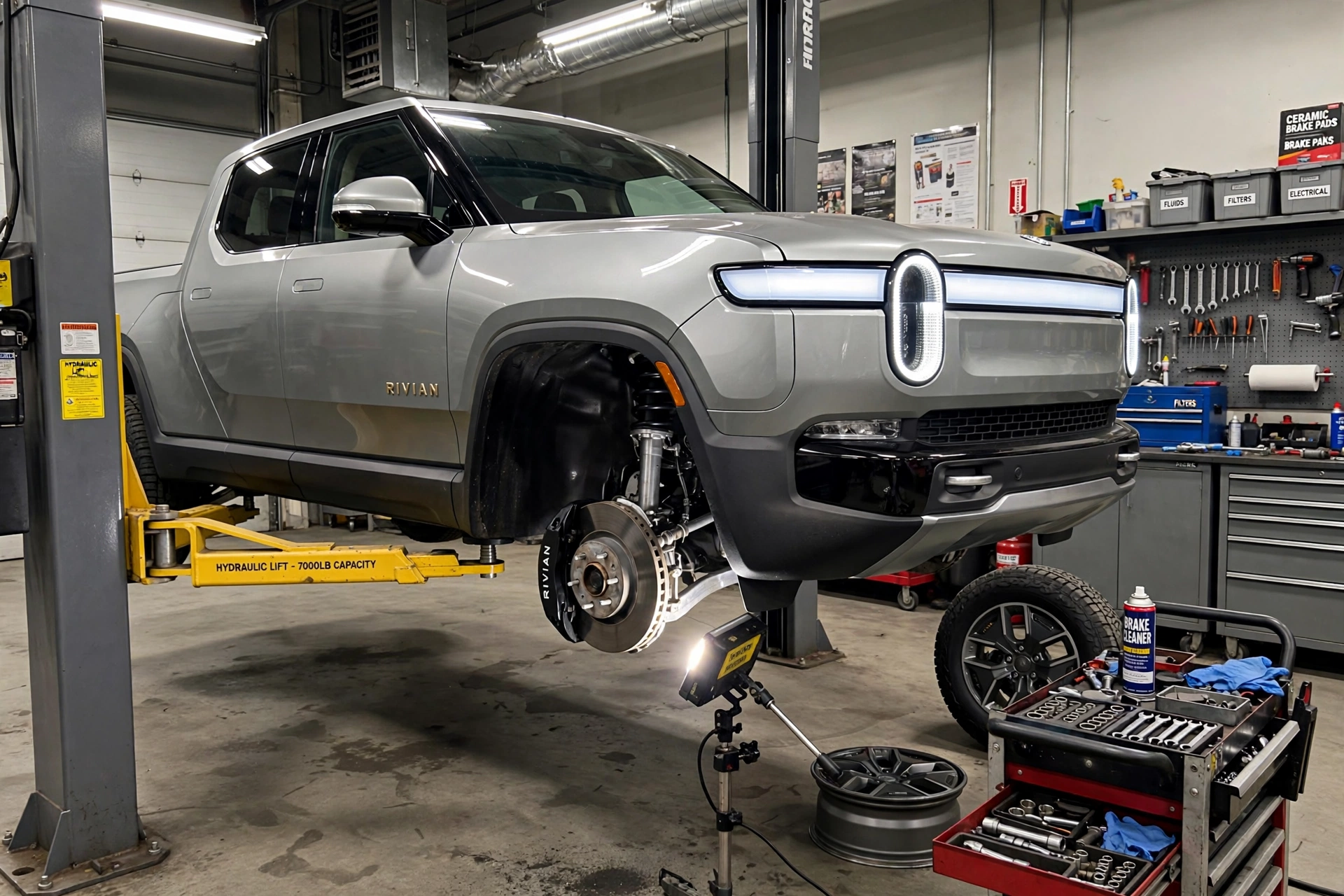
Now the expensive paragraph. Every R1 rides on air springs and adaptive dampers, tied together by a hydraulic roll-control system. There are no conventional steel anti-roll bars. It’s a brilliant setup — and when a strut leaks, a fitting weeps or the compressor burns itself out chasing a leak, you’re not buying a $180 shock absorber. You’re buying into a pressurised system that very few shops outside Rivian are equipped to touch. Plan accordingly.
Regen first: why Rivian brakes wear differently
On a petrol truck, every stop grinds pad against rotor. On a Rivian, the motors do the first — and usually the hardest — share of the work, feeding energy back into the battery. The friction brakes handle the final few mph, panic stops, and the moments regen can’t: a full battery, a cold battery, or a long descent where regen fades. That’s why the starting point for any rivian brake and suspension repair conversation is measurement, not mileage. There’s no sensible “pads every X miles” rule for these trucks. There’s a number in millimetres, per corner, and that’s the whole story.
Two habits protect the friction brakes. First, scrub the rotors occasionally: a few firm stops from 50 mph on a quiet road, once a month or so, keeps the faces clean and the pads bedded evenly. Second, remember the mountain-cabin trap. Charge to 100% at the top of a pass and there’s no headroom for regen on the way down, so a roughly 7,000 lb truck rides its friction brakes all the way to the valley. They’ll do it — the hardware is sized for towing — but that’s the one scenario where Rivian brakes genuinely work hard.
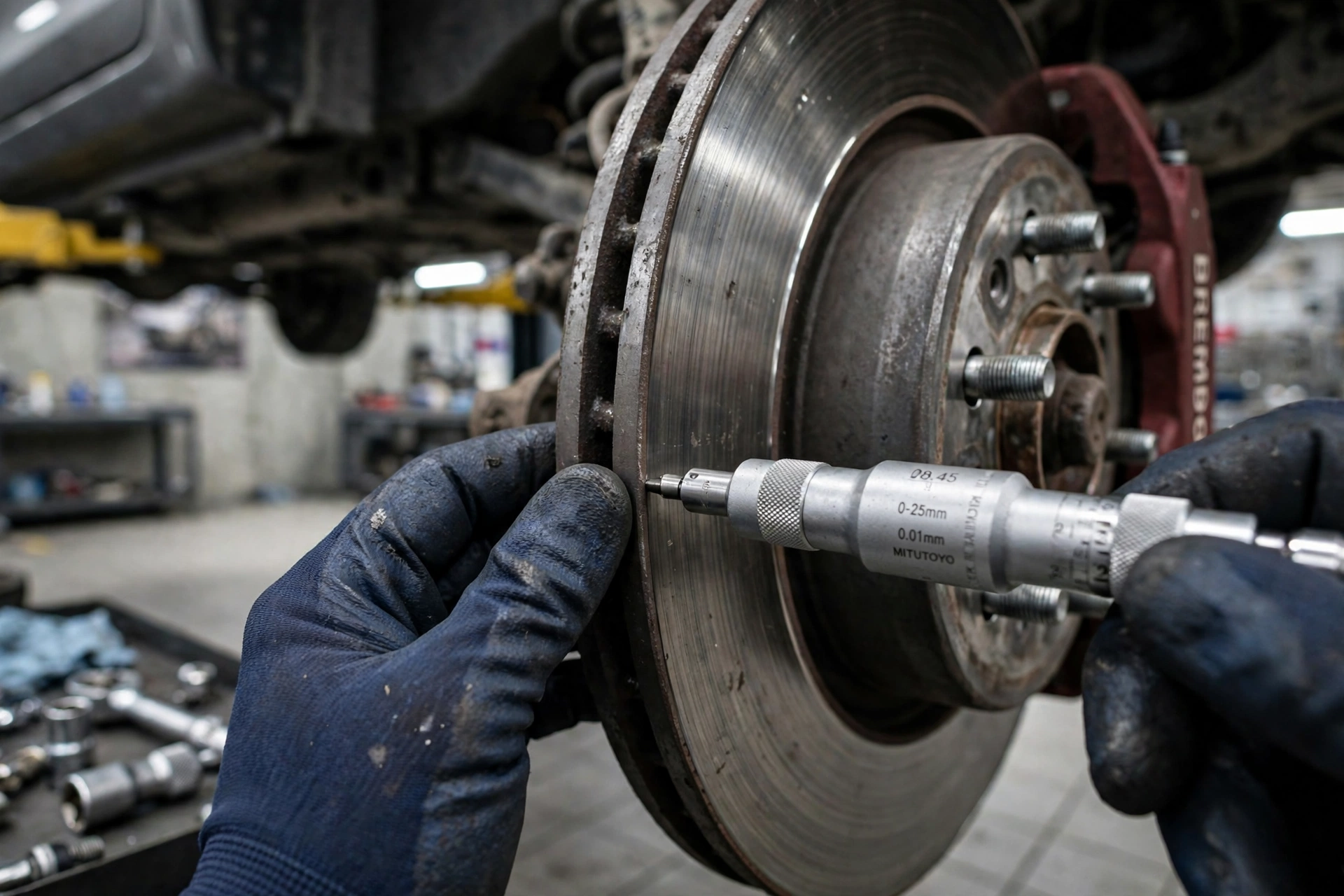
My rule, and I’ll stand by it: never approve a pad-and-rotor quote without a millimetre measurement for all four corners written on the estimate. One owner was quoted nearly $2,000 for pads and “scored” rotors by a mobile tech, then took the truck to an independent mechanic who showed him more than 6 mm of pad remaining — a quarter inch (owner-reported). Six millimetres is not a worn pad. It’s a pad with most of its life left. Measurements end arguments; adjectives start them.
Rivian brake and suspension repair starts with the schedule
Rivian’s published R1 schedule is short, and most of it is inspection rather than replacement. The full table lives on Rivian’s official maintenance schedule page, but here’s the version that matters for brakes and suspension:
| Item | Interval | Why it matters |
|---|---|---|
| Tyre rotation | Every 9,000 miles | Your chance to measure pads and eyeball struts while the wheels are off |
| Comprehensive inspection | Every 18,000 miles or 18 months | Includes brake pad and rotor thickness, suspension wear, air suspension and roll-control checks |
| Clean and lubricate brake calipers | Every 12 months or 12,000 miles on salted roads | Stops pins seizing and pads dragging on corroded hardware |
| Brake fluid replacement | Every 3 years | Fluid absorbs water whether the brakes work hard or not |
| Coolant (and drive unit fluid, 2022–2024 Quad only) | Every 108,000 miles | Not a chassis item, but it shares the same service visit logic |
Notice what’s missing: no pad interval, no rotor interval, no strut interval. rivian brake and suspension repair is condition-based, which is honest engineering and a budgeting headache at the same time. The comprehensive inspection — about $300 at a service centre, owner-reported — is where the condition gets recorded. Get one done just before your comprehensive warranty expires, whatever the odometer says. Anything it finds while cover is live is Rivian’s problem. Anything it finds the week after is yours.
Air suspension anatomy: the expensive half of rivian brake and suspension repair
Each corner of an R1 carries an air spring built into a damper strut. A compressor feeds a reservoir tank, a valve block meters air to each corner, height sensors report back, and the whole system can swing the truck from kneeling for loading to a maximum 14.9 inches of ground clearance. Layered over it is the hydraulic roll-control system: the dampers are cross-linked by hydraulic lines — the “jounce lines” owners talk about — so the truck leans far less than a 7,000 lb vehicle on tall tyres has any right to.
The weak points are predictable, and they’re the same ones that have dogged air suspension for decades:
- Air spring leaks. Rubber bladders age, crack and weep. The first sign is the compressor running longer and more often, or one corner sitting low after a parked night.
- Compressor burnout. The compressor is the system’s heart and its fuse. A small leak makes it run constantly until it overheats and dies — which is how a leaking strut becomes a strut plus a compressor on the invoice. The widely shared $7,500 case was exactly this pattern: front system collapsed at 60,000 miles, compressor cooked from chasing the leak (owner-reported).
- Jounce line weeping. The hydraulic lines and fittings for the roll-control system have weeped on a number of trucks; several owners report jounce lines replaced under warranty. A major hydraulic repair out of warranty is the scariest number in the Rivian world — forum reports put worst cases around $16,000 (owner-reported).
- Height sensors and valve block faults. Less common, and they usually announce themselves with warnings rather than a collapsed corner.
Rivian clearly heard the feedback. The Gen 2 trucks brought redesigned air springs, revised damper valving, reworked hydraulic fittings and thermal protection for the compressor — aimed squarely at these failure modes. Time will grade that homework. For Gen 1 owners, the practical takeaway is that rivian brake and suspension repair costs are really air-system costs, and catching a leak at the “compressor sounds busy” stage is the difference between a strut and a system.
Two suspension recalls worth checking today
Suspension fasteners have put Rivian in the recall book twice, and both campaigns are free fixes:
- October 2022 (NHTSA 22V744, Rivian FSAM 997): 12,212 vehicles — 2022 R1T, R1S and EDV — recalled because the fastener joining the front upper control arm to the steering knuckle may not have been torqued correctly. Separation means a sudden loss of control. Remedy: inspection and tightening, free of charge.
- January 2026 (NHTSA bulletin RRC-18-26-001): 19,641 model-year 2022–2025 R1T and R1S vehicles that had rear suspension service before March 10, 2025, performed with an older procedure. The rear toe link joint may not have been reassembled to spec and can separate. Remedy: Rivian replaces the toe-link-to-knuckle fasteners using the updated procedure, free. The full document is in the NHTSA recall bulletin for the toe link campaign.
That second one carries a lesson beyond the recall itself: on this truck, suspension bolts are ride-height-torqued, procedure-sensitive parts. It’s why alignment and suspension work on an R1 isn’t a generic job, which brings us to prices.
What rivian brake and suspension repair actually costs
Rivian doesn’t publish a menu, so the table below is built from the company’s schedule, owner-reported invoices and quotes gathered from owner forums, and clearly-flagged estimates. Prices checked October 25, 2026. Owners report service-centre labour rates around $250 an hour, which explains most of the gap between the columns.
| Job | Typical cost | Basis |
|---|---|---|
| Tyre rotation at Rivian | $60 | Owner-reported |
| Comprehensive inspection | ~$300 | Owner-reported |
| Wheel alignment | $200–$287 | Owner-reported |
| Brake fluid change (every 3 years) | $200–$350 | (est.) — roughly an hour of labour plus fluid at reported Rivian rates |
| Brake pads only, mobile service | ~$200 | Owner-reported quote at 80,000 miles |
| Pads and rotors, all four corners | ~$2,000 | Owner-reported service-centre quote |
| Caliper clean and lube, per visit | $150–$300 | (est.) — labour-based, salt-belt schedule item |
| Air strut, one corner, fitted | $1,500–$2,500 | (est.) — parts plus reported labour rates; an independent quoted struts and tie-rod ends at $1,700 (owner-reported) |
| Air compressor, fitted | $1,200–$2,500 | (est.) — typical air-suspension compressor pricing plus Rivian labour |
| Front air system + compressor | $7,500 | Owner-reported, at 60,000 miles, out of warranty |
| Full suspension refresh, 67,000–72,000 miles | ~$8,000 | Owner-reported forum figures |
Read the table the way an owner should: the brake rows are cheaper than the equivalent work on a petrol truck, and every frightening number lives in the air rows. rivian brake and suspension repair is a tale of two budgets.
The 100,000-mile maths: R1T vs a petrol truck
Here’s our own model — a northern R1T on salted roads, brakes and suspension only, 100,000 miles. Rivian side first:
- Brake fluid: changes at years 3 and 6 → 2 × $275 (est. mid-point) = $550
- Caliper clean and lube: 100,000 ÷ 12,000 ≈ 8 visits × $200 (est.) = $1,600
- Pads and rotors: one full set at ~90,000 miles, rust-driven = $2,000
- One air strut corner = $1,900 (est.)
- Compressor: survives in this scenario = $0
Total: $550 + $1,600 + $2,000 + $1,900 = $6,050, or 6.1 cents per mile. Now the tail risk: swap that single strut for the documented $7,500 front-system-plus-compressor failure and the total becomes $6,050 − $1,900 + $7,500 = $11,650, or 11.7 cents per mile.
A comparable petrol half-ton (F-150 class) over the same distance, all figures (est.): two pad-and-rotor jobs at 45,000 and 90,000 miles, 2 × $900 = $1,800; brake fluid 2 × $150 = $300; one set of four shocks/struts at ~90,000 miles, $1,600 fitted; ball joints and tie-rod ends, $600. Total: $4,300, or 4.3 cents per mile.
So the Rivian is about $1,750 dearer across 100,000 miles in this model — and the entire gap, plus change, is the air strut. The friction brakes actually win their half of the comparison. Fold these numbers into the bigger picture with our EV total cost of ownership calculator and the running-cost breakdown in our electric car cost per mile guide, because tyres — not brakes — are the R1’s real consumable bill.
Warranty cover vs paying out of pocket
Air struts, dampers, the compressor and roll-control hardware are ordinary components under Rivian’s comprehensive warranty: defects are covered, wear isn’t. The catch is the clock. Quad-Motor trucks from 2022–2024 carry 5 years or 60,000 miles of comprehensive cover; Dual-Motor trucks and the 2025–2026 range carry 4 years or 50,000 miles. The 8-year battery and drivetrain warranties don’t help you here — a collapsed front end at 60,001 miles on a Quad is, as one owner learned, your $7,500.
Two details soften that. The 1-year/12,000-mile adjustment warranty is unusually generous — it covers alignment and even brake pad/lining replacement early in the truck’s life. And the recall campaigns above are free regardless of warranty status, forever. Everything else in the rivian brake and suspension repair world is a negotiation between the calendar and your reserve fund.
Extended cover exists — Rivian Care plans, priced by Assurant — but go in with open eyes. Owner-reported Rivian Care quotes for a 54,700-mile Quad-Motor truck ran from roughly $5,600 with a $1,000 deductible to over $13,500 with zero deductible on longer terms (checked October 25, 2026). At the top of that range, you’re pre-paying for the $7,500 failure and most of another one. My position: for a Gen 1 truck you plan to keep past 60,000 miles, either price the extended warranty against a self-funded reserve honestly, or hold the $7,500 in a separate account and let it earn interest. What doesn’t work is holding nothing and hoping.
DIY-able jobs and service-only jobs
Realistic driveway work: tyre rotations (you’ll want jack pucks, a 3-ton jack, Tire Change Mode on the screen, and a torque wrench — Rivian’s own Tire Service Guide specs lug nuts at 190 Nm, 140 lb-ft, M14 × 1.5 thread, 22 mm socket, tightened in a star pattern); pad measurement with a gauge at every rotation; visual checks of strut boots, air lines and hydraulic fittings; the overnight sag test in the checklist below.
Borderline: brake fluid. It’s a conventional hydraulic system, but bleeding correctly, disposing of fluid and keeping air out of the ABS module makes the ~$275 (est.) service-centre charge fair value for most owners.
Service-centre territory: anything in the air or hydraulic systems. Struts need the air system depressurised and refilled correctly; the roll-control hydraulics need Rivian’s vacuum fill equipment; suspension fasteners are torqued at ride height under specific procedures — the toe-link recall exists precisely because a procedure was followed loosely. Independent EV specialists are starting to take on R1 work and their quotes undercut Rivian (that $1,700 strut-and-tie-rod quote is real), but parts supply still runs through Rivian and software access is limited (est., based on owner reports). Choose an independent the way you’d choose a surgeon: by referrals from other R1 owners, not by the sign outside.
The pre-trip and post-winter checklist
Clip this. It’s the cheapest rivian brake and suspension repair there is — the kind that happens before anything breaks.
After winter (salt-belt trucks especially):
- Calipers cleaned and pins lubricated — every 12 months or 12,000 miles, per the schedule. Non-negotiable in the salt belt.
- Rotor faces checked for rust banding; a few firm stops from 50 mph on a quiet road to scrub them clean.
- Pad thickness written down in millimetres, all four corners. Compare with last year’s numbers; a sudden drop on one corner means a sticking caliper.
- Air lines, strut boots and jounce line fittings eyeballed for cracks, chafing and wet weep marks.
- Compressor behaviour noted: if it’s running longer or louder than last spring, book a leak test now, not after the collapse.
Before a long trip:
- Tyre pressures set to the door placard (48 psi on most R1 fitments) and tread checked across the full width.
- Lug torque verified: 190 Nm (140 lb-ft), star pattern.
- Overnight sag test: park on level ground in the evening, note each corner’s height against the tyre, compare in the morning. A corner that’s dropped is a leak introducing itself.
- Brake fluid age checked against the 3-year clock; if it’s due mid-trip, do it before you leave.
- VIN run through the recall check — two minutes, and both campaigns above are free.
- Towing? Remember the battery-full descent trap: leave regen headroom at the top of long grades.
Verdict: who should fix what, where
Rivian service centres — Our score: 6.3/10 (Cost 4/10 · Competence 9/10 · Convenience 6/10). The only hands I’d trust with air and hydraulic work today, and the only route for recalls and warranty claims. You pay for it: ~$250-an-hour labour (owner-reported), hub-and-spoke geography that can mean a long tow, and the odd upsell that a millimetre measurement would have prevented.
Independent shops — Our score: 6.7/10 (Cost 7/10 · Competence 6/10 · Convenience 7/10). The right call for rotations, pad measurements, alignments and — at a proven EV specialist — straightforward strut work at half the labour rate. The wrong call for hydraulics and anything needing Rivian software. If you’re cross-shopping the truck against rivals on running costs, our EV cars guide puts the R1 in context.
The one-line summary: brakes are a rounding error on this truck; the air suspension is a savings account you either fund or gamble against. Fund it.
FAQ
How much does rivian brake and suspension repair cost once the warranty ends?
Brakes stay cheap — pads from ~$200 (owner-reported, mobile service) and a full pad-and-rotor set around $2,000 (owner-reported). Suspension is the risk: one air strut runs $1,500–$2,500 fitted (est.), and the documented front-system-plus-compressor failure cost $7,500 at 60,000 miles (owner-reported).
How long do Rivian brake pads actually last?
Owners report 9–10 mm of pad remaining at 38,000 miles, which points to 100,000 miles or more for gentle drivers. In salted-road states, rotors often corrode out before pads wear out — the replacement trigger is rust and scoring, not thin friction material.
Is the air suspension covered by Rivian’s warranty?
Yes, as part of the comprehensive warranty when a component fails from a defect: 5 years/60,000 miles on 2022–2024 Quad-Motor trucks, 4 years/50,000 miles on most others. Wear, damage and corrosion aren’t covered, and the 8-year battery/drivetrain cover doesn’t extend to suspension parts.
What are the first signs of an air suspension leak?
The compressor running more often or for longer, one corner sitting visibly lower after the truck has been parked overnight, and suspension fault warnings. Catch it at this stage and you’re pricing a strut; ignore it and you’re pricing a strut plus a burnt-out compressor.
Can an independent shop work on Rivian brakes and suspension?
Brakes, yes — the friction hardware is conventional, and tyre shops already handle R1 rotations. Suspension work is emerging at EV specialists with noticeably lower labour rates, but air-system refills, hydraulic roll-control work and anything software-linked still belong at Rivian for now. Always ask whether the shop has done R1 suspension work before, and get the answer in writing on the estimate.
When budgeting for rivian brake and suspension repair, start with the inspection, not the invoice. A clear rivian brake and suspension repair plan keeps the cheap brake work cheap and catches air-system leaks early. That is why this guide treats rivian brake and suspension repair as two budgets in one truck.
For a final rivian brake and suspension repair check, compare the inspection sheet with the prices in this guide before you approve any work. A second rivian brake and suspension repair opinion is worth the time when a quote jumps straight to a full system replacement. Keep the rivian brake and suspension repair records with the truck, so the next owner — or the next technician — can see what was measured, not just what was charged.