Last updated: October 25, 2026
Ask ten people to explain the types of chargers an electric car can use and you will get ten different answers, most of them half right. That is not your fault. The industry uses one word, “charging,” for two separate questions: how fast the energy flows, and which shape of plug delivers it. Untangle those two questions and the whole subject becomes simple. This guide untangles them, one term at a time.
Here is the short version first, because a good explainer should never make you wait for the point. There are three speeds. Level 1 is a trickle from an ordinary wall outlet. Level 2 is a steady flow from a bigger circuit, the kind a clothes dryer uses. DC fast charging is a flood, delivered by a machine the size of a fridge. Then there are four plug shapes you will meet in North America, and by the end you will be able to name all four and know which ones your car accepts.
A word about the unit you will see everywhere: the kilowatt, written kW. A kilowatt is simply a speedometer for electricity, measuring how fast energy is moving, the way miles per hour measures how fast a car is moving. A battery’s size is measured in kilowatt-hours (kWh): the amount of energy, the size of the tank. Speed of flow in one column, size of tank in the other. Hold onto that distinction and every charging claim you ever read will make sense.
We will go family by family, then plug by plug, then finish with worked numbers, home installation costs, and public-charging etiquette.
Two families hide inside the types of chargers: AC and DC
Every charger on Earth belongs to one of two families, and the family names are just the two forms electricity takes. AC is alternating current, the kind that comes out of your walls, wiggling back and forth 60 times a second. DC is direct current, flowing one steady way, and it is the only form a battery can store. Think of AC as water sloshing in a pipe and DC as water resting in a tank. Before wall electricity can rest in the tank, something has to convert it.
That converter lives inside your car. It is called the onboard charger: a charger, on board the vehicle. When you use Level 1 or Level 2, the box on your garage wall is not really the charger at all. Technicians call it EVSE (electric vehicle supply equipment), which in plain English means “a smart safety switch with a plug.” It hands AC power to the car, and the car’s own converter does the slow work of turning it into DC. That is why AC charging has a ceiling: the converter in the car is only so big, typically able to accept 7.7 to 11.5 kW.
DC fast charging moves that converter out of the car and into the station, where it can be enormous, liquid-cooled, and fed by industrial power. The station hands the battery DC directly, bypassing the car’s small converter entirely. Same battery, same tank, far bigger hose. Once you see that single trick, every speed difference in this guide follows from it.
Level 1: the ordinary wall outlet, patience required
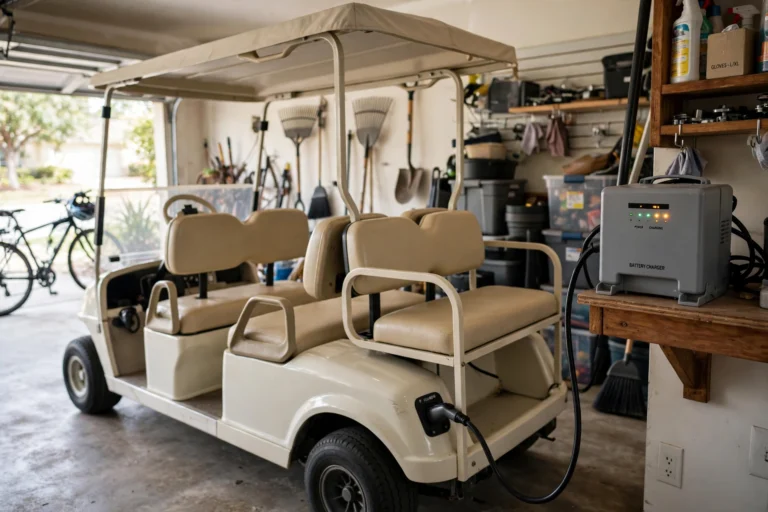
Level 1 means charging from a standard 120-volt household outlet, the same socket that runs a reading lamp. The cord that ships with most EVs plugs straight in, no electrician, no installation, nothing to buy. On a normal circuit it delivers about 1.4 kW (120 volts times 12 amps, the safe continuous draw), which the US Department of Energy’s Alternative Fuels Data Center charging basics translates to roughly 3 to 5 miles of range added per hour of charging.
Three to five miles an hour sounds like a joke until you do the overnight maths. Park for 12 hours and you have added 40 to 60 miles; the average American commute is well under that. So Level 1 is genuinely enough for a surprising number of people: short commutes, a second car that mostly does school runs, and especially plug-in hybrids. (A plug-in hybrid, plainly translated, is a petrol car with a small plug-in battery; that battery fills overnight on Level 1 easily.) Our advice: if your daily driving is under 40 miles, try Level 1 for a month before spending a cent on anything faster. Plenty of owners never upgrade. They just sleep while the car sips.
Level 2: the types of chargers most owners actually live on
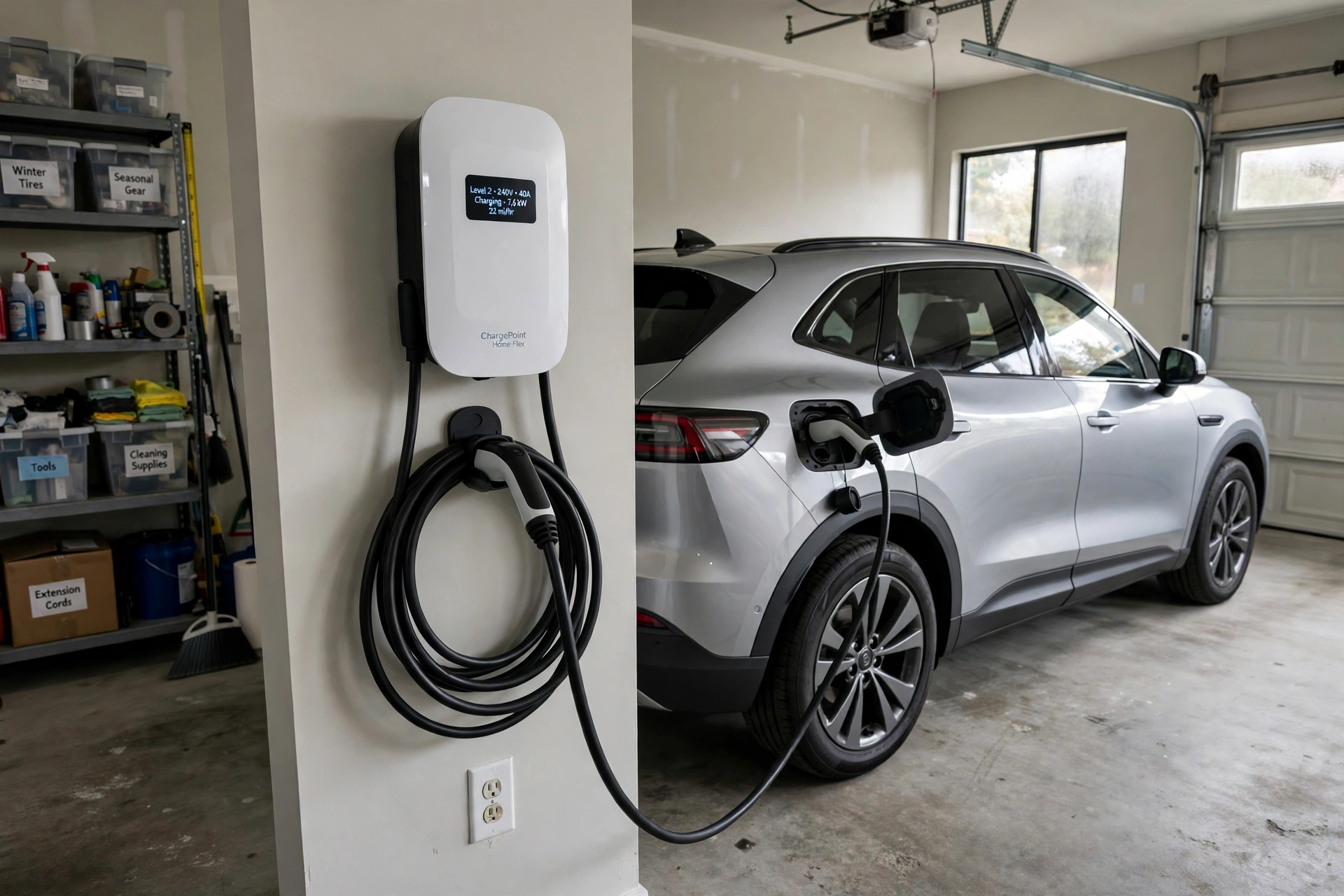
Level 2 uses a 240-volt circuit at home (208 volts in many commercial buildings), the same grade of power as an electric dryer or an oven. It delivers from 3.3 kW for a small unit up to 19.2 kW for the largest, with most home units at 7.7 or 11.5 kW. In miles, a typical 40-amp unit adds roughly 25 to 35 miles of range per hour. An empty-ish battery at bedtime is a full battery at breakfast, every day, and that quiet reliability is the real product being sold.
You will meet Level 2 in three places. At home, as a wall box in the garage or a plug-in unit on a dryer-style socket. At workplaces, where employers install rows of modest units that refill a car across a shift. And in public, at shops, hotels, car parks and libraries, usually at middling speeds because the car is expected to sit for hours anyway. If you want the details of squeezing a normal socket for all it is worth, our guide to charging an electric car with a regular outlet walks through it. Level 2 is simply the answer for about nine out of ten charging sessions in North America, and our scores at the end reflect that.
DC fast charging: the road-trip tier, with tiers of its own
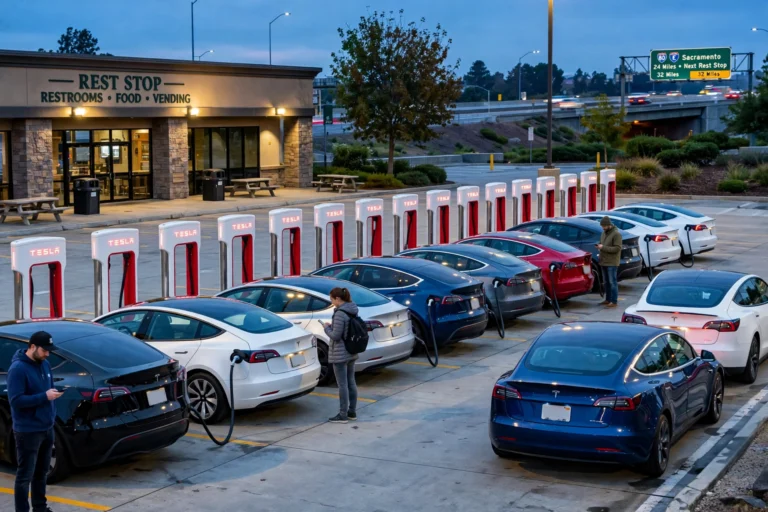
DC fast charging (often shortened to DCFC) skips the car’s converter and pushes direct current straight into the battery at 50 kW and upward. The useful measure is not miles per hour but minutes per stop: a healthy session takes a battery from about 10% to 80% full. (“State of charge” is the jargon for that percentage; it just means how full the tank is.) Older 50 kW stations need 40 minutes or more for that job. The common 150 kW class does it in roughly 25 to 35 minutes.
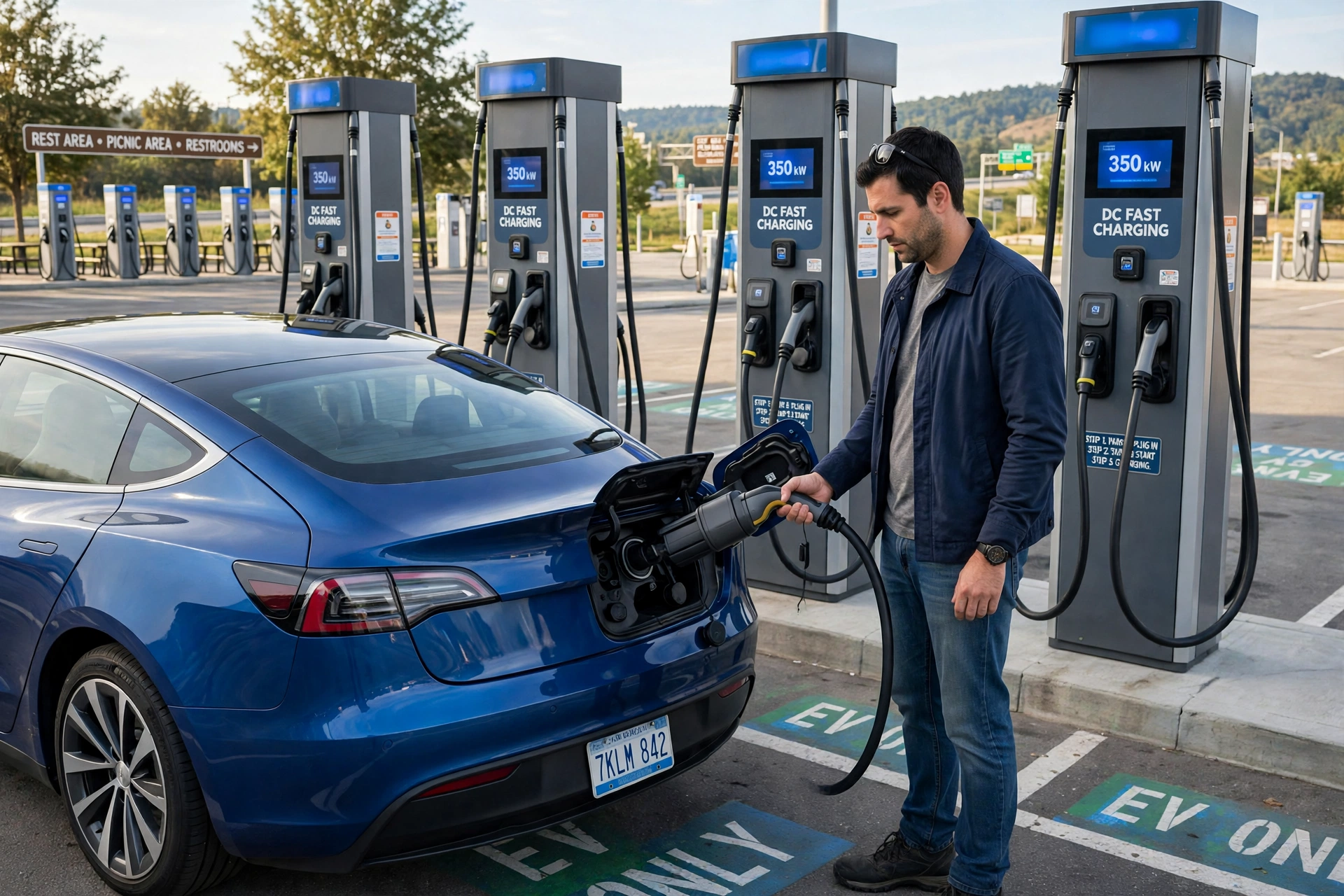
The 350 kW flagships, and Tesla’s newest V4 Supercharger cabinets rated up to 500 kW, can do it in 18 to 25 minutes on the newest 800-volt cars. (An 800-volt car is simply one whose battery pack is wired to a higher voltage, letting it drink faster without overheating anything.)
One honest warning, because the headline numbers mislead. Fast charging slows as the battery fills, deliberately, to protect the pack. Think of pouring into a bottle through a funnel: fast at first, then a careful trickle near the top so nothing spills. Engineers call that slowdown “taper.” A charger advertised at 350 kW might average closer to 100 kW across a full session on many cars, and above 80% the flow can drop to a crawl. Road-trippers learn the rhythm quickly: arrive low, leave at 80%, let the next stop do the rest. For realistic times in full, see our answers on how long it takes to charge an electric car.
The plug shapes, decoded one by one
Speeds sorted, now shapes: North America has four connector shapes to recognise.
J1772: the universal slow-and-medium plug. This round, five-pin connector is the standard for Level 1 and Level 2 AC charging on nearly every non-Tesla EV sold in North America, and Teslas use it too through a small adapter. If a charger plugs into a wall and takes hours, the handle is almost certainly J1772. It is the USB-A of the charging world: not glamorous, but everywhere, and it is not disappearing, because home charging needs nothing fancier.
CCS1: the fast-charging plug that is being replaced. CCS stands for Combined Charging System, and the name describes the trick: it takes the J1772 shape and bolts two fat DC pins underneath it, so one big handle does both AC and DC. For a decade this was the non-Tesla US fast-charging standard, fitted to Fords, Chevrolets, BMWs and most others. It works fine. It is also bulky, and it is now officially the outgoing standard, as the next entry explains.
NACS, officially SAE J3400: the new default. NACS (North American Charging System) is the slim connector Tesla designed in 2012 and opened to everyone in late 2022. One small handle carries both AC and DC through the same two pins, which is why it is roughly half the size of a CCS1 handle. SAE International, the engineering body that writes automotive standards, adopted it as standard J3400: the core standard was finalised in 2024, and the detailed connector specification, J3400/2, was published in May 2025 (SAE’s J3400 family announcement).
By late 2026 the transition is visibly under way: Hyundai, Kia, Rivian, Nissan and Cadillac already sell models with the J3400 socket built in, NACS handles account for close to half of US public fast-charging ports, and networks from EVgo to Electrify America are fitting them to new stations. Everyone else arrives with adapters, covered below.
CHAdeMO: the veteran in its final niche. CHAdeMO (a Japanese standard whose name is a pun on “let’s have tea while it charges”) was the original fast-charging plug, and for years it meant one car: the Nissan Leaf. It tops out around 50 kW on most stations and is now a legacy connector. Nissan dropped it entirely on the redesigned 2026 Leaf, which uses J3400 for fast charging, so no new car on sale in the US uses CHAdeMO. If you own an older Leaf or a Mitsubishi Outlander plug-in hybrid, CHAdeMO stations still exist and still matter to you. Everyone else can file the name under history.
Which charger can your car actually use?
Your car decides at the factory. Look at your charge port: a round socket alone means J1772 and AC-only charging; that same socket with a flap hiding two extra holes beneath it means CCS1 and fast charging; one small oval socket means J3400 and both jobs. A car can never use a fast charger its port does not fit, and no software update changes the shape of the hole.
Adapters bridge some, not all, of the gaps. The big 2026 story is non-Tesla access to Tesla Superchargers. Cars with built-in J3400 ports plug straight in. CCS1 cars from Ford, GM, Hyundai and others use a manufacturer-approved DC adapter, free from some brands and sold by others (Honda lists its approved adapter at $225, checked October 25, 2026), and can charge at V3 and V4 Superchargers once their brand has been switched on.
Some Supercharger sites carry Tesla’s Magic Dock, a built-in adapter in the stall itself, so any CCS car can charge with nothing extra. Two rules keep you safe: use only the adapter your carmaker approves, because a fast charger pushes enormous current through that joint, and never try to adapt your way into CHAdeMO or out of it for fast charging; those conversion boxes exist but are expensive, limited, and not something we would trust on a family road trip.
A quick word for the smaller machines, since readers ask. E-bikes and e-scooters do not use any of these types of chargers. They come with a simple AC adapter, a brick like a laptop’s, that plugs into a wall outlet and feeds their small batteries at 100 to 300 watts. There is no standard plug war at that size, just one rule: use the adapter the maker supplied, because the wrong charger can damage the pack.
Setting up at home: the choices that matter
Home Level 2 comes in two flavours. Hardwired units are fixed to the wall by an electrician and can run at up to 48 amps or more. Plug-in units end in a dryer-style plug (the common NEMA 14-50 socket; a NEMA code is just the standardised name for a socket shape) and can be taken with you if you move. Hardware from reputable brands runs $300 to $700 (est., based on typical US retail listings checked October 25, 2026), and a straightforward installation usually lands between $500 and $1,500 (est.), depending on how far your electrical panel is from the parking spot.
Our firm advice: buy for the car you have, not the car you imagine. Of all the types of chargers sold for home use, a 40-amp unit that adds about 30 miles per hour covers almost every household, including two-EV homes that share it on alternate nights. The giant 80-amp units make sense mainly for electric pickups with huge batteries or drivers who genuinely arrive home empty every evening. The cheapest home charger is the one you discover you never needed.
One example car, four ways to charge it: our own numbers
Brochures quote best cases. We would rather show one honest comparison of the main types of chargers, worked out in the open. Take a typical midsize electric crossover with a 75 kWh battery (usable capacity; the amount you can actually spend) and an efficiency of 3.3 miles per kWh (est., in line with EPA ratings for this class). Prices are the US averages we checked on October 25, 2026: home electricity at $0.18 per kWh, public Level 2 at $0.28, and DC fast charging at $0.49. Driving 100 miles takes 100 ÷ 3.3 = 30.3 kWh of energy wherever you buy it.
| Charger | Power | Miles added per hour | Cost per 100 miles | 20% to 80% (45 kWh) |
|---|---|---|---|---|
| Level 1 at home | 1.4 kW | about 4.6 | $5.45 | about 32 hours |
| Level 2 at home (40-amp) | 9.6 kW | about 32 | $5.45 | about 4 hours 42 minutes |
| Level 2, public | 9.6 kW | about 32 | $8.48 | about 4 hours 42 minutes |
| DC fast charging (150 kW stall) | about 100 kW averaged across the session (est., after taper) | about 330 during the fast window | $14.85 | about 27 minutes |
Level 1 and home Level 2 cost exactly the same per mile, because the electricity is identical. That single 20-to-80% top-up costs $8.10 at home and $22.05 at the fast charger, which is a fair price for saving four hours on a road trip and a silly price to pay every week. Fast charging is a tool for journeys. Home charging is a tool for life. Confusing the two is how people end up paying petrol-car money to run an electric one.
Public charging: what it costs and how to behave
Public pricing is the wild west next to your home tariff. Public Level 2 typically runs $0.20 to $0.40 per kWh, and some workplaces and hotels still give it away free. DC fast charging averages about $0.49 per kWh nationally (checked October 25, 2026), with peak hours charging more and membership plans from networks like Electrify America and EVgo trimming roughly 20 to 25% for a monthly fee. A few stations still bill by the minute; if yours does, a slow-charging car pays dearly, so check the screen before you plug in. To plan a stop before you are low and annoyed, our map guide to finding EV charging stations shows the apps drivers actually use.
Etiquette is simpler than the pricing, and it matters because these types of chargers are shared. Unplug and move when you reach 80% on a fast charger; the last 20% takes as long as the first 60% and somebody is waiting. Never unplug another car, even if it looks finished, unless the station screen clearly says the session has ended. Watch for idle fees, a per-minute charge (commonly $0.40 to $1.00 a minute) that starts a few minutes after charging completes; they work on the forgetful. Coil the cable back on its hook, keep the accessible stall free unless you need it, and report a broken charger in the app. Thirty seconds of courtesy per driver keeps the whole network pleasant.
Our scores for the main types of chargers
Level 1 (wall outlet): Our score: 6/10 — Speed 2/10 · Cost 10/10 · Convenience 7/10. Hopeless on a deadline, unbeatable on price, and the right answer for far more households than the industry admits.
Level 2 at home: Our score: 9/10 — Speed 7/10 · Cost 10/10 · Convenience 10/10. The best charger in America is the boring box in your garage. Full battery every morning at the cheapest rate you will ever be offered.
DC fast charging: Our score: 8/10 — Speed 10/10 · Cost 4/10 · Convenience 6/10. Nothing else makes a 600-mile day possible, and nothing else should be your weekly habit. Expensive per mile and hard on your schedule when a site is busy or broken.
Types of chargers: frequently asked questions
How many types of chargers does a new EV owner actually need to understand?
Three speeds and, realistically, two plug shapes. Know Level 1, Level 2 and DC fast charging; know the shape fitted to your own car; and know the shape of the network you plan to use on road trips. Everything else is refinement.
Will fast charging damage my battery if I use it often?
Used occasionally on trips, no meaningful harm; modern packs manage their own temperature and taper the speed to protect themselves. Used as your only fuel source, it does add wear compared with gentle AC charging. The bigger sin is leaving the car sitting at 100% for days, whatever charger filled it.
Why does charging slow down so much after 80%?
That is the taper, and it is chemistry, not a broken charger. A nearly full battery accepts energy reluctantly, the way a nearly full suitcase accepts one more sweater. The car orders the slowdown to protect the cells. On a trip, leaving at 80% and stopping again sooner is almost always faster overall than waiting for 100%.
Do I need an adapter to use a Tesla Supercharger in a non-Tesla?
It depends on your port. Cars with a built-in J3400 socket plug straight in. CCS1 cars need the manufacturer-approved DC adapter their brand supplies or sells, and access switches on brand by brand. Sites with a Magic Dock need nothing at all. Check your carmaker’s app before a trip rather than discovering the answer at 12% battery.
Can I charge in the rain or snow?
Yes. The connectors are sealed, the system checks itself before any meaningful current flows, and the handle only goes live once it is latched into the car and the two have agreed everything is safe. Millions charge outside in all weathers. Just keep the socket free of packed snow and ice, the same as you would a fuel flap.
Is it safe to leave the car plugged in overnight, every night?
Yes, and it is the pattern the system was designed around. The car stops drawing real power when it reaches the charge limit you set, commonly 80 or 90% for daily use. Set the limit, plug in when you get home, and let the car and the charger negotiate the rest while you sleep.
When you compare the types of chargers side by side, the right choice usually comes down to where you charge most often. For daily driving, the types of chargers that matter most are the ones you can use at home overnight, while the types of chargers that matter most on a road trip are the fast ones along the route.