Last updated: October 25, 2026
Every week, thousands of shoppers type the same hopeful phrase into a search bar — toyota rav electric — expecting to find the country’s favourite SUV with a plug and no petrol engine at all. This guide gives that search a straight answer: Toyota does not sell a fully electric RAV4 in 2026, and it has announced no plan to build one. What it sells instead is more interesting than a refusal, and its cabin, where you will spend your years with the car, is better than the car it replaces.
The sixth-generation RAV4, on sale for 2026, is electrified in every sense except the one those searchers want. Each of its ten trims is either a hybrid, which charges itself and never touches a plug, or a plug-in hybrid with a battery for the school run, the commute and the weekly shop, covered in silence. If your heart is set on a toyota rav electric in the pure sense, Toyota will walk you across the showroom to the bZ, its dedicated electric SUV. Stay with the RAV4, though, and the plug-in version deserves a slow and careful look.
Here is that plug-in in a single breath, because its numbers are startling. It makes 324 horsepower, more than any RAV4 in history, and Toyota rates it at up to 52 miles of electric driving from a 22.7 kWh battery, with all-wheel drive as standard and a 3,500-pound towing rating. Prices run from $41,500 for the SE to $48,500 for the new GR Sport, before destination, checked October 25, 2026. It is, in effect, an electric car shaped to fit most people’s weeks, with a petrol engine held in reserve for their holidays.
And then there is the cabin, where this guide will linger, unapologetically. The new RAV4 lowers its dashboard, enlarges its screens and thinks harder about trays, lids and the small geography of family life than any RAV4 before it. It also makes two or three quietly maddening decisions about materials and controls. A car you will touch every day for a decade should be judged by its fingertips as much as by its figures.
The toyota rav electric question, answered plainly
Begin with the fact itself. Toyota’s 2026 RAV4 range contains no battery-electric model: not as a trim, not as a special order, not tucked at the bottom of the price list. Toyota’s own RAV4 page offers Hybrid and Plug-in Hybrid, and that is the whole menu. As of this update in October 2026, Toyota has made no announcement of a RAV4 EV and shown no concept. Toyota’s electric SUV at this size is the bZ, refreshed for 2026 with up to 314 miles of EPA-estimated range and a native NACS port. The RAV4’s brief is different: to electrify the journeys of people who are not ready to give up the petrol station entirely.
There is arithmetic behind the decision. A hybrid RAV4 needs a battery of roughly 1.6 kWh to transform its fuel economy; the plug-in needs 22.7; a pure electric RAV4 would need 70 kWh or more, in the most price-sensitive class Toyota sells. Toyota chose to spread its batteries across more driveways. You may disagree with the choice, and plenty of readers do, yet it explains why the toyota rav electric remains, for now, a hybrid wearing an electric hat.
One clarification, because the vocabulary trips up more buyers than the technology does. A hybrid RAV4 cannot be plugged in; its small battery is charged by the engine and by braking. A plug-in hybrid charges from a wall, drives dozens of miles on electricity alone, then behaves as a hybrid. If that distinction is still fuzzy, our guide to what a hybrid car actually is walks through it slowly, using the RAV4 as the example.
The plug-in hybrid is the real toyota rav electric, for most of the week
Under the plug-in’s floor sits the largest battery Toyota has ever fitted to the nameplate: 22.7 kWh, feeding two electric motors at the front and a third at the rear axle, with electric all-wheel drive standard on every plug-in trim. Add the 2.5-litre petrol engine and the system produces 324 net combined horsepower. The sprint to 60 mph takes about 5.6 seconds (est.). It is not the point of the car; it is also rather fun.
Electric range is the figure that matters, and it is a good one. Toyota rates the SE and XSE at 52 miles, the trail-trimmed Woodland at 49 and the GR Sport at 48; these are manufacturer estimates; the final EPA figures are posted at fueleconomy.gov. Once the battery is spent, the plug-in settles into hybrid duty at a manufacturer-estimated 40 mpg combined for the SE and XSE, 38 for the Woodland and 37 for the GR Sport. Every plug-in trim tows 3,500 pounds, and cargo space is unharmed: 37.8 cubic feet behind the rear seats, because the pack lives under the floor rather than in the boot.
Prices, MSRP before a destination charge of roughly $1,450, checked October 25, 2026: the plug-in SE starts at $41,500, the Woodland at $45,300, the XSE at $47,200 and the GR Sport at $48,500.
The ordinary hybrids run from $31,900 for the LE to $43,300 for the Limited, so the fair comparison for a plug-in SE is the Hybrid SE with all-wheel drive at $36,100 — a premium of $5,400 for the big battery, the extra 88 horsepower and the silence. Keep that $5,400 in mind; the cost section below asks whether it ever comes back. Driven on electricity alone, the plug-in is serene — instant torque, a faint inverter hum — although reviewers note the petrol engine’s drone under hard acceleration on a depleted battery, the one sound that does not belong in a car of this price.
Charging: the two trims that can, and the two that cannot
For 2026 the plug-in gains something no RAV4 has had: DC fast charging. It arrives, though, on only two of the four trims. The XSE and the Woodland carry a CCS1 port and an 11 kW onboard AC charger, and Toyota quotes 10 to 80 percent in approximately 30 minutes under ideal conditions. Toyota USA publishes no peak DC rate; Toyota’s European and Australian divisions quote 50 kW, so treat it as the working figure (est., from the regional specifications). Gentle by electric car standards; for a plug-in hybrid, transformative — a lunch stop can restore most of a week’s commuting.
The SE and the GR Sport have a J1772 port and a 7 kW onboard charger, and no DC capability at all; 10 to 80 percent on a Level 2 supply takes around four hours. Irrelevant at home; decisive on a journey. Plainly: the GR Sport, the flagship at $48,500, tuned by Gazoo Racing, cannot fast-charge at all, and that is the silliest specification decision Toyota has made this decade. The cheapest plug-in can be excused its slower port. The most expensive one cannot. If you will ever charge away from home, the shortlist is two names long, and neither is the GR Sport.
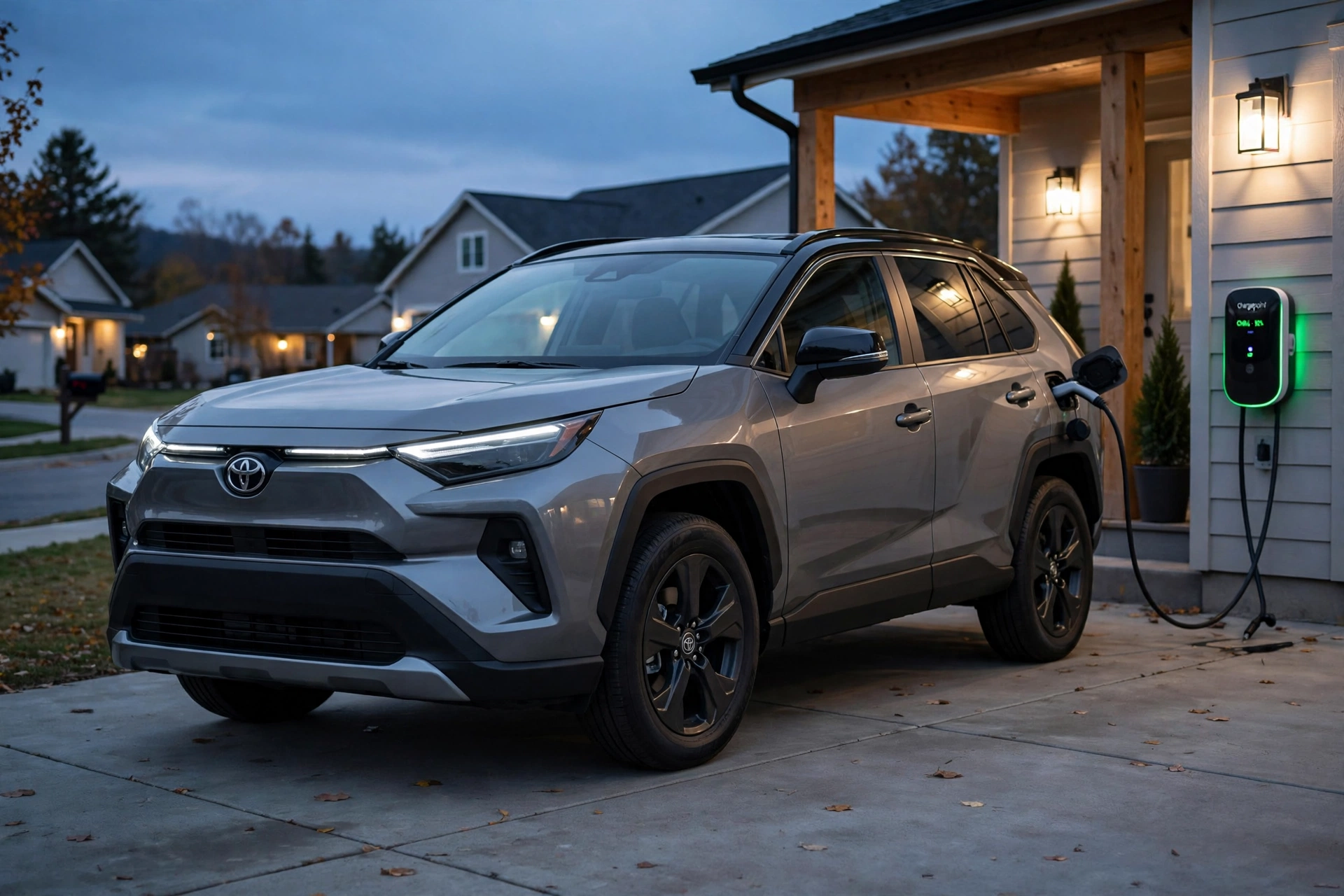
At home, life is simpler. Every plug-in comes with a dual-voltage cable for a household socket or a 240-volt supply. A full charge from a household socket takes the better part of a day (est., roughly 16 hours from empty), so most owners will fit a wallbox; on the 11 kW cars a full battery takes around two and a half hours (est.), and even the 7 kW trims refill overnight without drama. The charging menus feel designed for a plug-in, with scheduling that makes sense. The Woodland adds a small, delightful luxury: a 120-volt, 1,500-watt outlet, for campsite kettles and tailgate laptops.
Inside the toyota rav electric: the screens, and a dashboard that finally lets you see out
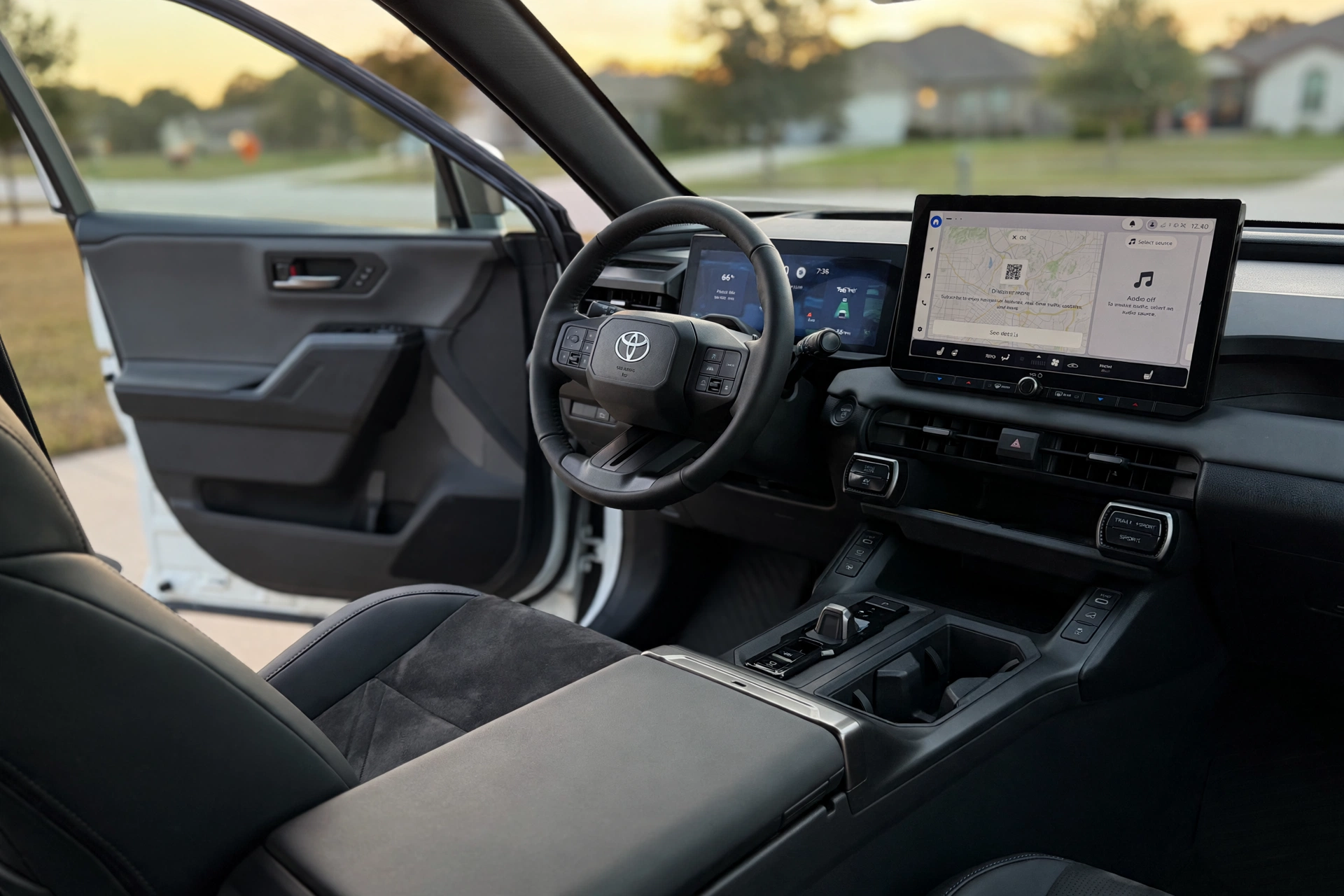
Sit down, and the first thing you notice is the view. Toyota lowered the dashboard by 40 millimetres, and it transforms the car: the bonnet falls away, junctions open up, and the cabin feels rinsed with light. Ahead of you sits a 12.3-inch digital instrument cluster, fitted to every RAV4 from the $31,900 LE upward. The centre screen is 10.5 inches on most trims and grows to 12.9 inches on the XSE, Limited and GR Sport; both run Toyota’s Arene software, quicker and far cleaner than the system it replaces, with wireless Apple CarPlay and Android Auto standard.
The small things are where this cabin earns its keep. A long tray runs across the dashboard in front of the passenger, sized exactly for a phone, sunglasses and a parking ticket. The centre console lid opens from either side, so driver and passenger stop elbowing each other, and flips over to become a tray. Door bins are deep, bottle holders squared off to stop the rattle, and the XSE offers twin wireless charging pads. The seats are firm and supportive, heated and ventilated on upper trims; the rear bench reclines over a nearly flat floor, with vents and two USB-C ports. None of this will appear in an advertisement. All of it will be used every day.
Materials, honestly: the lovely and the scratchy
Now the fingertips. The plug-in XSE wears the nicest upholstery in the range: SofTex, Toyota’s synthetic leather, mixed with suede-like inserts that feel soft, look expensive and shrug off the evidence of children. The Limited adds a panoramic roof and nine-speaker JBL audio; stitching, panel fit and switch solidity are all high, and the drive-mode switches are chunky and satisfying. At dusk, screens dimmed, the cabin feels like a calm place to spend an hour of traffic.
Then your knee finds the lower dashboard, and the spell thins. There is a great deal of hard, grey, faintly scratchy plastic in this cabin: low on the dash, low on the doors, around the console, where a hand explores at a red light. Reviewers have noted it almost in unison.
At the hybrid LE’s $33,350 with destination, such plastics are honest workmanship. At the plug-in XSE’s $48,685 with destination, they are an apology Toyota forgot to write, because rivals at that money wrap their cabins in softer surfacing. The materials are durable and easy to clean, real virtues in a family car. They are not luxurious, and at the top of the range the word should have applied.
The other irritation is smaller and, somehow, worse, because you will meet it daily. Toyota kept physical buttons for temperature and the demisters. Yet the fan speed, the one climate control you adjust constantly, all year, lives inside the touchscreen. A quick blast of air becomes a glance down, a tap, another tap. It is the single worst decision in an otherwise thoughtful cabin. Buy with your eyes open: the screens are excellent, and the one thing they should never have been asked to do is breathe for you.
The toyota rav electric numbers, worked out properly: what the electric miles save
Brochures prefer adjectives; this section prefers arithmetic, worked from stated assumptions. Assume a 40-mile round-trip commute on 250 working days, 12,000 miles a year in total, petrol at $3.10 a gallon and home electricity at $0.17 per kWh (both est.). It is the same thinking our guide to the electric car cost per mile applies to pure EVs, turned on a plug-in.
Start with coverage. The SE and XSE’s 52 miles cover that 40-mile commute with 12 miles to spare, and even the GR Sport’s 48 miles cover it whole. Multiply it out: 250 days times 40 miles is 10,000 miles a year driven without the petrol engine starting once, provided the car is plugged in each night. Five sixths of a typical year’s driving, in silence. No hybrid can perform that trick.
Now the money. A full charge draws roughly 21 kWh from the wall after charging losses (est., from the 22.7 kWh pack and its usable capacity), costing 21 × $0.17 = $3.57 and returning up to 52 miles: 6.9 cents a mile. The 10,000 electric miles cost about $690 in electricity. The remaining 2,000 miles, driven as a hybrid at 40 mpg, burn 50 gallons: $155. Total for the year, roughly $845.
The Hybrid AWD, at 42 mpg combined across all 12,000 miles, burns 286 gallons and costs $886. Forty-one dollars a year is the saving against its own hybrid sibling. Against the previous generation’s petrol-only RAV4, at 29 mpg combined, the same year costs $1,283, and there the plug-in saves a real $438 — against a car Toyota no longer sells.
The starkest figure is the price of the range itself. The plug-in SE at $41,500, divided by its 52 electric miles, is $798 for every mile of electric range. Toyota’s actual electric SUV, the bZ, sells electric miles at $148 each in base form ($34,900 for 236 miles) and $121 each in long-range form ($37,900 for 314 miles). The RAV4’s electric miles cost more than five times the bZ’s. That is not an argument against the plug-in; it is a description of what its money buys.
You are not purchasing range. You are purchasing the right to ignore range: to drive electrically all week and drive to another state on Saturday without a charging plan.
And the premium? The plug-in SE costs $5,400 more than the comparable Hybrid SE AWD. Divided by that $41 of annual fuel saving, the payback period is 132 years. The plug-in does not pay for itself. What the $5,400 buys is 324 horsepower instead of 236, all-wheel drive as standard, a 3,500-pound towing rating and a working week conducted in near-silence. Bought for those reasons, it is money spent on real things. Bought as a fuel-saving device, it is a very handsome mistake.
A short, fond history of the RAV4 EV that did exist
There really was a fully electric RAV4, and it was a stranger, more wonderful thing than the badge suggests. Between 2012 and 2014 Toyota sold the RAV4 EV, built for California’s zero-emission rules and developed in about 22 months with Tesla. Under its floor sat a Tesla-designed 41.8 kWh battery and a 154-horsepower Tesla motor driving the front wheels. The EPA rated it at 103 miles of range, remarkable when the Nissan Leaf managed about 80, at a price of $49,800.
Sport mode cut the sprint to 60 mph to 7.0 seconds, and it lost no cargo space to the battery. Toyota planned roughly 2,600 cars and sold a little under that, each in California; when the Tesla battery agreement ended, the car ended with it. An earlier fleet-only RAV4 EV of the late 1990s makes this the second time Toyota built the thing today’s searchers want. The survivors are curiosities now.
Verdict: which toyota rav electric should you actually buy?
RAV4 Plug-in Hybrid XSE — Our score: 8.4/10. Electric Range: 8/10, because 52 miles covers the working week of most households and few plug-ins do better. Charging: 7/10, because the DC port and 11 kW charger are useful, yet 50 kW (est.) is slow and cheaper trims do without. Value: 7/10, because hard plastics and a failed payback argue against it; pace, towing and silence argue for it. This is the connoisseur’s RAV4, bought with the heart fully informed by the head.
RAV4 Hybrid AWD — Our score: 8.7/10. Electric Range: 2/10, because it can creep through a car park on electricity and that is nearly all. Charging: 10/10, because it asks nothing of you, ever — a deep, underrated luxury. Value: 9/10, because 42 mpg combined, 236 horsepower and $36,100 for the SE AWD make it the rational centre of the range. For most households this is simply the correct RAV4, and you should buy it unless your commute and driveway make the plug-in’s case.
Toyota bZ — Our score: 8.1/10. Electric Range: 10/10, because up to 314 miles is the real thing and no RAV4 approaches it. Charging: 8/10, because 150 kW DC charging and a native NACS port open the Supercharger network. Value: 7/10, because it starts $6,600 below the plug-in SE yet has a smaller cargo hold, 27.7 cubic feet against 37.8, and a plainer cabin. If your household is ready to be done with petrol entirely, this is the Toyota to test-drive, and our survey of electric cars, their range, charging and costs sets it among its rivals.
The summary fits on the fridge door. There is no electric RAV4, and grieving for it wastes a Saturday. There is a hybrid that asks nothing and returns 42 mpg, a plug-in that turns the working week electric and the weekend into a grand tour, and an electric SUV across the showroom for the ready. The toyota rav electric question has three answers, and all of them are good cars. Choose by your driveway, your commute and your honesty about both.
Frequently asked questions
Is there a fully electric Toyota RAV4?
No. The 2026 RAV4 is sold only as a hybrid or a plug-in hybrid, and Toyota has announced no battery-electric version. Its electric SUV at this size is the bZ, with up to 314 miles of range. A fully electric RAV4 did exist from 2012 to 2014, sold in California with a Tesla powertrain.
I searched for a toyota rav electric — which model should I actually be looking at?
Almost certainly the RAV4 Plug-in Hybrid. It is the closest thing to the search in the showroom: up to 52 miles of electric driving, 324 horsepower, all-wheel drive as standard, and a petrol engine for the journeys the battery cannot finish. If you never want to buy petrol again, the car you want is the Toyota bZ.
How far does the RAV4 Plug-in Hybrid go on electricity alone?
Toyota’s manufacturer estimates are 52 miles for the SE and XSE, 49 for the Woodland and 48 for the GR Sport, from a 22.7 kWh battery. Then it runs as a hybrid, at an estimated 40 mpg combined. Cold weather and motorway speeds will trim that figure, as in every plug-in.
Which RAV4 plug-in trims can DC fast-charge?
Only the XSE and the Woodland. They carry a CCS1 port and an 11 kW charger, and Toyota quotes 10 to 80 percent in approximately 30 minutes. The SE and GR Sport charge on AC only, up to 7 kW through a J1772 port, taking around four hours for the same 10-to-80 percent window on a Level 2 supply.
How much does the 2026 RAV4 cost?
The hybrids run from $31,900 for the LE to $43,300 for the Limited. The plug-ins run from $41,500 for the SE to $48,500 for the GR Sport, through the Woodland at $45,300 and the XSE at $47,200. All are MSRP before a destination charge of roughly $1,450, checked October 25, 2026.
Is the plug-in worth the premium over the ordinary hybrid?
Not as a money-saving device: on this guide’s worked example it saves roughly $41 a year in fuel against the Hybrid AWD, against a $5,400 premium. As a car, it can be worth every cent: 324 horsepower, a silent electric working week, standard all-wheel drive and a 3,500-pound towing rating. Buy it for how it drives and how your weekdays feel.
For shoppers still weighing a toyota rav electric, the verdict above is the short version: test the plug-in XSE for a silent working week, test the hybrid for simplicity, and test the bZ if you want no petrol at all. That toyota rav electric choice comes down to driveway, commute and honesty about both, which is why this guide keeps returning to those three things. If a toyota rav electric is on your shortlist, charge it, drive it and compare it on your own roads before deciding.
One last note for anyone still comparing a toyota rav electric with its rivals: drive the plug-in on your normal route, not just around the block, and check how often you can charge at home. A toyota rav electric makes most sense when that home charging is easy, and the plug-in rewards that routine every weekday. Keep the toyota rav electric verdict scores in mind, but let your own driveway decide.
That is the whole toyota rav electric picture in one place, and it is worth a test drive before you rule anything out. A toyota rav electric decision is best made after comparing the hybrid, the plug-in and the bZ side by side.