Last updated: October 24, 2026
Start with a number that explains an entire strategy: 57. That is the EPA combined rating, in miles per gallon, of the most efficient car Toyota sells in the United States — and it is not an electric car. It is a Prius, a hybrid. Toyota hybrid vehicles now span twelve nameplates in the US market, from a $24,975 Corolla Hybrid to a $57,600 Land Cruiser, and the company sells more of them than any other manufacturer on earth. This guide sets out what each model costs, what it actually returns at the pump, how the hardware works, and — the question European readers ask first — how the American EPA figures translate for someone used to litres per 100 kilometres and WLTP test cycles.
A note on method before the tables. Every fuel-economy figure in this guide is the official EPA rating published via fueleconomy.gov, because EPA numbers are the most conservative of the major test cycles. A car rated at 51 mpg by the EPA will often wear a WLTP figure in Europe that looks 10 to 20 percent better on paper. It is not better. It is measured differently. Prices are US starting MSRPs before destination charges unless stated, checked on October 24, 2026, and they move — confirm the current figure before signing anything.
Toyota Hybrid Vehicles in 2026: The Full Lineup at a Glance
Twelve models. One basic idea, executed at very different scales. The table below uses the most efficient widely available configuration for the MPG column; where a range exists across trims, the text that follows explains it.
| Model | Starting price (US) | EPA combined MPG | System power | Drive |
|---|---|---|---|---|
| Corolla Hybrid | $24,975 | 50 | 138 hp | FWD or AWD |
| Prius | $28,550 | 57 | 194 hp | FWD or AWD |
| Camry | $29,300 | 51 | 225 hp | FWD or AWD |
| Corolla Cross Hybrid | $29,395 | 42 | 196 hp | AWD |
| RAV4 Hybrid | $31,900 | Up to 44 | 236 hp | FWD or AWD |
| Sienna | $40,420 | 36 | 245 hp | FWD or AWD |
| Toyota Crown | $41,440 | 41 | 236 hp | AWD |
| Crown Signia | $44,490 | 38 | 240 hp | AWD |
| Grand Highlander Hybrid | $45,210 | 34 | 245 hp | AWD |
| Highlander Hybrid | $47,620 | 35 | 243 hp | AWD |
| Land Cruiser | $57,600 | 23 | 326 hp | Full-time 4WD |
| Tacoma i-FORCE MAX | $46,300 (est.) | 23 (est.) | 326 hp | 4WD |
Three structural facts stand out. First, the Camry, the Sienna and — new for 2026 — the RAV4 no longer offer a petrol-only version in the US at all. Hybrid is not the option; it is the car. Second, the price floor is genuinely low: the Corolla Hybrid undercuts every plug-in vehicle in the country by a five-figure margin. Third, the spread of efficiency is enormous, from 57 mpg down to 23, because the word “hybrid” at Toyota describes two quite different engineering philosophies. One chases economy. The other chases torque. Confusing them is the most common buying mistake in this lineup, and this guide will keep them separate.
For readers arriving from the European market, one curiosity deserves a sentence. In Europe, the Prius is sold only as a plug-in hybrid, and the Corolla Hybrid is a staple of taxi fleets from Berlin to Barcelona. The American market inverts the emphasis: here, the plain hybrid — no plug, no cable, no behaviour change — is the volume product. Having covered both markets, I consider the American arrangement the more honest one. The car does the work. The driver changes nothing.
How the Toyota Hybrid System Actually Works
Toyota calls it Hybrid Synergy Drive, and the architecture has been in continuous production since the first Prius of 1997. It is a series-parallel system. That term matters, so let us be precise about it.
A petrol engine — usually an Atkinson-cycle unit that sacrifices some peak power for thermal efficiency — connects through a planetary gear set to two electric motor-generators. The planetary gear set is the clever part. It splits the engine’s output continuously between the driven wheels and a generator that feeds the battery or the main traction motor. There are no fixed gear ratios and no belt-and-pulley arrangement of the sort the term “CVT” suggests to most people. Toyota labels the result an e-CVT, an electronically controlled continuously variable transmission, but mechanically it is a power-split device with almost nothing to wear out. No clutch packs. No torque converter. No starter motor, no alternator in the conventional sense — the motor-generators cover those jobs.
The operating logic runs as follows. At low speed and light load, the car moves on electric power alone, silently. Under harder acceleration, engine and motor drive the wheels together — this is the parallel part. At a cruise, the engine drives the wheels while simultaneously generating electricity — the series part. Braking regenerates energy into a small battery, roughly 1.3 to 1.9 kWh (est.) depending on model, in either lithium-ion or nickel-metal hydride chemistry. The battery is a buffer, not a fuel tank. It is sized to capture braking energy and fill torque gaps, which is precisely why these cars never need plugging in and why their electric-only range is measured in hundreds of metres rather than miles.
All-wheel drive, where offered, follows an elegant pattern: a separate electric motor on the rear axle, with no mechanical driveshaft linking front and rear. It wakes when the front wheels slip or when you accelerate hard from rest. Simple, light, effective.
The exception is the i-FORCE MAX family in the trucks and the Land Cruiser. There, a 48-hp electric motor sits inside the bell housing between a turbocharged engine and a conventional eight- or ten-speed automatic gearbox. Same badge on the tailgate. Completely different machine, built for towing torque rather than fuel economy. If you want the deeper conceptual grounding first, our explainer on what a hybrid car is and how the main types differ walks through series, parallel and mild-hybrid layouts in plain language.
The Cars: Prius, Corolla Hybrid and the All-Hybrid Camry
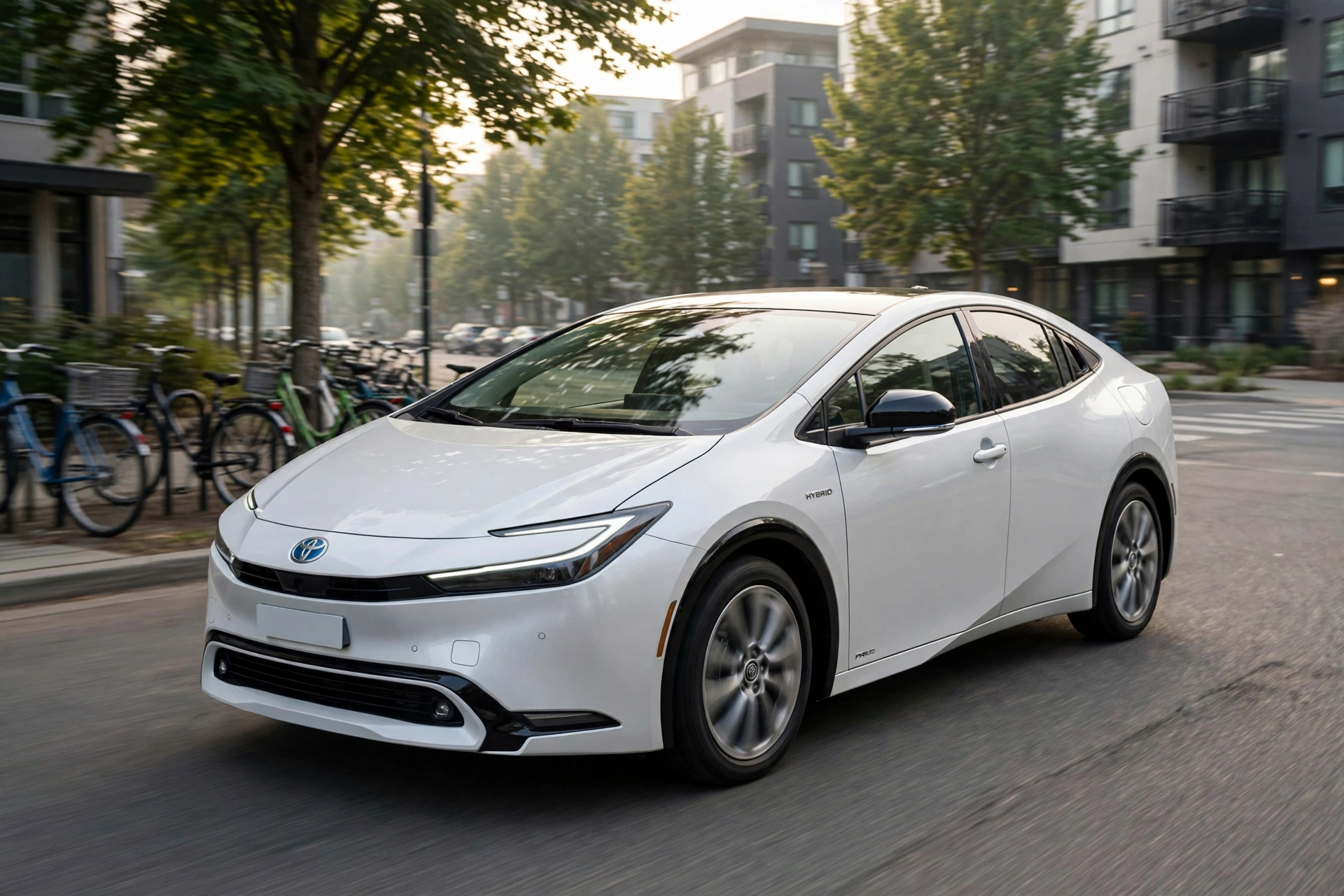
The Prius remains the reference point. The current car is a sleek, monoform hatchback — genuinely handsome, which still surprises people — with 194 hp in front-wheel-drive form and an EPA rating of 57/56/57 mpg city/highway/combined for the LE. Range on a tank is 644 miles. All-wheel drive adds a rear motor, lifts output to 196 hp, costs $1,400, and trims the rating to 54 mpg combined. Prices run from $28,550 to $35,565 for the Limited. It is the efficiency champion of the entire range, full stop.
Our score: Prius — 8.8/10. Efficiency 10/10. Performance 7/10. Value 9/10. Nothing else without a plug touches 57 mpg, and the 644-mile range embarrasses most petrol cars outright. The deductions are for the sloping roofline’s rear headroom and a cabin that prioritises the driver over the passengers behind.
The Corolla Hybrid is the rational purchase. A 1.8-litre hybrid system with 138 hp, 50 mpg combined in front-wheel-drive form (48 with AWD), and a starting price of $24,975 — the lowest of any hybrid Toyota sells. It is not fast. It was never meant to be. What it is, is a car whose fuel bill over five years will be smaller than the options list of most rivals. European readers will recognise the formula instantly; this is the car your taxi driver in Vienna already swears by, in sedan form.
Our score: Corolla Hybrid — 8.6/10. Efficiency 9/10. Performance 6/10. Value 10/10. The cheapest route into 50-mpg motoring in America, with Toyota’s reliability record attached. Buy it with AWD if you live where it snows and stop thinking about it.
Then the Camry, which is the headline act. Since the 2025 redesign, every Camry sold in the US is a hybrid — Toyota deleted the petrol-only car entirely. The 2.5-litre system produces 225 hp with front-wheel drive or 232 hp with AWD, and the LE front-driver is EPA-rated at 52/49/51 mpg. Fueleconomy.gov lists a 663-mile range and a $1,250 annual fuel cost at their standard assumptions for that version. Sportier trims trade a little economy for equipment, landing in the mid-40s. Starting price: $29,300. My position is unqualified: this is the default family sedan recommendation in the United States now, and rivals from Honda and Hyundai are chasing it, not the reverse.
Our score: Camry — 9.1/10. Efficiency 9/10. Performance 8/10. Value 9/10. Fifty-one miles per gallon, 225 horsepower, midsize space, a ten-year/150,000-mile hybrid battery warranty, and a price under $30,000. The complete package.
The SUVs and the Van: Corolla Cross, RAV4, Highlander, Sienna, Crown
The Corolla Cross Hybrid takes the Corolla formula, raises the seating position, adds standard AWD and a stronger 196-hp system, and returns 42 mpg combined from $29,395. It is the one to buy if the Corolla sedan’s shape is the only thing stopping you. Our score: Corolla Cross Hybrid — 8.0/10. Efficiency 8/10. Performance 7/10. Value 8/10.
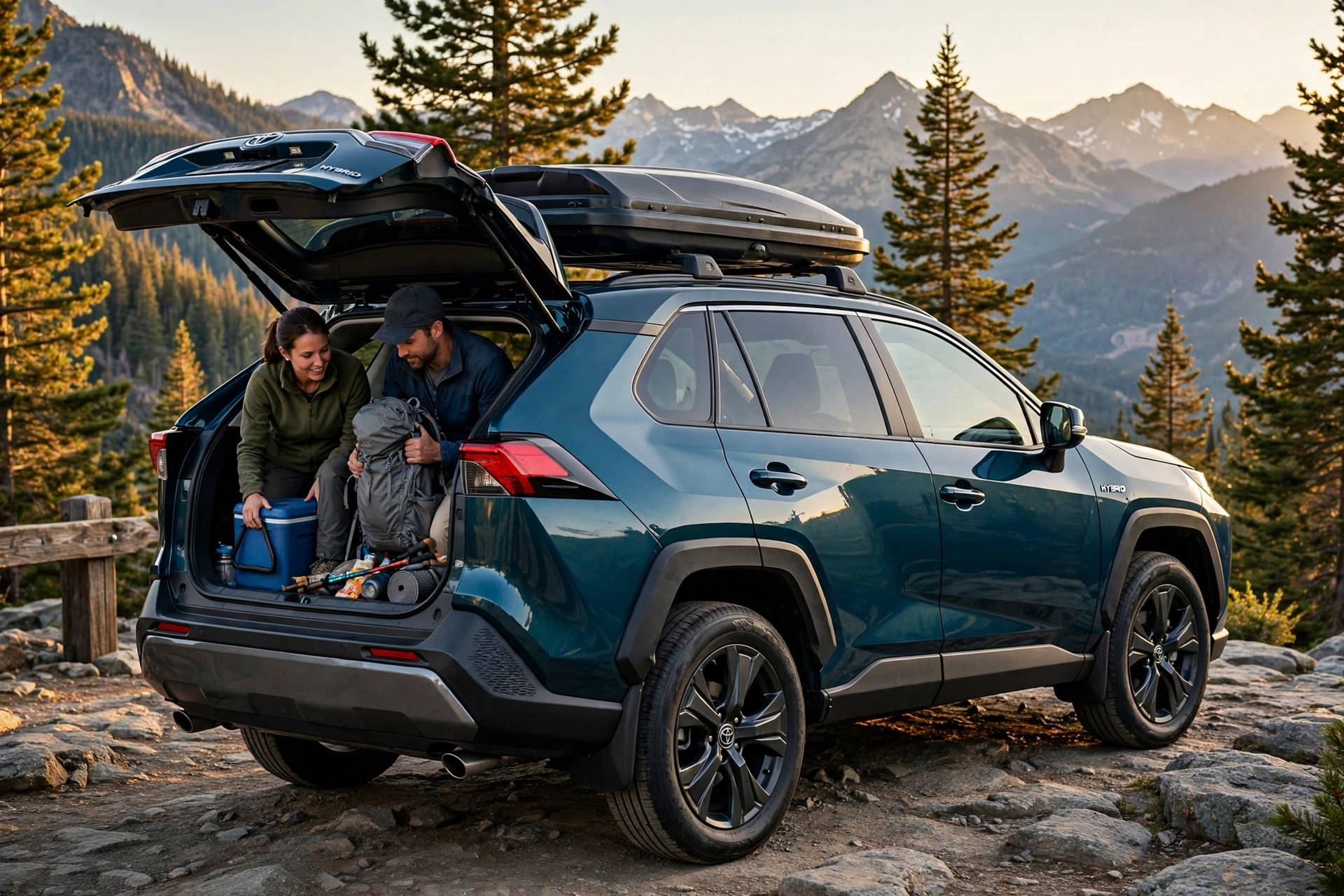
The RAV4 is the volume story. For 2026 the entire RAV4 range went hybrid or plug-in hybrid — the petrol-only model is gone. The standard hybrid now makes 236 hp, with front-wheel drive newly available and EPA ratings up to 44 mpg combined in the most efficient configuration; AWD versions sit closer to 40 to 42 depending on trim (est., from Toyota’s published city/highway figures). Prices start at $31,900. This is America’s best-selling SUV wearing the powertrain it should have had as standard years ago. Our score: RAV4 Hybrid — 8.9/10. Efficiency 9/10. Performance 8/10. Value 9/10. If a household can own only one vehicle and it must do everything, this is the one I would sign for.
The Sienna deserves more respect than the market gives it. It is hybrid-only, produces 245 hp, seats seven or eight, offers AWD that its main rival cannot match, and returns 36 mpg combined (35 with AWD) from $40,420. A seven-seat vehicle at 36 mpg was science fiction fifteen years ago. Our score: Sienna — 8.7/10. Efficiency 9/10. Performance 7/10. Value 9/10. Families cross-shopping three-row SUVs should drive this first and justify the SUV afterwards, if they still can.
The Highlander Hybrid (243 hp, 35 mpg, from $47,620) and the larger Grand Highlander Hybrid (245 hp, 34 mpg, from $45,210) serve the three-row SUV buyer; the Grand Highlander’s extra space for less money makes the standard car a hard sell unless its smaller footprint is the point. Scores: Highlander Hybrid — 7.9/10 (Efficiency 7/10, Performance 7/10, Value 7/10); Grand Highlander Hybrid — 8.2/10 (Efficiency 7/10, Performance 7/10, Value 8/10). The two Crown models are the oddities: the Crown sedan (236 hp, 41 mpg, from $41,440) and the Crown Signia wagon (240 hp, 38 mpg, from $44,490) are comfortable, quiet and well finished, but neither is the rational choice next to a Camry or RAV4 at thousands less. Crown — 7.4/10. Crown Signia — 7.6/10. Buy them because you like them, not because the spreadsheet told you to.
When “Hybrid” Means Torque: Land Cruiser, Tacoma and Tundra i-FORCE MAX
Now the second philosophy. The Land Cruiser, Tacoma, Tundra, 4Runner and Sequoia use i-FORCE MAX: a turbocharged engine, a 48-hp electric motor integrated into the transmission bell housing, a 1.87-kWh nickel-metal hydride battery, and a proper automatic gearbox. The Land Cruiser and Tacoma versions pair a 2.4-litre turbo four with that motor for 326 hp and 465 lb-ft of torque — the torque figure is the entire point — returning 23 mpg combined in the Land Cruiser and towing up to 6,000 lb. The Tundra and Sequoia step up to a 3.4-litre twin-turbo V6 version with 437 hp and 583 lb-ft (est.), rated around 20 to 22 mpg depending on drive.
Judged as economy cars, these numbers look poor. Judged correctly — as V8 replacements — they are excellent. The Land Cruiser’s 23 mpg combined is roughly 6 mpg better than the old V8 model’s real-world appetite, with substantially more torque delivered lower in the rev range. Our score: Land Cruiser — 7.8/10. Efficiency 5/10. Performance 9/10. Value 7/10. Tacoma i-FORCE MAX — 7.9/10. Efficiency 5/10. Performance 9/10. Value 8/10. These are performance hybrids that happen to save some fuel, and Toyota is at least honest about the ordering of those priorities.
Our Own Math: What Each Model Costs to Run for a Year
Here is the computation we run on every hybrid guide, with the assumptions stated in the open so you can redo it with your own numbers. Drive 12,000 miles a year. Petrol costs $3.50 a gallon — close to the US average at the time of writing, October 2026. Annual fuel cost is simply miles divided by EPA combined MPG, multiplied by price.
| Model | EPA combined | Gallons per year | Fuel cost per year |
|---|---|---|---|
| Prius | 57 mpg | 211 | $737 |
| Camry (LE FWD) | 51 mpg | 235 | $824 |
| Corolla Hybrid | 50 mpg | 240 | $840 |
| RAV4 Hybrid (AWD) | 40 mpg | 300 | $1,050 |
| Sienna | 36 mpg | 333 | $1,167 |
| Highlander Hybrid | 35 mpg | 343 | $1,200 |
| Land Cruiser | 23 mpg | 522 | $2,139 (premium at $4.10, est.) |
| Comparable midsize EV | 30 kWh/100 mi | 3,600 kWh | $612 at $0.17/kWh home charging |
Two conclusions fall out of that table. First, the five-year comparison against the Camry’s own petrol past: the previous-generation petrol Camry returned about 32 mpg combined, which at these assumptions is $1,313 a year. The hybrid’s $824 saves roughly $489 annually — call it $2,445 over five years, before counting the hybrid’s gentler brake wear from regeneration. Second, a full EV charged at home still wins the energy line outright: $612 against $824 for the Camry Hybrid, and it pulls further ahead with every mile. What the EV cannot do is refuel in four minutes anywhere on the continent. Run your own version of this arithmetic across a full ownership period with our total cost of ownership calculator, which folds in purchase price, maintenance and resale alongside fuel and electricity.
Toyota Hybrid Vehicles vs Plug-in Hybrids vs Full EVs: Choosing Honestly
Toyota sells all three technologies, sometimes in the same showroom row. The plug-in versions dropped the old “Prime” badge after 2024; they are now simply the Prius Plug-in Hybrid and RAV4 Plug-in Hybrid. The Prius Plug-in offers 44 miles of EPA electric range, 220 hp, and 52 mpg combined once the battery is depleted, from $33,375. The RAV4 Plug-in counters with 42 electric miles, a muscular 302 hp, standard AWD and 38 mpg in hybrid mode. Toyota lays out the whole electrified range, hybrids through fuel cell, on Toyota’s official electrified vehicles page, and every rating quoted here can be cross-checked against the EPA’s own records at fueleconomy.gov.
So who should buy what? The decision tree is shorter than the marketing suggests.
Choose the standard hybrid if you cannot charge at home, rent your home, drive very long distances, or simply refuse to think about fuel at all. It asks nothing of you. That is its genius, and for the apartment-dwelling half of the car-buying public it settles the question.
Choose the plug-in hybrid if you have a driveway or garage, a commute under roughly 40 miles, and the discipline to plug in nightly. Do that and most of your driving is electric at $612-a-year energy costs, with a petrol engine for the long trips. Fail to plug in and you have bought a heavier, more expensive hybrid — the one genuinely bad outcome in this entire guide.
Choose the full EV if you can charge at home and your longest regular journey fits comfortably inside 250 miles of range. The running-cost table above is the argument; the driving experience finishes it. Our broader comparison of electric cars — range, charging and costs works through that side of the decision in full.
My overall verdict on Toyota’s range is this: the hybrids are no longer a compromise position between petrol and electric. At 51 mpg in a $29,300 Camry and 57 mpg in the Prius, they are a mature technology at the top of its development curve, sold at prices that undercut the plug-in alternatives by $4,000 to $9,000. For buyers without home charging, that is not second best. That is the correct answer.
Frequently Asked Questions
Do Toyota hybrid vehicles need to be plugged in?
No. The standard hybrids charge their own battery through regenerative braking and the engine, via the power-split system described above. Only the Prius Plug-in Hybrid and RAV4 Plug-in Hybrid have a socket — and even those run perfectly well as ordinary hybrids if you never plug them in, just less cheaply.
How long does the battery in toyota hybrid vehicles last?
Toyota warranties the hybrid battery for 10 years or 150,000 miles in the US, and hybrid components generally for 8 years or 100,000 miles. In practice, taxi fleets routinely run these systems well past 250,000 miles. The battery is a small buffer pack, not a large EV battery, and replacements — when they are eventually needed — cost a fraction of an EV pack replacement (est., typically low four figures for older models through independent specialists).
Which Toyota hybrid gets the best fuel economy?
The Prius LE front-wheel drive, at 57 mpg combined (57 city, 56 highway), with a 644-mile range per tank. The Camry LE front-wheel drive is second at 51 combined, and the Corolla Hybrid third at 50. All-wheel drive typically costs 2 to 3 mpg on the cars that offer both configurations.
Why do EPA figures look worse than the European numbers for the same car?
Because the test cycles differ. The US EPA cycle includes harder acceleration, air-conditioning use and a correction factor that pulls the published figure toward real-world results; European WLTP testing is gentler. A rough conversion: 51 mpg US is about 4.6 L/100 km, and a WLTP brochure figure for similar hardware will often read closer to 4.2 L/100 km. Treat the EPA number as the pessimistic, trustworthy one.
Are the hybrid versions slower than the petrol cars they replaced?
Generally, no. The Camry Hybrid’s 225 hp exceeds the old base petrol Camry’s output, and electric torque makes the hybrids feel quicker at town speeds than the figures suggest. The clear exception is towing-focused machinery in reverse: the i-FORCE MAX trucks are substantially stronger than the engines they replaced, with 465 lb-ft in the Land Cruiser against the old V8’s 401 lb-ft.
Is a Toyota hybrid a better buy than a full EV in 2026?
It depends entirely on charging access, and I will not pretend otherwise. With home charging, the EV wins on energy cost ($612 versus $824 a year at this guide’s assumptions), maintenance and driving refinement. Without home charging, the hybrid wins on convenience and total cost, because public fast charging erodes the EV’s price advantage while adding time. The hybrid is the better buy for the charger-less. It is not close.